
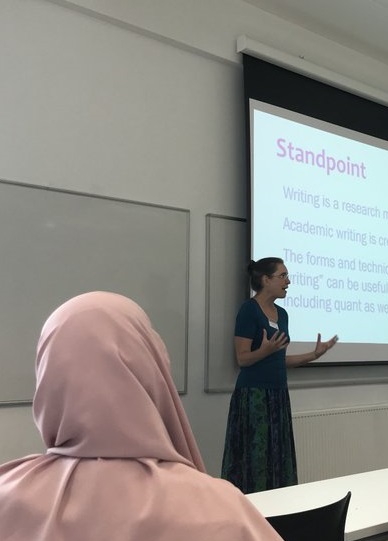
My first proper job after my first degree was as a training administrator for a big firm in the City of London. I attended a ‘train the trainer’ course and learned to design and provide training courses myself, which I did for the next four years. That experience has proved invaluable in my research career. Now I talk of the research methods/ethics training I offer as ‘teaching’ because I mostly do it in universities and that is the term they use. But, as I teach short courses as an external expert rather than full modules as a university lecturer, designing and delivering those courses involves more-or-less the same process as the training I used to provide in London.
I have been teaching research methods and ethics for universities and research organisations since 2008. I teach around the UK and overseas: so far in Europe, Australia, Canada, the Middle East, Latin America and Asia. I often teach international groups online and am humbled by students who attend my courses in the middle of the night, their time. (I do not teach in the middle of the night, my time. I am too old for that!) In pre-pandemic times I did most of my teaching in person. For the last 18 months it has all been online, but now I am beginning to receive invitations to go back to the classroom, albeit with Covid precautions in place. I suspect in the future it will be part online and part in person. Teaching online has some advantages: nobody has to travel, which reduces stress and cost and environmental impact, and makes it possible for some people to attend who couldn’t if it was in person. However, it has some disadvantages too, primarily (from my point of view) that I won’t know if someone is struggling unless they tell me, whereas in the classroom I can see if a student is puzzled and wander over to get them unstuck. So I will be glad when I can do more in-person teaching again, though I have learned a lot about teaching online and will be happy to offer that too.
The courses I offer routinely are Creative Research Methods (1 or 2 days), Creative Academic Writing aka Creative and Productive Thesis Writing (1–4 days), Radical Research Ethics (1 day) and Documents as Data (1 day). The first three are based on books I have written or co-written, the fourth is based on books by other people. I can also run courses on other topics, adapt my existing courses, and teach in other ways. In 2018 I ran two of my existing courses for Coventry University’s graduate school, and also courses on qualitative data coding/analysis and qualitative interviewing. Next month I am running my Creative Academic Writing course, adapted to meet the needs of The Anthropocene and More-Than-Human World Writing Workshop Series funded by the British Academy. And I am currently in discussion with Liverpool John Moores University about a data analysis course for postgraduate researchers, and with Nanyang Academy of Fine Arts in Singapore about facilitating a monthly ‘reading circle’ on autoethnography and arts-based research, with a view to helping participants work towards writing for publication. Both LJMU and NAFA are existing clients. I am glad to say my teaching clients usually book me again; there are a number of universities and other organisations who I teach for every year, sometimes several times in a year.
I don’t do much teaching for less than a day at a time, though that can be split into two half-days if we’re working online. I will do the occasional webinar or shorter seminar, though my minimum charge is my half-day rate (because, as regular readers know, an hour is not an hour even when working online). What my day rate is depends on the country where I will be working, whether in person or virtually. The resources of countries around the world vary greatly, as do those of organisations. So I aim to charge the standard rate for each country and type of institution I am working with. I should also add that if I design a new course for a client, I charge an extra half-day per day of training for design and preparation. This means that I would cost a new one-day course at 1.5 x my day rate.
I am glad to say my teaching is becoming increasingly popular. So much so that I am needing to restrict the number of teaching assignments I take on, because otherwise I don’t have enough time for my client work and writing. I have decided to teach for no more than four days in any one month, or 36 days in any one year. On this basis, I have a couple of teaching days still available in 2021. In 2022, January, February and July are already full, and I have several bookings in other months. So if you’re thinking about asking me to teach at your institution, don’t drag your feet!
This blog, and the monthly #CRMethodsChat on Twitter, and my YouTube channel, are funded by my beloved patrons. It takes me more than one working day per month to post here each week, run the Twitter chat and produce content for YouTube. At the time of writing I’m receiving funding from Patrons of $87 per month. If you think a day of my time is worth more than $87 – you can help! Ongoing support would be fantastic but you can also make a one-time donation through the PayPal button on this blog if that works better for you. Support from Patrons and donors also enables me to keep this blog ad-free. If you are not able to support me financially, please consider reviewing any of my books you have read – even a single-line review on Amazon or Goodreads is a huge help – or sharing a link to my work on social media. Thank you!

 Helen Kara