
I am delighted to announce the publication of this book which I have edited. I am sorry it is very expensive – I hope Bloomsbury will produce a paperback in due course, and in the meantime, you should be able to get hold of a copy if you have access to an academic library.
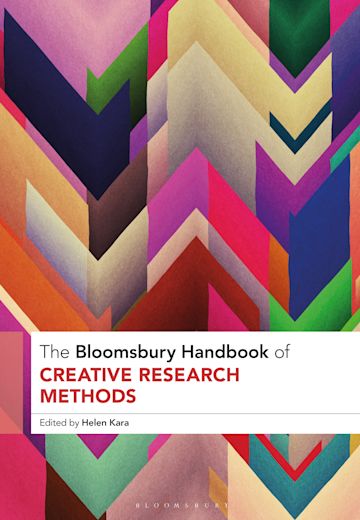
The book has 22 chapters in nine sections with 2-4 chapters per section. The first section is an overview with chapters on creative research methods and ethics, creative research methods in the geo-political south, digital tools for creative data analysis, and human geography and creative methods. The other sections are on narrative inquiry, poetic analysis, visual methods, creating visual art, participatory textiles, embodied performative methods, participants as experts, and creative collaboration. I chose these divisions. The content of the book is so rich that there are many other ways I could have divided the chapters. For example, I could have had a section on digital methods, or one on multi-modal methods, or one on feminist research. I made the choices I did with two key aims: first, to make the book flow as well as possible from start to finish, and second, to highlight some of the key points that were coming through in the chapters. Of course this book is in no sense exhaustive, but it does provide some useful insight into the scope and range of creative methods in the 2020s.
The authors come from Australia, Canada, Belgium, India, Ireland, Nepal, the UK and the US, and include doctoral students, independent researchers, practice-based researchers and senior professors. Each chapter is excellent, important, and potentially useful for researchers. They all tell previously untold stories. Perhaps because of my interest in research ethics, Caroline Aldridge’s chapter seems particularly important to me. It highlights some of the barriers that can still face researchers wanting to use creative methods. Caroline is a former social worker and a bereaved mother whose son died as a result of mental illness. She wanted to investigate how other similarly bereaved parents experienced professional and organisational responses and investigations following their child’s death. Caroline worked with potential participants, via a private Facebook group, to co-create a research design which used participatory textiles. These would include a mixed-media quilt co-created with participants, plus researcher-created mixed-media visual vignettes. Both are tried and tested techniques. Caroline did this work carefully, respectfully, and ethically, using all her trauma-sensitive professional social work and insider researcher skills. Then her proposed approach, with all its supporting evidence, was rejected by her university’s research ethics committee. They wanted her to use more conventional methods where the researcher retains more power and the participants are simply providers of data. This left Caroline with a choice of doing her work ethically while disobeying the ethics committee, or obeying the ethics committee and, paradoxically, doing less ethical research. She made a third and very difficult choice and, with considerable sadness, suspended her doctoral research. Many researchers have faced similar dilemmas but they are rarely reflected in the literature. I am grateful to Caroline for agreeing to write a rather different chapter than she had originally proposed, because I think these stories need to be heard.
The overview chapters are important too. Su-ming Khoo, from the National University of Ireland, explores the relationships between creativity, art and science, with an unflinching look at the dark side of creativity, and demonstrates the place of creativity in ethical decision-making as well as research methods. Bibek Dahal and Suresh Gautam, from Nepal, show us where the differences and similarities lie in creative research methods in the geo-political North and South of the world. Christina Silver, Sarah L. Bulloch and Michelle Salmona, from the UK and Australia, outline the role of computer-assisted qualitative data analysis software packages in creative data analysis. Nadia von Benzon from the UK traces the development and use of creative research methods in geography, and considers some ways in which creative research methods transcend disciplinary boundaries. Taken together, these lenses – ethical, global, digital and disciplinary – tell us a lot about where the field of creative research methods is at present.
Overall the book gives us a good insight into a global field in which people are reviewing and developing methods, identifying new ethical difficulties and finding ways to overcome them, making good use of technology, and working across disciplines. It also shows that creative research methods are local, manual, and applicable within single disciplines. And it clearly demonstrates that creative methods are not only useful for gathering data but can also be useful at every point from research design to dissemination.
I would love to know which chapter (or chapters) of this book seems most important to you, and why. Perhaps you could tell me in a comment.

 Helen Kara