
On Monday 29 July I got an absolutely astonishing email from the National Centre for Research Methods (NCRM). I had to read it about 12 times – all of the words and sentences made sense, but I couldn’t get the meaning to sink into my brain. Particularly the part that said “We would like to award you an NCRM Lifetime Achievement Award.” I was completely gobsmacked.
The following morning at 5 am I went from being fast asleep to wide awake, my heart racing and my brain in overdrive, thinking “I’m getting a lifetime achievement award!” I couldn’t tell anyone apart from my nearest and dearest, as the news was not to be publicised for another month. NCRM eventually went public on 29 August when I was away at the Autscape conference. The reaction on social media, and from the couple of people I mentioned it to at the conference, was hearteningly positive.
One interesting thing about getting a lifetime achievement award: once the news has sunk in and a few people have responded positively, it’s really good for counteracting impostor syndrome. When the critical voices start up in my head, I tell them “shut up, I got a lifetime achievement award” – and it works!
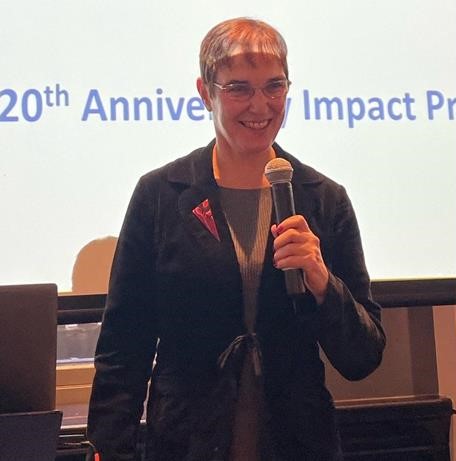
The award ceremony was in Manchester as part of NCRM’s MethodsCon conference. It was in the early evening, two days after ICRMC and the day before I was going on holiday. So I could get there which was nice. I arrived a bit early and chatted with a few people, including Jackie Carter who I was delighted to meet in person after knowing her online for years.
I wasn’t the only award recipient; there were two other awards. One was for developing new methods, which went to a team of four researchers: Susie Weller, Emma Davidson, Ros Edwards and Lynn Jamieson. The other was for positively impacting the wellbeing of older adults, which went to doctoral student Naureen Meghani and her supervisor Joanna Hudson.
I was given the opportunity to say a few words, so I talked about my work on the International Creative Research Methods Conference, the Creative Research Methods in Practice book series, and the Journal of Creative Research Methods. My main point was that, with a little support, independent researchers can do a great deal. There were funders in the room; I hope they were listening.
I have worked quite closely with NCRM in a wide variety of ways over the last 10 years. They have been incredibly supportive of my work and that has been a huge help to me. They are set to lose their funding in a year’s time, which I think is a great shame, because I think there is still a considerable need for the kind of work they do. Not least in supporting independent as well as other researchers. There is very little support available for independent researchers in the UK, and almost no access to research funding. I have argued for years that this is a waste of a national resource because independent researchers are agile and responsive, can do a lot with a small amount of funding, and have tiny overheads. I will continue to make this argument at every chance I get. As I’m now 60 years old, I doubt this will lead to real change in my own working lifetime, but I hope I can help to facilitate change for the next generation of researchers. If this award provides a stepping stone towards reaching that position, NCRM’s impact will be greater than they might currently expect.

 Helen Kara