
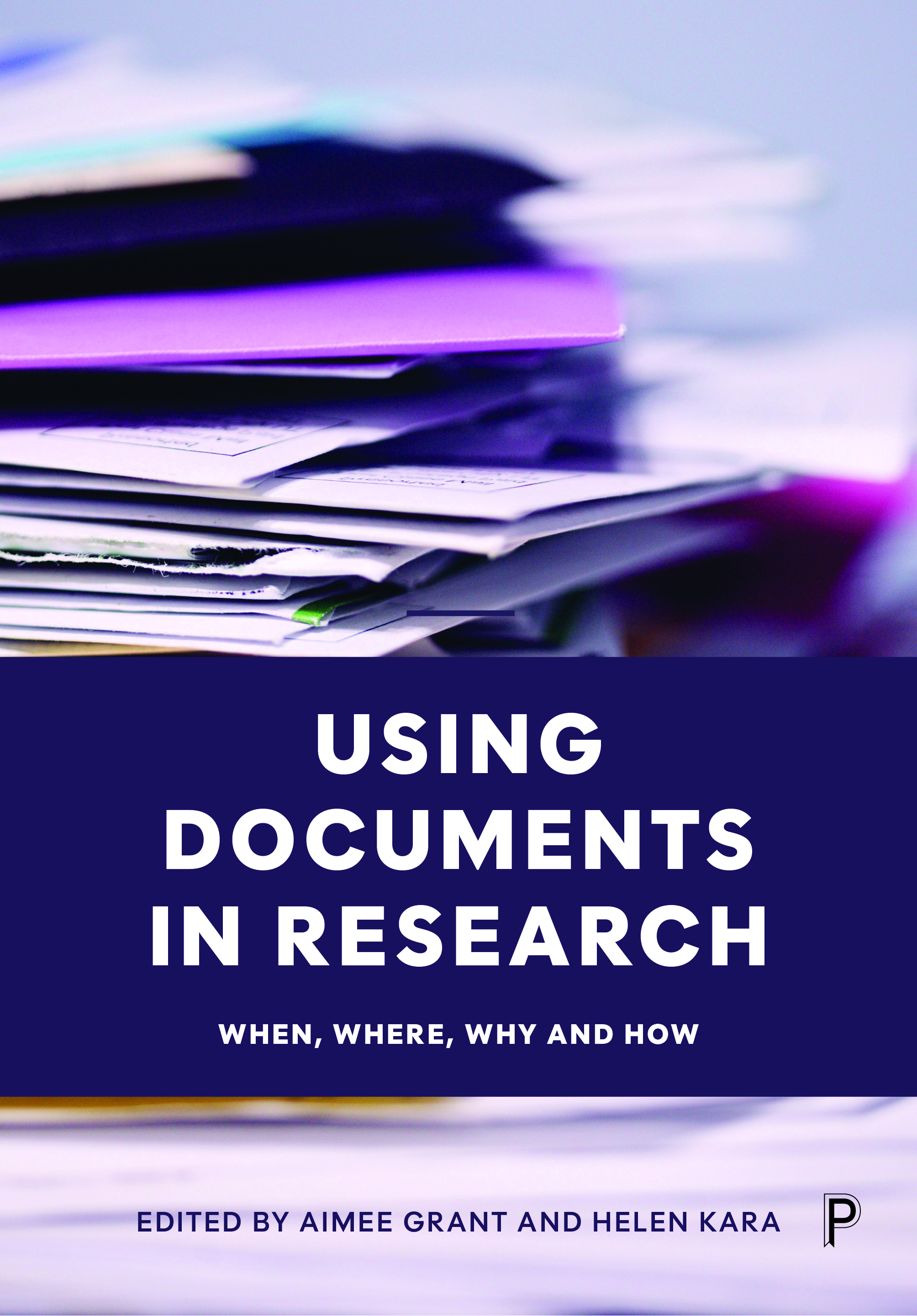
I have a new book out! At least, I’m co-editor… The book is Using Documents In Research: When, Where, Why And How. The lead editor is Dr Aimee Grant who is a joy to work with. And our contributors are an absolutely stellar bunch!
We are holding two online book launches on Thursday 19 March, at 10 am and 5 pm GMT. They are open to all and free to attend, and each will include presentations by three of our contributors.
The first event, at 10 am GMT on 19 March, will feature:
Helen Abnett, Research Fellow in public health and social policy at the University of Hertfordshire, who will present her research on using data from charity annual reports to consider questions of representation.
Max Perry, a post-doctoral sociologist at the University of Edinburgh, who will discuss what can be gained by reading medical records as documents of practice.
Abigail Winter, an independent researcher (yay!) who will introduce her work using public documents in arts-based research and knowledge translation.
You can register for that event here.
The second event, at 5 pm GMT on 19 March, will feature:
José Ragas, Assistant Professor of History at the Pontificia Universidad Católica in Chile, who will showcase his work on using historical ethnographic techniques to research identity documents.
Kate Carruthers Thomas, transdisciplinary Associate Professor at Birmingham City University, who will tell us about creating an illustrated digital archive from diary and interview data.
Órla Meadhbh Murray, Assistant Professor of Criminology and Sociology at Northumbria University, will talk about using institutional ethnographic techniques to conduct feminist research with audit documents from UK universities.
You can register for that event here.
And those are only half of the contributors to the book! We would have liked to include them all, but that wasn’t feasible. However, I can tell you about them here. The other lead contributors, in alphabetical order of first name, are:
Anna J. Davis, an expert on foreign policy, international identity and nuclear cooperation based in Washington, DC, who offers a gripping account of the challenges of obtaining documents on nuclear policy in Armenia, Belarus and Ukraine during times of political turbulence.
Ella Houston, Senior Lecturer in Disability Studies at Liverpool Hope University, who studies representations of disability in advertisements.
George Jennings, Senior Lecturer in sport sociology at Cardiff Metropolitan University, who uses a variety of books to theorise Asian martial arts folklore.
Katarzyna Niziołek, Assistant Professor of Sociology at the University of Białystok in Poland, who explains the research method of documentary theatre.
Rosemary Golding, Professor of Music at the Open University, who finds evidence of both music and silences in texts about Victorian asylums.
Victoria Pagan, Senior Lecturer in the Business School at Newcastle University, who uses government inquiry documents to research non-disclosure agreements, and outlines how she analyses her data abductively using a framework of epistemic injustice.
This brief summary shows how documents can be useful in research on a wide variety of topics across many disciplines. It also signals that researchers can use a vast number of theoretical and methodological options when working with documents. In ethical terms, we should all be using secondary data first, because there is so much of it now which is readily available. And documents form a big part of that.
So I hope to see you at one or other of the launches, which promise to be both informative and entertaining. Or, of course, you could just buy the book! (Word to the wise: if you sign up for the publisher’s e-newsletter, via the banner at the top of the webpage, you get a huge 25% discount on this and any other books of theirs that take your fancy.)
 Helen Kara