Ethics of Academic Publishing

publishers need youLast week I posted about ten ways to get hold of academic literature from outside the academy. I also questioned the ethics of some of the methods I suggested. This week I’m talking about that in more detail.

Publishing is, on the whole, a money-making enterprise. Most academic publishers, or their parent companies, are very wealthy organisations. Writers see very little of this wealth. For every JK Rowling, there are thousands of writers earning tiny amounts from their writing. The median income of writers dropped by over 50% between 2000 and 2013, and was reported in that year as £4,000. I aspire to reach those dizzy heights. Last year I grossed almost £1,000 from writing. I spent nearly that much, too, buying reference books and funding my new self-publishing business. I’m hoping 2016 may be the first year when I earn more from writing than I spend on my writing.

As a writer who needs to earn money, I felt uncomfortable, last week, about advising you to look online for cheap second-hand copies of books. However, as a frequently rather skint person, I know how useful cheap second-hand books can be. I buy new books when I can afford to, though I always check the book price comparison site bookbutler first (and before you tell me I should buy from bookshops, I do when I can, but the nearest one is 15 miles away and doesn’t stock any academic books). Bookbutler is available in other countries too, and seems to index just about everywhere except eBay which is also worth checking. Some bookselling sites are independent, such as Wordery or Alibris, so I try to use those rather than the mammoth monopolies. And if I buy a book second-hand, I aim to do something else for the author, such as write a review online, promote their work on social media, or download an affordable e-book they wrote.

I don’t feel so worried about ethics where journal articles are concerned, because academic publishers generally make a load of money out of university library journal subscriptions (have you seen how much they cost? It’s eye-watering!). I know that the academic publishing business is getting more competitive, like everything else, with the recession requiring all expenditure to be thoroughly justified. But even so, I’m on the editorial board of a journal (unpaid) and I write articles for journals (unpaid) so I figure the least the journal world can do is let me have some pdfs now and again.

But I am very worried about the move to open access. Yes, it’s great from the reader’s point of view. But what about the writers? There are now many journals in which I can’t afford to publish. This doesn’t only affect indie researchers; university publishing budgets are limited, so junior academics may struggle. And it applies to books as well as journals. Recently De Gruyter Open, a reputable academic publisher (not the desperate kind I’ve written about before), emailed to ask whether I’d like to publish a book with them at a cost of only 10,000 euros (approx £7,000 or $14,000). I don’t have that kind of money lying around – and if I did, I could think of lots of things I’d rather do with it than pay to publish a book which the publisher will then charge people to buy.

I don’t know how we got to this point because publishers need writers to survive. Not the other way round – especially not in these days of self-publishing entrepreneurship. Maybe it’s because some people think publishers are doing them a favour by publishing their work. If you’re one of them, undelude yourself immediately!

Another arena where I think (some) publishers are shafting authors is in royalties on e-books. This is an area where publishers could give authors a really good deal without damaging their own profit margins. Royalties on hard copy books are usually in the range of 10-15% – i.e. authors earn just 10-15% of the sale price of books, depending on whether they’re hardback or paperback, and on how many copies have sold (for example, some deals are e.g. 12.5% on the first 2,000 paperbacks, 15% thereafter). This is because publishers have to bear significant costs associated with hard copy books, such as printing, warehousing, shipping, and pulping. These costs don’t apply to e-books, which only require a day or two for a distribution professional to format and upload. Therefore publishers could easily give authors royalties of 50%. But on the whole, they don’t, unless you negotiate hard (negotiate, people, negotiate! Remember, publishers need you!).

I chose my own publisher for their ethical stance. Policy Press is a non-profit-making organisation with a commitment to social justice. They have treated me fairly and I would recommend them to anyone wanting to publish in the fields they cover. I also have a lot of time for the Committee on Publication Ethics (CoPE) which raises awareness of, and works to support, the ethical publication of academic journals. But all its work is directed to internal ethics: ethical peer review, challenging suppression of results, handling fraud, and so on. This is important and I’m glad they are doing it. But there is a real need for more awareness of, and some challenges to, the unethical aspects of academic publishing on the macro level.

Ten Ways To Get Hold Of Academic Literature

https://www.flickr.com/photos/jdickert/2570185865One of the big barriers to doing academic work when you’re not a salaried academic is lack of access to academic literature. Books are one problem, though you can often get hold of them through inter-library loans, national libraries, or (if they’re not too new) cheap second-hand copies online. But academic journals are the major difficulty.

People outside academia often don’t realise that even salaried academics won’t have access to everything. University libraries have budgets and have to decide which journals to subscribe to. Even professors sometimes need to use the techniques in this post. But those of us outside academia need to use them all the time. So, for those who don’t yet know, here are my top ten methods for getting hold of academic literature.

  1. Use openly accessible literature. Much of this can be found online. You may find relevant ‘grey’ (non-academic) literature through conventional search engines: anything from commercial research reports to zines. But for journal articles, I’d recommend starting with the Directory of Open Access Journals. This independent directory includes over 2 million articles in over 10,000 open access journals, more than half of which are searchable at article level, and more are being added all the time. The journals cover most topics and must be subject to peer review or editorial quality control.
  1. Look for conventionally published articles that are openly accessible. Publishers such as Sage, Taylor & Francis, Elsevier, Emerald, Wiley, and Springer are quietly making more and more content open access. Follow them on Twitter for the latest news. Sometimes a publisher will open its electronic doors completely for a limited period of time, which gives you a chance to get in and harvest pdfs to your heart’s content. More often they will offer a selection of openly accessible articles which you can find by digging around in their websites. And some have initiatives such as SpringerOpen which encompasses a range of fully open access journals in science, technology, and mathematics.
  1. When you search using Google Scholar, look beneath each search result for the small print that says ‘all X versions’ (X being a number). Click on that link and sometimes you will find that one or more of the versions includes a pdf you can download. This may be a pre-print or draft article, but it will be close enough to the final paper for you to assess whether you want to cite it.
  1. Academic social media sites, such as ResearchGate and Academia.edu, act as repositories for pre-prints and other openly accessible formats of articles which are uploaded by their authors. Anyone can sign up to these sites and they can be a useful way of keeping track, particularly of new literature by people whose work you respect.
  1. Google Books is a project for scanning and digitizing books. If a book is out of copyright, or the author has given consent, you can search and see full pages. Otherwise you can search and see small sections of text around the search string; sometimes this can be enough for your purposes.
  1. Amazon lets you ‘look inside’ some books, and again you can search and see parts of the text around the search string. Amazon is also handy for tracking down citation details as you can always look at the copyright page of any book with the ‘look inside’ feature.
  1. For much fuller access to academic literature, you could consider securing an affiliation with a university department. Universities can offer honorary titles such as Associate Fellow or Visiting Fellow. These don’t come with a salary attached, but they do come with benefits including access to electronic and hard copy literature, seminars, collaborations, and perhaps some mentoring. Also, it looks good on your CV. You might be asked to do some teaching or other academic work in return. If you know of a department where there are people in your field, you could ask whether they would take you on as an associate.
  1. Another option is to ask people you know in universities to get pdfs for you. If you’re going to do this, make sure first that the university concerned has access to the journal from which you want articles; you should be able to do this via the journal’s website, or the university library’s website, or both. It’s probably best not to ask people too often, though, as that can get annoying.
  1. Twitter is also a great place for sourcing articles. You can either put out a general tweet, perhaps with the ubiquitous ‘pls RT’ at the end, or you can use a hashtag such as #ICanHazPDF which will put your tweet in front of a wider audience. Do include the link for the article you want, and use a link shortener such as bitly to make more space in your tweet.
  1. If all else fails, email the corresponding author and ask for a copy of the article. Keep your email short, and polite, but try to say something about why you want the article and what you’ll be using it for. Authors are usually pleased if someone shows an interest in their work and will be happy to email an article to you.

However, there is a big question, for me, about the extent to which all this is ethical. And there are certainly some very unethical ways of accessing academic information, such as downloading pirated e-books – though I do realise that, in some countries, people have few or no alternatives. So next week I’ll say more about the ethics of academic publishing.

Review of the Year 2015

I was interested to check my blog stats and find ou2015t which were the three top posts of 2015. By far the most popular was my declaration that I will not work for nothing for wealthy institutions such as universities. That was published on 19 May, almost halfway through the year, and has had many more hits than any other post. Perhaps it will contribute to some universities becoming a little less reluctant to pay independent experts properly. Wouldn’t that be nice?

The second most popular post was published in June, and called for researchers and academic writers to make reading a priority. This was a useful post for me to revisit, as in amongst my autumnal travels I forgot about the commitment I’d made to read at least one book chapter a day, six days a week. I have been reading, but more sporadically and lumpily, so now I’ve remade that commitment.

I was surprised and delighted to find that the third most popular postwas the one from September when I announced my new venture into indie publishing, and launched my first self-published e-book, Starting Your PhD: What You Need To Know. The second in the PhD Knowledge series, Gathering Data For Your PhD: An Introduction, was published in November, and I’ve now written the third, Analysing Data For Your PhD: An Introduction. That is with my editor and due for publication in January. My brand-new publishing company, Know More Publishing, has already had three enquiries from other writers who want to publish with us, and that was something I did not expect at all.

There’s a fourth post, from the very start of the year, on how to write a killer conference abstract. That was the most popular post from last January but only received a tenth of the hits of the top post overall. However, this post probably outstrips all the others, because it was picked up and reposted on the LSE Impact Blog. Of course I can’t be sure, because I don’t have access to their stats, but through the year I have seen this post being retweeted more than any of my others, right up to and including last week. So I suspect this one may be the real big hitter.

Beyond the blog, 2015 has been a terrific year for me. Highlights included the publication of Creative Research Methods for the Social Sciences: A Practical Guide in April; the creative research methods conference at the British Library in May; working in Calgary, Canada, in October; and being made a Fellow of the Academy of Social Sciences in the same month. It’s also been a rather tiring year, so this blog and I are going to have a little rest, now, till the New Year.

I’m excited for 2016 as I have lots of plans. I’ll be publishing the next four e-books in the PhD Knowledge series, convening a session on ‘research for social justice: moving ethics forward’ at the Research Methods Festival in July, collaborating on special issues and e-books, teaching, speaking, and doing research. And I’m sure lots of other fun and interesting things will happen that I have no idea about as yet. I love my life!

Creative Research Methods on Video

Last week I was so poorly I did very little work, so this week I’m playing catch-up as hard as I can go. I wasn’t sure where I’d find the time to write a blog post, but luckily I don’t have to, because those nice people at the UK’s National Centre for Research Methods have made a video of a seminar on creative research methods I gave at the University of Southampton last month.

This video references two other videos which I will include here for your viewing pleasure. They are both creative research outputs, coincidentally both from Canada, though they are very different from each other. The first is ‘The 7,024th Patient’, and talks about an exhibition created to disseminate research into people’s experiences of open-heart surgery.

The second is ‘Have We Waited Too Long?’, a digital story about some of the effects of climate change on the remote northern community of Rigolet in Labrador.

Together, these videos will give you a sense of the breadth and possibilities offered by creative research methods. Grab the popcorn, sit back, and enjoy!

Let’s Talk About The Day Rates

coins on handI was halfway through a post in response to Debs’ latest blog in the ongoing conversation with her and Naomi Barnes and Katie Collins when I was stricken with a chest infection. One of my disabilities is asthma, so these things hit me hard, and I’m now in bed, on steroids, coughing and wheezing and waiting to feel better. My brain isn’t working too well so I’m going to write a post inspired by a real-life conversation with my friend and collaborator Katy Vigurs earlier this week, about day rates. Katy told me it would be useful if I explained how they work. So here goes.

My day rates are between £250 and £550. Generally speaking, I offer the lowest rates to small charities, medium rates to national charities or charitable funders, and the highest rates to the private sector, central government and universities. Having said that, I will negotiate, and may offer a lower rate if it’s work I particularly want to do, or I’m feeling flush and it’s a good cause, or it’s a low-hassle job I can do from home. I may charge more for work I don’t really want to do or which will involve lots of travel or unfunded collaborative extras.

So my median rate is £400. That’s fairly low by the standards of most of my competitors, but seems high to salaried people. They wonder how, if I am self-employed and work from home, I can justify charging so much. Partly this is because I am an expert and have a wide range of skills and abilities to offer. More prosaically, it’s because of the economics.

Let’s start with holiday pay. If I take a standard level of holiday – 4 weeks per year, 8 bank holidays, and 104 weekend days – that leaves 233 working days in the year over 48 weeks. In theory, therefore, I could bring in £93,200 each year. In practice it doesn’t work that way.

I need an average of one day per week for essential business-related tasks: marketing (including writing these blog posts), keeping up to date with my field (oh the never-ending reading!), administrative management of my finances, my office, and my paperwork. So now I’m down to 185 chargeable days per year. But there is other work I can’t charge for. Lots of other work. Pre- and post-contract work, hold-ups caused by clients who cancel meetings at short notice or don’t meet agreed deadlines, writing journal articles, replying to queries via email and Twitter, my own professional development. Nobody pays me for any of that. If I do a day’s work at your university, it’ll be around two days’ work in reality, with all the planning, preparation, and follow-up work. And travel. There’s lots of travel. Sometimes it’s included in the day rate, but I would estimate about half of it isn’t. So overall that’s another day a week, so now I’m down to 137 working days. (Actually it’s more like another two days, which probably explains why I mostly only have one day off at the weekend.)

Then there’s sickness. The average annual sickness absence in the UK at present is just 4.4 days per worker, though there are suspicions that this hides ‘presenteeism’ i.e. turning up when you’re not fit. I certainly do this, because I hate letting people down, because if I don’t turn up I don’t get paid, and because I need people to know I’m reliable. Though sometimes, like today, I just can’t. I’m supposed to be chairing an event in Cardiff tonight for the SRA – expenses only as I’m on the Board, so at least I’m not losing income, but I am gutted to miss it and to let them all down. So let’s say another five days per year on average for sickness, leaving 132 working days.

At £400/day on average, in theory I could make £52,800 per year – though that would be pre-tax turnover, not profit. But it is very rarely possible to secure paid work, at my median rate, for every available working day. In reality, last year, my turnover was just over £25,000. To work out how much I can pay myself, I have to deduct all my business expenses: heat and light for my office, accountants’ fees, subscriptions, IT equipment, telecomms costs, stationery, books, etc. I have to put away a big chunk of my turnover, usually around 20%, for tax, which I pay once a year. And I need to keep 6-12 months’ running costs in the bank in case of lean periods or cash-flow problems. For the last year I’ve been able to afford to pay myself £1,000 per month. I’m hoping I can continue to do so, as dropping below that means some belt-tightening. But there are no guarantees.

I’m not writing this post as a complaint. I love my lifestyle. It buys me my greatest luxuries: time and space. I am writing this post to debunk the assumptions people have about me: that because I’m an expert, a published author, a Fellow of the Academy of Social Sciences, my income is commensurate with all those status markers. It’s not. The world doesn’t work like that any more.

Showing My Workings

keep-calm-and-show-your-workings-14

Image credit

There’s a principle that I learned in primary school maths classes which I think also belongs in research: the principle of showing my workings. “Don’t just give me the answer,” my teacher told me. “Show me how you got there. Then even if your answer is wrong, I can understand your thinking.”

With primary school maths, it was easy to show my workings. At my current level of academic writing it’s rather more complicated. As so often happens, others in my network are thinking about this at the same time as me, and Naomi Barnes aka @nomynjb published a blog post yesterday on a similar topic.

I think it is particularly important to show my workings because my next traditionally published book will be on research ethics. I have not yet come across a sole authored book on research ethics with a reflexive element. The closest I’ve found is Alice Dreger’s book Galileo’s Middle Finger, which is beautifully written, incisive, and about research ethics among other things. It is a page-turner which is very rare among research books. I want to write a book on research ethics as compelling and insightful.

Dreger shows her workings – or, as the qualitative researchers say, positions herself – throughout the book. Using a novelist’s technique, she drip-feeds the information to the reader. I’m not yet at a point where I can do that, and anyway, this is a blog, not a book. So you’re going to get the main points in a single download. Here goes.

I was born into a Catholic family. I lost my faith in my early teens, and have never got it back, though I guess one day I might reconnect with it. Or not. But I still hanker after rules and the apparent clarity they bring, and have to work to counteract my tendency to look for and follow an external imperative. I also hold many Christian values, such as valuing love, kindness, and compassion. And, like many Christians, I set myself high standards, frequently fail to meet them, and then give myself a hard time.

I was the oldest in my generation, so I’m independent, hard-headed, and intelligent. Now in my 50s, I’m beginning to feel my age, and most days there is more about that which I like than which I don’t like.

I am happily female, not very feminine, and thoroughly feminist. I can’t be bothered with make-up, hair dye, jewellery, or other trappings of femininity. I’ve never wanted to be a mother; I’ve never regretted not having children. But I am not a trans woman; I could probably claim the title ‘queer’, but have never felt the need.

I am bisexual. I have known this is what I am ever since I knew such a thing existed. It’s about who I am attracted to, not about what I do. I’m attracted to a person first, their gender second. I have always been bisexual: through times of celibacy, singledom, relationships with women or men or both. I will always be bisexual.

I am disabled, mostly invisibly. I have asthma and rheumatoid arthritis. My hands and feet are deformed but you have to look fairly closely to notice. My disabilities affect my life far more than you might guess from the outside. I have given up many things such as knitting, crochet, cycling, reading hardback books, driving long distances, DIY, gardening (these last two no hardship for me, but a bit tough on my partner). My focus, though, is not on what I can’t do, but on what I can do. And I can still do so many things that bring me joy. That’s what counts.

I am white and British. I’m not interested in genealogy, though I bet if I was, I’d find a big genetic mix in my heritage. I know that recent generations encompass English, Welsh, Irish and Scots lineages, and one side of my family has a strong suspicion of Jewish blood in there too. I have relatives buried in Wrexham churchyard; I’m entitled to wear the Sutherland tartan; and I’m told there is a community in the Mountains of Mourne with eyebrows just like mine. I like this mixing; mongrel status suits me fine. I like being indigenous – a term usually used in research to refer to people of colour, but it is what I am too. I love my country and her people: I see very many imperfections and injustices, yet overall I see more good than bad.

I have been with my partner for 20 years. He strengthens me and enhances my life. I aim, I try, to do the same for him.

I worked as a humanist funeral celebrant for 14 years, alongside my research work, from 1997 to 2011. This enhanced my understanding of grief and my appreciation of life.

There are many more workings I could show at increasing levels of granularity. But at the big picture level I think these are the key points I need to make. I want to weave these into my ethics book, to show my workings in a way that hasn’t been done before. I don’t know whether I can, but I’m going to try.

Some of the narrative may change. As an ethical researcher, I believe it is important to be open to changing, and willing to change, my mind, and to explain when and why any such change took place. So this is not a manifesto, it’s a statement of where I’m at with all this right now. (I wish our politicians could work this way – or, perhaps, that they could own up to working this way. Maybe one day.)

Traditionally, the academy has eschewed the personal. People who have tried to make explicit links between their lives, standpoints, beliefs etc and their research work have been written off as self-indulgent. Though that is not a view I hold in the abstract, I have read some work which has come across that way. And other work which has not – for me, the difference is in the analysis. Personal disclosure is all very well but there has to be a point beyond the narcissistic. In my book, I will be aiming to synthesise the data I gather from my own life with the data I gather from interviews and texts. I don’t yet know how to do this, or whether I can do it effectively, but I’m keen to find out. I want my readers to understand how I think, so they can see what has led me to any conclusions I may reach. I want to show my workings.

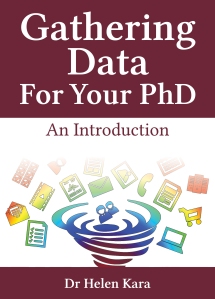
Gathering Data For Your PhD – New Book Launch!

GDFYPhD_red_data_LC_multi_RGBYou may remember that just two months ago, on this very blog, I announced the start of my indie publishing career. I’m publishing a range of short e-books for doctoral students, and the first one was Starting Your PhD: What You Need To Know, launched on 8 September. I’m delighted to launch the second one today: Gathering Data For Your PhD: An Introduction.

Again, it’s around 11,000 words, and is suitable for all doctoral students, whether studying for a scholarly PhD or a professional doctorate. Here is the blurb:

You can’t do research without data. But what kind of data will help you answer your research question? Where can you find that data? And how much data do you need? If you’re doing doctoral research, particularly in the social sciences, arts, or humanities, this book will help you answer those questions. It offers an overview of traditional and innovative methods of gathering quantitative, qualitative, secondary and primary data. The book also outlines the pros and cons of devising your own method of gathering data, and lists a range of resources for further exploration of the methods that interest you most.

Just like the last book, it’s available for the price of a coffee: $2.99/£1.99/E2.99 or thereabouts – exact prices may vary slightly with different distributors. Talking of which, it’s available (or will be any minute) from all the major players: Kindle, iBooks, Kobo, Nook etc.

This seems a perfect time to launch my latest oeuvre, as it’s the first ever Academic Book Week here in the UK. There are loads of events and discussions happening all over the country. There’s very little, though, about indie publishing – perhaps because Academic Book Week mostly involves traditional publishers and booksellers. I want to emphasise here that I don’t see indie publishing as a rival to traditional publishing, though I guess there may be some booksellers who wish digital books had never been invented. I love p-books and I don’t want, or expect, them to disappear. But I think there is also room for e-books in academia, and it surprises me that so few academics and alt-acs are taking up this opportunity.

Many New Experiences

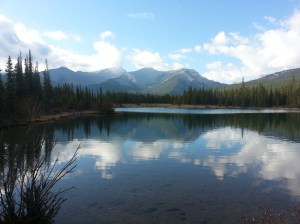
Forget-me-not Pond

Forget-me-not Pond, near Calgary, Canada

I’ve just had an unforgettable couple of weeks in Canada, with lots of new experiences.

My first time in Calgary. Not a beautiful city, all grids and skyscrapers and right-angles, but the friendliest people I’ve ever met. And I loved the way that people of all races, genders, and ages met my gaze equitably, smiled, and spoke to me as an equal. I hadn’t realised how depressing I find the suspicion I often encounter in England: from older people because I’m younger, from younger people because I’m older, from non-white people because I’m white, from some women because I’m the wrong kind of woman… no-one seems to do any of that in Calgary.

My first keynote speech, at a public multi-agency conference at Calgary Public Library, on Creative Research Methods: Finding Ways To Prove Impact. I will confess to you that I was really nervous about doing a keynote, but you know what? I loved it! I was afraid I might not have enough to say, but in fact I had the opposite problem (probably no surprise to anyone who knows me in person).

My first time teaching in Canada. I taught creative research methods to staff and students at Mount Royal University and the University of Calgary. They were gratifyingly keen to engage with new ideas, ask intelligent questions, and think laterally about how they might apply different methods. And they were so welcoming! I was taken out for breakfast, coffee, lunch, dinner – and given the huge portion sizes in Canada, I’m amazed I can still fit in my trousers.

My first time falling in love with mountains. I’ve been to the Alps, the Pyrenees, the Alpujarras, the mountains of Oman and Turkey and Greece, probably others I’ve forgotten, and they’re all beautiful and amazing but I didn’t love any of them and long to return. The Rockies, though, are a whole different deal. From the way they rise out of the prairie, to their pristine air and water – I lost my heart to those magnificent mountains.

My first time in an airplane window seat. I never flew till I was in my 20s, and to my surprise I was terrified. It took me decades to get over the fear, but I’m there now; nevertheless, I always choose an aisle seat. When I’d finished work in Calgary, I flew to Vancouver Island to visit a friend for a few days. I knew the flight would take in the prairie, the mountains, and the ocean, and was only 75 minutes long, so I plucked up my courage and asked for a window seat. It was worth it, too; I spent most of my time glued to the view.

My first time hiring a car in my own name. I’ve co-hired with my partner before, but never on my own, and I was a little nervous as I’ve also never driven in Canada. However, my friend who I’m visiting doesn’t drive, the public transport on Vancouver Island is all but non-existent, and we wanted to take a little road trip. I got a free upgrade, and I think the car rental person was expecting me to be pleased, but it just made the whole thing more daunting – though it all worked out OK.

My first time driving an automatic. With push-button ignition and push-button handbrake. That took some getting used to, and I was glad of my sister’s advice to drive six times round the car park before tackling the traffic. But by the end of the trip, I was a convert, and now I want an automatic of my own.

My first time visiting Quadra Island. A friend of mine in England grew up there, and has always spoken warmly of the island, but honestly, it’s so beautiful, friendly, and relaxed. The friend I was staying with and I rented a little hobbit house right by the water’s edge, a geodesic dome with living quarters on the ground floor and an attic bedroom above, and an extension with utility room and another bedroom, and a deck reaching out over the beach with table, chairs, and gas barbecue. We spent a couple of very happy days on ‘island time’, exploring the trails through forests and by the ocean, eating yet more delicious food, reading, talking, and laughing.

And of course in the middle of all this I got last week’s astonishing news that I’ve been made a Fellow of the Academy of Social Sciences. It’s been such a high-octane fortnight that I’m not quite sure who I actually am, but I expect it will all sink in over the next few days and weeks.

An unexpected honour – and a dilemma

acss-large-header-logoThis was not the post I expected to write this week. I had planned to tell you all about my experiences in Canada and my first keynote speech. But that will have to wait. Because I have astonishing news: I have been made a Fellow of the Academy of Social Sciences.

In the UK, most academic subject areas have their own Academy. Some have been around for centuries – some are even Royal Academies – and some are newer. The Academy of Social Sciences (AcSS for short) was formed in the 1970s, so it is one of the newest. Its members are learned societies, such as the Social Research Association, the Association of Social Anthropologists, and the British Psychological Society, as well as around 1,000 individual Fellows.

The individual Fellows are almost all Professors (93%), mostly male (70%), and I suspect predominantly white. The first person who explained to me about how the AcSS worked, who was a senior academic and a Fellow of the Academy, said quite matter-of-factly that it wasn’t for people like me. So when a kind Professor and Fellow I’ve been working with asked if I would like to be nominated, I said ‘no, thank you’. He gently suggested that I think about it, which I rather grumpily agreed to do, though I couldn’t really see the point. In the course of my thinking, I telephoned a colleague who is also a Fellow but not an academic, and she told me firmly that I should go for it. So I agreed to be nominated, sent the kind Professor my CV, and heard nothing further.

The selection process involves ‘a thorough process of peer review’ to assess potential Fellows for ‘the excellence and impact of their work in the social sciences’ (quote from this week’s AcSS press release). And it all happens behind closed doors. I couldn’t imagine that they would accept me as a Fellow – but they did. Apparently the AcSS send out letters to new Fellows, to notify them, before the news is released to the public. But I’ve been working in Canada for the last week so I didn’t get the letter. I did get an email to congratulate me on my ‘conferment’ and say the press release had been issued, but there wasn’t much other information, except that I was invited to the President’s lunch where I could receive my certificate. It’s not the kind of invitation I’m used to, because mostly when people invite me to lunch I don’t have to pay £85 for the privilege. EIGHTY-FIVE QUID!!! That’s a fortnight’s food budget in my life. I like eating out, and have even been known to go out for dinner with several courses and drinks on occasion, but I’ve never spent as much as £85 on one of those, let alone on a lunch. Also, I think there is more financial commitment, because there was a direct debit form with the email, but it didn’t say what for; presumably that information is in the welcome pack on my doormat at home.

I guess all those Professors have universities to pay their costs for them because of the prestige it brings. Or, if they have to pay for themselves, they’re on the kind of salary that means it’s possible to spend £85 on lunch. The average salary for a Professor in the UK is around £66,500. Over the last five years, I’ve averaged £14,000 take-home per year, which is approximately equivalent to an employed person’s salary of £16,500 – around a quarter of what a Professor earns. I can live on my income, but it doesn’t support an £85 lunch habit. Though, as a prudent businesswoman, I aim to keep 6-12 months’ running costs in my business account to protect me against lean times. So I could draw from my reserves, treat the cost as a business expense, and set it off against my tax bill. But would that be any kind of ethical?

I want to go to the lunch. I want to advocate for the value of independent researchers in social science, and it seems that eminent social scientists think I’m fit to be their representative. There aren’t many others – in fact there’s only one Fellow who describes himself as an ‘independent academic’, and he used to be a Professor. Those who are not Professors or attached to a university seem mostly to be attached to, or retired from, research organisations or Government departments. So I may be the only Fellow who is, and has been throughout my research career, completely independent of any institution.

I am truly delighted to receive this unexpected honour, but it does bring new ethical dilemmas. Even if I decide I can afford the £85 plus the train fare to Cardiff, is it ethical to spend that much on a glitzy lunch when desperate refugee people are freezing and starving at our gates, and increasing numbers of people within our borders are seeking help from food banks? Which is the greater good, me advocating for independent researchers within the Academy or my £85 providing food for those who have none?