
Independent Research Ethics Committee – panel members needed!

You may already be aware that I have been involved in setting up a new Independent Research Ethics Committee (aka IREC). The aim is to offer ‘nose-to-tail’ ethical review, i.e. considering all aspects of a project, with minimal bureaucracy and maximum flexibility. This is proving surprisingly popular, particularly as we have done very little promotion apart from setting up a website and a few posts on social media. Which means we need more panel members.

This is paid work, though irregular and freelance. We can’t guarantee any specific amount of work but I can tell you that right now we have as much as we can handle.

We are looking for people with ethics expertise, though our definition of that is broad. There are no specific requirements, e.g. you don’t have to be (or have been) a member of a research ethics committee, or be an academic, or have written a book on ethics. You do need to be able and willing to work within our seven principles of intersectionality, justice, dignity, respect, fairness, honesty, and care. More information about what we understand by these principles is on the website.

Middle-aged white women and qualitative researchers are over-represented in the applications we receive. We have nothing against middle-aged white women (I am one! At least, I think I still am – 60 is middle-aged these days, right?) or qualitative researchers. Being one or the other – or both – will not necessarily rule you out. But we do seek a diverse pool of people from which to draw panel members. In terms of the make-up of our current pool, we would particularly welcome applications from:

  • Men, trans and non-binary people
  • Quantitative researchers
  • People of colour
  • People with lived experience of intersectionality
  • Younger and older people

You do not need to be resident in the UK, though you do need to be available for online meetings with other panel members. At present we are all based in Europe.

Our application process is quite straightforward: we only ask for a statement of up to 500 words plus two referees who can confirm the claims you make in your statement. If you would like an informal chat with me first, please email the IREC address you will find in the link above, and someone will be in touch to arrange a brief meeting.

If this doesn’t sound like something that would suit you, perhaps someone you know might be a good fit. If so, I would be grateful if you could pass this on to them. Thank you.

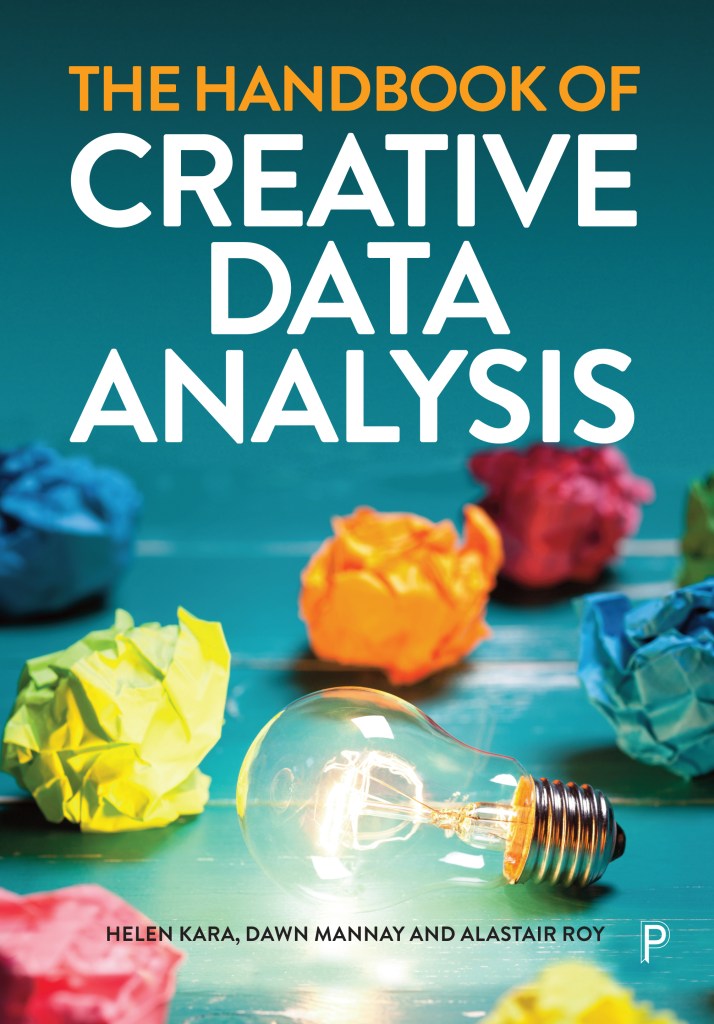
The Handbook of Creative Data Analysis

I am delighted to say that The Handbook of Creative Data Analysis was published this month. It’s a chunky tome with 29 substantive chapters, each outlining a creative method and its implications, plus introductory and concluding chapters by the editors.

Here’s how it came about. I first wanted to do this book in 2016. I knew it wasn’t a book I could write myself unless I could get some funding to research it – I applied for a grant from Leverhulme in 2017, for which independent researchers were eligible, but I was unsuccessful. I didn’t think it was a book that could be co-written, either. I thought of an edited collection, but wasn’t confident of doing that well enough on my own. And I didn’t have any good ideas about who to ask to co-edit with me.

Then in February 2021 I chaired a webinar on creativity in research for Policy Press with Dawn Mannay (Professor of Creative Research Methodologies at Cardiff) and Ali Roy (Professor of Social Research at UCLan). I already knew them both and it was a pleasure to do the webinar with them. We were surprised by the number of questions about data analysis, and after the webinar it occurred to me that they would be good co-editors for the book I had in mind. Then I considered their busy academic lives and figured they probably wouldn’t be interested. Then I thought I could just send an email to ask – nothing ventured, nothing gained… and they both said yes!

We decided Policy Press should publish the book and we put together a call for proposals. At this stage we were envisaging a standard-sized book with maybe 12 chapters. What we weren’t envisaging was around 60 proposals, most of which were really good. So we asked Policy Press if we could do a Handbook instead and they said yes. (Around this time I had also been asked to edit the Bloomsbury Handbook of Creative Research Methods. Fortunately I was able to divert a lot of the good proposals we couldn’t fit into the Policy Press Handbook to the Bloomsbury Handbook, so we didn’t have to reject too many outright.)

The process of editing this Handbook was a joy for several reasons. Dawn and Ali were great to work with – we named ourselves ‘good cop’ (me), ‘bad cop’ (Dawn), and ‘ambivalent cop’ (Ali)! I wanted to say yes to as much as possible, Dawn had a keen eye for quality standards, and Ali was great at seeing the merits of, and balancing, different arguments. And the combination of those three attributes was, in practice, greater than the sum of its parts. Then our contributors were, without exception, terrific, responsive, collegial people to work with. And Policy Press were thoroughly supportive throughout.

The part I liked best, though, was the learning. Each individual chapter held fascinating lessons and made me want to have a go at doing analysis with emojis, or reflective stitching, or word clouds. But there were some overall learning points, each made by several authors, that I found particularly interesting. The first is that any data can be analysed creatively: quant or qual, conventionally collected or creatively generated. The second is that analysis is not a discrete phase of research which falls between acquiring data and reporting results. Analytic work begins at the design stage of research and continues through dissemination and beyond. The third overall learning point is that doing analysis differently helps us to find new insights, learning, and understanding. The fourth is that analysing data often requires creativity, whether or not this is explicit.

Researchers use tacit as well as acknowledged creative practices to support their analytic work, and this is highlighted in several chapters. These tacit creative practices have always fascinated me. When I get stuck in the analytic mire, I write poems or create diagrams to help me move forward. Sometimes only half a poem or diagram, and my analytic poems never see the light of day though occasionally my diagrams do. But these techniques help my analytic thought processes. I was interested to discover other tacit creative practices, such as visual arts (doodling, drawing, collage etc), making (models, installations etc), music (to accompany and promote thought), and embodied practices such as walking, running and swimming. No doubt there are others too.

The fifth overall learning point is that analytic processes do not need to be fixed or rigid. This book demonstrates, in many ways, that analytic work can be experimental, playful, and fun.

At present the book is only available in hardback and digital versions. The digital version is much cheaper than the hardback, and you can get a 25% discount on either version by signing up to the publisher’s e-newsletter. If you are at college or university you should be able to get hold of a copy from the library. And there will be a paperback in due course. I am so happy that this book is out in the world because I think it will help a lot of people.

Feedback from #ICRMC23

I am astonished and delighted that feedback from last year’s International Creative Research Methods Conference is still coming in. Recently I found out that Lucy Robinson from Oxford University, who attended last year’s conference, published a review of the event in the most recent issue of the British Psychological Society’s Qualitative Methods in Psychology (QMiP) Bulletin. Unfortunately, it is paywalled but I was able to get hold of a copy. Lucy said ‘the hardest part was deciding what to attend’ (which chimed with feedback I was given at the event) and that it was ‘difficult to choose a highlight’. She also said: 

Ultimately, Helen’s goal for the conference was to ‘bring together the global CRM community to share knowledge, promote understanding, enable networking and have fun!’ (Kara, 2023, taken from the conference programme). From my perspective, something she achieved wholeheartedly.

I’m not just picking out the good bits to share with you, because Lucy’s review was entirely positive, as was almost all of the feedback we have received. There was a little helpful constructive criticism, most of which we have been able to implement this year, and other than that it was compliments all the way. But don’t take my word for it, check out these tweets: 

None of those are from people in my own networks, they are all from people I hadn’t met in person or online before the conference. And there were lots more – search #ICRMC on the socials to find them. 

Then, even more recently, I heard from Heather Bullen that #ICRMC23 was featured in the Actual News! Not the national news, but the Liverpool Echo, which reported on a project that was conceived at last year’s conference. The project involved women refugees and asylum-seekers, and used trauma-informed zine-making to explore ways to build resilience and move beyond trauma. The report is very favourable, with women commenting that the project helped them to ‘learn to live again’, ‘find peace’, and ‘get hope’. It is lovely to know that a presentation and connection at #ICRMC23 led to such a positive impact. 

Perhaps this is part of the reason we have already sold over half of the in-person tickets for this year’s conference. So, if you haven’t booked yet and you want to come in person, it would be worth doing so soon, to ensure you don’t miss out. There is also an online conference with two streams this year – we only had one stream online in 2023, having two streams this year is partly due to feedback received last year. The programmes and all the information you need to book your place are here. See you in September!

On Editing Book Series 

Since 2017 I have been working with Pat Thomson on the Insider Guides to Success in Academia. We now have 15 published titles and more in the pipeline. Then a couple of years ago I started to work with Policy Press on the Creative Research Methods in Practice series; the first book, Photovoice Reimagined by Nicole Brown, was published in April, there are three more scheduled for this year, and – again – more in the pipeline. 

A book series needs a clear purpose and a significant investment of time from its editor(s). That said, I have heard about series editors who do very little beyond adding their name to a series. I am not that kind of editor – I don’t want to micromanage authors, but I do offer help and advice. Some authors don’t need any assistance, particularly if they are experienced, while others need quite a bit of input, particularly if they are inexperienced. People helped me when I was a novice writer so I’m glad to be able to pay that forward. 

Rather than simply acting as a conduit between authors and publisher, I read and comment on every proposal and every manuscript. I consider reviewers’ comments carefully and discuss them with Pat for the Insider series, and with our publishers for both series, before passing them on to authors. And I am always available for any queries or concerns that series authors may have.  

Another part of the work is commissioning books, which lies somewhere between offering people a publishing opportunity and persuading people to write for your series. I try to stay closer to the ‘offering’ than the ‘persuading’ end of that spectrum, though sometimes it’s hard. Pat and I wanted to commission a book on project management for researchers from a very early stage in our series, and we tried one pair of authors who agreed but then were unable to follow through, and another single author who also agreed but was unable to follow through, all for perfectly understandable and very good reasons. So now we’re writing it ourselves with two colleagues. I co-authored the first book in the series on Publishing For Your Doctoral Research with Janet Salmons, and more recently Pat has written one on Refining Your Academic Writing

Since the launch of the creative methods series, I have had several enquiries from would-be authors. Together with the books I had already begun commissioning, I have been promised around a dozen books. Apparently a 50% conversion rate, from promised to proposal, is good going. So, I need to keep on promoting the series, and talking to people about the series, to try to secure more promises – and then ideally proposals. 

I get some royalties as series editor. Not a lot, but then, although it’s a job for sure, it’s much less work than writing the books. However, it does take time for them to come through. The first book in the Insider series was published in December 2019, so my first royalties were in March 2021, and my editor royalties for that series over the last four years have been just over £1,000 in total. On the plus side, most of that was this year, so it’s ramping up now – but series editing is definitely a long game, not a quick win. 

There are two parts of series editing I like best of all. One is when an unsolicited submission arrives which really fits the series, and the other is when a box of published books arrives in my office. As series editor, I get a few free paperback copies which I use for promotion, and it’s always a joy to see the finished product. Seeing the sales figures is nice too! 

The worst part is when we have to say ‘no’ to an author. This doesn’t happen often, and I think I have got better at managing it, but I haven’t always dealt with it well. It is hard to tell someone that their cherished vision doesn’t match yours.  

Most of the time, though, I really enjoy editing book series. I love seeing the series grow, watching authors flourish, and hearing readers’ comments. However, I don’t enjoy it enough to take on any more series – two is plenty! 

Photo by Suzy Hazelwood

NCIS Guide for Independent Scholars 

NCIS stands for the National Coalition for Independent Scholars which is in fact a global institution that includes independent researchers as well as independent scholars. I have been a member for some years and was very grateful when they supported the inaugural International Creative Research Methods Conference with sponsorship plus a conference chairperson and someone to manage the online chat.  

I am grateful to them again because they have produced an open-access Guide for Independent Scholars which is free to download. It is a full-length book with 17 chapters in five sections (full disclosure: two of the chapters are by me). The Guide was edited by Amanda Haste and Linda Baines, former and current Presidents of NCIS, and they did a fine job. 

The main reason I am grateful is because I think now people will stop asking me to write a book about and for indies. Or at least, if anyone does ask me, I can say no because it’s already been done – and done very well. I think it is a much better book than I could have written, because independent research and scholarship is an incredibly wide and varied profession, and multiple voices of people from around the world give a much clearer view of this breadth and variety than I could have done alone. I think this is part of the reason why I didn’t want to write a book for indies. I have a strong instinct for which books I can write by myself, and which need a pair or team of authors or to be an edited collection. I guess maybe I could have edited a collection of chapters, but Amanda and Linda are far better placed to do that, with their extensive NCIS networks, than I would have been. 

Also, I have been glad to be able to read this book! It contains a lot of valuable stories and nuggets of information, useful even for someone like me who has been independent for 25 years, and invaluable for someone starting out or early in their independent career. I recommend this book if you are independent yourself, or you work with indies, or you know an independent researcher or scholar, or you are considering moving into independent work. I am pleased to be able to tell you that it is a good read – at least, the chapters not by me are; you will have to judge mine for yourself. 

Asynchronous Online Focus Groups

I recently had the opportunity to take part in an asynchronous online focus group. So, I did; not least because I was curious to know what it would be like. I found it a rather odd experience. I had a few problems with the tech to start with, which was a bit annoying but is not unusual. I managed to get it sorted in the end – my pop-up blockers were to blame – but I did come close to abandoning the whole exercise through frustration at having to email support people rather than doing what I needed to do in the group. I’m not a techie, but I understand that it can be difficult to create a platform which works seamlessly on any type of hardware – laptop, tablet, mobile etc – and in any browser. So, tolerance may be required for participating in research online.

Once I got into the online environment, I found a series of intriguing questions to work through. Others had already responded to some of the questions so I could take their responses into account. (I don’t think I was supposed to be able to see them until I had answered each question myself, but I could see them, so I read them before formulating my own answers.) Even so, it didn’t feel at all like a group. I have facilitated many in-person focus groups and the interactions between group members are definitely a big part of the process; so much so that some researchers have chosen to analyse these as well as the transcript. Maybe if there had been more responses and exchanges it might have felt more like a group discussion, but I think it would still have felt like quite a solitary, albeit interesting, endeavour.

I think part of why it didn’t feel much like a group was the amount of reading and viewing required. The focus group didn’t only have questions to answer, but also text, videos, and diagrams to digest in between each question. Also, there were points where to give a full answer, I would have needed to stop and read a couple of journal articles and/or book chapters, and/or take a walk to think about the issue. But I didn’t because of time. 

This focus group had 10 discussion topics, most of which included at least a dozen questions. In theory, we could choose a topic to focus on, but in practice, I found I had no option but to work through all of the questions from the start (though it is entirely possible that this was due to my technological incompetence). As a result, I spent more time feeling a sense of urgency to get through all the many questions than happily engaging with the interesting material presented. It took me almost three hours to work through the questions at speed. I skip-read some of the text and skipped almost all the videos. I started to watch one in an area I was particularly interested in but then saw that it was 17 minutes long and decided I couldn’t allocate that much time. I tried to start another but the software asked for access to my camera and microphone so I said no because of the security risks. If I had engaged with everything as thoroughly as the researcher no doubt wanted me to – and as I would have liked to myself, if my time was unlimited – I think it would have taken me at least a full day to work through all the materials and answer all the questions. And when I did eventually get to the end, it was just the end. After all that work I would have liked a ‘thank you’ message at the very least, and ideally a big burst of fireworks on the screen! Though I expect the researcher didn’t do that because they were only expecting participants to focus on one or two topics.

The group was online for a couple of months and the researcher included various messages encouraging members to come back and respond to others’ input. I can see why this would be useful for the research, but I couldn’t see much – if any – evidence of people doing that, even though my own contributions were made closer to the end than the start of the operational period. Also, I didn’t go back and add further responses myself. I felt as if I should, but I didn’t get around to it. There was no option to receive email alerts when a new answer was posted, which might have helped, though everyone’s inboxes are overstuffed so if that option had been available I might well not have taken it up, or taken it up and then deleted the emails without reading them. 

I could see that the researcher had worked hard to try to provide a good online environment in which their expert participants could engage with specialised material. Alternative methods could include: reducing the number of questions, or separating the sections into different “focus groups” in different online spaces and asking people to participate in one or more of those groups in accordance with their interests, preferences, and capacities. Also, I think for participation which is so complex and time-consuming, there should really be an incentive, though I know not everyone has a budget for such things.

Although I found it quite onerous, participation was useful because it provided some insight into the potential impacts of this method on a participant. That gave me some ideas about what to do and not do if I ever want to use asynchronous online focus groups myself, or if I am mentoring someone who wants to use this method. It was also useful because the researcher who set it up was doing their best to research a complex and important piece of work which is likely to end up helping a lot of people. Although aspects of the experience were frustrating at times, my interest in methods renders those aspects also interesting to me in retrospect. So overall I think it was time well spent.

The Importance of Checking

Recently I was talking to a friend about the exercise routine another friend is using to recover from a serious illness, which involves a lot of walking. My friend said, “He should try bricking.” 

I asked what bricking was, and my friend said, “You put a brick in a rucksack and wear it while you’re walking. After a while, you add another brick. It’s really good for strengthening your legs and core.” 

I was intrigued so I did a quick search online. 

“You mean rucking,” I said. 

“Rucking?” he said. “Sounds a bit rude. What’s rucking?” 

“What you’re talking about – putting weights in a backpack and wearing it while walking. It comes from military training.”

“It’s called bricking! I invented it, 30 years ago!” my friend said, in mock indignation.

This conversation reminded me of a Guardian column by Julie Burchill which made an impression on me when I first read it almost 25 years ago. Julie was pleased with herself for inventing the phrase “They married in Hastings and repented in Leicester”. While I can’t find that column, I have found a follow-up article from 2000 in which she acknowledges the readers who wrote to tell her that “her” phrase was not original.

The Bible tells us that “there is nothing new under the sun”. Although there are debates about the origin and authorship of the Bible, nobody contests the fact that it was written a very long time ago. So, this concept is evidently not a recent phenomenon. But why is it relevant for research and scholarship? Because when one of us has an idea, which feels like a good idea, it also feels as if we are the first person ever to think of that idea. But clearly, we may not be.

I see this in the creative research methods literature where there are examples of people in separate parts of the world devising the same method as each other and each claiming its invention. Which is fair enough because they have both – or all – invented it. But in Euro-Western cultures, people regard these kinds of ideas as the property of the person who had the ideas, and this leads to all sorts of problems.

So, if you have a good idea, it is important to check whether you really are the first person to have that idea. Look online, use all the search terms you can think of, and try your hardest to make sure nobody else has had the same brainwave. This is not a fool-proof process. I only can read the English language so I can’t search for work in other languages. Also, people use different terms for the same thing which makes searching difficult. I see this often where people in separate locations who have coincidentally devised the same method, each call it something different. But if you check as best you can, then you have done all anyone could ask of you.

Photo by Alexander Suhorucov

How to bring creativity to your research

Last year I wrote a post to announce this forthcoming series. Now, I am delighted to say, it is no longer forthcoming – it’s here

The first book in the series, Photovoice Reimagined by Nicole Brown, is published today. There are three others scheduled for publication this year. Fiction and Research, by Becky Tipper and Leah Gilman, will be published in July; Doing Phenomenography, by Amanda Taylor-Beswick and Eva Hornung, will follow in September; and Encountering The World with i-Docs, by Ella Harris, will be available in December. Three more are currently in the writing phase, two proposals are out for review, and I am in discussions with eight or nine other authors or teams of authors about possible future publications. Potential topics under development include enhanced interviewing, poetic inquiry and decolonisation, sandboxing, using comics in research, creative sonic research methods, zines in the research encounter, mapping, journey mapping, inclusive creative fieldwork, creative evaluation, visual scribing, urban exploration, visual methods in practice and emoji coding. 

I decided to edit this series because I knew there were not enough publication opportunities for people writing about creative research methods. That meant students and researchers wanting to learn more about these kinds of methods were struggling to find relevant information. The books in the series are short, practical how-to books, designed to help researchers learn enough to try out the methods for themselves.

This kind of initiative also helps to establish the legitimacy of creative research methods. Now, in the first half of the 21st century, creative research methods are following a similar trajectory to that of qualitative methods in the second half of the 20th century. It may surprise you to know that economists began adopting qualitative methods as early as the 1960s. After much debate, psychologists began using qualitative methods in the 1980s and engineers joined in in the 2010s. Other disciplines also expanded their methodological repertoires and, as a result, academic journals publishing qualitative research were set up for areas of study formerly thought of as quantitative. For example, the journal Qualitative Health Research was founded in 1991, though Qualitative Psychology was not set up until 2013.

At present, creative research methods are perhaps most firmly established in the discipline of education, I suspect because it is such a creative profession. But I am seeing creative methods being used and promoted in a very wide range of disciplines, such as facilities managementhealth and the politics of fashion. This is reflected in the doctoral students I teach on courses for the National Centre for Research Methodsdoctoral training partnerships and universities. Students come to learn about creative methods from arts and humanities and social sciences disciplines. So far, so unsurprising. But I also get engineers, physicists, business students, computer scientists – all sorts in fact. 

In the Euro-Western world we think of creative research methods as new. However, the work of Indigenous methods experts such as Bagele Chilisa from Botswana, Margaret Kovach from Canada and Linda Tuhiwai Smith from New Zealand shows us that creative methods are in fact very old indeed – tens of thousands of years old, in some cases, so very much older than the ‘scientific method’ which has only dominated research in the Euro-Western world for the last few centuries. ‘Older’ does not necessarily equal ‘better’, but in this case I think it does. The scientific method has its place but is not the be-all and end-all of research. Creative methods are more likely to treat people holistically, take context into account and produce rich data and analyses. The scientific method assumes a level of universal consistency and uniformity, while creative methods make space for individual particularities. 

Creative Research Methods in Practice is a small but tangible step on our journey away from the dominance of positivism and post-positivism. These stances emphasise objectivity, which is unachievable, and usually consider experiments to be the ideal form of research. Again, there is a place for experimental methods, but there is also a role in research for all sorts of creative methods, from participatory approaches to autoethnography, board games to computer games, apps to zines. And these are the kinds of methods I aim to showcase in the series. If you would like to write a book for this series, please do get in touch.

Can You Help?

Dear Friends,

If you are not an academic and my work has had an impact on you, I would like to hear about that. Also, if you are, or were, an academic and my work had an impact on you at a time when you were not an academic, I would like to hear about that too. I am specifically interested in the impact of any of the following:

    • Open courses on Creative Research Methods and/or radical Research Ethics that I have run for NCRM in the UK, online, or in person.

    If you can help, please use my contact form (or my email address, if you have it) to send me a message about which of the above resources had an impact on you and the difference(s) made to you – whether to your thinking, work, career, life, anything at all. Your message can be as short or as long as you like. 

    Many thanks and kind regards,

    Helen

    Creative Methods in Unlikely Places 

    I am finding creative research methods in more and more unexpected locations. I stumbled across a fascinating example while researching the ethics of project management for a book I’m co-writing. It is in the International Journal of Project Management which is not a journal I have read much from until recently. The author is Jan Bröchner, an Emeritus Professor from Chalmers University of Technology in Sweden, who specialises in facilities management in construction organisations. Does he sound like a creative methods person to you? He didn’t sound like one to me – but my stereotyping was soon overturned as I began to read his article. 

    Bröchner gathered and analysed fictional accounts of construction project management. He was particularly interested in the way project managers’ individual values were expressed in these accounts. He cites a book from 1994 called ‘Good Novels, Better Management’ as foundational to the idea that fiction can be relevant for organisational research. This is a book I have on my shelves from my doctoral student days 20 years ago! My PhD focused on storytelling and organisations. Though I have lost touch with this area of research since then, it is good to see how it has developed. Bröchner cites other relevant work from 1995 to 2019 to support his contention that studying fiction is more use than conventional research methods for investigating the ethical dilemmas that project managers face and for gaining insights ‘into less desirable managerial behaviours’ (Bröchner 2021:594).  

    Bröchner drew on the values identified by the Polish-American psychologist Milton Rokeach in the 1970s as the internal reference points people use to formulate their attitudes and opinions. (I’m not sure how universal these are, as values can be influenced by society, religion etc and may change over time, but most of them seem reasonably widespread.) Bröchner used a five-step method for finding and working with his fictional data. First, he defined the criteria for selecting his data: they had to be novels, short stories, or plays; available in English, French, or German; with at least one construction project as a prominent feature; and a character who is the construction project manager. Using these criteria, he found fourteen novels, two short stories, and four plays for his dataset. The literature he selected ranged from Aristophanes’ play The Birds, written in 414 BC, to The Victoria System, a novel by Éric Reinhardt published in 2011. 

    In the second and third steps, Bröchner wrote one short summary to highlight the relevant action; and another to briefly summarise any other relevant details of background information. Here is an example: 

    Peter Ackroyd: Hawksmoor (1985) 

    Novel. Two intertwined murder stories. One featuring a satanist clerk of works (or supervisor) responsible for building seven churches in 18th-century London. The other concerning the same churches and a 1980s detective.  

    Background: Career of Nicholas Hawksmoor (d. 1736) as assistant to Christopher Wren and supervising architect. (Bröchner 2021:600) 

    Bröchner found that all the authors had relevant personal experiences, and many worked hard to understand construction project management (Bröchner 2021:601). 

    In the fourth step, Bröchner used the Rokeach values as pre-determined codes and applied those codes to his data. And in the fifth step, he used the results of that coding process to assess how each of the values was represented by the authors, and how frequently each occurred.  

    Bröchner found that the top five values were Imagination, (Mature) Love, Ambition, Courage, and Happiness (Bröchner 2021:600). These may not be the first five values you would expect a construction project manager to have. Values such as capability, logic, self-respect, politeness, and a sense of accomplishment seem more likely (and yes, those are Rokeach values too). So Bröchner’s findings are surprising and therefore interesting. He expresses a hope that his pioneering work will shift the focus from ‘management methods that are intended to lead to successful project outcomes to an acceptance [of] project managers as human beings’ with their own values and personal commitments to balance with their work and ethical considerations (Bröchner 2021:602). 

    I think this is one of the key benefits of creative research methods: they facilitate people being accepted as people. We are slowly moving away from the idea that people should compartmentalise themselves so that when you are at work your personal life is irrelevant, and only your work-related knowledge and skills can be of use. Creative methods offer an opportunity for people to bring all their knowledge, and skills, and imagination, and ideas, and courage, and love into their research work. With creative methods, there is no need to exclude anything except whatever is not useful for the task in hand.