I got an email through my contact form in mid-December. Would I like to spend a day teaching creative research methods to an EU-funded project team, at the University of Barcelona, in the middle of March – on a Friday?
Would I ever!
This was my first time teaching creative research methods to an EU-funded project team. However, I have been part of an EU-funded project team, and I work with EU-funded project teams as an ethics expert, so I am familiar with the terrain. It was also my first time working in Spain, and fortunately my client and his colleagues were able and willing to help me find my way through the maze of Spanish bureaucracy.
My client, Juan-José Boté, is a Professor at the University of Barcelona. He is also the project lead for GEDIS, which stands for Gender Diversity in Information Science, a project that began work at the start of 2025. Juanjo had a copy of my book on creative research methods which had led him to ask for my help. He wanted a day of awareness-raising, with some hands-on practice, and an emphasis on gender. So that’s what we did.
Juanjo kindly arranged for me to stay at a comfortable hotel very close to the university. On the morning of our session he came to meet me at the hotel to show me the way to the university and the room where we would be working. Before we got around to the business of the day, Juanjo showed me a marvellous three-dimensional ‘toolkit for librarians’ he had created with help from an artist, which is designed to fold down flat for easy transport to conferences.
Juanjo and meGEDIS librarians’ toolkit
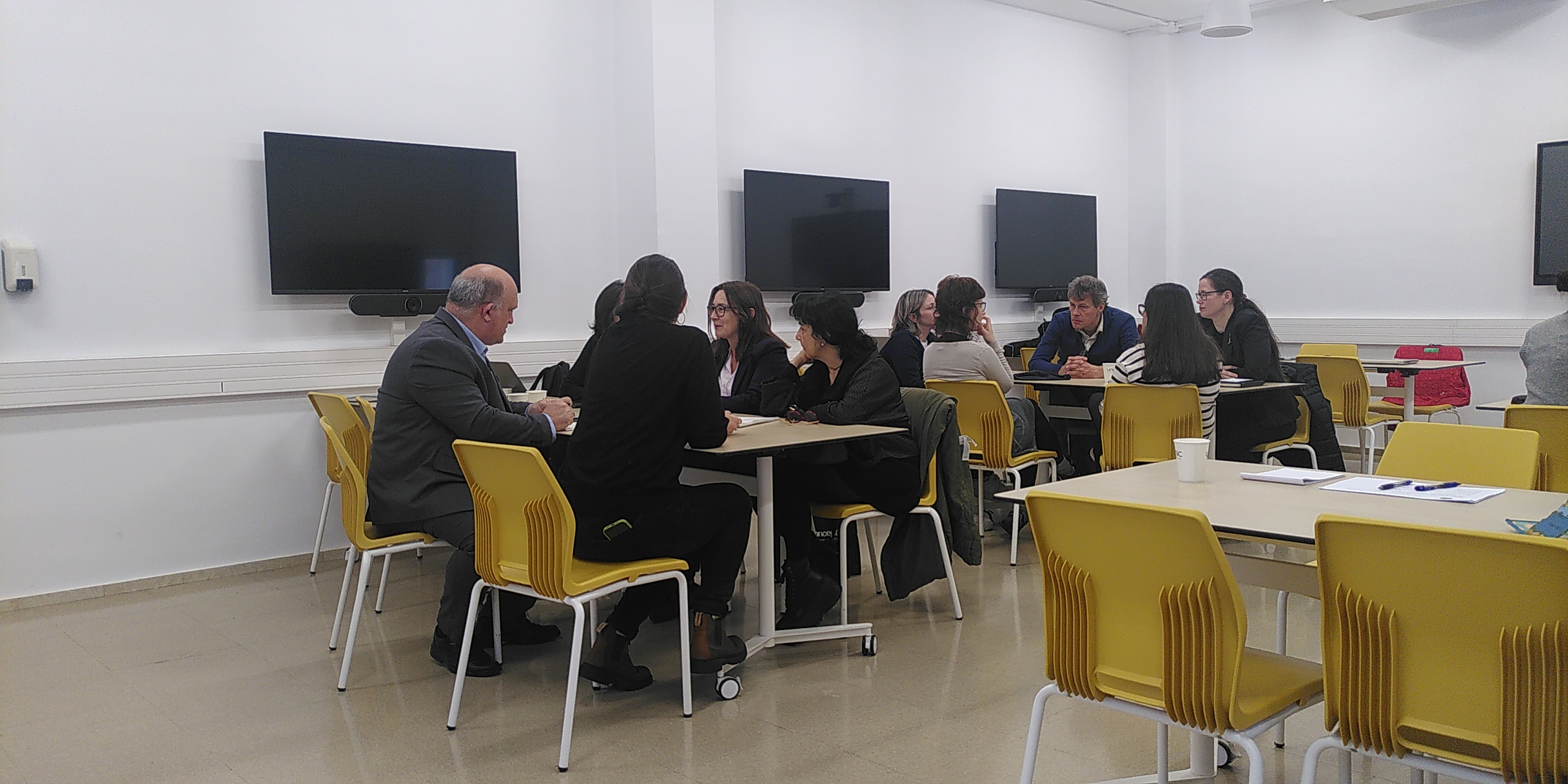
There were 21 people in the group, who came from a range of countries including Czechia, Austria, Bosnia, Germany, Croatia, Spain and Mexico. I began, as I always do, by asking people to introduce themselves and say what they wanted to get out of the day. It turned out that most were quite senior, including librarians and Professors, and several were also teachers of research methods. I had a moment of internal ‘eek!’, wondering whether I had taken on an assignment I couldn’t fulfil, but it turned out to be fine.
Our day together came at the end of a week of intensive co-working, and everyone was tired, but they all concentrated hard and asked really good questions. The discussions were focused on how creative methods could help GEDIS, and the group generated some excellent ideas.
Juanjo emailed me the following week to say:
“Partners told me that they were really happy with the session. It reported to them new and fresh ideas, to use not only at GEDIS at some point but also to their projects. In my case, I enjoyed the session so much.”
I was particularly pleased, in this global moment, to be able to assist a project working to strengthen gender diversity. And on a personal level I was delighted to be able to spend the weekend in Barcelona!
When I learned history at school, it was all about European royalty and battles from the distant past. This was in the 1970s when Britain was an even more overtly racist country than it is now. Yet I learned nothing about the British empire, or about other empires either. At least not from my lessons; what I learned about the British empire, I learned from the fiction I read.
My father took care to provide diverse reading for me, including books by African and Caribbean authors, and Enid Blyton’s books were banned from our house because of their overt racism and sexism. But a number of other authors whose work had racist elements slipped through, such as Hugh Lofting, Willard Price, and Laura Ingalls Wilder. From these books, and from the wider culture around me, I learned that the British empire had been a great endeavour in which brave pioneers had travelled, and sometimes settled, in lands where no white man had ever been. This was a heroic narrative involving encounters with ‘the other’, i.e. black and brown people, who were generally either hostile or servile. They were sometimes treated by the white characters with respect and kindness, but they could never, ever, be equal. The white people in the stories ended up richer in some way or another, and the black and brown characters were incidental to that story. The fundamental message was one of white superiority, whether on an individual, local, national or global scale.
I have written before on this blog about my own racism. In recent years I have been taking steps to educate myself about colonialism and its impacts. This mostly involved reading a bunch of books. As always with my book-related posts, I am not presenting this as any kind of exhaustive or authoritative list, but simply the books I have chosen to read.
The first book I read was Inglorious Empire: What the British Did to India by Shashi Tharoor. This is a dignified, scholarly, polite assessment of Britain’s looting and ravaging of India over 200 years from the mid-1700s to the mid-1900s. Tharoor builds his argument carefully, piece by piece, giving credit where it is – occasionally – due. He acknowledges that the English language was and is a valuable legacy for India (p 202). But he concludes, unequivocally, that ‘The India that succumbed to British rule enjoyed an enormous financial surplus, deployed a skilled artisan class, exported high-quality goods in great global demand, disposed of plenty of arable land, had a thriving agricultural base, and supported some 100 to 150 million without either poverty or landlessness. All of this was destroyed by British rule.’ (pp 219-20)
Then I read Slave Empire: How Slavery Built Modern Britain by Padraic Scanlan. This is written more like my school history books, with lots of names and dates. It focuses on slavery, primarily British slavery albeit in a global context, defining England as ‘among the world’s largest slaveholding powers and one of its most prolific slave traders’ (p 28). Scanlan covers the rise and the fall of the slave trade, and carefully documents how the official end of slavery did not in fact end ‘Britain’s entanglement with slavery’ as ‘British industry and finance remained deeply connected to enslaved labour’ (p 373).
Next came Empireland: How Imperialism Has Shaped Modern Britain by Sathnam Sanghera. Sanghera’s chatty journalistic writing style initially made his book seem like an easier read, but – unsurprisingly, given the subject matter – it was as demanding as the others. Sanghera, though, has a unique view in both directions. As a British Sikh, he has been on the sharp end of colonialism, but also had to face up to Sikh collusion in some aspects of colonisation, such as Sikhs’ participation in violently quashing the Indian rebellion against British rule in 1857. Sanghera describes facing up to this as ‘onerous’ (p 153) and acknowledges the possibility that the history of colonialism ‘is just too painful to digest’ (p 208).
I am grateful to Sanghera because I, too, find the process of facing up to this history to be onerous and painful. I realise that this may be seen as a form of ‘white tears’ – what right do I have to feel sad about a change to my national narrative when millions of lives were stolen? Yet I think if we do not acknowledge the potential and actual emotional impacts of this facing up process, we are effectively expecting people to learn about dreadful atrocities without any emotional consequences, and that is unrealistic.
Learning about this stuff is tough. It is also vital.
The next book I read was The New Age of Empire: How Racism and Colonialism Still Rule the World by Kehinde Andrews. Andrews demonstrates that the systems developed as colonialism was formed are still in action today. He also argues that we need to know about this because ‘The world can only ever be as equal as the knowledge it is built upon’ (p 2). Andrews asserts that ‘the premise of this book is deeply optimistic’ (p 205), but I have to say it didn’t seem so to me and I’m not sure how it could. The author does, though, express a hope that I share, which is that ‘understanding the scale of the problem and the limits of the solutions offered can spark a genuine conversation about how to overhaul this wicked system.’ (p 207)
Now I am reading Epistemic Freedom in Africa: Deprovincialization and Decolonization by Sabelo Ndlovu-Gatsheni. The author draws primarily on theoretical and research work from African, Asian, and south American scholars. He shows us, among other things, that not only lands and bodies but also people’s minds are colonized by the global dominance of Eurocentric thought and ideas. ‘Epistemic freedom is fundamentally about the right to think, theorize, interpret the world, develop own methodologies and write from where one is located and unencumbered by Eurocentrism.’ (p 3).
Although these books are justifiably angry, they are not polemics. Each engages with other structural inequalities such as sexism/patriarchy and class as well as racism, embraces nuance, and looks forward as well as back. Of course there is much, much more to each book than I have been able to explain here. I would recommend them all to anyone wanting to learn more about colonialism.
Ndlovu-Gatsheni’s book seems to me to be truly optimistic, perhaps because it offers a key to action I can take. It is easy to feel powerless in the face of colonialism, not least because that is partly what colonialism is designed to achieve. And for sure what I can do is only a minute fraction of what is needed. It is a truism that I can only do what I can do, but that truism is used too often to absolve people from the need to act. I think it is equally true that I should do what I can do. And what I can do – what I realise, now, I have been doing for years – is to encourage people towards epistemic freedom.
This blog and the videos on my YouTube channel are funded by my beloved Patrons. Patrons receive exclusive content and various rewards, depending on their level of support, such as access to my special private Patreon-only blog posts, bi-monthly Q&A sessions on Zoom, free e-book downloads and signed copies of my books. Patrons can also suggest topics for my blogs and videos. If you want to support me by becoming a Patron click here. Whilst ongoing support would be fantastic you can make a one-time donation instead, through the PayPal button on this blog, if that works better for you. If you are not able to support me financially, please consider reviewing any of my books you have read – even a single-line review on Amazon or Goodreads is a huge help – or sharing a link to my work on social media. Thank you!
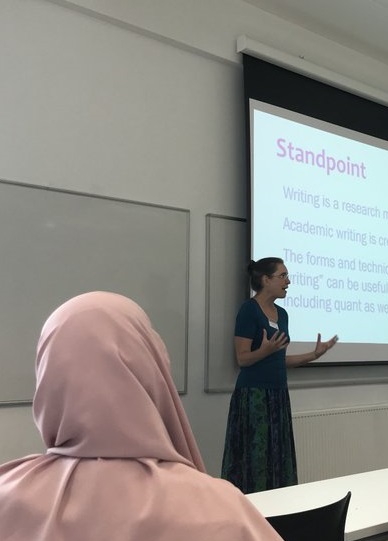
I ran my first academic writing retreat in 2015, over a weekend, for doctoral students at Staffordshire University. It was very enjoyable for me and, judging by the feedback, for the students too. Since then I have led many retreats and courses, mostly for doctoral students and/or university staff at institutions around the world. My standpoint is that all writing is creative, writing is a research method, and writing can be fun.
This month I ran an academic writing retreat over three days for Cumbria University in a delightful rural venue; a welcome change from the gritty urban spaces I usually go to for such gigs. This one had a transdisciplinary flavour with people from health and criminology, fashion and social care, media and education, and no doubt other departments I have forgotten. I never mind working with people from a single discipline, school, or faculty, but I do find that transdisciplinary groups have richer discussions. And the feedback I got was very positive.
I also get rich transdisciplinary discussions and good feedback when I run my four-day creative academic writing course for the Methods@Manchestersummer school, which this year is from 3–7 July online. The people who come on the course are always from a wide variety of disciplines and professions, and every year it is exciting to find out who I will be working with. (There are still some tickets available if you’re interested.)
And I run creative thesis writing courses for various universities, doctoral training partnerships, and other clients such as Guild HE. In fact I am running a creative thesis writing course next week for Liverpool John Moore’s University.
I love these parts of my work. I really enjoy demystifying the writing process, seeing the light-bulb moments people have, and witnessing their satisfaction in the progress they make. So I have taken the big step of booking other delightful rural venues for three independent residential retreats in 2023–24, one of which will be co-facilitated. In brief:
20–23 May 2024: creative research writing for publication, at Northern College near Barnsley.
My retreats are supportive, with some taught sessions, plenty of breaks, lots of time to write, and optional one-to-one chats with me. Costs are inclusive of accommodation and catering. The venues are delightful. More information here and if you have any questions, please ask in the comments or email enquiries@creativeresearchemethods.com.
This blog and the videos on my YouTube channel are funded by my beloved Patrons. Patrons receive exclusive content and various rewards, depending on their level of support, such as access to my special private Patreon-only blog posts, bi-monthly Q&A sessions on Zoom, free e-book downloads and signed copies of my books. Patrons can also suggest topics for my blogs and videos. If you want to support me by becoming a Patron click here. Whilst ongoing support would be fantastic you can make a one-time donation instead, through the PayPal button on this blog, if that works better for you. If you are not able to support me financially, please consider reviewing any of my books you have read – even a single-line review on Amazon or Goodreads is a huge help – or sharing a link to my work on social media. Thank you!
Back in 2015–16 I published a set of short affordable e-books for doctoral students – or, in the case of the first book, would-be doctoral students. Starting Your PhD: What You Need To Know was free on all platforms, because I wanted it to be easily accessible for people thinking about maybe doing a PhD or a professional doctorate such as an EdD or DBA. The other five were each around the price of a coffee in the UK, which seemed a reasonably affordable price.
Over the last year I have revised these e-books thoroughly and the second editions are now available. The first e-book is still free on all platforms except Amazon, because now the minimum price for a Kindle e-book appears to be 77 pence in the UK (and presumably equivalent amounts elsewhere). If you only have a Kindle, I recommend getting the e-book from Payhip where you can get a free epub.
I have updated all the text, references and resources in each of the books. Also, this time around I used a formatting service. I would have liked to do that last time but I couldn’t afford it – I paid for editing and cover design, and that was all I could manage. This time I used the same covers with a ‘second edition’ banner added, and my support worker did the editing for me. So I was delighted to be able to work with Leigh Forbes of Blot Publishing, a hugely experienced formatter of e-books and paper books. Her advice was consistently helpful and her professional approach made working with her a pleasure.
To celebrate the launch of these second editions, I am offering them to readers of this blog post at half price until 9 May 2023. This is also through Payhip where if you use this code at the checkout – RLCFPO6XU9 – you should receive 50% off any of the e-books. Or you can buy all six in a bundle, which is priced at £15.00 on Payhip, cheaper than Amazon UK where the whole series is currently £18.22. The 50% off code will work for the bundle too. Please feel free to share the code with others in your networks, though do also tell them about its expiry date.
In case it’s of interest, I am not doing this as a money-making exercise. The first editions never even covered their costs, let alone making any profit to pay for the time I spent in writing and publishing them. I charge for five of the e-books because (a) I am an eternal optimist and they might cover their costs this time and (b) I know that, bizarrely, people value things more if they cost money than if they are free.
I got ‘paid’ in good reviews which were heartening and encouraging to read. However, a downside of producing second editions is that all the first edition reviews have disappeared. I hope some people will write new ones soon, to help potential purchasers. Maybe even you!
This blog and the videos on my YouTube channel are funded by my beloved Patrons. Patrons receive exclusive content and various rewards, depending on their level of support, such as access to my special private Patreon-only blog posts, bi-monthly Q&A sessions on Zoom, free e-book downloads and signed copies of my books. Patrons can also suggest topics for my blogs and videos. If you want to support me by becoming a Patron click here. Whilst ongoing support would be fantastic you can make a one-time donation instead, through the PayPal button on this blog, if that works better for you. If you are not able to support me financially, please consider reviewing any of my books you have read – even a single-line review on Amazon or Goodreads is a huge help – or sharing a link to my work on social media. Thank you!
I have been working entirely from home since mid-March 2020. It was a sudden transition. In the week beginning Monday 10 March 2020, I was zooming all over the place, and this was normal. On the Monday morning I set off from my home in the English Midlands to travel to Southampton by train. The train was delayed, so I missed two meetings I had planned for the afternoon, but arrived in time to have dinner with a colleague who had flown from South Africa for my workshop the next day. On the Tuesday I taught creative research methods all day, then caught a train to Gatwick and an evening plane to Stavanger in Norway. On the Wednesday morning I gave a keynote speech at a conference in Stavanger. The plan had been for me to teach at the conference in Stavanger on the Thursday and return home on Friday, but the pandemic was taking hold in Europe and there was talk of airports closing. My clients were understandably worried, and conference delegates were leaving, so they booked me onto a flight home on Thursday afternoon, and into the Premier Inn at Heathrow for the night as I arrived too late to get back to my home in the Midlands. On the Friday I travelled home by tube and train. I remember seeing a man on the tube with a big black bin bag which was obviously full of toilet rolls, and thinking, wow, this is different.
In the first couple of months of 2020 I worked in Brussels, Manchester, Sheffield, Brussels again, Cork, Dublin, Belfast, and Glasgow, as well as Southampton and Stavanger. It was rare for a week to go by without a trip; in fact, I would block out a ‘no travelling week’ in my calendar every few months so I could catch my breath. Since mid-March 2020 I have not travelled for work, and I have not used public transport at all apart from one short off-peak return train journey in London, in summer 2022, to travel to the wedding reception of some good friends. Next week, though, I am going back to Ireland, to teach in Dublin and Belfast. Before the pandemic I was working in Ireland two or three times a year. I love Ireland, and I am really looking forward to reconnecting with colleagues and friends in Northern Ireland and in the Republic.
Booking travel and accommodation again was weird. I had forgotten how I used to do that, and so many things have changed. Not least the trains: I used to take the train to and from the airport, but I live on a branch line where there is now one train every two hours instead of two trains an hour outside peak times. Also we are experiencing frequent train strikes at present here in the UK. So I will be driving and parking at the airport instead, which is much more expensive and much less environmentally friendly, but with the trains in such a bad way I don’t think there is another option.
On the plus side, now I know I’m autistic, I am allowing myself to pay for airport lounges – as long as they are not too expensive – because avoiding the noise and bustle of the main airport will mean I arrive at my destination in much better shape. Also, I often need a meal at the airport, and that is included in the lounge cost, so it’s not as expensive as it looks.
I can tell you one thing, though. I won’t be travelling most weeks again, ever. It was exhausting – I really have no idea how I managed. I am glad we can do more online, because it’s better for the environment, and better for our lives. I would rather spend more time at home and less time on stations and trains, in airports and planes. Even so, I am glad to be able to travel more freely in general, and I’m looking forward to going back to Ireland in particular. If you are one of my Irish colleagues or friends – I’ll see you soon!
This blog and the videos on my YouTube channel are funded by my beloved Patrons. Patrons receive exclusive content and various rewards, depending on their level of support, such as access to my special private Patreon-only blog posts, bi-monthly Q&A sessions on Zoom, free e-book downloads and signed copies of my books. Patrons can also suggest topics for my blogs and videos. If you want to support me by becoming a Patron click here. Whilst ongoing support would be fantastic you can make a one-time donation instead, through the PayPal button on this blog, if that works better for you. If you are not able to support me financially, please consider reviewing any of my books you have read – even a single-line review on Amazon or Goodreads is a huge help – or sharing a link to my work on social media. Thank you!
Not many people know this, but I spent my first four years of full-time employment, after my first degree, working as a training administrator in the City of London, first for a merchant bank and then for a law firm. (Neither is still in business. I am not taking that personally.) My work involved conducting training needs analyses (research!), commissioning and evaluating training (more research!), and designing and running training courses. I went on a ‘train the trainer’ course to learn to structure and present a course; I remember it was held in a room at The Guardian newspaper office, which was in Farringdon Road at the time. And then I put my learning into practice, over and over again.
After a while, when I had paid off my post-university overdraft and done enough voluntary work to gain experience, I left the City and became a residential social worker. I didn’t think I would use my training skills again. Fast forward a dozen or so years to 2003 by which time I am a researcher with an MSc in Social Research Methods and a PhD underway, and a client asks if I can train her staff in evaluation research. I say ‘yes’ and the whole thing snowballs from there.
Now I teach short courses in research methods and ethics worldwide, mostly to postgraduate researchers and early career staff at universities, as well as open courses via organisations such as the National Centre for Research Methods and Methods@Manchester. Of course, this has all been online for the last couple of years, and some was online long before that, but I now have in-person bookings for 2022–23 which I very much hope can go ahead. My most popular courses are on creative research methods (1–4 days), creative and productive academic writing (1–4 days), radical research ethics (1 day), and documents as data (1 day). Each of these courses is highly interactive, with short presentations, discussions, practical exercises and lots of time for questions. I also offer bespoke training for clients who want specific courses for their students and/or staff.
I enjoy this kind of teaching very much, but I can’t do it all the time because it is quite demanding, and I also like doing research and keynote speeches and writing books. So I have taken the decision to restrict my teaching to 40 days per year. One-fifth of these days are taken up by the Methods@Manchester summer school, where I teach two four-day courses, one on creative and productive academic writing and – this year for the first time – one on qualitative research for quantitative researchers. Most of the rest are taken up by universities that book me each year for a regular day or two. This academic year is almost fully booked, and the next academic year is booking up fast.
One of the things I love most about teaching is, paradoxically, how much I learn from my students. This year alone I have learned to use the term ‘geopolitical North/South’ rather than ‘global North/South’, and about Effin Birds (content warning: many many swears) which provided an excellent birthday present for a good friend with a robust sense of humour. Students bring all sorts of useful knowledge to my courses and share it for everyone’s benefit. They give me lovely compliments about my teaching (and from time to time some helpful constructive criticism) but they forget to notice or mention how much they themselves contribute to the course, and how very valuable that is.
I think I am so lucky to be able to teach in this way. I hope I will be able to travel for work again soon – in January 2020 I was planning teaching trips to South Africa and Aus/NZ – but I know just how lucky I am to have been able to continue with this most rewarding part of my work throughout the pandemic. If you have been on one of my courses, remember: everyone is creative!
This blog, the monthly #CRMethodsChat on Twitter, and the videos on my YouTube channel, are funded by my beloved Patrons. Patrons receive exclusive content and various rewards, depending on their level of support, such as access to my special private Patreon-only blog posts, bi-monthly Q&A sessions on Zoom, free e-book downloads and signed copies of my books. Patrons can also suggest topics for my blogs and videos. If you want to support me by becoming a Patron click here. Whilst ongoing support would be fantastic you can make a one-time donation instead, through the PayPal button on this blog, if that works better for you. If you are not able to support me financially, please consider reviewing any of my books you have read – even a single-line review on Amazon or Goodreads is a huge help – or sharing a link to my work on social media. Thank you!
I have been talking about the research trajectory with my students for years. I describe my conception of this trajectory, which I call ‘The Helen Kara Inverted Bell Curve Of Research’. I often use this conception to help me explain why it is usually not a good idea, when data analysis is challenging, to decide that all problems will be solved by throwing in a few extra methods – gathering more data, reading a new body of literature, and so on.
It occurred to me that manifesting the image I see in my head might be entertaining for me (it was!) and perhaps useful for others. So I made a graphic. Here it is. Does it resonate with you?
The Helen Kara Inverted Bell Curve Of Research
This blog, the monthly #CRMethodsChat on Twitter, and the videos on my YouTube channel, are funded by my beloved Patrons. Patrons receive exclusive content and various rewards, depending on their level of support, such as access to my special private Patreon-only blog posts, bi-monthly Q&A sessions on Zoom, free e-book downloads and signed copies of my books. Patrons can also suggest topics for my blogs and videos. If you want to support me by becoming a Patron click here. Whilst ongoing support would be fantastic you can make a one-time donation instead, through the PayPal button on this blog, if that works better for you. If you are not able to support me financially, please consider reviewing any of my books you have read – even a single-line review on Amazon or Goodreads is a huge help – or sharing a link to my work on social media. Thank you!
My first proper job after my first degree was as a training administrator for a big firm in the City of London. I attended a ‘train the trainer’ course and learned to design and provide training courses myself, which I did for the next four years. That experience has proved invaluable in my research career. Now I talk of the research methods/ethics training I offer as ‘teaching’ because I mostly do it in universities and that is the term they use. But, as I teach short courses as an external expert rather than full modules as a university lecturer, designing and delivering those courses involves more-or-less the same process as the training I used to provide in London.
I have been teaching research methods and ethics for universities and research organisations since 2008. I teach around the UK and overseas: so far in Europe, Australia, Canada, the Middle East, Latin America and Asia. I often teach international groups online and am humbled by students who attend my courses in the middle of the night, their time. (I do not teach in the middle of the night, my time. I am too old for that!) In pre-pandemic times I did most of my teaching in person. For the last 18 months it has all been online, but now I am beginning to receive invitations to go back to the classroom, albeit with Covid precautions in place. I suspect in the future it will be part online and part in person. Teaching online has some advantages: nobody has to travel, which reduces stress and cost and environmental impact, and makes it possible for some people to attend who couldn’t if it was in person. However, it has some disadvantages too, primarily (from my point of view) that I won’t know if someone is struggling unless they tell me, whereas in the classroom I can see if a student is puzzled and wander over to get them unstuck. So I will be glad when I can do more in-person teaching again, though I have learned a lot about teaching online and will be happy to offer that too.
The courses I offer routinely are Creative Research Methods (1 or 2 days), Creative Academic Writing aka Creative and Productive Thesis Writing (1–4 days), Radical Research Ethics (1 day) and Documents as Data (1 day). The first three are based on books I have written or co-written, the fourth is based on books by other people. I can also run courses on other topics, adapt my existing courses, and teach in other ways. In 2018 I ran two of my existing courses for Coventry University’s graduate school, and also courses on qualitative data coding/analysis and qualitative interviewing. Next month I am running my Creative Academic Writing course, adapted to meet the needs of The Anthropocene and More-Than-Human World Writing Workshop Series funded by the British Academy. And I am currently in discussion with Liverpool John Moores University about a data analysis course for postgraduate researchers, and with Nanyang Academy of Fine Arts in Singapore about facilitating a monthly ‘reading circle’ on autoethnography and arts-based research, with a view to helping participants work towards writing for publication. Both LJMU and NAFA are existing clients. I am glad to say my teaching clients usually book me again; there are a number of universities and other organisations who I teach for every year, sometimes several times in a year.
I don’t do much teaching for less than a day at a time, though that can be split into two half-days if we’re working online. I will do the occasional webinar or shorter seminar, though my minimum charge is my half-day rate (because, as regular readers know, an hour is not an hour even when working online). What my day rate is depends on the country where I will be working, whether in person or virtually. The resources of countries around the world vary greatly, as do those of organisations. So I aim to charge the standard rate for each country and type of institution I am working with. I should also add that if I design a new course for a client, I charge an extra half-day per day of training for design and preparation. This means that I would cost a new one-day course at 1.5 x my day rate.
I am glad to say my teaching is becoming increasingly popular. So much so that I am needing to restrict the number of teaching assignments I take on, because otherwise I don’t have enough time for my client work and writing. I have decided to teach for no more than four days in any one month, or 36 days in any one year. On this basis, I have a couple of teaching days still available in 2021. In 2022, January, February and July are already full, and I have several bookings in other months. So if you’re thinking about asking me to teach at your institution, don’t drag your feet!
This blog, and the monthly #CRMethodsChat on Twitter, and my YouTube channel, are funded by my beloved patrons. It takes me more than one working day per month to post here each week, run the Twitter chat and produce content for YouTube. At the time of writing I’m receiving funding from Patrons of $87 per month. If you think a day of my time is worth more than $87 – you can help! Ongoing support would be fantastic but you can also make a one-time donation through the PayPal button on this blog if that works better for you. Support from Patrons and donors also enables me to keep this blog ad-free. If you are not able to support me financially, please consider reviewing any of my books you have read – even a single-line review on Amazon or Goodreads is a huge help – or sharing a link to my work on social media. Thank you!
Over the next three weeks I will be doing eight presentations about creative research methods, in Edinburgh, London, and Calgary, to audiences of practitioners, postgraduate students, and academics. I like doing presentations, once I get going, but this is a little daunting because each presentation is slightly different from the others. For example, one is for evaluation practitioners at the NSPCC, so they will want to know how to use creative methods in evaluation research focusing on children and families. Another is for MA students at the University of Calgary, who need to know about arts-based methods and research using technology. A third is for the Social Research Association in Edinburgh, which is likely to generate a mixed audience of practitioners and postgraduate students with a variety of learning needs.
Although I’ll be the one doing the teaching, the prospect of giving these presentations feels rather like the prospect of doing a bunch of exams. This is partly because I’ve had to do a whole load of revision. Although creative methods have always been part of my practice, I finished writing the book a year ago, and I seem to have forgotten a surprisingly large proportion of its contents. I feel rather as though I need to learn it off by heart – including the 500+ references – before I do the first presentation. Which is tomorrow morning. So that’s not going to happen, particularly as I already have rather a lot of work to do on the train to Edinburgh today.
Luckily I’ve had time to refresh my memory to some extent. When I re-read the book I wrote, I remember some parts vividly, while others almost feel like new information. I find myself thinking ‘Ooh, that’s a good point’, as if it had been written by someone else, and ‘Did I really write this?’ because I don’t remember.
This is a strange phenomenon, and I wonder whether other authors have similar experiences. I suspect at least some of them do. It’s not entirely new for me, either. I’ve never been one for hanging on to old papers, but some years ago I came across an essay I’d written for A level geography, all about fluvio-glaciation and peri-glaciation. I couldn’t remember ever knowing those words, let alone what they meant.
So I’ve been thinking about the difference between knowing and remembering. Sometimes I know I know something, such as the name of a tune I am hearing on the radio, but I can’t bring it to mind – we say, ‘It’s on the tip of my tongue’. Sometimes I don’t know I ever knew something, such as the geographic terminology above. Some things I know fairly indelibly, such as how to drive my car, make a veggie chilli, or write an email. Yet there must be lots of things I’ll never know I ever knew, which is a strange thought.
I did remember some things about exams which made me feel a bit better about my forthcoming ordeal-by-presentation. I remembered that I used to have the same feeling, that I needed to memorise everything in my schoolbooks, and the same lurching internal near-panic because I knew I couldn’t. And I remembered that I had actually been quite good at exams, and one thing I’d learned from doing exams that was still applicable now is that I don’t need to remember everything, but to remember enough, and to know what to do with what I remember. In fact, to be creative.





![Creative research methods in the social sciences [FC]](https://helenkara.com/wp-content/uploads/2015/05/creative-research-methods-in-the-social-sciences-fc.jpg?w=215)
 Helen Kara