Twelve top tips for co-editing a book series

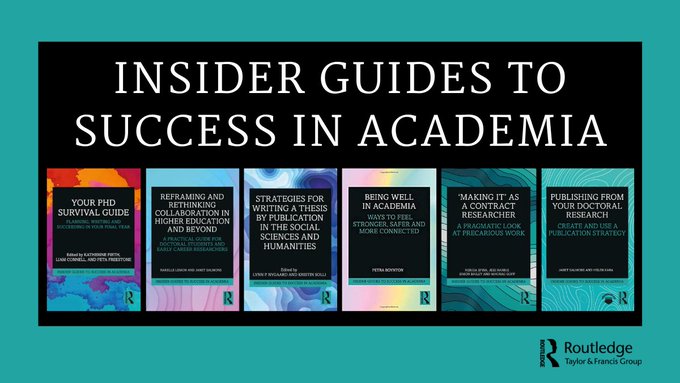
This post is co-written and simultaneously published with Pat Thomson, to coincide with the launch of the Insider Guides to Success in Academia book series.
Helen: It’s interesting to reflect on how we do this co-editing thing. We’ve been working together on this series since May 2017, so that’s three-and-a-half years. You and I hadn’t worked together before, though we’d talked a lot on Twitter, a bit by email, and got into a comfy habit of meeting for lunch now and again at a nice pub midway between our 
offices. Ahhh, those were the days… anyway, now it’s mostly email with the occasional online meeting. Those are the nuts and bolts, but there’s a lot more to co-editing a series than that. I think it helps that we share quite a similar outlook on life. Was that why you asked me to 
co-edit with you?

Pat: I’m always prepared to take an educated punt on who might be fun to collaborate with. I saw that you were talking with doctoral and early academic career people on social media, as I was, but you had a very different background. You were an independent researcher, as opposed to me, a full time academic. However, we shared an interest in methodologies and methods. But we also knew about some different things too. As I remember it, we hadn’t actually even met face to face, but “knew” each other online. I think that you can actually get to know people through social media, just as you used to be able to through the medium of writing letters. Over time, as you see how people are on social media you get an impression of how they are and how they might be to work with. So asking you if you’d be interested in working on a series was in part about our shared interests and complementary differences, but also about the hunch that you would be good to work with. But why did you say yes?

Helen: I was a little bit flattered by you asking, and I too thought you could be fun to collaborate with. But mostly I agreed with you about the gap in the market for short books on topics around academia that didn’t merit a full-length book and so weren’t adequately covered in the literature. It was so interesting to think about! I’ve just checked my records and when we met in April 2018, the first book in the series was being written and we had 21 other ideas of titles and/or authors to follow up. Some have come to fruition now, such as Narelle Lemon’s and Janet Salmons’ book on collaboration, and Petra Boynton’s book on being well in academia. That’s lovely to see. Some didn’t even get off the starting blocks, and we have others in the series that we didn’t consider in that meeting, such as Your PhD Survival Guide which offers doctoral students help for their final year. Many of our authors come from our networks, so clearly networking and thinking are two of the key skills for co-editing a book series. You have more experience of this than me; what would you say are the others?

Pat: Well there’s choosing a publisher. I’d had a very initial discussion with Sarah, an editor at Routledge who I had worked a lot with before. I’d floated the idea of a series for doctoral and early career researchers that were shorter than usual, covered niche topics were affordable. She was very enthusiastic about the idea and encouraged me to pursue it. She also sent me a few small books that I could look at. At our first meeting, we discussed the style and tone of the books. We agreed on the size question, and also that our books should have a voice somewhere between a blog and an ordinary academic book. We also wanted something where the layout was half way between a text book and a monograph – so we needed a template/house style that allowed for different kinds of exercises, examples, illustrations. So afterwards, when we wrote the actual book series proposal we not only knew the competition and the market as well as the prospective authors, we also had a clear idea of what the books would be and do. And then of course there was the series cover decision!

Helen: OMG the cover decision… that took us a while, didn’t it? But I’m happy with the results. I have copies of all the books we’ve published so far, and they look good together. That’s important for the Routledge stand at academic conferences – not that those are happening at present, but I hope they will be again in time. So promotion is another skill co-editors need, and of course social media savvy is helpful there too. I think communication skills are also important. You and I communicate well with each other and with our authors and would-be authors. And it mattered to us both from day one to be supportive to people thinking of writing, or actually writing, for our series. I don’t think all series editors do that and I’m not sure why; do you have any thoughts?

Pat: Well, we are really committed to the series and what we think it can be, and we want it to be super good. We want to make the dream we had about it at the start a reality. I guess we run the risk of being seen as being too hands-on, but I think I’d rather that than distant and un-contactable. And I’ve certainly had the experience of working with a pretty remote series editor when I could have done with some conversation about working with a production editor and that was much harder than it needed to be. We do want our authors to feel supported, and that also means offering some constructive suggestions for improvement.  And of course it’s important that Sarah, our Routledge Editor, shares our view of what the series is and does; we do have a productive partnership with our publisher. That’s important too; we can make suggestions about the series, its direction and processes, and also about its promotion.

So here’s our twelve top tips for series editing:

  1. Know the field, its debates and authors
  2. Choose a co-editor with complementary skills and similar interests
  3. Identify the niche in the field that the series will occupy, and the potential audience
  4. Imagine the possible series – what it could be – and its USP
  5. Identify the right publisher you can partner with
  6. Build a list of potential titles and authors
  7. Line up the first two or three titles and authors
  8. Write a short and punchy proposal for the series
  9. Work with the publisher on the series identity – size, layout, cover etc
  10. Actively recruit authors and titles
  11. Work with the authors through proposal and manuscript development stages
  12. Actively engage with the publisher and authors in promoting the series

Why Academics Should Publish Books With University Presses

I discovered that last Friday was publication day for a book of great interest to me: Indigenous Research Ethics: Claiming Research Sovereignty Beyond Deficit and the Colonial Legacy, an edited collection out of New Zealand and published by Emerald. In hardback. For £85. Or as an e-book, for £80.75.

I have been cross for a while about the ridiculous pricing of some academic publications, and now I’m furious. I really want to read this book, and it’s way beyond my budget. It will be beyond the budget of most independent or precariously employed researchers. And how many Indigenous scholars can afford £85 for a book – or the e-book with a derisory £4.25 reduction?

This pricing is calculated for academic libraries. It is closed access in book form. The publisher can claim they are supporting Indigenous researchers and scholars and, sure, those whose work is published in this book get a new line on their CV which may help them in their career. But their work is not going to be widely read, used, and cited by others. Because, guess what, academic libraries are experiencing budget cuts. I was chatting on social media with a senior academic who had asked her university library to get this book, and whose library had said no, that’s above our threshold now.

This is of course n=1, so let’s take a wider look. I’ve been doing some research into the practices and economics of academic publishing – and it’s horrifying. Of course books and journals are inextricably linked, but I can’t cover both in one post, so I’m focusing on books today; journals in a couple of weeks’ time.

Broadly, academic publishers can be divided into three categories:

  1. for profit and part of a bigger business;

2. stand-alone independent for profit; and

3. not for profit.

In general, the scholarly publishing industry makes a 35-40% profit margin. Walmart makes 3%. Publishers that are part of bigger businesses are usually part of global corporations who divert a proportion of any profit to their shareholders. In such corporations, the academic publishing arm is often so profitable that it is propping up other parts of the business.

A lot of scholars are completely unaware of how this works. Most scholars in the social sciences and the humanities have heard of the book publisher Routledge; most STEM scholars have heard of CRC Press. Some know that one or other is part of the academic publisher Taylor & Francis. Few understand that Taylor & Francis is part of Informa, a global corporation in the FTSE 100, huge, wealthy, growing – and making good money for its shareholders. Taylor & Francis isn’t a little bit of Informa, it is the second biggest of five divisions, and, according to the 2019 annual report, is showing ‘good levels of growth’. In 2019 Taylor & Francis’ revenue was £560m, and its adjusted operating profit was £218m. Part of this was due to ‘a steady performance in books’ – 7,300 books, in fact, that year. E-books accounted for 31% of the year’s total book sales.

I found a vaguely equivalent book on Routledge’s website: Social Science Research Ethics for a Globalizing World: Interdisciplinary and CrossCultural Perspectives, another edited collection. The hardback price is an eye-watering £125, but at least there is a less expensive paperback (£36.99) and e-book (£33.29). They’re still outside my budget, though – my ceiling is £30. (Full disclosure – I could buy the paperback with my Routledge author discount. But we can’t all write for all of the publishers. And these prices are still very high for a 350-page book.)

By contrast, UCL Press is a fully open access press. It is run by a working group of the UCL Library Committee, and has published 184 books since it was established in 2015. And those books are all fully open access. Which means free. Free to download, free to read.

Not, sadly, free to write, though – at least, not for all authors. Publication is free for people working at UCL, and for their co-authors and co-editors. UCL also cover the publication costs of up to five non-UCL book projects each year. After that, it costs £5,000 to publish a book of up to £100,000 words. This would usually come from research funders, as part of the dissemination strategy for a research bid.

So there is still a huge degree of privilege in operation here. To publish a book with UCL Press you need to be connected with UCL, or very lucky, or funded, or rich. You almost certainly won’t be from the global South. I have been worried for a long time that open access would benefit readers at the expense of writers, and this does seem to be happening. But I understand that, on the whole, this is a step on the way to social good, as it offers good quality academic literature more freely to any reader with an internet connection. Also, UCL Press are offering consultancy and training to other universities that want to set up open access publishers of their own.

There are other OA and scholar-led presses at Goldsmiths, Westminster, Huddersfield and elsewhere. Larger university presses in the UK include Bristol University Press, Liverpool University Press, Manchester University Press and Edinburgh University Press. Then there are the oldest and largest, Cambridge University Press and Oxford University Press. And there are many others around the world. Their mission includes making research available to the public, and giving voice to under-represented groups and experiences. Any surplus income they generate goes to support their mission.

You can see the difference, too, when you read the books. Routledge publishes some good books but their production values are not high. They are often poorly edited and with inadequate or no index, and their cover designs are basic and repetitive. Policy Press, an imprint of Bristol University Press, also publishes some good books and their production values are much higher. The editing is good, more of their books have good indexes, and their covers are carefully designed.

So, academics, what do you want for your books? Do you want them to be well constructed and made available to as many people as possible, by an organisation with a mission to help make that happen? Or do you want them to be averagely constructed and available only through some academic libraries, by an organisation that has a mission to line the pockets of its shareholders?

The recent Open Access Manifesto for Freedom, Integrity and Creativity in the Humanities and Interpretive Social Sciences recommends that scholars in those sectors consider the political and ethical implications of where they choose to publish, and aim for ‘outlets whose values align with your own’. I would recommend that for scholars and researchers in all sectors.

This blog, and the monthly #CRMethodsChat on Twitter, is funded by my beloved patrons. It takes me at least one working day per month to post here each week and run the Twitterchat. At the time of writing I’m receiving funding from Patrons of $70 per month. If you think a day of my time is worth more than $70 – you can help! Ongoing support would be fantastic but you can also make a one-time donation through the PayPal button on this blog if that works better for you. Support from Patrons and donors also enables me to keep this blog ad-free. If you are not able to support me financially, please consider reviewing any of my books you have read – even a single-line review on Amazon or Goodreads is a huge help – or sharing a link to my work on social media. Thank you!

Book Giveaway!

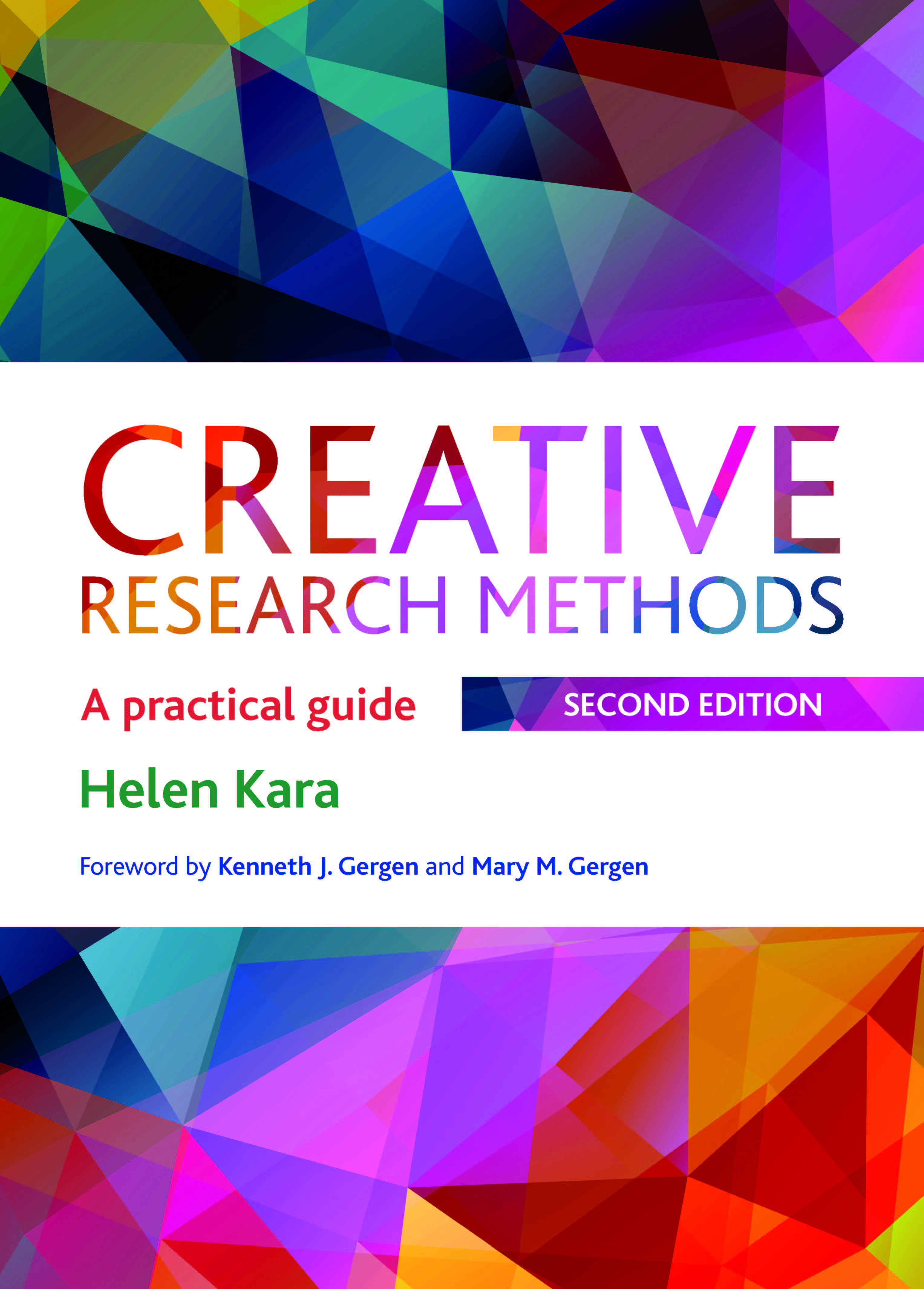
This week I simply do not have time to write a post for you all. So I thought instead I’d run a 24-hour giveaway for my subscribers. Would you like to win a copy of one of my books? I’m offering a copy of my book on creative research methods – the new second edition – or, if you already have that (or if you prefer), the title of your choice from the Insider Guides to Success in Academia series that I’m co-editing with Pat Thomson.

If you already subscribe to this blog, hurrah, you’re eligible! If you don’t, the first thing you need to do is find ‘Follow Blog By Email’ (probably on the right of the screen if you’re on a laptop or tablet, at the bottom if you’re on a phone), put your email address in the box and click ‘Follow’.

(By the way, as far as I am concerned you are subscribers, not followers. I don’t mind having subscribers but I don’t like the idea of having followers because I’m not the Pied Piper or some kind of dodgy cult figurehead.)

So, OK, now you’re a subscriber, or maybe you already were; either way, hurrah. All you need to do to enter the giveaway is leave a comment below telling me which book you would like if you win. Then in around 24 hours – that’s between 9.30 and 10 am BST on Friday 16 October 2020 – I will type out all the names in the same order as the comments, number them consecutively, and use this random number generator to select the winner. Then I will announce the winner here, they can give me their address through the contact form on this website, and I will send their book to wherever they are in the world.

Good luck!

This blog, and the monthly #CRMethodsChat on Twitter, is funded by my beloved patrons. It takes me at least one working day per month to post here each week and run the Twitterchat. At the time of writing I’m receiving funding from Patrons of $70 per month. If you think a day of my time is worth more than $70 – you can help! Ongoing support would be fantastic but you can also make a one-time donation through the PayPal button on this blog if that works better for you. Support from Patrons and donors also enables me to keep this blog ad-free. If you are not able to support me financially, please consider reviewing any of my books you have read – even a single-line review on Amazon or Goodreads is a huge help – or sharing a link to my work on social media. Thank you!

Five Top Tips for Managing Deadlines

October is a month of several deadlines. The rapid e-books on Researching in the Age of COVID-19 that I’m co-editing with Su-ming Khoo are being published on Friday 23rd, and I have to draft a post for the LSE Impact Blog to be published on that date. The online launch for the Insider Guides to Success in Academia series I’m co-editing with Pat Thomson is on Thursday 28th, and I have a bunch of preparation to do beforehand. The end of the month is the deadline for four draft chapters of a new book I’m writing for SAGE, and for the draft MS of a book I’m co-editing with Su-ming Khoo for Policy Press. I have to draft the conclusion for that book by then. And those are just the publishing deadlines; I have client deadlines too, and this blog needs writing every week, and my accounts will be due soon. The deadline pressure seems never-ending.

People have different attitudes to deadlines. Some need the pressure of a deadline to do good work. Others find the stress of an approaching deadline means their work deteriorates, so they need to plan ahead. Some are continually surprised by deadlines; others ignore them. The writer Douglas Adams famously said, “I love deadlines. I like the whooshing sound they make as they fly by.” We often talk in terms of meeting deadlines, but that’s not the whole story. I think we need to learn to manage our deadlines. Here are my five top tips for deadline management.

  1. Don’t let your deadlines take you by surprise

I’m sure we’ve all had colleagues who have said things like, “You mean this week?”, and caused much eye-rolling irritation. Everyone needs a system to help us stay aware of our deadlines. I use lists; a friend uses Post-Its stuck around her computer monitor; another friend uses a big wall-mounted year planner. It doesn’t matter what system you use, what matters is that it works for you

2. Do sweat the small stuff

Paying attention to detail really helps when you’re managing deadlines. Some people really struggle with details, such as ‘big picture’ thinkers and some neurodiverse people. If you find it really difficult to pay attention to detail, try to work with others who have these skills, or enlist the support of a friend who can help you to focus. If you find it a bit tricky, whether because you find it boring or because you’ve never really honed the skills, I recommend working to develop your ability to pay attention to detail. The time invested will pay dividends.

3. Manage your time well

Time management helps with deadline management. I raise my head from my immediate tasks to check on my deadlines and review my progress at least once a week, usually late on a Friday or early on a Monday. Sometimes more often if I feel the need. At particularly busy times I might do this daily; it is particularly helpful at times when deadlines and priorities are, or may be, changing. Another important component of time management is to be realistic about what you can get done in the time available. I worked with one person who was frequently astonished by the need to spend time on things like childcare and teaching preparation – which, as they were a parent and a teacher, seemed quite odd to me. A third component of time management is to say ‘no’ when necessary. I’ll be saying ‘no’ to anything else with an October deadline. ‘Too many deadlines already’ is a very good reason for saying ‘no’.

4. Communicate if you have a problem

If you think you’re not going to meet a deadline, tell the people who need to know. Most people are forgiving and flexible, particularly if you have an unforeseen problem, sometimes even if it’s simply because the work was more complicated than you had expected. The earlier you can let them know, the easier it is for them to be forgiving and flexible. (Making a habit of missing deadlines has the opposite effect. Therefore I don’t advise this as a regular practice, but it’s useful when needed.) So don’t procrastinate here, not least because that will only add to your stress levels.

5. Practise self-care

Looking after ourselves should always be a priority. If we are well cared for, we are better able to manage our deadlines. And managing deadlines is a form of self-care in its own right, because really the whole point of deadline management is to manage the stress and pressure deadlines can cause.

So those are my five top tips. Is there anything I’ve missed? If so, please let me know in the comments.

This blog, and the monthly #CRMethodsChat on Twitter, is funded by my beloved patrons. It takes me at least one working day per month to post here each week and run the Twitterchat. At the time of writing I’m receiving funding from Patrons of $70 per month. If you think a day of my time is worth more than $70 – you can help! Ongoing support would be fantastic but you can also make a one-time donation through the PayPal button on this blog if that works better for you. Support from Patrons and donors also enables me to keep this blog ad-free. If you are not able to support me financially, please consider reviewing any of my books you have read – even a single-line review on Amazon or Goodreads is a huge help – or sharing a link to my work on social media. Thank you!

Decolonisation Resources

I wanted to compile a list of online resources around decolonisation, for my benefit as well as yours, so I went looking. And I found that other people already had this idea and did the work. Quite a number of other people, in fact. I found three good long lists that already existed online, and I have put them here in a list of their own.

I haven’t checked all of the resources listed, because there are thousands. Many are open access, freely available online as web pages, videos, podcasts, and suchlike. There are also books, films, artworks, and so on – my Christmas list has grown considerably in the course of this exercise!

The first one I found is from a symposium, held at the University of East Anglia in the UK in 2018, on decolonising the curriculum. This led to a ‘researchathon’ to create a list of relevant resources, which is now an open access list on Zotero. There are over 1,000 resources in this list alone, and many are free to access.

The second is from another UK university, SOAS (the School of Oriental and African Studies), which has a Decolonising SOAS Working Group, set up in 2016. The Group has produced a list of learning and teaching resources, plus events, media coverage, reading suggestions, podcasts, videos and more.

The third is from a conference held in 2019 by Monash University from Australia at their European base in Prato, Italy. This is another long list, divided into non-fiction, fiction and art, activism, community projects, events, publications, and other resource lists – mostly reading lists.

This post may be short but it leads to a wealth of content. Are there other lists I should include? If so, please let me know in the comments.

This blog, and the monthly #CRMethodsChat on Twitter, is funded by my beloved patrons. It takes me at least one working day per month to post here each week and run the Twitterchat. At the time of writing I’m receiving funding from Patrons of $71 per month. If you think a day of my time is worth more than $71 – you can help! Ongoing support would be fantastic but you can also make a one-time donation through the PayPal button on this blog if that works better for you. Support from Patrons and donors also enables me to keep this blog ad-free. If you are not able to support me financially, please consider reviewing any of my books you have read – even a single-line review on Amazon or Goodreads is a huge help – or sharing a link to my work on social media. Thank you!