
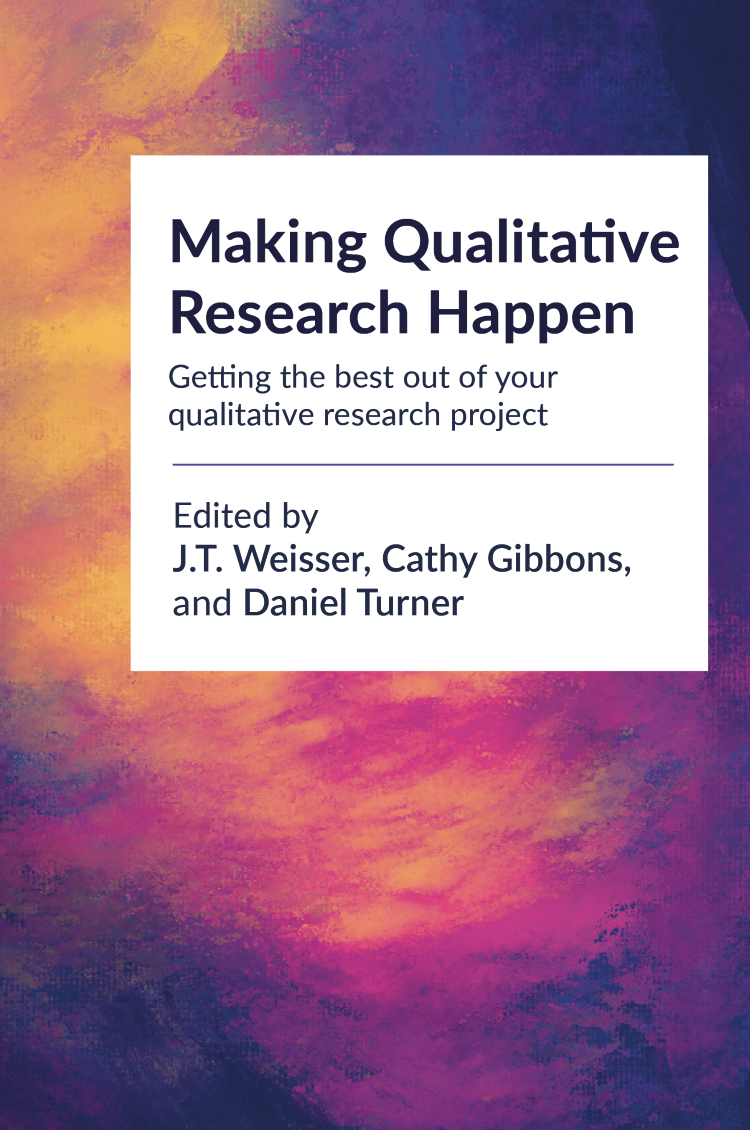
A few weeks ago I received a mysterious parcel. When I opened it, I found a book called Making Qualitative Research Happen: Getting The Best Out Of Your Qualitative Research Project, edited by Jess Weisser, Cathy Gibbons, and Daniel Turner. I know Daniel quite well, and Cathy a little, and I thought it very kind of them to send me a copy of their book. Until I scanned the contents pages, I had completely forgotten that I wrote a couple of its sections myself!
I wrote the sections on creative research methods and on collaboration, data analysis, and ethics. I’m in good company, too, as other contributors include Mónica Sánchez-Hernández on colonialism, coloniality and decolonising approaches in research, and academic extractivism and exploitation; Christina Silver on what’s occurring in the qual-AI space and why it matters; Kimberley Hirsh on when to use a priori coding; and Anuja Cabraal on using emojis for coding and analysis. But Jess, Cathy, and Daniel wrote most of this 373-page book, and that is a laudable achievement. They are all very experienced qualitative researchers, and experienced teachers of other qualitative researchers, and their wealth of experience and knowledge enriches every page.
The book is written in a friendly style and lightly referenced, and so is very readable. It is comprehensive, too, with sections on epistemology and meta issues, designing and planning research, gathering data, managing and handling data, analysing and transforming data, and writing and reporting findings and research. The structure and contents are well signposted, and there is a useful index, so it’s easy to dip in and out of to read the parts you need or which interest you most. And the chapter on qualitative research and AI brings the book bang up to date.
I was interested to read, on the QDAS website, that Christina Silver’s position on the use of generative AI in research is different from Daniel Turner’s. I wasn’t surprised, though, because I know Daniel to be open-minded and interested in viewpoints that are different from his own. I think this is exemplary book editing practice, because books where all contributors share the same views would soon become boring to read. Also, the book is very competitively priced, with the paperback plus eBook at £30 and the eBook alone at only £8.
But perhaps most importantly, this book acknowledges the challenges qualitative researchers may face as well as giving invaluable advice on the process of qualitative research. I wish I had had this book when I started my MSc in social research methods in 1999 – though some of the content would have read like science fiction back then!
Of course Making Qualitative Research Happen doesn’t include every single thing about qualitative research. That would be impossible because there is too much to cover and the field is always developing. However, the back cover describes it as ‘everything you need to get started with qualitative research’ and I think that is no exaggeration. This book is a very clear and useful companion for anyone who is new to, or would like to know more about, qualitative research in practice.


A laudable achievement – no doubt about that. And of great practical use to qualitative researchers both experienced and novice! Well done to the editors and contributors!
LikeLike