
Let’s Talk About Self-Care

This has been such an unkind year that those of us who can practise self-care need to do so more than ever. I say ‘those of us who can’ because practising self-care requires resources in itself – time, at least, and often money too – and so is a manifestation of privilege.

With privilege, I believe, comes responsibility. This is often construed solely as responsibility to care for others. Yet I argue that self-care is also part of that responsibility, particularly for those on whom the responsibility to care for others falls more heavily, such as women, and for those who face daily oppression, such as people of colour and trans people.

Self-care is also part of our responsibility as researchers. Research work can be enormously stressful, and researchers are not often well supported. Research ethics committees rarely consider researcher well-being, an omission I regard as quite unethical. Also, researchers often work alone, gathering and analysing data, which may involve hearing and revisiting distressing stories or phenomena, and is always a mentally taxing business even when it’s not emotionally draining. We are the people who know what we feel and experience, and what we need by way of support and help. It is our responsibility to look after our own wellbeing.

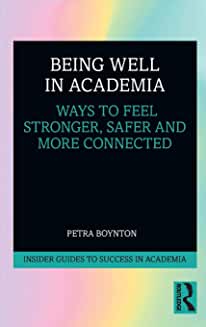
My colleague and friend Dr Petra Boynton has written a really useful book for anyone who is at all uncertain about how or why they might take care of themselves. It is called Being Well in Academia but it has relevance far beyond the ivory towers. The book’s subtitle is Ways To Feel Stronger, Safer And More Connected, and those are topics in which we all have an interest. Petra offers a huge amount of guidance, support, and resources in her concise, readable book, which I recommend highly.

There is a potential problem with emphasizing self-care if it is hijacked by the neoliberal agenda and used to supersede the importance of combating structural inequalities. And there is a potential problem in the opposite direction too, if we pour all our resources into combating structural inequalities and so burn out. For me, self-care and activism need to go hand in hand: if we take good care of ourselves, we will have more energy for working to dismantle structural inequalities. Also, we will be better able to care for others. You have probably heard the saying ‘put your own oxygen mask on before helping others’ – it refers to a drop in aeroplane cabin pressure, and is now used as a metaphor for the importance of self-care.

For much of this year I did not practise what I’m preaching. This has been partly due to circumstance: the first three months of the year were very busy with work including a lot of travelling, then the pandemic put paid to holidays I had planned, and losing my mother to the virus threw everything out of whack. As a result I took my eye off the self-care ball, and so had a big health dip in the autumn. That is now resolved and I’m back to more diligent self-care. So over the next few weeks I will be taking a break from creating content in particular and being on social media in general; I do this every year and it always does me good. I’ll be back the second week in January. This holiday season will be difficult for many people and I would encourage you all to take whatever steps you can to care for yourselves. And remember, here in the northern hemisphere, this time next week the days will be getting longer. The wheel of the year continues to turn, bringing the hope of warmer, sunnier days ahead. I wish you all as happy a holiday as possible, whatever and however you celebrate.

This blog, and the monthly #CRMethodsChat on Twitter, is funded by my beloved patrons. It takes me at least one working day per month to post here each week and run the Twitterchat. At the time of writing I’m receiving funding from Patrons of $68 per month. If you think a day of my time is worth more than $68 – you can help! Ongoing support would be fantastic but you can also make a one-time donation through the PayPal button on this blog if that works better for you. Support from Patrons and donors also enables me to keep this blog ad-free. If you are not able to support me financially, please consider reviewing any of my books you have read – even a single-line review on Amazon or Goodreads is a huge help – or sharing a link to my work on social media. Thank you!
Research and Stories, Part 2

My recent post Research Is All About Stories got a big reaction on the socials. I encouraged people who tweeted me to add their comments to the blog, which several of them did. They made some really useful points that I’m going to amplify in this post. Also on Twitter Hoda Wassif recommended The Science of Storytelling by Will Storr which I am now reading. It’s an excellent book and quite an eye-opener, even to someone who has been interested in stories and storytelling for many years.

In my last post I said that stories are used all around the world, and I stand by that, but I have learned from Storr’s book that there are cultural differences in the types of stories which are told. Stories told in Europe (and therefore, by extension, stories told by European settlers and their descendants in the US and Canada) generally focus on a courageous individual who can create change, and have a clearly defined ending. Stories told in China usually focus on a group or community, involve multiple perspectives, and have an ambiguous ending which the reader can figure out as they please. European readers take pleasure in a story’s resolution; Chinese readers take pleasure in deciding on their preferred solution to narrative puzzles.

Of course it’s not quite that simple. There are elements of ambiguity to the ending of some European stories, and I would suspect there are elements of resolution to the ending of some Chinese stories. And other cultures treat stories differently again. The Indigenous writer Jo-ann Archibald/Q’um Q’um Xiiem, in her book Indigenous Storywork, tells us that in the oral traditions of Indigenous peoples, stories are used for many purposes, such as education, entertainment, healing, ritual, community, and spirituality. A storyteller will select a story for a particular occasion and reason, and will tell it in their own way, as honestly and clearly as they can. The listener is expected to listen fully, engaging their emotions as well as their cognition, and visualising scenes and interactions.

The key point for us, as researchers, is to understand that if we are using stories with participants and/or audiences from a variety of cultures, they may have a different understanding of what constitutes ‘story’ and what stories are for. We need to know about this if we are to do our work effectively.

In response to my last post on stories, Pauline Ridley helpfully questioned my assertion that ‘we all do know, when we read or hear or watch a narrative, whether it tells a truth’. She pointed out that ‘Unfamiliar stories, outside the listener’s experience, may take longer to penetrate before they ring true.’ This chimes with the information I have gathered about the different ways in which stories are told and used within different cultures. I should know better by now than to treat anything as widespread as stories as a single homogenous category, but clearly I have some way to go!

Damian Milton and Olumide Adisa on Twitter, and Hala Ghanem on the blog, all made the important point that we need to consider who is telling a story and whose stories are being told – and heard, and acted upon. Storytellers have power, and for some years researchers thought a good, ethical, use of our power was to use our stories to ‘give voice’ to marginalised people. More recently we have begun to see this as paternalistic and to recognise that others’ voices are not ours to bestow. Marginalised people already have perfectly good voices, which researchers might usefully amplify at times, by helping to ensure those voices are heard by people in power. One reason stories are useful for research is that a story poses and investigates a question. So does a research project, albeit in a different way, but the parallel is clear. Stories are useful for research in a multitude of ways: on funding applications, as data, in reports and presentations, among others. I’m not sure it would be possible to complete a research project without involving a story somewhere, somehow. Anyway, I wouldn’t want to try. My human brain is hardwired to create stories; I would rather recognise and acknowledge this, and work with it rather than against it. Bring on the stories!

This blog, and the monthly #CRMethodsChat on Twitter, is funded by my beloved patrons. It takes me at least one working day per month to post here each week and run the Twitterchat. At the time of writing I’m receiving funding from Patrons of $68 per month. If you think a day of my time is worth more than $68 – you can help! Ongoing support would be fantastic but you can also make a one-time donation through the PayPal button on this blog if that works better for you. Support from Patrons and donors also enables me to keep this blog ad-free. If you are not able to support me financially, please consider reviewing any of my books you have read – even a single-line review on Amazon or Goodreads is a huge help – or sharing a link to my work on social media. Thank you!

Demystifying The Author-Editor Relationship

This week’s blog is a podcast I made with my Policy Press editor, Philippa Grand.

There were a couple of things I thought of afterwards. One is that we should have explained the distinction between a commissioning editor and a copy editor. A copy editor is what most people think of when they talk about an editor: someone who goes through your text, line by line, and makes it better. Policy Press use that kind of an editor too, but Philippa is a commissioning editor. She works with authors to create and develop books and is her authors’ first point of contact throughout the writing process, until the book goes into production.

The second thing that occurred to me was that we didn’t say as much as we’d intended to about the process of creating the rapid response e-books I co-edited with Su-ming Khoo. I have already written about that process on this blog, and there is more about the e-books on the LSE Impact Blog here and here.

And here is the podcast. I hope you enjoy listening. Do let us know what you think, either in the comments below or on Twitter where we’re @DrHelenKara and @BUP_philippa.

This blog, and the monthly #CRMethodsChat on Twitter, is funded by my beloved patrons. It takes me at least one working day per month to post here each week and run the Twitterchat. At the time of writing I’m receiving funding from Patrons of $68 per month. If you think a day of my time is worth more than $68 – you can help! Ongoing support would be fantastic but you can also make a one-time donation through the PayPal button on this blog if that works better for you. Support from Patrons and donors also enables me to keep this blog ad-free. If you are not able to support me financially, please consider reviewing any of my books you have read – even a single-line review on Amazon or Goodreads is a huge help – or sharing a link to my work on social media. Thank you!