
 I have more exciting news! But first: why is this blog like a bus stop? Because you wait ages for posts with exciting news, then two come along in quick succession!
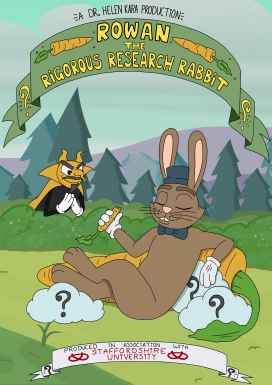
Further to last week’s comics extravaganza, this week I would like to present an animation I wrote, which has been animated by clever and diligent students at Staffordshire University. The idea for this came from Alke Gröppel-Wegener. She and I were chatting over lunch late last year and I told her about the comic I was writing. “Why don’t you write an animation, too?” she asked. “Because I don’t know how to write an animation and I don’t know any animators,” I said, thinking that was a fairly conclusive argument. But Alke brushed away my objections with a flick of her hand, explained there were student animators at the University, and proclaimed her conviction that of course I could write an animation if I tried.
So I went home and asked the internet how to write an animation and whaddaya know, it knew. I was also very lucky to work with Laura Weston, a knowledgeable and gifted tutor who downloaded segments of her brain into mine on demand. And as for the animators – well!
Laura told me I’d be working with third-years. She helped me to put together a brief, mainly by reining me in when I got all enthusiastic about over-complicating things, and then she publicised the brief. To begin with we asked for character sketches and received several submissions. It was so hard to choose between them that I ended up asking two people to work together – and then discovered that (a) Kalina Kolchevska and Kiefer Bray were first-years and (b) they were already good friends and happy to collaborate. They did a great job creating our hero Rowan and his evil nemesis Cavil the Carrot Fly.
Then I went to meet with a group of third-years, had a chat with them about the freelance lifestyle, and explained that I wanted to put a team together to create the animation. I am so pleased that Carolann Dalziel, aka Caz, volunteered to be the producer, because she did an amazing job. I am also very pleased that Aimee Carter volunteered to direct. I would have been happy with whoever wanted to work on the project, but I am honestly delighted to have had two women working with me as the animation industry is so male-dominated. (I’m also delighted that my comic was illustrated by a woman because that industry is too.)
The rest of the team included artistic director and lead animator Janine Perkins, sound technician and background artist Cameron Jones, Aneesa Malik and David Trotter who drew the storyboards, and Kiefer Bray and Ash Michaelson who worked as junior animators. They have all done such a terrific job that the animation looks very professional. I went to the end-of-year degree show at Staffordshire University earlier this month, where the animation was first shown to the public, and it got excellent feedback.
It is of course about research methods: in particular, how to choose a research question. This is something that troubles students year after year, all around the world. Caz and Aimee, Kalina and Kiefer, Aneesa and David, Janice and Cameron and Ash and I all hope that the animation we have made will help students through this knotty problem. Check it out and see what you think. It’s only one minute long.
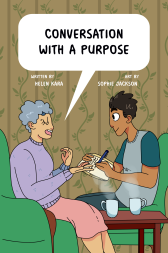 I have exciting news! This has been a long time in the planning and making, and has come to fruition in part thanks to the support of
  Your first set of reviewers’ comments lands in your inbox. Your heart begins to race. Will your work be accepted or rejected? Will they love it or hate it? Can you bear to open the email?
![Research ethics in the real world [FC]](https://helenkara.com/wp-content/uploads/2018/05/research-ethics-in-the-real-world-fc.jpg?w=185&h=278) For the last three-and-a-quarter years I have been writing
For the last three-and-a-quarter years I have been writing  Those outside the UK probably won’t be aware of
  I have written two chapters for edited collections, both on qualitative research ethics. The first was for a book called
  The Clockwork Muse: A Practical Guide to Writing Theses, Dissertations, and Books.
  How To Write A Lot: A Practical Guide to Productive Academic Writing.
  Writing in Social Spaces: A Social Processes Approach to Academic Writing.
  Becoming an Academic Writer: 50 Exercises for Paced, Productive, and Powerful Writing.
  Air & Light & Time & Space: How Successful Academics Write.
 Do you ever think about the indexes of textbooks and reference books? Do you ever wonder how they’re created? Because they don’t appear as if by magic, and as yet no software has been invented that can extract a good quality index from the text of a book. It takes human intellectual effort to figure out how readers will want to use a book, and so which words and phrases and ideas from the text need headings or cross-references in the index.
 This is a post with a difference: it’s written by Tee Ola, Managing Editor of
