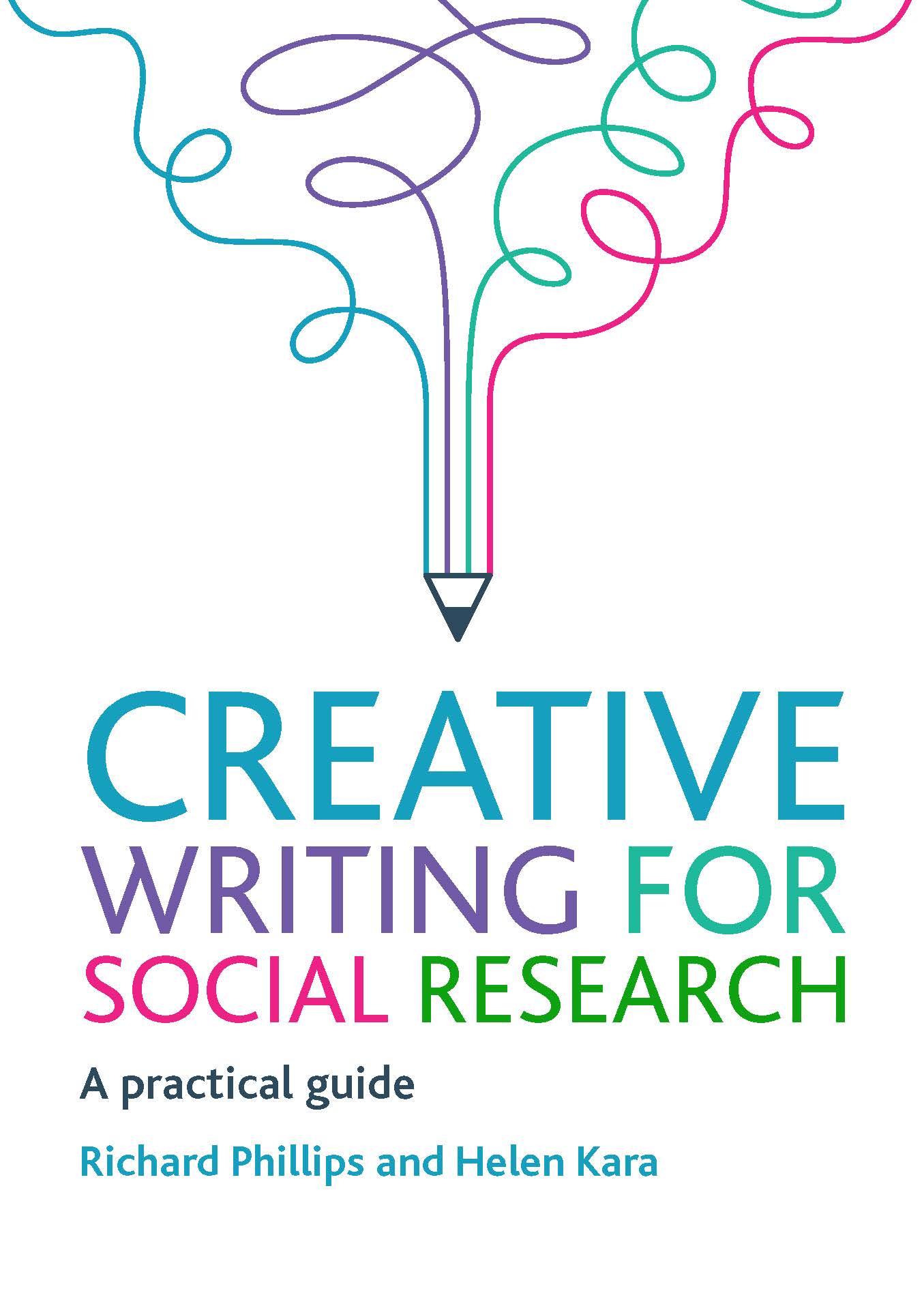
Creative Writing for Social Research

Today is the official launch day for Creative Writing for Social Research, the book Richard Phillips and I have written, with 14 short contributions from other creative scholarly writers. I am so proud of this book! It is not perfect – no book is perfect – but I think it is the book I am most proud to have written. We will be on Twitter for much of the day: you can find all the launch information via #CreativeAcWri.

Every book has out-takes; good sections that, for sensible reasons, don’t make the final cut. To celebrate the launch of this book, I thought I would share one of its out-takes that I drafted, and was – am – fond of, but which just didn’t fit. It is about field notes, and centres on an excerpt from Eating Soup Without A Spoon by Jeffrey Cohen. That is an ethnography I love because, unlike most anthropologists, the author discusses his methods.

Here is the out-take:

“Ethnographers, who might spend years living with the people they are studying, were the first social researchers to use their own field notes as data. In the early 1990s, the American anthropologist Jeffrey Cohen and his wife Maria spent a year living in the rural village of Santa Ana del Valle in Oaxaca district in Mexico. Cohen writes eloquently about the complexity hidden by the glib term ‘field notes’ (2015:39-40):

Each night found me sitting at my desk writing notes; in fact, most nights found me writing at least two and sometimes three different kinds of notes.

The first notes, to which Maria contributed as well, were daily diary-like entries recording observations and exploring our experiences as we were introduced to village life. We wrote about shopping, about social life and the gendered divisions that defined what men and women were doing in their lives and around their homes, managing kitchens and the challenge of keeping a house clean.

I also described our home and the houses we visited, noting the physical trappings of life such as the layout of compounds, what people owned, and what luxuries were present.

A second set of notes was anthropological. Although they also explored our experiences in and around the village and market, they were organized around critical themes in anthropological theory… I would use these notes to think about economic change… family cooperation and reciprocity… the efforts to… not simply survive but thrive in the changing world… in my notes I could explore how [these efforts] worked, how they failed, and how they matched up to my expectations and training.

The third set of notes was much more personal and reflected my sense of self and my own experiences. On occasion I wrote letters to long-dead ancestors in anthropology. Looking back on that odd process, I can see it was one way I was able to deal with the ghosts of anthropology’s past that haunted me.

This is a lovely depiction of writing in practice as a method of turning experiences into data. It is also a clear illustration of writing as friend, teacher, and therapist. In the first set of notes we can see writing as a friend to whom Cohen recounted daily events, in the second a teacher showing Cohen how to think about his work and link theory to practice, and in the third a therapist who helped Cohen manage his feelings of being haunted by anthropological ghosts.

This kind of creative ethnographic writing can generate lots of rich data. The downside is the huge amount of work resulting at the analytic stage. For some people, this is so overwhelming that they never complete their research (Cohen 2015:150). Even for those who do find a way through the analytic morass, it will be ‘hard, exhausting work’ that is incredibly time-consuming (Cohen 2015:149). Though again, here, there are creative writing techniques which can help, and we’ll be highlighting some of those later in this section. However, unless you are doing this kind of ethnographic work, we would advise you to limit the amount of data you generate. Working with creative writing can be fun and interesting and so it’s tempting to keep on going. But as we’ve seen, this can present considerable difficulties for analysis, so we recommend resisting any such temptation.”

That should have given you a flavour of the book Richard and I have written. I use the conceptions of writing as ‘friend, teacher, and therapist’ in teaching creative and productive thesis writing to doctoral students. I tell them writing is a teacher; we learn as we write, often surprising ourselves. Writing can be a therapist: obviously an actual therapist is, generally speaking, more use, but if you have a distressing or complicated experience during research, writing about it can be cathartic and help you process your feelings. And writing is always there for you; sometimes annoying and disappointing, but reliable and reasonably predictable, like a good friend.

This blog, and the monthly #CRMethodsChat on Twitter, is funded by my beloved patrons. It takes me at least one working day per month to post here each week and run the Twitterchat. At the time of writing I’m receiving funding from Patrons of $75 per month. If you think a day of my time is worth more than $75 – you can help! Ongoing support would be fantastic but you can also make a one-time donation through the PayPal button on this blog if that works better for you. Support from Patrons and donors also enables me to keep this blog ad-free. If you are not able to support me financially, please consider reviewing any of my books you have read – even a single-line review on Amazon or Goodreads is a huge help – or sharing a link to my work on social media. Thank you!

Why Secondary Data Should Come First

The argument put forward in this post has been brewing in my mind – and being put into practice in my research work – since some time before COVID19 appeared in our midst. The pandemic has accentuated the point I want to make.

Essentially, my argument is this: researchers should make as much use of secondary data as possible before we even think about gathering any primary data.

Most novice researchers are taught that new research requires primary data; that original research requires data gathered for the purpose by the researcher or the research team. Most research ethics committees focus most of their efforts on protecting participants. We need to change this. I believe we should be teaching novice researchers that new/original research requires existing data to be used in new ways, and primary data should be gathered only if absolutely necessary. I would like to see research ethics committees not only asking what researchers are doing to ensure the safety and wellbeing of participants, but also requiring a statement of the work that has been done using secondary data to try to answer the research question(s), and a clear rationale for the need to go and bother people for more information.

I believe working in this way would benefit researchers, participants, and research itself. For researchers, gathering primary data can be lots of fun and is also fraught with difficulty. Carefully planned recruitment methods may not work; response rates can be low; interviewees often say what they want to say rather than answering researchers’ questions directly. For participants, research fatigue is real. Research itself would receive more respect if we made better and fuller use of data, and shouted about that, rather than gathering data we never use (or worse, reclassifying stolen sacred artefacts and human remains as ‘data’ and refusing to return them to their communities of origin because of their ‘scientific importance’ – but that’s another story).

Some people think of secondary data as quantitative: government statistics, health prevalence data, census findings, and so on. But there is lots of qualitative secondary data too, such as historical data, archival data, and web pages current and past. Mainstream and social media provide huge quantities of secondary data (though with social media there are a number of important ethical considerations which are beyond the scope of this post).

Of course secondary data isn’t a panacea. There is so much data available these days that it can be hard to find what you need, particularly as it will have been gathered by people with different priorities from yours. Also, it’s frustrating when you find what you need but you can’t access it because it’s behind a paywall or it has an obstructive gatekeeper. Comparison can be difficult when different researchers, organisations, and countries gather similar information in different ways. It can be hard to understand, or detect any mistakes in, data you didn’t gather yourself, particularly if it is in large, complicated datasets. Information about how or why data was gathered or analysed is not always available, which can leave you unsure of the quality of that data.

On the plus side, the internet allows quick, easy, free access to innumerable quantitative and qualitative datasets, containing humongous amounts of data. Much of this has been collected and presented by professional research teams with considerable expertise. There is scope for historical, longitudinal, and cross-cultural perspectives, way beyond anything you could possibly achieve through primary data gathering. Working with secondary data can save researchers a great deal of time at the data gathering stage, which means more time available for analysis and reporting. And, ethically, using secondary data reduces the burden on potential participants, and re-use of data honours the contribution of previous participants.

There are lots of resources available on using quantitative secondary data. I’m also happy to report that there is now an excellent resource on using qualitative secondary data: Qualitative Secondary Analysis, a recent collection of really good chapters by forward-thinking researchers edited by Kahryn Hughes and Anna Tarrant. The book includes some innovative methods, interesting theoretical approaches, and lots of guidance on the ethics of working with secondary data.

Some people think that working with secondary data has no ethical implications. This is so wrong it couldn’t be wronger. For a start, it is essential to ensure that informed consent for re-use has been obtained. If it hasn’t, either obtain such consent or don’t use the data. Then there are debates about how ethical it is to do research using secondary data about groups of people, or communities, without the involvement of representatives from those groups or communities. Also, working with secondary data can be stressful and upsetting for researchers – imagine if you were working with historical data about the Holocaust, or (as Kylie Smith does) archival data about racism in psychiatric practice in mid-20th century America. Reading about distressing topics day after day can be harmful to our emotional and mental health, and so to our physical health as well.

These are just a few of the ethical issues we need to consider in working with secondary data. Again, it is beyond the scope of this post to cover them all. So working with secondary data isn’t an easy option; although it is different from working with primary data, it can be just as complex. I believe novice researchers should learn how to find and use secondary data, in ethical ways, before they learn anything about primary data gathering and analysis.

This blog, and the monthly #CRMethodsChat on Twitter, is funded by my beloved Patrons. It takes me at least one working day per month to post here each week and run the Twitterchat. At the time of writing I’m receiving funding from Patrons of $70 per month. If you think a day of my time is worth more than $70 – you can help! Ongoing support would be fantastic but you can also make a one-time donation through the PayPal button on this blog if that works better for you. Support from Patrons and donors also enables me to keep this blog ad-free. If you are not able to support me financially, please consider reviewing any of my books you have read – even a single-line review on Amazon or Goodreads is a huge help – or sharing a link to my work on social media. Thank you!
The Personal Is Empirical

Human beings are natural researchers: exploring, seeking and comparing data, testing, evaluating, drawing conclusions. We do this all our lives. One of our first research methods, when we are only a few months old, is to put everything in our mouths. By the time we are a few years old we are asking incessant questions. We are programmed to investigate. As we get older, our methods get more sophisticated – and if we train as a professional researcher, they become more systematic, too.

Do you know the roots of the word ‘empirical’? It is derived from the Greek word ‘empeirikos’, meaning ‘experienced’. It means something verifiable by experiment or experience. So, the personal is empirical.

Autoethnographers know this already. For a generation now autoethnographers have been ‘utilizing personal stories for scholarly purposes’ (Chang 2008:10). Some have put too much emphasis on the personal stories and not enough on the scholarly purposes, leading to accusations of self-indulgence, navel-gazing, and irrelevance. More, though, have worked to link their personal experience with other data and wider narratives, theory, evidence, policy, and practice, in a systematic and rigorous way.

Embodied researchers also know that the personal is empirical. They focus on the physical, sensory dimensions of experience, as part of the data they collect. This subverts the conventional view of scholarly work as entirely cerebral – or, as the embodied researchers would have it, ‘disembodied research’. Embodied research is also open to accusations of self-interest and irrelevance. Yet embodied researchers point out that no research can in fact be disembodied. Even sitting still and thinking is a physical activity; the brain with which you think forms part of your body.

Other researchers draw on the personal in other ways. In my work on creative research methods, I have been astonished by the number of people who combine their artistic skills, or their writing talents, or their aptitude for making, or their technological savvy, or some other personal attribute with their research. This usually results in enrichment and often innovation, yet even now working in these ways can feel like swimming against the tide. The way we try to contain knowledge in silos, and reify specialisation, is not the norm in human history. It is not long since nobody thought it strange for someone to be both weaver and astronomer, doctor and poet, musician and engineer. Why have we forgotten that ‘the more diverse someone’s knowledge, the more likely they are to be able to identify and implement creative solutions to problems’? (Kara 2020:11).

Musing on all of this, I came up with the phrase ‘the personal is empirical’. I tried it out on a group of students last month and it went down well. Then, like a good scholar, I checked to see whether anyone else had used the phrase already. It was used by one US academic, most recently around 15 years ago. She was a feminist too and I guess for her, as for me, the generation of this phrase was influenced by the old feminist mantra that ‘the personal is political’. Nobody owned that phrase, and nobody owns this one either – you’re free to use it if you wish.

In fact, it would be great if you did. Because we need more people to understand that ‘knowledge is worth having, no matter where it originates’ (Kara 2020:11) – whether that is in the body, or someone’s wider life experience, or in a test tube, or an encounter with a book, or a conversation, or an animated film. As a species, as inhabitants of planet Earth, we have a plethora of problems to solve. We cannot afford to reject knowledge, or create hierarchies of knowledge; we need to value everyone’s expertise. And their experience. And experiments, and evidence, and theories – the whole lot. In fact, it is all empirical, but nobody will argue if you talk about empirical experiments or empirical evidence. The personal is empirical? That’s more provocative. So take this toy I have given you, my dear ones; take it and play!

This blog, and the monthly #CRMethodsChat on Twitter, is funded by my beloved patrons. It takes me at least one working day per month to post here each week and run the Twitterchat. At the time of writing I’m receiving funding from Patrons of $70 per month. If you think a day of my time is worth more than $70 – you can help! Ongoing support would be fantastic but you can also make a one-time donation through the PayPal button on this blog if that works better for you. Support from Patrons and donors also enables me to keep this blog ad-free. If you are not able to support me financially, please consider reviewing any of my books you have read – even a single-line review on Amazon or Goodreads is a huge help – or sharing a link to my work on social media. Thank you!
Let’s Talk About Self-Care

This has been such an unkind year that those of us who can practise self-care need to do so more than ever. I say ‘those of us who can’ because practising self-care requires resources in itself – time, at least, and often money too – and so is a manifestation of privilege.

With privilege, I believe, comes responsibility. This is often construed solely as responsibility to care for others. Yet I argue that self-care is also part of that responsibility, particularly for those on whom the responsibility to care for others falls more heavily, such as women, and for those who face daily oppression, such as people of colour and trans people.

Self-care is also part of our responsibility as researchers. Research work can be enormously stressful, and researchers are not often well supported. Research ethics committees rarely consider researcher well-being, an omission I regard as quite unethical. Also, researchers often work alone, gathering and analysing data, which may involve hearing and revisiting distressing stories or phenomena, and is always a mentally taxing business even when it’s not emotionally draining. We are the people who know what we feel and experience, and what we need by way of support and help. It is our responsibility to look after our own wellbeing.

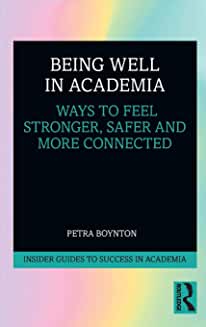
My colleague and friend Dr Petra Boynton has written a really useful book for anyone who is at all uncertain about how or why they might take care of themselves. It is called Being Well in Academia but it has relevance far beyond the ivory towers. The book’s subtitle is Ways To Feel Stronger, Safer And More Connected, and those are topics in which we all have an interest. Petra offers a huge amount of guidance, support, and resources in her concise, readable book, which I recommend highly.

There is a potential problem with emphasizing self-care if it is hijacked by the neoliberal agenda and used to supersede the importance of combating structural inequalities. And there is a potential problem in the opposite direction too, if we pour all our resources into combating structural inequalities and so burn out. For me, self-care and activism need to go hand in hand: if we take good care of ourselves, we will have more energy for working to dismantle structural inequalities. Also, we will be better able to care for others. You have probably heard the saying ‘put your own oxygen mask on before helping others’ – it refers to a drop in aeroplane cabin pressure, and is now used as a metaphor for the importance of self-care.

For much of this year I did not practise what I’m preaching. This has been partly due to circumstance: the first three months of the year were very busy with work including a lot of travelling, then the pandemic put paid to holidays I had planned, and losing my mother to the virus threw everything out of whack. As a result I took my eye off the self-care ball, and so had a big health dip in the autumn. That is now resolved and I’m back to more diligent self-care. So over the next few weeks I will be taking a break from creating content in particular and being on social media in general; I do this every year and it always does me good. I’ll be back the second week in January. This holiday season will be difficult for many people and I would encourage you all to take whatever steps you can to care for yourselves. And remember, here in the northern hemisphere, this time next week the days will be getting longer. The wheel of the year continues to turn, bringing the hope of warmer, sunnier days ahead. I wish you all as happy a holiday as possible, whatever and however you celebrate.

This blog, and the monthly #CRMethodsChat on Twitter, is funded by my beloved patrons. It takes me at least one working day per month to post here each week and run the Twitterchat. At the time of writing I’m receiving funding from Patrons of $68 per month. If you think a day of my time is worth more than $68 – you can help! Ongoing support would be fantastic but you can also make a one-time donation through the PayPal button on this blog if that works better for you. Support from Patrons and donors also enables me to keep this blog ad-free. If you are not able to support me financially, please consider reviewing any of my books you have read – even a single-line review on Amazon or Goodreads is a huge help – or sharing a link to my work on social media. Thank you!

Research and Stories, Part 2

My recent post Research Is All About Stories got a big reaction on the socials. I encouraged people who tweeted me to add their comments to the blog, which several of them did. They made some really useful points that I’m going to amplify in this post. Also on Twitter Hoda Wassif recommended The Science of Storytelling by Will Storr which I am now reading. It’s an excellent book and quite an eye-opener, even to someone who has been interested in stories and storytelling for many years.

In my last post I said that stories are used all around the world, and I stand by that, but I have learned from Storr’s book that there are cultural differences in the types of stories which are told. Stories told in Europe (and therefore, by extension, stories told by European settlers and their descendants in the US and Canada) generally focus on a courageous individual who can create change, and have a clearly defined ending. Stories told in China usually focus on a group or community, involve multiple perspectives, and have an ambiguous ending which the reader can figure out as they please. European readers take pleasure in a story’s resolution; Chinese readers take pleasure in deciding on their preferred solution to narrative puzzles.

Of course it’s not quite that simple. There are elements of ambiguity to the ending of some European stories, and I would suspect there are elements of resolution to the ending of some Chinese stories. And other cultures treat stories differently again. The Indigenous writer Jo-ann Archibald/Q’um Q’um Xiiem, in her book Indigenous Storywork, tells us that in the oral traditions of Indigenous peoples, stories are used for many purposes, such as education, entertainment, healing, ritual, community, and spirituality. A storyteller will select a story for a particular occasion and reason, and will tell it in their own way, as honestly and clearly as they can. The listener is expected to listen fully, engaging their emotions as well as their cognition, and visualising scenes and interactions.

The key point for us, as researchers, is to understand that if we are using stories with participants and/or audiences from a variety of cultures, they may have a different understanding of what constitutes ‘story’ and what stories are for. We need to know about this if we are to do our work effectively.

In response to my last post on stories, Pauline Ridley helpfully questioned my assertion that ‘we all do know, when we read or hear or watch a narrative, whether it tells a truth’. She pointed out that ‘Unfamiliar stories, outside the listener’s experience, may take longer to penetrate before they ring true.’ This chimes with the information I have gathered about the different ways in which stories are told and used within different cultures. I should know better by now than to treat anything as widespread as stories as a single homogenous category, but clearly I have some way to go!

Damian Milton and Olumide Adisa on Twitter, and Hala Ghanem on the blog, all made the important point that we need to consider who is telling a story and whose stories are being told – and heard, and acted upon. Storytellers have power, and for some years researchers thought a good, ethical, use of our power was to use our stories to ‘give voice’ to marginalised people. More recently we have begun to see this as paternalistic and to recognise that others’ voices are not ours to bestow. Marginalised people already have perfectly good voices, which researchers might usefully amplify at times, by helping to ensure those voices are heard by people in power. One reason stories are useful for research is that a story poses and investigates a question. So does a research project, albeit in a different way, but the parallel is clear. Stories are useful for research in a multitude of ways: on funding applications, as data, in reports and presentations, among others. I’m not sure it would be possible to complete a research project without involving a story somewhere, somehow. Anyway, I wouldn’t want to try. My human brain is hardwired to create stories; I would rather recognise and acknowledge this, and work with it rather than against it. Bring on the stories!

This blog, and the monthly #CRMethodsChat on Twitter, is funded by my beloved patrons. It takes me at least one working day per month to post here each week and run the Twitterchat. At the time of writing I’m receiving funding from Patrons of $68 per month. If you think a day of my time is worth more than $68 – you can help! Ongoing support would be fantastic but you can also make a one-time donation through the PayPal button on this blog if that works better for you. Support from Patrons and donors also enables me to keep this blog ad-free. If you are not able to support me financially, please consider reviewing any of my books you have read – even a single-line review on Amazon or Goodreads is a huge help – or sharing a link to my work on social media. Thank you!

Demystifying The Author-Editor Relationship

This week’s blog is a podcast I made with my Policy Press editor, Philippa Grand.

There were a couple of things I thought of afterwards. One is that we should have explained the distinction between a commissioning editor and a copy editor. A copy editor is what most people think of when they talk about an editor: someone who goes through your text, line by line, and makes it better. Policy Press use that kind of an editor too, but Philippa is a commissioning editor. She works with authors to create and develop books and is her authors’ first point of contact throughout the writing process, until the book goes into production.

The second thing that occurred to me was that we didn’t say as much as we’d intended to about the process of creating the rapid response e-books I co-edited with Su-ming Khoo. I have already written about that process on this blog, and there is more about the e-books on the LSE Impact Blog here and here.

And here is the podcast. I hope you enjoy listening. Do let us know what you think, either in the comments below or on Twitter where we’re @DrHelenKara and @BUP_philippa.

This blog, and the monthly #CRMethodsChat on Twitter, is funded by my beloved patrons. It takes me at least one working day per month to post here each week and run the Twitterchat. At the time of writing I’m receiving funding from Patrons of $68 per month. If you think a day of my time is worth more than $68 – you can help! Ongoing support would be fantastic but you can also make a one-time donation through the PayPal button on this blog if that works better for you. Support from Patrons and donors also enables me to keep this blog ad-free. If you are not able to support me financially, please consider reviewing any of my books you have read – even a single-line review on Amazon or Goodreads is a huge help – or sharing a link to my work on social media. Thank you!

Research Is All About Stories

My assertion that research is all about stories is probably less divisive and controversial now than it was 15 years ago when I was finishing my PhD. Still, I’m sure there are plenty of researchers who would disagree. Let me put my case and see whether I can convince some of them to come over to the fun side.

Stories are a key part of how human beings interact. To the best of my knowledge, there is no human community or culture in the world which does not use stories to communicate. We also use stories for entertainment – skilled oral storytellers and story singers have been popular entertainers since time immemorial, and the huge popularity of more recent media such as books and films speaks for itself.

I have argued earlier on this blog that stories are also valuable for learning. Communication and learning are central to research, and there is a role for entertainment, too. So we can see that stories might be a good fit. But, Helen, you might be saying at this point, shouldn’t research be about facts and the truth? Well now, let’s think a little about truth. In the English oral storytelling tradition, a teller will sometimes close a story with a short rhyme:

The dreamer awakes, the shadow goes by,

I told you a tale, my tale is a lie.

But heed to me closely, fair maiden, proud youth,

My tale is a lie – what it tells is the truth.

In a journal article I wrote with Lucy Pickering on the ethics of presentation, we said something very similar in a more academic way. Drawing on the work of Bakan and others, we distinguished between ‘literal’ truth and ‘real’, or authentic, truth. The former deals with facts, the latter deals more with feelings; what ‘rings true’, to use a metaphor whose source seems lost to history. Blacksmiths? Musicians? Campanologists? Who knows?. But we all do all know, when we read or hear or watch a narrative, whether it tells a truth.

Lucy Pickering and I argued that research needs an appropriate balance of literal and authentic truth. That balance will shift between topics and disciplines, but there always needs to be some of each. Even in the most quantitative research, a story is still necessary; the researcher can’t simply present pages and pages of tables, calculations, graphs and charts without a written narrative directing the reader to the salient points – how this calculation was chosen, why that outlier is important, the implications of the significance level for practice and policy.

Scholars of story Louise Phillips and Tracey Bunda, in their excellent book Research Through, With And As Storying, suggest that stories can be experienced as theories. I agree with this, and would extend it to suggest that theories can be experienced as stories. In fact I could go further and say that theories used and/or developed by researchers, whether formal or informal, are stories: stories about how the world can be shaped and about how we see the world.

In Unflattening, Nick Sousanis describes stories as ‘that most human of activities, the framing of experience to give it meaning’ (p 95). Which is exactly what researchers do, especially if they are using qualitative techniques.

Asking ourselves the question, “What’s the story here?” can be helpful at many points in research work. We should have a clear story to tell of why we are doing our research, and another to explain what the research is about. When we come to report on our research, whatever the medium – written, presented remotely, presented in person, video, animation, multi-media, whatever – we should be using stories. Stories are engaging, informative, and memorable. Surely that’s exactly what we want our research to be.

This blog, and the monthly #CRMethodsChat on Twitter, is funded by my beloved patrons. It takes me at least one working day per month to post here each week and run the Twitterchat. At the time of writing I’m receiving funding from Patrons of $67 per month. If you think a day of my time is worth more than $67 – you can help! Ongoing support would be fantastic but you can also make a one-time donation through the PayPal button on this blog if that works better for you. Support from Patrons and donors also enables me to keep this blog ad-free. If you are not able to support me financially, please consider reviewing any of my books you have read – even a single-line review on Amazon or Goodreads is a huge help – or sharing a link to my work on social media. Thank you!

Why Academics Should Publish Journal Articles With University Presses

Last month I wrote about why academics should publish books with university presses. This is a follow-up post explaining why I think academics should also publish journal articles with university presses. Much of the information in this post is taken from the Paywall documentary which I recommend watching if you are interested.

As a whole, academic publishing is quite phenomenally profitable, making a profit margin of 35-40% which compares with 12% for Toyota and 3% for Walmart. Academic publishing profits are in line with those of the biggest social media companies such as Facebook. What do they have in common, you may ask? People provide content and services for them for free, which they then sell on to advertisers and data purchasers (in the case of Facebook) or academic libraries.

Some single academic journals charge thousands of pounds for a university library subscription, and increase their costs by big percentages each year. These costs have been increasing above inflation for decades, and have contributed to the closure of some American universities. Even the library budgets of wealthy prestigious universities such as the University of California in San Francisco are struggling to make ends meet (and that was pre-pandemic; I understand that more libraries are cancelling more subscriptions now). The publishers of these journals also make it impossible to read their content without access through a subscribing university library, thereby creating the scarcity essential for a commodity to become expensive. And they do these things essentially because they can. The sought-after high impact journals are effectively mini-monopolies. Academics provide and review content for free – and these days may even pay to have their freely provided content, based on publicly funded research, made openly accessible. And this puts yet more money in the publishers’ pockets, because there is no corresponding reduction in subscription charges.

Some universities spend millions of pounds each year on journal subscriptions. This causes higher tuition fees for students, leading to personal sacrifice, debt, and misery, exacerbating social problems of poverty and mental ill-health. It also prevents access to the latest medical information for some doctors and other health workers, and for patients and their carers. This causes more sickness and grief.

Academia is culpable here too because of the emphasis on publishing in high impact journals as part of the research assessment process. This approach to publishing is subject to gaming, nepotism, and fraud, plus it maintains structural inequalities by being more accessible to insiders and professors than to outsiders and early career researchers. Also it wastes people’s time, as high-impact journals are more likely to reject publishable work which then has to be resubmitted elsewhere. The innovative online open access journal PLOS ONE was set up in 2006 to stop the cycle of wasting authors’, editors’ and reviewers’ time at the expense of research and society. We know, now, that open access journal articles get more views and more citations. Surely that constitutes higher impact?

Some influential people think so. In 2013 the San Francisco Declaration on Research Assessment (DORA) was published. This aims to stop using the “impact factor” as a measure of research quality. At the time of writing, DORA has been signed by over 16,500 individuals, and over 2,000 organisations. These include publishers of all kinds, libraries, learned societies and universities. In 2019 the Netherlands launched a new national system of recognition and reward for researchers based on the DORA principles.

So far, so good. But most journal publishers still charge their authors for open access publication, often a four-figure sum per article, which is a barrier for authors with no access to a budget for such payments. Imagine if the profit made by academic journals was not diverted into shareholders’ dividends but put back into the system, to make study more affordable, support research that could not otherwise be funded, help marginalised writers to publish their work, equalise access to that work. You may say I’m a fantasist. I say look at university presses.

Publishers are vital and in my view some are more vital than others, primarily those that help to democratise information and promote equality of access. This is important because, as you may have noticed, there are big global problems we need to solve. Expertise can exist anywhere in the world. The best minds need access to knowledge – and those minds are not all in academia. Collaboration is essential to solve such problems, including other thinkers and scholars as well as academics. University presses promote these kinds of working practices. And any surplus they make is reinvested into their work rather than disappearing into the pockets of shareholders.

Again, UCL Press is doing well here: all but one of their journals are free to publish in, and the one that isn’t free has a low publication charge. Other university presses offer free publication for some marginalised authors, such as those from countries in the “low human development” category of the UN at Bristol University Press. Cambridge University Press has ‘Read and Publish’ agreements which allow for some articles to be published at no cost to the author, though this is a rather more complex system. Some for-profit publishers also offer waivers for certain groups, such as Elsevier – and so they should – but at present they are in the minority. However, if you have no budget but have written an article which is a good fit for a particular open access or hybrid journal, it is always worth asking the editor whether they can waive the APC; they might say yes. And in general, if you can, please consider publishing your articles in university press journals, because overall they are rather more ethical than other types of publisher.

This blog, and the monthly #CRMethodsChat on Twitter, is funded by my beloved patrons. It takes me at least one working day per month to post here each week and run the Twitterchat. At the time of writing I’m receiving funding from Patrons of $67 per month. If you think a day of my time is worth more than $67 – you can help! Ongoing support would be fantastic but you can also make a one-time donation through the PayPal button on this blog if that works better for you. Support from Patrons and donors also enables me to keep this blog ad-free. If you are not able to support me financially, please consider reviewing any of my books you have read – even a single-line review on Amazon or Goodreads is a huge help – or sharing a link to my work on social media. Thank you!

Researching In The Age Of COVID-19

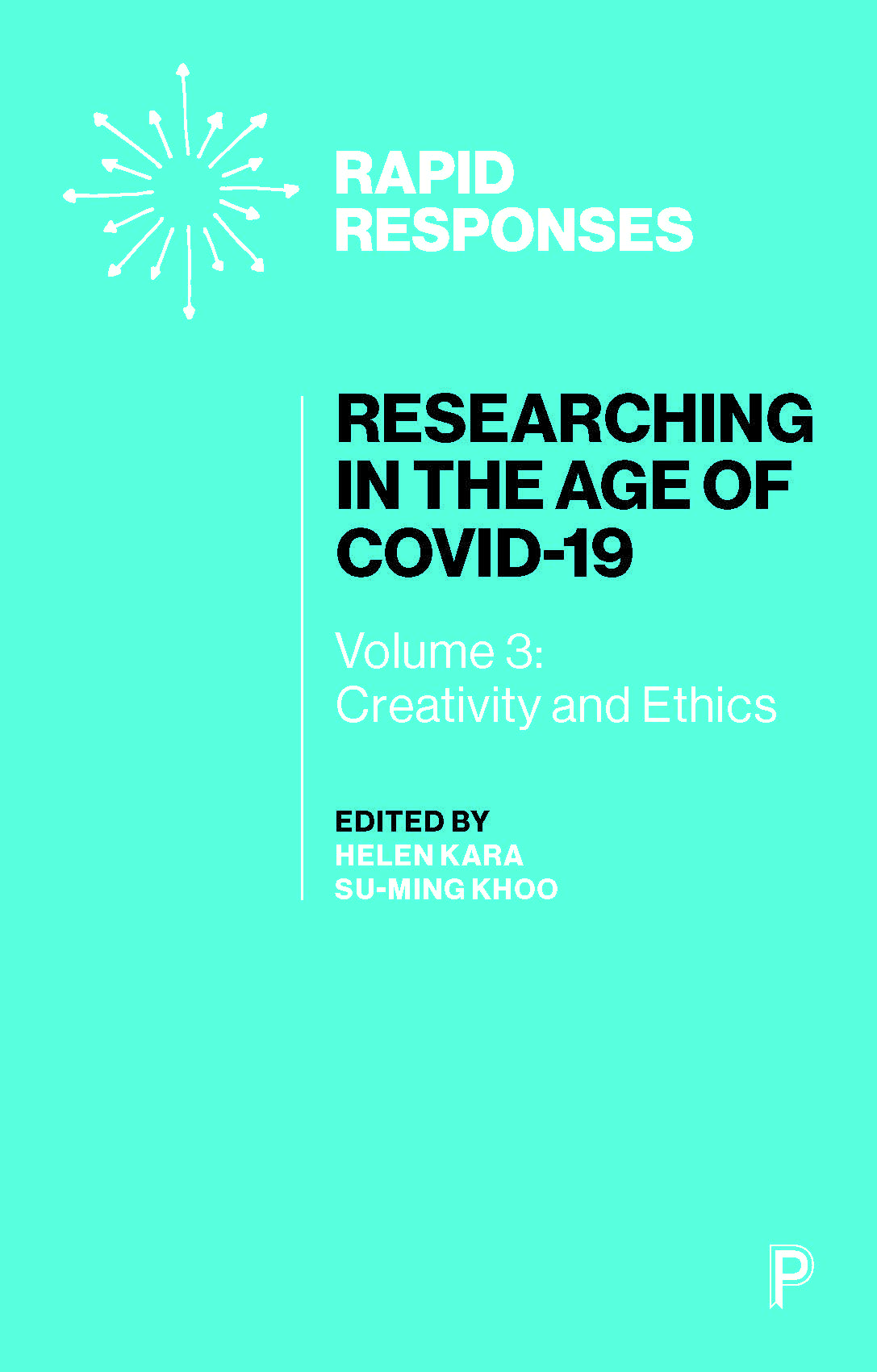
October was so full of events and deadlines that I’m only just catching up with myself. One event was the publication of the three rapid e-books I have co-edited, with Su-ming Khoo from the National University of Ireland, for Policy Press. Moving from putting out a call for chapters to publication in five months flat was an astonishing experience. Su-ming and I had not worked together before, in fact we’d only met twice, but fortunately we found that we work together well and enjoy collaborating. We wrote about our learning from co-editing for the Research Whisperer. And our contributors, my goodness, they were wonderful. Communicative, timely, responsive collaborators, with no rampant egos, providing excellent material. The staff at Policy Press also worked flat out – I think everyone involved with the production of these e-books worked out-of-hours and during holidays, because we all had a shared aim: to create resources to help researchers working under difficult pandemic conditions. And here they are!

Volume 1 is subtitled Response and Reassessment, Volume 2 is Care and Resilience, and Volume 3 is Creativity and Ethics. Each volume has 11 chapters, and our authors are based all over the world: Australia, Brazil, Colombia, England, Fiji and Tonga, Germany, Ghana, Hong Kong, India, Jordan, Lebanon, New Zealand, Nigeria, Palestine, Portugal, Scotland, South Africa and the US, with participants and collaborators in many more countries from Finland to Indonesia to Zimbabwe. Su-ming and I wrote about some of our learning from the e-books themselves, about how the pandemic has transformed research methods and research ethics, for the LSE Impact blog.

I’m also delighted that Policy Press has made these e-books so affordable, at least by Western standards. They are £6.99 each or equivalent – and, at the time of writing, are on offer at £5.59 each; a 20% discount. The pricing, too, is part of our shared aim to help as many researchers as possible. Please spread the word.

This blog, and the monthly #CRMethodsChat on Twitter, is funded by my beloved patrons. It takes me at least one working day per month to post here each week and run the Twitterchat. At the time of writing I’m receiving funding from Patrons of $67 per month. If you think a day of my time is worth more than $67 – you can help! Ongoing support would be fantastic but you can also make a one-time donation through the PayPal button on this blog if that works better for you. Support from Patrons and donors also enables me to keep this blog ad-free. If you are not able to support me financially, please consider reviewing any of my books you have read – even a single-line review on Amazon or Goodreads is a huge help – or sharing a link to my work on social media. Thank you!
Twelve top tips for co-editing a book series

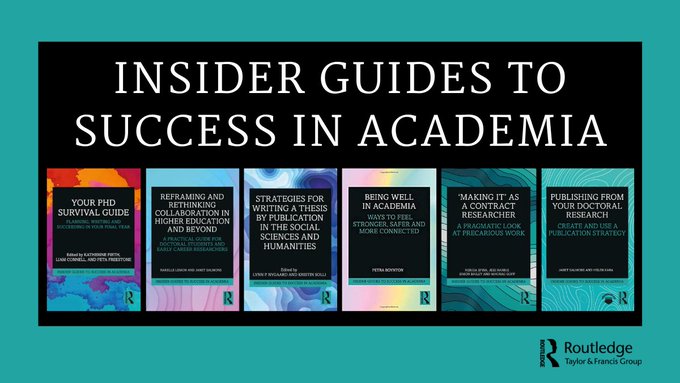
This post is co-written and simultaneously published with Pat Thomson, to coincide with the launch of the Insider Guides to Success in Academia book series.

Helen: It’s interesting to reflect on how we do this co-editing thing. We’ve been working together on this series since May 2017, so that’s three-and-a-half years. You and I hadn’t worked together before, though we’d talked a lot on Twitter, a bit by email, and got into a comfy habit of meeting for lunch now and again at a nice pub midway between our 
offices. Ahhh, those were the days… anyway, now it’s mostly email with the occasional online meeting. Those are the nuts and bolts, but there’s a lot more to co-editing a series than that. I think it helps that we share quite a similar outlook on life. Was that why you asked me to 
co-edit with you?

Pat: I’m always prepared to take an educated punt on who might be fun to collaborate with. I saw that you were talking with doctoral and early academic career people on social media, as I was, but you had a very different background. You were an independent researcher, as opposed to me, a full time academic. However, we shared an interest in methodologies and methods. But we also knew about some different things too. As I remember it, we hadn’t actually even met face to face, but “knew” each other online. I think that you can actually get to know people through social media, just as you used to be able to through the medium of writing letters. Over time, as you see how people are on social media you get an impression of how they are and how they might be to work with. So asking you if you’d be interested in working on a series was in part about our shared interests and complementary differences, but also about the hunch that you would be good to work with. But why did you say yes?

Helen: I was a little bit flattered by you asking, and I too thought you could be fun to collaborate with. But mostly I agreed with you about the gap in the market for short books on topics around academia that didn’t merit a full-length book and so weren’t adequately covered in the literature. It was so interesting to think about! I’ve just checked my records and when we met in April 2018, the first book in the series was being written and we had 21 other ideas of titles and/or authors to follow up. Some have come to fruition now, such as Narelle Lemon’s and Janet Salmons’ book on collaboration, and Petra Boynton’s book on being well in academia. That’s lovely to see. Some didn’t even get off the starting blocks, and we have others in the series that we didn’t consider in that meeting, such as Your PhD Survival Guide which offers doctoral students help for their final year. Many of our authors come from our networks, so clearly networking and thinking are two of the key skills for co-editing a book series. You have more experience of this than me; what would you say are the others?

Pat: Well there’s choosing a publisher. I’d had a very initial discussion with Sarah, an editor at Routledge who I had worked a lot with before. I’d floated the idea of a series for doctoral and early career researchers that were shorter than usual, covered niche topics were affordable. She was very enthusiastic about the idea and encouraged me to pursue it. She also sent me a few small books that I could look at. At our first meeting, we discussed the style and tone of the books. We agreed on the size question, and also that our books should have a voice somewhere between a blog and an ordinary academic book. We also wanted something where the layout was half way between a text book and a monograph – so we needed a template/house style that allowed for different kinds of exercises, examples, illustrations. So afterwards, when we wrote the actual book series proposal we not only knew the competition and the market as well as the prospective authors, we also had a clear idea of what the books would be and do. And then of course there was the series cover decision!

Helen: OMG the cover decision… that took us a while, didn’t it? But I’m happy with the results. I have copies of all the books we’ve published so far, and they look good together. That’s important for the Routledge stand at academic conferences – not that those are happening at present, but I hope they will be again in time. So promotion is another skill co-editors need, and of course social media savvy is helpful there too. I think communication skills are also important. You and I communicate well with each other and with our authors and would-be authors. And it mattered to us both from day one to be supportive to people thinking of writing, or actually writing, for our series. I don’t think all series editors do that and I’m not sure why; do you have any thoughts?

Pat: Well, we are really committed to the series and what we think it can be, and we want it to be super good. We want to make the dream we had about it at the start a reality. I guess we run the risk of being seen as being too hands-on, but I think I’d rather that than distant and un-contactable. And I’ve certainly had the experience of working with a pretty remote series editor when I could have done with some conversation about working with a production editor and that was much harder than it needed to be. We do want our authors to feel supported, and that also means offering some constructive suggestions for improvement.  And of course it’s important that Sarah, our Routledge Editor, shares our view of what the series is and does; we do have a productive partnership with our publisher. That’s important too; we can make suggestions about the series, its direction and processes, and also about its promotion.

So here’s our twelve top tips for series editing:

  1. Know the field, its debates and authors
  2. Choose a co-editor with complementary skills and similar interests
  3. Identify the niche in the field that the series will occupy, and the potential audience
  4. Imagine the possible series – what it could be – and its USP
  5. Identify the right publisher you can partner with
  6. Build a list of potential titles and authors
  7. Line up the first two or three titles and authors
  8. Write a short and punchy proposal for the series
  9. Work with the publisher on the series identity – size, layout, cover etc
  10. Actively recruit authors and titles
  11. Work with the authors through proposal and manuscript development stages
  12. Actively engage with the publisher and authors in promoting the series