Research and Stories, Part 2

My recent post Research Is All About Stories got a big reaction on the socials. I encouraged people who tweeted me to add their comments to the blog, which several of them did. They made some really useful points that I’m going to amplify in this post. Also on Twitter Hoda Wassif recommended The Science of Storytelling by Will Storr which I am now reading. It’s an excellent book and quite an eye-opener, even to someone who has been interested in stories and storytelling for many years.

In my last post I said that stories are used all around the world, and I stand by that, but I have learned from Storr’s book that there are cultural differences in the types of stories which are told. Stories told in Europe (and therefore, by extension, stories told by European settlers and their descendants in the US and Canada) generally focus on a courageous individual who can create change, and have a clearly defined ending. Stories told in China usually focus on a group or community, involve multiple perspectives, and have an ambiguous ending which the reader can figure out as they please. European readers take pleasure in a story’s resolution; Chinese readers take pleasure in deciding on their preferred solution to narrative puzzles.

Of course it’s not quite that simple. There are elements of ambiguity to the ending of some European stories, and I would suspect there are elements of resolution to the ending of some Chinese stories. And other cultures treat stories differently again. The Indigenous writer Jo-ann Archibald/Q’um Q’um Xiiem, in her book Indigenous Storywork, tells us that in the oral traditions of Indigenous peoples, stories are used for many purposes, such as education, entertainment, healing, ritual, community, and spirituality. A storyteller will select a story for a particular occasion and reason, and will tell it in their own way, as honestly and clearly as they can. The listener is expected to listen fully, engaging their emotions as well as their cognition, and visualising scenes and interactions.

The key point for us, as researchers, is to understand that if we are using stories with participants and/or audiences from a variety of cultures, they may have a different understanding of what constitutes ‘story’ and what stories are for. We need to know about this if we are to do our work effectively.

In response to my last post on stories, Pauline Ridley helpfully questioned my assertion that ‘we all do know, when we read or hear or watch a narrative, whether it tells a truth’. She pointed out that ‘Unfamiliar stories, outside the listener’s experience, may take longer to penetrate before they ring true.’ This chimes with the information I have gathered about the different ways in which stories are told and used within different cultures. I should know better by now than to treat anything as widespread as stories as a single homogenous category, but clearly I have some way to go!

Damian Milton and Olumide Adisa on Twitter, and Hala Ghanem on the blog, all made the important point that we need to consider who is telling a story and whose stories are being told – and heard, and acted upon. Storytellers have power, and for some years researchers thought a good, ethical, use of our power was to use our stories to ‘give voice’ to marginalised people. More recently we have begun to see this as paternalistic and to recognise that others’ voices are not ours to bestow. Marginalised people already have perfectly good voices, which researchers might usefully amplify at times, by helping to ensure those voices are heard by people in power. One reason stories are useful for research is that a story poses and investigates a question. So does a research project, albeit in a different way, but the parallel is clear. Stories are useful for research in a multitude of ways: on funding applications, as data, in reports and presentations, among others. I’m not sure it would be possible to complete a research project without involving a story somewhere, somehow. Anyway, I wouldn’t want to try. My human brain is hardwired to create stories; I would rather recognise and acknowledge this, and work with it rather than against it. Bring on the stories!

This blog, and the monthly #CRMethodsChat on Twitter, is funded by my beloved patrons. It takes me at least one working day per month to post here each week and run the Twitterchat. At the time of writing I’m receiving funding from Patrons of $68 per month. If you think a day of my time is worth more than $68 – you can help! Ongoing support would be fantastic but you can also make a one-time donation through the PayPal button on this blog if that works better for you. Support from Patrons and donors also enables me to keep this blog ad-free. If you are not able to support me financially, please consider reviewing any of my books you have read – even a single-line review on Amazon or Goodreads is a huge help – or sharing a link to my work on social media. Thank you!
Demystifying The Author-Editor Relationship

This week’s blog is a podcast I made with my Policy Press editor, Philippa Grand.

There were a couple of things I thought of afterwards. One is that we should have explained the distinction between a commissioning editor and a copy editor. A copy editor is what most people think of when they talk about an editor: someone who goes through your text, line by line, and makes it better. Policy Press use that kind of an editor too, but Philippa is a commissioning editor. She works with authors to create and develop books and is her authors’ first point of contact throughout the writing process, until the book goes into production.

The second thing that occurred to me was that we didn’t say as much as we’d intended to about the process of creating the rapid response e-books I co-edited with Su-ming Khoo. I have already written about that process on this blog, and there is more about the e-books on the LSE Impact Blog here and here.

And here is the podcast. I hope you enjoy listening. Do let us know what you think, either in the comments below or on Twitter where we’re @DrHelenKara and @BUP_philippa.

This blog, and the monthly #CRMethodsChat on Twitter, is funded by my beloved patrons. It takes me at least one working day per month to post here each week and run the Twitterchat. At the time of writing I’m receiving funding from Patrons of $68 per month. If you think a day of my time is worth more than $68 – you can help! Ongoing support would be fantastic but you can also make a one-time donation through the PayPal button on this blog if that works better for you. Support from Patrons and donors also enables me to keep this blog ad-free. If you are not able to support me financially, please consider reviewing any of my books you have read – even a single-line review on Amazon or Goodreads is a huge help – or sharing a link to my work on social media. Thank you!

Research Is All About Stories

My assertion that research is all about stories is probably less divisive and controversial now than it was 15 years ago when I was finishing my PhD. Still, I’m sure there are plenty of researchers who would disagree. Let me put my case and see whether I can convince some of them to come over to the fun side.

Stories are a key part of how human beings interact. To the best of my knowledge, there is no human community or culture in the world which does not use stories to communicate. We also use stories for entertainment – skilled oral storytellers and story singers have been popular entertainers since time immemorial, and the huge popularity of more recent media such as books and films speaks for itself.

I have argued earlier on this blog that stories are also valuable for learning. Communication and learning are central to research, and there is a role for entertainment, too. So we can see that stories might be a good fit. But, Helen, you might be saying at this point, shouldn’t research be about facts and the truth? Well now, let’s think a little about truth. In the English oral storytelling tradition, a teller will sometimes close a story with a short rhyme:

The dreamer awakes, the shadow goes by,

I told you a tale, my tale is a lie.

But heed to me closely, fair maiden, proud youth,

My tale is a lie – what it tells is the truth.

In a journal article I wrote with Lucy Pickering on the ethics of presentation, we said something very similar in a more academic way. Drawing on the work of Bakan and others, we distinguished between ‘literal’ truth and ‘real’, or authentic, truth. The former deals with facts, the latter deals more with feelings; what ‘rings true’, to use a metaphor whose source seems lost to history. Blacksmiths? Musicians? Campanologists? Who knows?. But we all do all know, when we read or hear or watch a narrative, whether it tells a truth.

Lucy Pickering and I argued that research needs an appropriate balance of literal and authentic truth. That balance will shift between topics and disciplines, but there always needs to be some of each. Even in the most quantitative research, a story is still necessary; the researcher can’t simply present pages and pages of tables, calculations, graphs and charts without a written narrative directing the reader to the salient points – how this calculation was chosen, why that outlier is important, the implications of the significance level for practice and policy.

Scholars of story Louise Phillips and Tracey Bunda, in their excellent book Research Through, With And As Storying, suggest that stories can be experienced as theories. I agree with this, and would extend it to suggest that theories can be experienced as stories. In fact I could go further and say that theories used and/or developed by researchers, whether formal or informal, are stories: stories about how the world can be shaped and about how we see the world.

In Unflattening, Nick Sousanis describes stories as ‘that most human of activities, the framing of experience to give it meaning’ (p 95). Which is exactly what researchers do, especially if they are using qualitative techniques.

Asking ourselves the question, “What’s the story here?” can be helpful at many points in research work. We should have a clear story to tell of why we are doing our research, and another to explain what the research is about. When we come to report on our research, whatever the medium – written, presented remotely, presented in person, video, animation, multi-media, whatever – we should be using stories. Stories are engaging, informative, and memorable. Surely that’s exactly what we want our research to be.

This blog, and the monthly #CRMethodsChat on Twitter, is funded by my beloved patrons. It takes me at least one working day per month to post here each week and run the Twitterchat. At the time of writing I’m receiving funding from Patrons of $67 per month. If you think a day of my time is worth more than $67 – you can help! Ongoing support would be fantastic but you can also make a one-time donation through the PayPal button on this blog if that works better for you. Support from Patrons and donors also enables me to keep this blog ad-free. If you are not able to support me financially, please consider reviewing any of my books you have read – even a single-line review on Amazon or Goodreads is a huge help – or sharing a link to my work on social media. Thank you!

Why Academics Should Publish Journal Articles With University Presses

Last month I wrote about why academics should publish books with university presses. This is a follow-up post explaining why I think academics should also publish journal articles with university presses. Much of the information in this post is taken from the Paywall documentary which I recommend watching if you are interested.

As a whole, academic publishing is quite phenomenally profitable, making a profit margin of 35-40% which compares with 12% for Toyota and 3% for Walmart. Academic publishing profits are in line with those of the biggest social media companies such as Facebook. What do they have in common, you may ask? People provide content and services for them for free, which they then sell on to advertisers and data purchasers (in the case of Facebook) or academic libraries.

Some single academic journals charge thousands of pounds for a university library subscription, and increase their costs by big percentages each year. These costs have been increasing above inflation for decades, and have contributed to the closure of some American universities. Even the library budgets of wealthy prestigious universities such as the University of California in San Francisco are struggling to make ends meet (and that was pre-pandemic; I understand that more libraries are cancelling more subscriptions now). The publishers of these journals also make it impossible to read their content without access through a subscribing university library, thereby creating the scarcity essential for a commodity to become expensive. And they do these things essentially because they can. The sought-after high impact journals are effectively mini-monopolies. Academics provide and review content for free – and these days may even pay to have their freely provided content, based on publicly funded research, made openly accessible. And this puts yet more money in the publishers’ pockets, because there is no corresponding reduction in subscription charges.

Some universities spend millions of pounds each year on journal subscriptions. This causes higher tuition fees for students, leading to personal sacrifice, debt, and misery, exacerbating social problems of poverty and mental ill-health. It also prevents access to the latest medical information for some doctors and other health workers, and for patients and their carers. This causes more sickness and grief.

Academia is culpable here too because of the emphasis on publishing in high impact journals as part of the research assessment process. This approach to publishing is subject to gaming, nepotism, and fraud, plus it maintains structural inequalities by being more accessible to insiders and professors than to outsiders and early career researchers. Also it wastes people’s time, as high-impact journals are more likely to reject publishable work which then has to be resubmitted elsewhere. The innovative online open access journal PLOS ONE was set up in 2006 to stop the cycle of wasting authors’, editors’ and reviewers’ time at the expense of research and society. We know, now, that open access journal articles get more views and more citations. Surely that constitutes higher impact?

Some influential people think so. In 2013 the San Francisco Declaration on Research Assessment (DORA) was published. This aims to stop using the “impact factor” as a measure of research quality. At the time of writing, DORA has been signed by over 16,500 individuals, and over 2,000 organisations. These include publishers of all kinds, libraries, learned societies and universities. In 2019 the Netherlands launched a new national system of recognition and reward for researchers based on the DORA principles.

So far, so good. But most journal publishers still charge their authors for open access publication, often a four-figure sum per article, which is a barrier for authors with no access to a budget for such payments. Imagine if the profit made by academic journals was not diverted into shareholders’ dividends but put back into the system, to make study more affordable, support research that could not otherwise be funded, help marginalised writers to publish their work, equalise access to that work. You may say I’m a fantasist. I say look at university presses.

Publishers are vital and in my view some are more vital than others, primarily those that help to democratise information and promote equality of access. This is important because, as you may have noticed, there are big global problems we need to solve. Expertise can exist anywhere in the world. The best minds need access to knowledge – and those minds are not all in academia. Collaboration is essential to solve such problems, including other thinkers and scholars as well as academics. University presses promote these kinds of working practices. And any surplus they make is reinvested into their work rather than disappearing into the pockets of shareholders.

Again, UCL Press is doing well here: all but one of their journals are free to publish in, and the one that isn’t free has a low publication charge. Other university presses offer free publication for some marginalised authors, such as those from countries in the “low human development” category of the UN at Bristol University Press. Cambridge University Press has ‘Read and Publish’ agreements which allow for some articles to be published at no cost to the author, though this is a rather more complex system. Some for-profit publishers also offer waivers for certain groups, such as Elsevier – and so they should – but at present they are in the minority. However, if you have no budget but have written an article which is a good fit for a particular open access or hybrid journal, it is always worth asking the editor whether they can waive the APC; they might say yes. And in general, if you can, please consider publishing your articles in university press journals, because overall they are rather more ethical than other types of publisher.

This blog, and the monthly #CRMethodsChat on Twitter, is funded by my beloved patrons. It takes me at least one working day per month to post here each week and run the Twitterchat. At the time of writing I’m receiving funding from Patrons of $67 per month. If you think a day of my time is worth more than $67 – you can help! Ongoing support would be fantastic but you can also make a one-time donation through the PayPal button on this blog if that works better for you. Support from Patrons and donors also enables me to keep this blog ad-free. If you are not able to support me financially, please consider reviewing any of my books you have read – even a single-line review on Amazon or Goodreads is a huge help – or sharing a link to my work on social media. Thank you!

Researching In The Age Of COVID-19

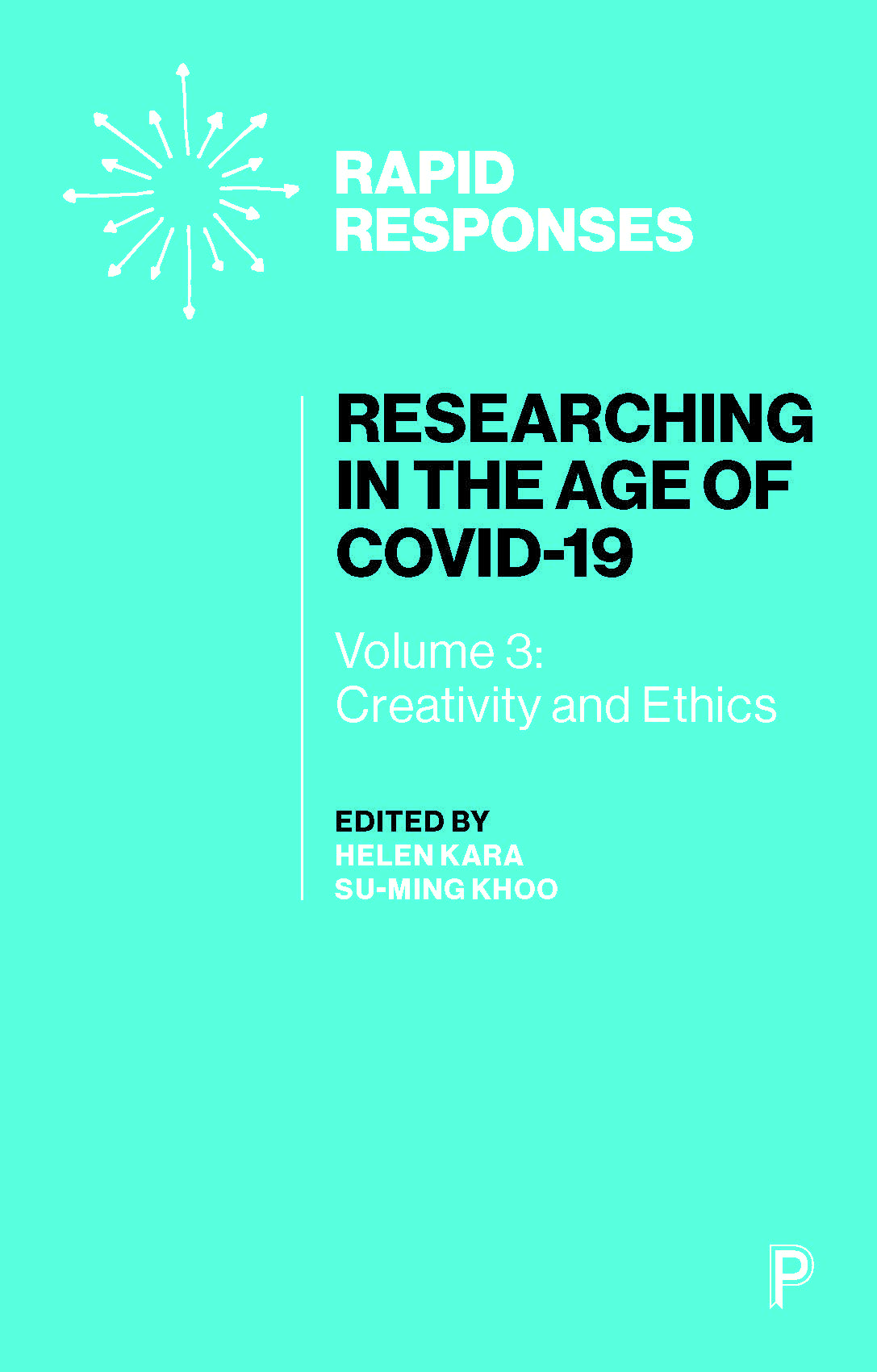
October was so full of events and deadlines that I’m only just catching up with myself. One event was the publication of the three rapid e-books I have co-edited, with Su-ming Khoo from the National University of Ireland, for Policy Press. Moving from putting out a call for chapters to publication in five months flat was an astonishing experience. Su-ming and I had not worked together before, in fact we’d only met twice, but fortunately we found that we work together well and enjoy collaborating. We wrote about our learning from co-editing for the Research Whisperer. And our contributors, my goodness, they were wonderful. Communicative, timely, responsive collaborators, with no rampant egos, providing excellent material. The staff at Policy Press also worked flat out – I think everyone involved with the production of these e-books worked out-of-hours and during holidays, because we all had a shared aim: to create resources to help researchers working under difficult pandemic conditions. And here they are!

Volume 1 is subtitled Response and Reassessment, Volume 2 is Care and Resilience, and Volume 3 is Creativity and Ethics. Each volume has 11 chapters, and our authors are based all over the world: Australia, Brazil, Colombia, England, Fiji and Tonga, Germany, Ghana, Hong Kong, India, Jordan, Lebanon, New Zealand, Nigeria, Palestine, Portugal, Scotland, South Africa and the US, with participants and collaborators in many more countries from Finland to Indonesia to Zimbabwe. Su-ming and I wrote about some of our learning from the e-books themselves, about how the pandemic has transformed research methods and research ethics, for the LSE Impact blog.

I’m also delighted that Policy Press has made these e-books so affordable, at least by Western standards. They are £6.99 each or equivalent – and, at the time of writing, are on offer at £5.59 each; a 20% discount. The pricing, too, is part of our shared aim to help as many researchers as possible. Please spread the word.

This blog, and the monthly #CRMethodsChat on Twitter, is funded by my beloved patrons. It takes me at least one working day per month to post here each week and run the Twitterchat. At the time of writing I’m receiving funding from Patrons of $67 per month. If you think a day of my time is worth more than $67 – you can help! Ongoing support would be fantastic but you can also make a one-time donation through the PayPal button on this blog if that works better for you. Support from Patrons and donors also enables me to keep this blog ad-free. If you are not able to support me financially, please consider reviewing any of my books you have read – even a single-line review on Amazon or Goodreads is a huge help – or sharing a link to my work on social media. Thank you!

Twelve top tips for co-editing a book series

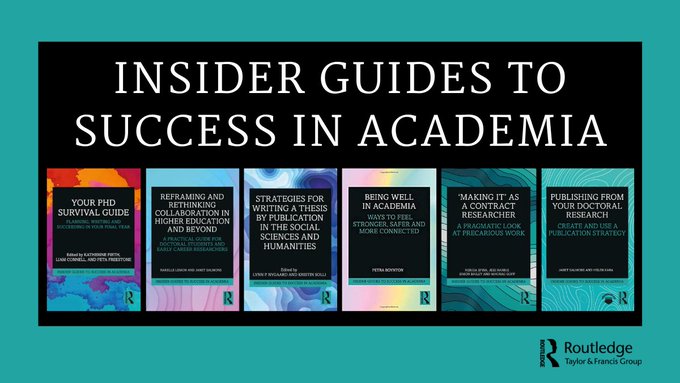
This post is co-written and simultaneously published with Pat Thomson, to coincide with the launch of the Insider Guides to Success in Academia book series.

Helen: It’s interesting to reflect on how we do this co-editing thing. We’ve been working together on this series since May 2017, so that’s three-and-a-half years. You and I hadn’t worked together before, though we’d talked a lot on Twitter, a bit by email, and got into a comfy habit of meeting for lunch now and again at a nice pub midway between our 
offices. Ahhh, those were the days… anyway, now it’s mostly email with the occasional online meeting. Those are the nuts and bolts, but there’s a lot more to co-editing a series than that. I think it helps that we share quite a similar outlook on life. Was that why you asked me to 
co-edit with you?

Pat: I’m always prepared to take an educated punt on who might be fun to collaborate with. I saw that you were talking with doctoral and early academic career people on social media, as I was, but you had a very different background. You were an independent researcher, as opposed to me, a full time academic. However, we shared an interest in methodologies and methods. But we also knew about some different things too. As I remember it, we hadn’t actually even met face to face, but “knew” each other online. I think that you can actually get to know people through social media, just as you used to be able to through the medium of writing letters. Over time, as you see how people are on social media you get an impression of how they are and how they might be to work with. So asking you if you’d be interested in working on a series was in part about our shared interests and complementary differences, but also about the hunch that you would be good to work with. But why did you say yes?

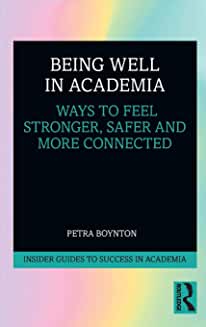
Helen: I was a little bit flattered by you asking, and I too thought you could be fun to collaborate with. But mostly I agreed with you about the gap in the market for short books on topics around academia that didn’t merit a full-length book and so weren’t adequately covered in the literature. It was so interesting to think about! I’ve just checked my records and when we met in April 2018, the first book in the series was being written and we had 21 other ideas of titles and/or authors to follow up. Some have come to fruition now, such as Narelle Lemon’s and Janet Salmons’ book on collaboration, and Petra Boynton’s book on being well in academia. That’s lovely to see. Some didn’t even get off the starting blocks, and we have others in the series that we didn’t consider in that meeting, such as Your PhD Survival Guide which offers doctoral students help for their final year. Many of our authors come from our networks, so clearly networking and thinking are two of the key skills for co-editing a book series. You have more experience of this than me; what would you say are the others?

Pat: Well there’s choosing a publisher. I’d had a very initial discussion with Sarah, an editor at Routledge who I had worked a lot with before. I’d floated the idea of a series for doctoral and early career researchers that were shorter than usual, covered niche topics were affordable. She was very enthusiastic about the idea and encouraged me to pursue it. She also sent me a few small books that I could look at. At our first meeting, we discussed the style and tone of the books. We agreed on the size question, and also that our books should have a voice somewhere between a blog and an ordinary academic book. We also wanted something where the layout was half way between a text book and a monograph – so we needed a template/house style that allowed for different kinds of exercises, examples, illustrations. So afterwards, when we wrote the actual book series proposal we not only knew the competition and the market as well as the prospective authors, we also had a clear idea of what the books would be and do. And then of course there was the series cover decision!

Helen: OMG the cover decision… that took us a while, didn’t it? But I’m happy with the results. I have copies of all the books we’ve published so far, and they look good together. That’s important for the Routledge stand at academic conferences – not that those are happening at present, but I hope they will be again in time. So promotion is another skill co-editors need, and of course social media savvy is helpful there too. I think communication skills are also important. You and I communicate well with each other and with our authors and would-be authors. And it mattered to us both from day one to be supportive to people thinking of writing, or actually writing, for our series. I don’t think all series editors do that and I’m not sure why; do you have any thoughts?

Pat: Well, we are really committed to the series and what we think it can be, and we want it to be super good. We want to make the dream we had about it at the start a reality. I guess we run the risk of being seen as being too hands-on, but I think I’d rather that than distant and un-contactable. And I’ve certainly had the experience of working with a pretty remote series editor when I could have done with some conversation about working with a production editor and that was much harder than it needed to be. We do want our authors to feel supported, and that also means offering some constructive suggestions for improvement.  And of course it’s important that Sarah, our Routledge Editor, shares our view of what the series is and does; we do have a productive partnership with our publisher. That’s important too; we can make suggestions about the series, its direction and processes, and also about its promotion.

So here’s our twelve top tips for series editing:

  1. Know the field, its debates and authors
  2. Choose a co-editor with complementary skills and similar interests
  3. Identify the niche in the field that the series will occupy, and the potential audience
  4. Imagine the possible series – what it could be – and its USP
  5. Identify the right publisher you can partner with
  6. Build a list of potential titles and authors
  7. Line up the first two or three titles and authors
  8. Write a short and punchy proposal for the series
  9. Work with the publisher on the series identity – size, layout, cover etc
  10. Actively recruit authors and titles
  11. Work with the authors through proposal and manuscript development stages
  12. Actively engage with the publisher and authors in promoting the series

Why Academics Should Publish Books With University Presses

I discovered that last Friday was publication day for a book of great interest to me: Indigenous Research Ethics: Claiming Research Sovereignty Beyond Deficit and the Colonial Legacy, an edited collection out of New Zealand and published by Emerald. In hardback. For £85. Or as an e-book, for £80.75.

I have been cross for a while about the ridiculous pricing of some academic publications, and now I’m furious. I really want to read this book, and it’s way beyond my budget. It will be beyond the budget of most independent or precariously employed researchers. And how many Indigenous scholars can afford £85 for a book – or the e-book with a derisory £4.25 reduction?

This pricing is calculated for academic libraries. It is closed access in book form. The publisher can claim they are supporting Indigenous researchers and scholars and, sure, those whose work is published in this book get a new line on their CV which may help them in their career. But their work is not going to be widely read, used, and cited by others. Because, guess what, academic libraries are experiencing budget cuts. I was chatting on social media with a senior academic who had asked her university library to get this book, and whose library had said no, that’s above our threshold now.

This is of course n=1, so let’s take a wider look. I’ve been doing some research into the practices and economics of academic publishing – and it’s horrifying. Of course books and journals are inextricably linked, but I can’t cover both in one post, so I’m focusing on books today; journals in a couple of weeks’ time.

Broadly, academic publishers can be divided into three categories:

  1. for profit and part of a bigger business;

2. stand-alone independent for profit; and

3. not for profit.

In general, the scholarly publishing industry makes a 35-40% profit margin. Walmart makes 3%. Publishers that are part of bigger businesses are usually part of global corporations who divert a proportion of any profit to their shareholders. In such corporations, the academic publishing arm is often so profitable that it is propping up other parts of the business.

A lot of scholars are completely unaware of how this works. Most scholars in the social sciences and the humanities have heard of the book publisher Routledge; most STEM scholars have heard of CRC Press. Some know that one or other is part of the academic publisher Taylor & Francis. Few understand that Taylor & Francis is part of Informa, a global corporation in the FTSE 100, huge, wealthy, growing – and making good money for its shareholders. Taylor & Francis isn’t a little bit of Informa, it is the second biggest of five divisions, and, according to the 2019 annual report, is showing ‘good levels of growth’. In 2019 Taylor & Francis’ revenue was £560m, and its adjusted operating profit was £218m. Part of this was due to ‘a steady performance in books’ – 7,300 books, in fact, that year. E-books accounted for 31% of the year’s total book sales.

I found a vaguely equivalent book on Routledge’s website: Social Science Research Ethics for a Globalizing World: Interdisciplinary and CrossCultural Perspectives, another edited collection. The hardback price is an eye-watering £125, but at least there is a less expensive paperback (£36.99) and e-book (£33.29). They’re still outside my budget, though – my ceiling is £30. (Full disclosure – I could buy the paperback with my Routledge author discount. But we can’t all write for all of the publishers. And these prices are still very high for a 350-page book.)

By contrast, UCL Press is a fully open access press. It is run by a working group of the UCL Library Committee, and has published 184 books since it was established in 2015. And those books are all fully open access. Which means free. Free to download, free to read.

Not, sadly, free to write, though – at least, not for all authors. Publication is free for people working at UCL, and for their co-authors and co-editors. UCL also cover the publication costs of up to five non-UCL book projects each year. After that, it costs £5,000 to publish a book of up to £100,000 words. This would usually come from research funders, as part of the dissemination strategy for a research bid.

So there is still a huge degree of privilege in operation here. To publish a book with UCL Press you need to be connected with UCL, or very lucky, or funded, or rich. You almost certainly won’t be from the global South. I have been worried for a long time that open access would benefit readers at the expense of writers, and this does seem to be happening. But I understand that, on the whole, this is a step on the way to social good, as it offers good quality academic literature more freely to any reader with an internet connection. Also, UCL Press are offering consultancy and training to other universities that want to set up open access publishers of their own.

There are other OA and scholar-led presses at Goldsmiths, Westminster, Huddersfield and elsewhere. Larger university presses in the UK include Bristol University Press, Liverpool University Press, Manchester University Press and Edinburgh University Press. Then there are the oldest and largest, Cambridge University Press and Oxford University Press. And there are many others around the world. Their mission includes making research available to the public, and giving voice to under-represented groups and experiences. Any surplus income they generate goes to support their mission.

You can see the difference, too, when you read the books. Routledge publishes some good books but their production values are not high. They are often poorly edited and with inadequate or no index, and their cover designs are basic and repetitive. Policy Press, an imprint of Bristol University Press, also publishes some good books and their production values are much higher. The editing is good, more of their books have good indexes, and their covers are carefully designed.

So, academics, what do you want for your books? Do you want them to be well constructed and made available to as many people as possible, by an organisation with a mission to help make that happen? Or do you want them to be averagely constructed and available only through some academic libraries, by an organisation that has a mission to line the pockets of its shareholders?

The recent Open Access Manifesto for Freedom, Integrity and Creativity in the Humanities and Interpretive Social Sciences recommends that scholars in those sectors consider the political and ethical implications of where they choose to publish, and aim for ‘outlets whose values align with your own’. I would recommend that for scholars and researchers in all sectors.

This blog, and the monthly #CRMethodsChat on Twitter, is funded by my beloved patrons. It takes me at least one working day per month to post here each week and run the Twitterchat. At the time of writing I’m receiving funding from Patrons of $70 per month. If you think a day of my time is worth more than $70 – you can help! Ongoing support would be fantastic but you can also make a one-time donation through the PayPal button on this blog if that works better for you. Support from Patrons and donors also enables me to keep this blog ad-free. If you are not able to support me financially, please consider reviewing any of my books you have read – even a single-line review on Amazon or Goodreads is a huge help – or sharing a link to my work on social media. Thank you!

Book Giveaway!

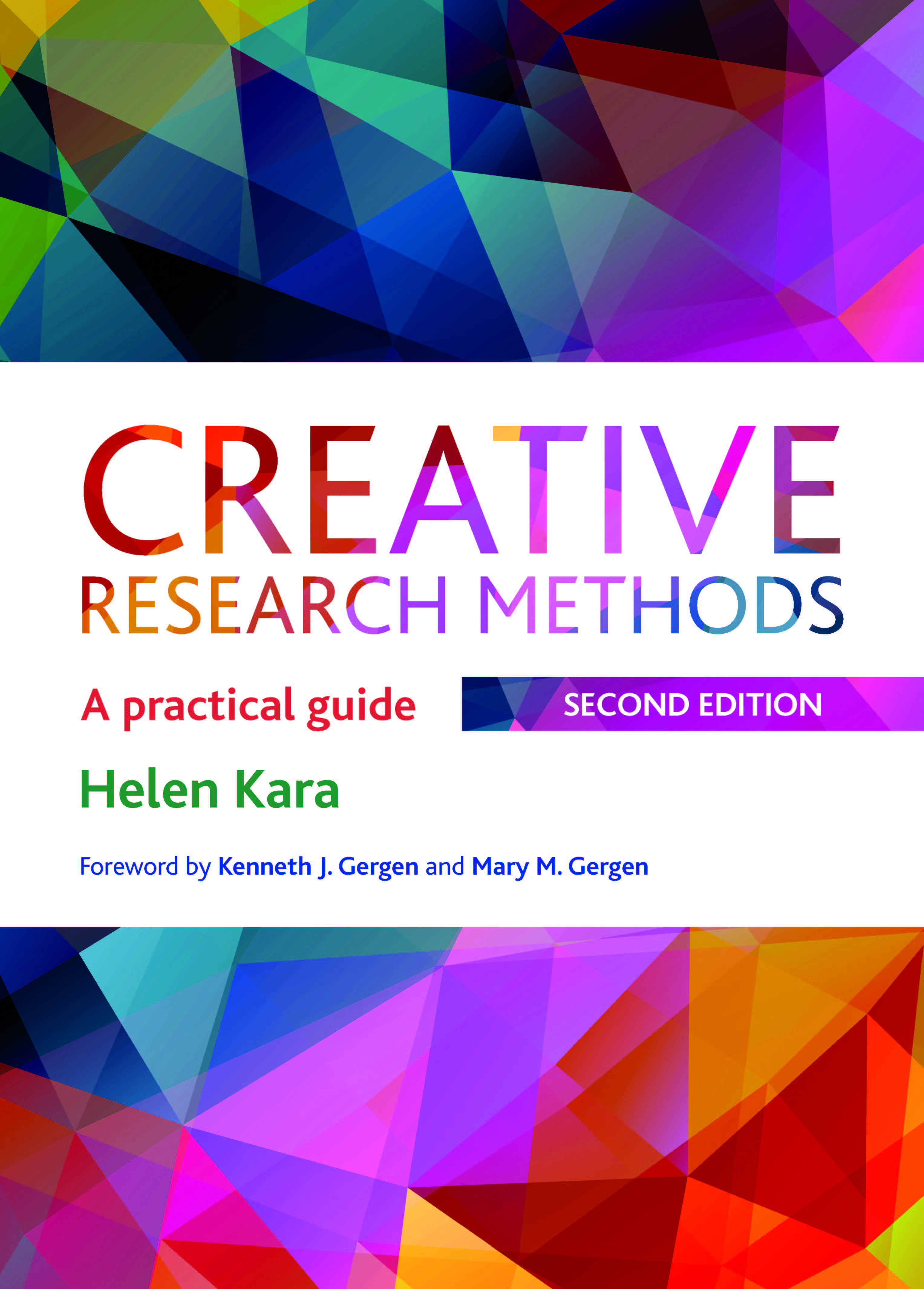
This week I simply do not have time to write a post for you all. So I thought instead I’d run a 24-hour giveaway for my subscribers. Would you like to win a copy of one of my books? I’m offering a copy of my book on creative research methods – the new second edition – or, if you already have that (or if you prefer), the title of your choice from the Insider Guides to Success in Academia series that I’m co-editing with Pat Thomson.

If you already subscribe to this blog, hurrah, you’re eligible! If you don’t, the first thing you need to do is find ‘Follow Blog By Email’ (probably on the right of the screen if you’re on a laptop or tablet, at the bottom if you’re on a phone), put your email address in the box and click ‘Follow’.

(By the way, as far as I am concerned you are subscribers, not followers. I don’t mind having subscribers but I don’t like the idea of having followers because I’m not the Pied Piper or some kind of dodgy cult figurehead.)

So, OK, now you’re a subscriber, or maybe you already were; either way, hurrah. All you need to do to enter the giveaway is leave a comment below telling me which book you would like if you win. Then in around 24 hours – that’s between 9.30 and 10 am BST on Friday 16 October 2020 – I will type out all the names in the same order as the comments, number them consecutively, and use this random number generator to select the winner. Then I will announce the winner here, they can give me their address through the contact form on this website, and I will send their book to wherever they are in the world.

Good luck!

This blog, and the monthly #CRMethodsChat on Twitter, is funded by my beloved patrons. It takes me at least one working day per month to post here each week and run the Twitterchat. At the time of writing I’m receiving funding from Patrons of $70 per month. If you think a day of my time is worth more than $70 – you can help! Ongoing support would be fantastic but you can also make a one-time donation through the PayPal button on this blog if that works better for you. Support from Patrons and donors also enables me to keep this blog ad-free. If you are not able to support me financially, please consider reviewing any of my books you have read – even a single-line review on Amazon or Goodreads is a huge help – or sharing a link to my work on social media. Thank you!
Five Top Tips for Managing Deadlines

October is a month of several deadlines. The rapid e-books on Researching in the Age of COVID-19 that I’m co-editing with Su-ming Khoo are being published on Friday 23rd, and I have to draft a post for the LSE Impact Blog to be published on that date. The online launch for the Insider Guides to Success in Academia series I’m co-editing with Pat Thomson is on Thursday 28th, and I have a bunch of preparation to do beforehand. The end of the month is the deadline for four draft chapters of a new book I’m writing for SAGE, and for the draft MS of a book I’m co-editing with Su-ming Khoo for Policy Press. I have to draft the conclusion for that book by then. And those are just the publishing deadlines; I have client deadlines too, and this blog needs writing every week, and my accounts will be due soon. The deadline pressure seems never-ending.

People have different attitudes to deadlines. Some need the pressure of a deadline to do good work. Others find the stress of an approaching deadline means their work deteriorates, so they need to plan ahead. Some are continually surprised by deadlines; others ignore them. The writer Douglas Adams famously said, “I love deadlines. I like the whooshing sound they make as they fly by.” We often talk in terms of meeting deadlines, but that’s not the whole story. I think we need to learn to manage our deadlines. Here are my five top tips for deadline management.

  1. Don’t let your deadlines take you by surprise

I’m sure we’ve all had colleagues who have said things like, “You mean this week?”, and caused much eye-rolling irritation. Everyone needs a system to help us stay aware of our deadlines. I use lists; a friend uses Post-Its stuck around her computer monitor; another friend uses a big wall-mounted year planner. It doesn’t matter what system you use, what matters is that it works for you

2. Do sweat the small stuff

Paying attention to detail really helps when you’re managing deadlines. Some people really struggle with details, such as ‘big picture’ thinkers and some neurodiverse people. If you find it really difficult to pay attention to detail, try to work with others who have these skills, or enlist the support of a friend who can help you to focus. If you find it a bit tricky, whether because you find it boring or because you’ve never really honed the skills, I recommend working to develop your ability to pay attention to detail. The time invested will pay dividends.

3. Manage your time well

Time management helps with deadline management. I raise my head from my immediate tasks to check on my deadlines and review my progress at least once a week, usually late on a Friday or early on a Monday. Sometimes more often if I feel the need. At particularly busy times I might do this daily; it is particularly helpful at times when deadlines and priorities are, or may be, changing. Another important component of time management is to be realistic about what you can get done in the time available. I worked with one person who was frequently astonished by the need to spend time on things like childcare and teaching preparation – which, as they were a parent and a teacher, seemed quite odd to me. A third component of time management is to say ‘no’ when necessary. I’ll be saying ‘no’ to anything else with an October deadline. ‘Too many deadlines already’ is a very good reason for saying ‘no’.

4. Communicate if you have a problem

If you think you’re not going to meet a deadline, tell the people who need to know. Most people are forgiving and flexible, particularly if you have an unforeseen problem, sometimes even if it’s simply because the work was more complicated than you had expected. The earlier you can let them know, the easier it is for them to be forgiving and flexible. (Making a habit of missing deadlines has the opposite effect. Therefore I don’t advise this as a regular practice, but it’s useful when needed.) So don’t procrastinate here, not least because that will only add to your stress levels.

5. Practise self-care

Looking after ourselves should always be a priority. If we are well cared for, we are better able to manage our deadlines. And managing deadlines is a form of self-care in its own right, because really the whole point of deadline management is to manage the stress and pressure deadlines can cause.

So those are my five top tips. Is there anything I’ve missed? If so, please let me know in the comments.

This blog, and the monthly #CRMethodsChat on Twitter, is funded by my beloved patrons. It takes me at least one working day per month to post here each week and run the Twitterchat. At the time of writing I’m receiving funding from Patrons of $70 per month. If you think a day of my time is worth more than $70 – you can help! Ongoing support would be fantastic but you can also make a one-time donation through the PayPal button on this blog if that works better for you. Support from Patrons and donors also enables me to keep this blog ad-free. If you are not able to support me financially, please consider reviewing any of my books you have read – even a single-line review on Amazon or Goodreads is a huge help – or sharing a link to my work on social media. Thank you!
Decolonisation Resources

I wanted to compile a list of online resources around decolonisation, for my benefit as well as yours, so I went looking. And I found that other people already had this idea and did the work. Quite a number of other people, in fact. I found three good long lists that already existed online, and I have put them here in a list of their own.

I haven’t checked all of the resources listed, because there are thousands. Many are open access, freely available online as web pages, videos, podcasts, and suchlike. There are also books, films, artworks, and so on – my Christmas list has grown considerably in the course of this exercise!

The first one I found is from a symposium, held at the University of East Anglia in the UK in 2018, on decolonising the curriculum. This led to a ‘researchathon’ to create a list of relevant resources, which is now an open access list on Zotero. There are over 1,000 resources in this list alone, and many are free to access.

The second is from another UK university, SOAS (the School of Oriental and African Studies), which has a Decolonising SOAS Working Group, set up in 2016. The Group has produced a list of learning and teaching resources, plus events, media coverage, reading suggestions, podcasts, videos and more.

The third is from a conference held in 2019 by Monash University from Australia at their European base in Prato, Italy. This is another long list, divided into non-fiction, fiction and art, activism, community projects, events, publications, and other resource lists – mostly reading lists.

This post may be short but it leads to a wealth of content. Are there other lists I should include? If so, please let me know in the comments.

This blog, and the monthly #CRMethodsChat on Twitter, is funded by my beloved patrons. It takes me at least one working day per month to post here each week and run the Twitterchat. At the time of writing I’m receiving funding from Patrons of $71 per month. If you think a day of my time is worth more than $71 – you can help! Ongoing support would be fantastic but you can also make a one-time donation through the PayPal button on this blog if that works better for you. Support from Patrons and donors also enables me to keep this blog ad-free. If you are not able to support me financially, please consider reviewing any of my books you have read – even a single-line review on Amazon or Goodreads is a huge help – or sharing a link to my work on social media. Thank you!