Conference Organisation Behind The Scenes

If you’ve never organised a conference before, the chances are you have no idea how much work is involved. It takes at least a year; more if it’s your first one. Good venues and good keynote speakers are usually booked up a year or more in advance, and both are crucial to the success of the event. I am already starting to think about the keynote speakers for the 2026 International Creative Research Methods Conference (ICRMC) which is still 19 months away.

Immediately after an annual conference has been held, there is a bunch of work to do: thanking keynote speakers and sponsors, preparing videos for sharing, signing a contract with the venue for the following year, and working on the call for proposals for the next conference. ICRMC is held in the second week of September and we aim to publicise the call for the following year at the start of October, with a deadline of early December. (Every year we get anguished messages, for weeks after the deadline, from people who have missed it – we had a couple just a week or so ago – so if you might be one of those people in future years, make a note now!)

While the call for proposals is out, the conference team are seeking sponsorship. Sponsorship is useful for a range of reasons: sometimes sponsors want to fund useful things like bursaries or the printing of the conference programme; institutional sponsors lend credibility; sponsors often provide merch for the goody bags. (We have had more difficulty than usual in finding sponsors this year, and so far we only have a very small amount of funding for bursaries. If you know of any individual or organisation that might be interested in sponsoring ICRMC25, please get in touch.)
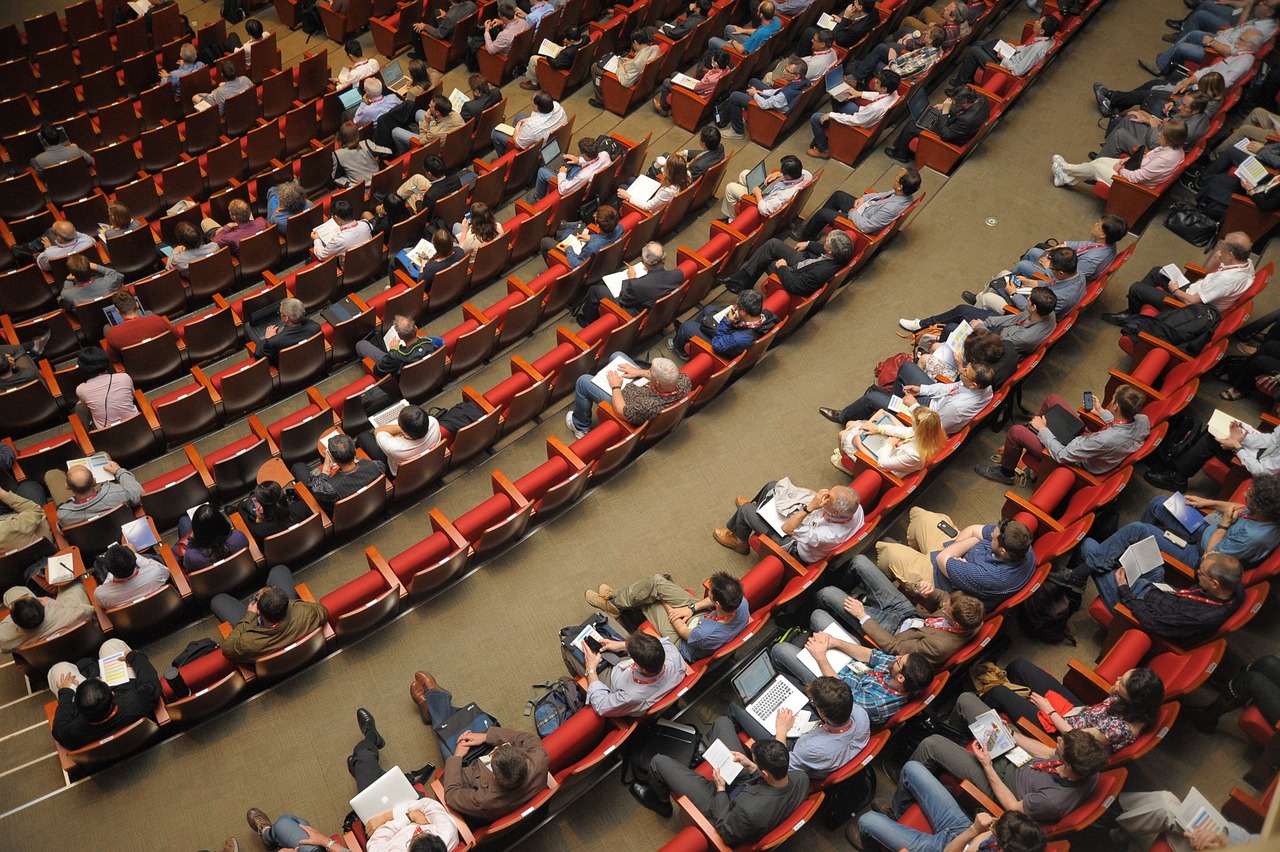
Image by 정훈 김 from Pixabay

In early January a small group of us meet to assess the proposals we have received. Then the conference programme needs to be put together which is a particularly complicated job for this conference. That is because (a) we let people choose how long they want, in multiples of 15 minutes, from 15-90 minutes, and (b) it is a hybrid conference so we need to create a good conference-within-a-conference for people who are attending online. So the programme can take two or three weeks to finalise.

In early March tickets go on sale, so bookings, and applications for bursaries, start to come in. Queries do too: which band do I fall into for payment, can I bring my breastfeeding baby, is there an induction loop, etc etc etc.

Over the following six months there are plenty of jobs to keep us busy. We need to order new conference bags and make sure we have enough good quality merch to go in them; prepare the virtual ‘goody bag’ with links and discounts from sponsors and presenters; make decisions about the bursary applications and communicate those decisions to the applicants; liaise with the venue about people’s dietary requirements; and so on. And the queries keep coming.

Throughout this whole time, promo is happening on social media, in newsletters, and anywhere else we can advertise the conference. Then the weekend before the conference is very busy with printing programmes and name badge inserts, making up name badges, filling goody bags, and managing the inevitable last-minute crises such as a presenter having to drop out and needing to be replaced. (Or worse, a keynote speaker, though fortunately that hasn’t happened yet and I hope it never will.)

And then we’re off to Manchester, already exhausted but also excited and with enough adrenalin to see us through. We have two wonderful days with a delightful group of like-minded people from around the world, which makes it all worthwhile. Then the whole thing starts all over again!

Writing Creatively For Work Or Study

I have written a book called Writing Creatively For Work or Study: Easy Techniques to Engage Your Readers which is now available for pre-order and will be published in May. This is my first trade book, which means it’s intended for a mainstream audience, even though the publisher is Manchester University Press.

MUP was not my first choice of publisher. Nor my second, third, fourth, or… I lost count. I had the idea for this book back in 2018, and I wrote a proposal and sent it to every non-fiction publisher I thought might be interested, in the UK and the US, and every single one turned me down like a bedspread. Then in 2022, when I was looking for potential publishers for a co-written book with a colleague, I was checking out MUP and discovered that in 2020 they had started publishing trade books on topics aligned with the academic books they publish. I remembered my poor sad lonely proposal and wondered if it might find a home at last. I knew one of the MUP editors slightly via Twitter, so I emailed him, he passed me on to a colleague who was definitely interested, and now the book is almost here!

There are a lot of books on how to write all kinds of outputs in many different contexts. I have read quite a few of them myself. But I don’t think anyone has written a book like this before. In essence, the premise is that non-fiction writing is creative, so creative writing techniques – stories, metaphors, poems, dialogue and the like – can be very useful in non-fiction writing. Of course you need to be selective, choosing techniques to suit the purpose of your writing, your skills, and your readers. And the book shows you how to do that, because whether you’re writing a sales report or an NVQ assignment, an appraisal form or a college dissertation, creative writing techniques can help you to get your message across in an accessible and engaging way.

The book is stuffed with examples of work by people who have done just that. You will find a legal contract which looks like a poem; comics used for marketing; letters from scientists to school-children; and many more. These are macro examples and there are also micro examples: a single sentence of sensory language from a book on ethics; a paragraph of memoir from a book on statistics; a six-word story; and lots of others. And there is loads of how-to advice alongside the examples: how to use fiction writing techniques such as repetition and recapitulation, how different poetic forms work, why a zine might be a useful format in the workplace and how to approach writing one, and plenty more besides.

I have had some lovely reviews already! The stand-up poet and broadcaster Kate Fox said,

‘This book is an absolute treasure trove of creative writing techniques and ideas. With great clarity and common sense, Helen Kara demystifies creative writing in a way that will give anyone in a work or study setting the knowledge and confidence to put these suggestions into practice.’

And the Sunday Times best-selling novelist C.L. Taylor said,

‘Everyone from students to business owners will benefit from Helen Kara’s insightful and entertaining exploration of the secrets behind memorable, engaging and authentic writing.’

And the poet, academic, and international writing expert Helen Sword said,

‘Creative methods
Transform dusty documents –
Readers wake and smile.’

That’s the first time I’ve ever had a review in poetic form, and I love it! I hope it starts a trend.

If you like writing, this book is designed to help you enjoy it even more. If you loathe writing, this book should help you to hate it a little less. And whatever you feel about writing, this book will help you to write with more conviction, energy, and skill.

Helsinki revisions and their implications

The Declaration of Helsinki focuses on research ethics and, like me, is 60 years old. It was first adopted by the World Medical Association (WMA) in June 1964 at their meeting in Helsinki, hence the name. The WMA describe the Declaration as ‘the global reference for medical research involving human participants’. As medical research ethics developments are often influential for other disciplines and sectors, even though medical research ethics do not always translate smoothly to social research contexts, the Declaration is also a key reference for social research in general.

The Declaration has been revised a number of times, most recently in October 2024. The latest revisions are the culmination of an extensive global consultation process over 30 months involving physicians, patients, members of research ethics committees, and others. From my perspective, some of the revisions seem like the WMA are playing catch-up, e.g. it is only in this latest iteration that they have stopped talking about ‘human subjects’ and started talking about ‘participants’. (Regular readers may remember that I have ranted about this before.) But other revisions seem rather more forward-looking.

For a start, the 2024 revisions use the phrase ‘physicians and other researchers’, when previous iterations seemed to regard physicians as the only people who would be doing medical research. This is definite progress as of course it is not only physicians who are able to conduct medical research.

The Declaration’s position on harm to the environment has been strengthened from ‘minimise possible harm’ to recommend avoiding or minimising harm to the environment and striving for environmental sustainability. That is quite a big move, and an important one in the current global context.

The latest iteration specifies that ‘medical research takes place in the context of various structural inequities’ which was not previously mentioned. Also, the previous version specified that medical research ‘must be preceded by careful assessment of predictable risks and burdens to the individuals and groups involved in the research’, but mostly focused on risks. The latest version uses ‘risks and burdens’ throughout, and widens ‘individuals and groups’ to ‘individuals, groups, and communities’.

A more radical statement is: ‘When collaborative research is performed internationally, the research protocol must be approved by research ethics committees in both the sponsoring and host countries.’ This is laudable but may be difficult to implement as some countries still have little or no research ethics governance. Even so, I think it’s a worthwhile aim, and may even help to speed up the process of devising good quality research ethics governance systems for places where they do not yet exist.

The revised Declaration says quite a bit about research ethics committees (RECs) and their remit. The previous version from 2013 said that RECs must have the right to monitor ongoing studies (which just goes to show that the implementation of the Declaration has its limits, as many RECs still do not do this). The latest version says that RECs ‘must have the right to monitor, recommend changes to, withdraw approval for, and suspend ongoing research.’ That is quite a big shift. It suggests that the work of RECs may need to become more relational and dialogical, rather than being primarily compliance-based, which I think would be a good thing. However, it also has implications for the staffing and resourcing of RECs, as well as for the ethical work of researchers, because more monitoring etc means more time which means more money. I wonder where the WMA think that could come from.

Some of the revisions are specifically about medical procedures such as clinical trials, which are as important as any other revisions from the WMA’s perspective but are not as relevant to non-medical research. However, the revisions highlighted in this post, and no doubt others too, will reverberate through research ethics work around the world for years to come.

Proposals And A Proposal

Proposals for next year’s International Creative Research Methods Conference are coming in, though more slowly than in previous years. I am trying not to have sleepless nights about this! We often get a big last-minute flurry so by the deadline – 6 December 2024 in case you were wondering – we may have enough proposals to make a conference. I hope so. If not, we will extend the deadline, and make it clear that we have done so, and why. (I’m never impressed with those social media posts that say ‘this conference has been so popular that we have extended the deadline for proposals’.)

I wonder whether the slower rate of submissions is because we said we were particularly interested in proposals for creative methods other than those for gathering data. This was in response to some of the feedback from this year’s conference, where people pointed out that most of the sessions focused on data gathering, and said they would like to know more about creative methods at other stages of the process. We usually have several sessions on writing, and some on analytic techniques – The Handbook of Creative Data Analysis demonstrates that researchers are doing a lot of creative work at the analytic stage. And I know from my own research and writing that creative work is also being done with research design, literature reviews and other kinds of context-setting, presenting findings, disseminating results, and so on.

That said, we do not expect, or want, to have a creative methods conference which includes nothing about creative data gathering. So if you have a method you’d like to share, but you’ve been holding back because you think we might not be interested – bring it on!

While I’m talking about ICRMC, I have a proposal for you, especially if you work outside the UK or have colleagues who do. I am currently in discussions with people in Australia and Canada about the possibility of holding ICRMCs in those countries – not instead of the UK, but as well. Whether those discussions will bear fruit remains to be seen. But I would love to see ICRMC spread its wings and take to the skies. So if you would like to host an ICRMC outside the UK, please get in touch, and I will give you all the help and information I can.

Musings On Language

Academics love a definition. Many journal articles, book chapters, even whole books include definitions of various terms. This is sensible because words are slippery. Defining terms helps us to use language with more precision. This makes it more likely that our readers will take from our writing what we had intended it to say, rather than attributing some other meaning to our work.

People attribute meanings to our work which we did not put there because everyone is always influenced by their own past experiences and present emotions. These lead some readers to reach different conclusions from other readers about the same piece of writing. Even though they have read the same words in the same order, they have had different experiences.

Also, human memory is notoriously fallible. Think of something you read a few months ago. How much of it can you remember? Unless you are one of the rare people with a photographic or eidetic memory, I bet the answer is ‘not much’. This means that even when we define our terms, the impact of that definition will fade with time.

This has happened even to key research terms such as ‘statistical significance’. That term was originally intended to indicate how likely or unlikely a result was to have occurred by chance. However, lay people might read a newspaper article reporting that a research finding is ‘statistically significant’ and attribute the everyday meaning of ‘significance’, i.e. important or meaningful, to the findings. Indeed the journalist who wrote the article may have made the same attribution. Yet statistical significance was never intended to imply that a result was important or meaningful in everyday terms.

The statisticians who devised tests of statistical significance were careful to define their terms. Unfortunately the care they took was diluted over time, and the conflation between the use of ‘significance’ as both a technical and an everyday term caused a multitude of errors and conflicts, ultimately leading to mass calls for its retirement as a technical term.

There are examples of this from other fields too. Emergency medical dispatchers in the US used to ask callers whether the patient was alert. This caused confusion and delay, which is not what anyone wants in a crisis. Enquiries revealed that ‘alert’ has a specific clinical meaning which is not understood in the same way by members of the public. Now dispatchers ask callers whether the patient is responding normally, which is much easier for most people to answer and still tells the dispatcher what they need to know.

There is a symbiotic relationship between language and thought. Language helps us to think; many of us think in language, at least some of the time; the language we use, hear, and read influences the thoughts we have. When we need to name something, such as a new research method we have devised, it is tempting to reach for a name with pizazz, a name that will be eye-catching and memorable. Perhaps those early statisticians chose ‘statistical significance’ for that very reason. However, experience shows that it makes more sense to choose a term which offers a description that is as simple, clear, and accurate as possible. Even then there are no guarantees that everyone will understand – but at least we have given it our best shot.

I Won An Award!

On Monday 29 July I got an absolutely astonishing email from the National Centre for Research Methods (NCRM). I had to read it about 12 times – all of the words and sentences made sense, but I couldn’t get the meaning to sink into my brain. Particularly the part that said “We would like to award you an NCRM Lifetime Achievement Award.” I was completely gobsmacked.

The following morning at 5 am I went from being fast asleep to wide awake, my heart racing and my brain in overdrive, thinking “I’m getting a lifetime achievement award!” I couldn’t tell anyone apart from my nearest and dearest, as the news was not to be publicised for another month. NCRM eventually went public on 29 August when I was away at the Autscape conference. The reaction on social media, and from the couple of people I mentioned it to at the conference, was hearteningly positive.

One interesting thing about getting a lifetime achievement award: once the news has sunk in and a few people have responded positively, it’s really good for counteracting impostor syndrome. When the critical voices start up in my head, I tell them “shut up, I got a lifetime achievement award” – and it works!

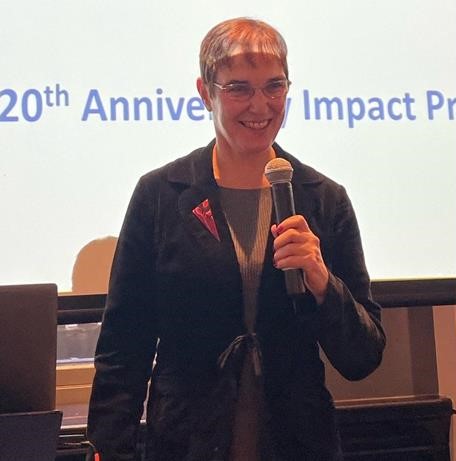
Image of me collecting my award in Manchester

The award ceremony was in Manchester as part of NCRM’s MethodsCon conference. It was in the early evening, two days after ICRMC and the day before I was going on holiday. So I could get there which was nice. I arrived a bit early and chatted with a few people, including Jackie Carter who I was delighted to meet in person after knowing her online for years.

I wasn’t the only award recipient; there were two other awards. One was for developing new methods, which went to a team of four researchers: Susie Weller, Emma Davidson, Ros Edwards and Lynn Jamieson. The other was for positively impacting the wellbeing of older adults, which went to doctoral student Naureen Meghani and her supervisor Joanna Hudson.

I was given the opportunity to say a few words, so I talked about my work on the International Creative Research Methods Conference, the Creative Research Methods in Practice book series, and the Journal of Creative Research Methods. My main point was that, with a little support, independent researchers can do a great deal. There were funders in the room; I hope they were listening.

I have worked quite closely with NCRM in a wide variety of ways over the last 10 years. They have been incredibly supportive of my work and that has been a huge help to me. They are set to lose their funding in a year’s time, which I think is a great shame, because I think there is still a considerable need for the kind of work they do. Not least in supporting independent as well as other researchers. There is very little support available for independent researchers in the UK, and almost no access to research funding. I have argued for years that this is a waste of a national resource because independent researchers are agile and responsive, can do a lot with a small amount of funding, and have tiny overheads. I will continue to make this argument at every chance I get. As I’m now 60 years old, I doubt this will lead to real change in my own working lifetime, but I hope I can help to facilitate change for the next generation of researchers. If this award provides a stepping stone towards reaching that position, NCRM’s impact will be greater than they might currently expect.

Independent Research Ethics Committee – panel members needed!

You may already be aware that I have been involved in setting up a new Independent Research Ethics Committee (aka IREC). The aim is to offer ‘nose-to-tail’ ethical review, i.e. considering all aspects of a project, with minimal bureaucracy and maximum flexibility. This is proving surprisingly popular, particularly as we have done very little promotion apart from setting up a website and a few posts on social media. Which means we need more panel members.

This is paid work, though irregular and freelance. We can’t guarantee any specific amount of work but I can tell you that right now we have as much as we can handle.

We are looking for people with ethics expertise, though our definition of that is broad. There are no specific requirements, e.g. you don’t have to be (or have been) a member of a research ethics committee, or be an academic, or have written a book on ethics. You do need to be able and willing to work within our seven principles of intersectionality, justice, dignity, respect, fairness, honesty, and care. More information about what we understand by these principles is on the website.

Middle-aged white women and qualitative researchers are over-represented in the applications we receive. We have nothing against middle-aged white women (I am one! At least, I think I still am – 60 is middle-aged these days, right?) or qualitative researchers. Being one or the other – or both – will not necessarily rule you out. But we do seek a diverse pool of people from which to draw panel members. In terms of the make-up of our current pool, we would particularly welcome applications from:

  • Men, trans and non-binary people
  • Quantitative researchers
  • People of colour
  • People with lived experience of intersectionality
  • Younger and older people

You do not need to be resident in the UK, though you do need to be available for online meetings with other panel members. At present we are all based in Europe.

Our application process is quite straightforward: we only ask for a statement of up to 500 words plus two referees who can confirm the claims you make in your statement. If you would like an informal chat with me first, please email the IREC address you will find in the link above, and someone will be in touch to arrange a brief meeting.

If this doesn’t sound like something that would suit you, perhaps someone you know might be a good fit. If so, I would be grateful if you could pass this on to them. Thank you.

The Handbook of Creative Data Analysis

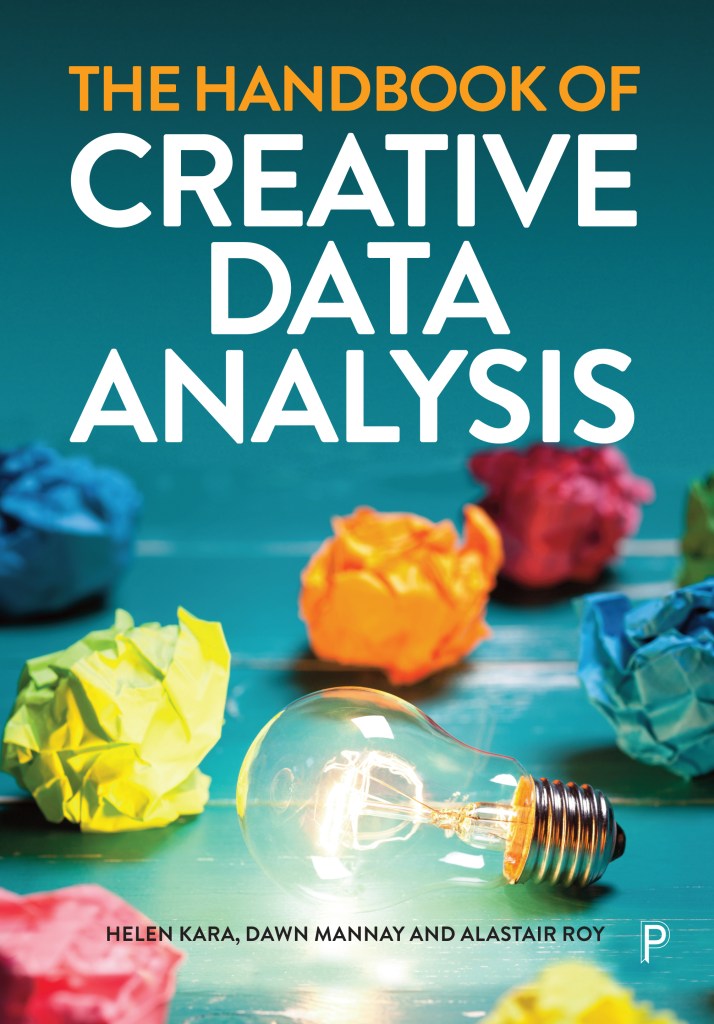
I am delighted to say that The Handbook of Creative Data Analysis was published this month. It’s a chunky tome with 29 substantive chapters, each outlining a creative method and its implications, plus introductory and concluding chapters by the editors.

Here’s how it came about. I first wanted to do this book in 2016. I knew it wasn’t a book I could write myself unless I could get some funding to research it – I applied for a grant from Leverhulme in 2017, for which independent researchers were eligible, but I was unsuccessful. I didn’t think it was a book that could be co-written, either. I thought of an edited collection, but wasn’t confident of doing that well enough on my own. And I didn’t have any good ideas about who to ask to co-edit with me.

Then in February 2021 I chaired a webinar on creativity in research for Policy Press with Dawn Mannay (Professor of Creative Research Methodologies at Cardiff) and Ali Roy (Professor of Social Research at UCLan). I already knew them both and it was a pleasure to do the webinar with them. We were surprised by the number of questions about data analysis, and after the webinar it occurred to me that they would be good co-editors for the book I had in mind. Then I considered their busy academic lives and figured they probably wouldn’t be interested. Then I thought I could just send an email to ask – nothing ventured, nothing gained… and they both said yes!

We decided Policy Press should publish the book and we put together a call for proposals. At this stage we were envisaging a standard-sized book with maybe 12 chapters. What we weren’t envisaging was around 60 proposals, most of which were really good. So we asked Policy Press if we could do a Handbook instead and they said yes. (Around this time I had also been asked to edit the Bloomsbury Handbook of Creative Research Methods. Fortunately I was able to divert a lot of the good proposals we couldn’t fit into the Policy Press Handbook to the Bloomsbury Handbook, so we didn’t have to reject too many outright.)

The process of editing this Handbook was a joy for several reasons. Dawn and Ali were great to work with – we named ourselves ‘good cop’ (me), ‘bad cop’ (Dawn), and ‘ambivalent cop’ (Ali)! I wanted to say yes to as much as possible, Dawn had a keen eye for quality standards, and Ali was great at seeing the merits of, and balancing, different arguments. And the combination of those three attributes was, in practice, greater than the sum of its parts. Then our contributors were, without exception, terrific, responsive, collegial people to work with. And Policy Press were thoroughly supportive throughout.

The part I liked best, though, was the learning. Each individual chapter held fascinating lessons and made me want to have a go at doing analysis with emojis, or reflective stitching, or word clouds. But there were some overall learning points, each made by several authors, that I found particularly interesting. The first is that any data can be analysed creatively: quant or qual, conventionally collected or creatively generated. The second is that analysis is not a discrete phase of research which falls between acquiring data and reporting results. Analytic work begins at the design stage of research and continues through dissemination and beyond. The third overall learning point is that doing analysis differently helps us to find new insights, learning, and understanding. The fourth is that analysing data often requires creativity, whether or not this is explicit.

Researchers use tacit as well as acknowledged creative practices to support their analytic work, and this is highlighted in several chapters. These tacit creative practices have always fascinated me. When I get stuck in the analytic mire, I write poems or create diagrams to help me move forward. Sometimes only half a poem or diagram, and my analytic poems never see the light of day though occasionally my diagrams do. But these techniques help my analytic thought processes. I was interested to discover other tacit creative practices, such as visual arts (doodling, drawing, collage etc), making (models, installations etc), music (to accompany and promote thought), and embodied practices such as walking, running and swimming. No doubt there are others too.

The fifth overall learning point is that analytic processes do not need to be fixed or rigid. This book demonstrates, in many ways, that analytic work can be experimental, playful, and fun.

At present the book is only available in hardback and digital versions. The digital version is much cheaper than the hardback, and you can get a 25% discount on either version by signing up to the publisher’s e-newsletter. If you are at college or university you should be able to get hold of a copy from the library. And there will be a paperback in due course. I am so happy that this book is out in the world because I think it will help a lot of people.

Feedback from #ICRMC23

I am astonished and delighted that feedback from last year’s International Creative Research Methods Conference is still coming in. Recently I found out that Lucy Robinson from Oxford University, who attended last year’s conference, published a review of the event in the most recent issue of the British Psychological Society’s Qualitative Methods in Psychology (QMiP) Bulletin. Unfortunately, it is paywalled but I was able to get hold of a copy. Lucy said ‘the hardest part was deciding what to attend’ (which chimed with feedback I was given at the event) and that it was ‘difficult to choose a highlight’. She also said: 

Ultimately, Helen’s goal for the conference was to ‘bring together the global CRM community to share knowledge, promote understanding, enable networking and have fun!’ (Kara, 2023, taken from the conference programme). From my perspective, something she achieved wholeheartedly.

I’m not just picking out the good bits to share with you, because Lucy’s review was entirely positive, as was almost all of the feedback we have received. There was a little helpful constructive criticism, most of which we have been able to implement this year, and other than that it was compliments all the way. But don’t take my word for it, check out these tweets: 

None of those are from people in my own networks, they are all from people I hadn’t met in person or online before the conference. And there were lots more – search #ICRMC on the socials to find them. 

Then, even more recently, I heard from Heather Bullen that #ICRMC23 was featured in the Actual News! Not the national news, but the Liverpool Echo, which reported on a project that was conceived at last year’s conference. The project involved women refugees and asylum-seekers, and used trauma-informed zine-making to explore ways to build resilience and move beyond trauma. The report is very favourable, with women commenting that the project helped them to ‘learn to live again’, ‘find peace’, and ‘get hope’. It is lovely to know that a presentation and connection at #ICRMC23 led to such a positive impact. 

Perhaps this is part of the reason we have already sold over half of the in-person tickets for this year’s conference. So, if you haven’t booked yet and you want to come in person, it would be worth doing so soon, to ensure you don’t miss out. There is also an online conference with two streams this year – we only had one stream online in 2023, having two streams this year is partly due to feedback received last year. The programmes and all the information you need to book your place are here. See you in September!

On Editing Book Series 

Since 2017 I have been working with Pat Thomson on the Insider Guides to Success in Academia. We now have 15 published titles and more in the pipeline. Then a couple of years ago I started to work with Policy Press on the Creative Research Methods in Practice series; the first book, Photovoice Reimagined by Nicole Brown, was published in April, there are three more scheduled for this year, and – again – more in the pipeline. 

A book series needs a clear purpose and a significant investment of time from its editor(s). That said, I have heard about series editors who do very little beyond adding their name to a series. I am not that kind of editor – I don’t want to micromanage authors, but I do offer help and advice. Some authors don’t need any assistance, particularly if they are experienced, while others need quite a bit of input, particularly if they are inexperienced. People helped me when I was a novice writer so I’m glad to be able to pay that forward. 

Rather than simply acting as a conduit between authors and publisher, I read and comment on every proposal and every manuscript. I consider reviewers’ comments carefully and discuss them with Pat for the Insider series, and with our publishers for both series, before passing them on to authors. And I am always available for any queries or concerns that series authors may have.  

Another part of the work is commissioning books, which lies somewhere between offering people a publishing opportunity and persuading people to write for your series. I try to stay closer to the ‘offering’ than the ‘persuading’ end of that spectrum, though sometimes it’s hard. Pat and I wanted to commission a book on project management for researchers from a very early stage in our series, and we tried one pair of authors who agreed but then were unable to follow through, and another single author who also agreed but was unable to follow through, all for perfectly understandable and very good reasons. So now we’re writing it ourselves with two colleagues. I co-authored the first book in the series on Publishing For Your Doctoral Research with Janet Salmons, and more recently Pat has written one on Refining Your Academic Writing

Since the launch of the creative methods series, I have had several enquiries from would-be authors. Together with the books I had already begun commissioning, I have been promised around a dozen books. Apparently a 50% conversion rate, from promised to proposal, is good going. So, I need to keep on promoting the series, and talking to people about the series, to try to secure more promises – and then ideally proposals. 

I get some royalties as series editor. Not a lot, but then, although it’s a job for sure, it’s much less work than writing the books. However, it does take time for them to come through. The first book in the Insider series was published in December 2019, so my first royalties were in March 2021, and my editor royalties for that series over the last four years have been just over £1,000 in total. On the plus side, most of that was this year, so it’s ramping up now – but series editing is definitely a long game, not a quick win. 

There are two parts of series editing I like best of all. One is when an unsolicited submission arrives which really fits the series, and the other is when a box of published books arrives in my office. As series editor, I get a few free paperback copies which I use for promotion, and it’s always a joy to see the finished product. Seeing the sales figures is nice too! 

The worst part is when we have to say ‘no’ to an author. This doesn’t happen often, and I think I have got better at managing it, but I haven’t always dealt with it well. It is hard to tell someone that their cherished vision doesn’t match yours.  

Most of the time, though, I really enjoy editing book series. I love seeing the series grow, watching authors flourish, and hearing readers’ comments. However, I don’t enjoy it enough to take on any more series – two is plenty! 

Photo by Suzy Hazelwood