NCIS stands for the National Coalition for Independent Scholars which is in fact a global institution that includes independent researchers as well as independent scholars. I have been a member for some years and was very grateful when they supported the inaugural International Creative Research Methods Conference with sponsorship plus a conference chairperson and someone to manage the online chat.
I am grateful to them again because they have produced an open-access Guide for Independent Scholars which is free to download. It is a full-length book with 17 chapters in five sections (full disclosure: two of the chapters are by me). The Guide was edited by Amanda Haste and Linda Baines, former and current Presidents of NCIS, and they did a fine job.
The main reason I am grateful is because I think now people will stop asking me to write a book about and for indies. Or at least, if anyone does ask me, I can say no because it’s already been done – and done very well. I think it is a much better book than I could have written, because independent research and scholarship is an incredibly wide and varied profession, and multiple voices of people from around the world give a much clearer view of this breadth and variety than I could have done alone. I think this is part of the reason why I didn’t want to write a book for indies. I have a strong instinct for which books I can write by myself, and which need a pair or team of authors or to be an edited collection. I guess maybe I could have edited a collection of chapters, but Amanda and Linda are far better placed to do that, with their extensive NCIS networks, than I would have been.
Also, I have been glad to be able to read this book! It contains a lot of valuable stories and nuggets of information, useful even for someone like me who has been independent for 25 years, and invaluable for someone starting out or early in their independent career. I recommend this book if you are independent yourself, or you work with indies, or you know an independent researcher or scholar, or you are considering moving into independent work. I am pleased to be able to tell you that it is a good read – at least, the chapters not by me are; you will have to judge mine for yourself.
I recently had the opportunity to take part in an asynchronous online focus group. So, I did; not least because I was curious to know what it would be like. I found it a rather odd experience. I had a few problems with the tech to start with, which was a bit annoying but is not unusual. I managed to get it sorted in the end – my pop-up blockers were to blame – but I did come close to abandoning the whole exercise through frustration at having to email support people rather than doing what I needed to do in the group. I’m not a techie, but I understand that it can be difficult to create a platform which works seamlessly on any type of hardware – laptop, tablet, mobile etc – and in any browser. So, tolerance may be required for participating in research online.
Once I got into the online environment, I found a series of intriguing questions to work through. Others had already responded to some of the questions so I could take their responses into account. (I don’t think I was supposed to be able to see them until I had answered each question myself, but I could see them, so I read them before formulating my own answers.) Even so, it didn’t feel at all like a group. I have facilitated many in-person focus groups and the interactions between group members are definitely a big part of the process; so much so that some researchers have chosen to analyse these as well as the transcript. Maybe if there had been more responses and exchanges it might have felt more like a group discussion, but I think it would still have felt like quite a solitary, albeit interesting, endeavour.
I think part of why it didn’t feel much like a group was the amount of reading and viewing required. The focus group didn’t only have questions to answer, but also text, videos, and diagrams to digest in between each question. Also, there were points where to give a full answer, I would have needed to stop and read a couple of journal articles and/or book chapters, and/or take a walk to think about the issue. But I didn’t because of time.
This focus group had 10 discussion topics, most of which included at least a dozen questions. In theory, we could choose a topic to focus on, but in practice, I found I had no option but to work through all of the questions from the start (though it is entirely possible that this was due to my technological incompetence). As a result, I spent more time feeling a sense of urgency to get through all the many questions than happily engaging with the interesting material presented. It took me almost three hours to work through the questions at speed. I skip-read some of the text and skipped almost all the videos. I started to watch one in an area I was particularly interested in but then saw that it was 17 minutes long and decided I couldn’t allocate that much time. I tried to start another but the software asked for access to my camera and microphone so I said no because of the security risks. If I had engaged with everything as thoroughly as the researcher no doubt wanted me to – and as I would have liked to myself, if my time was unlimited – I think it would have taken me at least a full day to work through all the materials and answer all the questions. And when I did eventually get to the end, it was just the end. After all that work I would have liked a ‘thank you’ message at the very least, and ideally a big burst of fireworks on the screen! Though I expect the researcher didn’t do that because they were only expecting participants to focus on one or two topics.
The group was online for a couple of months and the researcher included various messages encouraging members to come back and respond to others’ input. I can see why this would be useful for the research, but I couldn’t see much – if any – evidence of people doing that, even though my own contributions were made closer to the end than the start of the operational period. Also, I didn’t go back and add further responses myself. I felt as if I should, but I didn’t get around to it. There was no option to receive email alerts when a new answer was posted, which might have helped, though everyone’s inboxes are overstuffed so if that option had been available I might well not have taken it up, or taken it up and then deleted the emails without reading them.
I could see that the researcher had worked hard to try to provide a good online environment in which their expert participants could engage with specialised material. Alternative methods could include: reducing the number of questions, or separating the sections into different “focus groups” in different online spaces and asking people to participate in one or more of those groups in accordance with their interests, preferences, and capacities. Also, I think for participation which is so complex and time-consuming, there should really be an incentive, though I know not everyone has a budget for such things.
Although I found it quite onerous, participation was useful because it provided some insight into the potential impacts of this method on a participant. That gave me some ideas about what to do and not do if I ever want to use asynchronous online focus groups myself, or if I am mentoring someone who wants to use this method. It was also useful because the researcher who set it up was doing their best to research a complex and important piece of work which is likely to end up helping a lot of people. Although aspects of the experience were frustrating at times, my interest in methods renders those aspects also interesting to me in retrospect. So overall I think it was time well spent.
Recently I was talking to a friend about the exercise routine another friend is using to recover from a serious illness, which involves a lot of walking. My friend said, “He should try bricking.”
I asked what bricking was, and my friend said, “You put a brick in a rucksack and wear it while you’re walking. After a while, you add another brick. It’s really good for strengthening your legs and core.”
I was intrigued so I did a quick search online.
“You mean rucking,” I said.
“Rucking?” he said. “Sounds a bit rude. What’s rucking?”
“What you’re talking about – putting weights in a backpack and wearing it while walking. It comes from military training.”
“It’s called bricking! I invented it, 30 years ago!” my friend said, in mock indignation.
This conversation reminded me of a Guardian column by Julie Burchill which made an impression on me when I first read it almost 25 years ago. Julie was pleased with herself for inventing the phrase “They married in Hastings and repented in Leicester”. While I can’t find that column, I have found a follow-up article from 2000 in which she acknowledges the readers who wrote to tell her that “her” phrase was not original.
The Bible tells us that “there is nothing new under the sun”. Although there are debates about the origin and authorship of the Bible, nobody contests the fact that it was written a very long time ago. So, this concept is evidently not a recent phenomenon. But why is it relevant for research and scholarship? Because when one of us has an idea, which feels like a good idea, it also feels as if we are the first person ever to think of that idea. But clearly, we may not be.
I see this in the creative research methods literature where there are examples of people in separate parts of the world devising the same method as each other and each claiming its invention. Which is fair enough because they have both – or all – invented it. But in Euro-Western cultures, people regard these kinds of ideas as the property of the person who had the ideas, and this leads to all sorts of problems.
So, if you have a good idea, it is important to check whether you really are the first person to have that idea. Look online, use all the search terms you can think of, and try your hardest to make sure nobody else has had the same brainwave. This is not a fool-proof process. I only can read the English language so I can’t search for work in other languages. Also, people use different terms for the same thing which makes searching difficult. I see this often where people in separate locations who have coincidentally devised the same method, each call it something different. But if you check as best you can, then you have done all anyone could ask of you.
The first book in the series, Photovoice Reimagined by Nicole Brown, is published today. There are three others scheduled for publication this year. Fiction and Research, by Becky Tipper and Leah Gilman, will be published in July; Doing Phenomenography, by Amanda Taylor-Beswick and Eva Hornung, will follow in September; and Encountering The World with i-Docs, by Ella Harris, will be available in December. Three more are currently in the writing phase, two proposals are out for review, and I am in discussions with eight or nine other authors or teams of authors about possible future publications. Potential topics under development include enhanced interviewing, poetic inquiry and decolonisation, sandboxing, using comics in research, creative sonic research methods, zines in the research encounter, mapping, journey mapping, inclusive creative fieldwork, creative evaluation, visual scribing, urban exploration, visual methods in practice and emoji coding.
I decided to edit this series because I knew there were not enough publication opportunities for people writing about creative research methods. That meant students and researchers wanting to learn more about these kinds of methods were struggling to find relevant information. The books in the series are short, practical how-to books, designed to help researchers learn enough to try out the methods for themselves.
This kind of initiative also helps to establish the legitimacy of creative research methods. Now, in the first half of the 21st century, creative research methods are following a similar trajectory to that of qualitative methods in the second half of the 20th century. It may surprise you to know that economists began adopting qualitative methods as early as the 1960s. After much debate, psychologists began using qualitative methods in the 1980s and engineers joined in in the 2010s. Other disciplines also expanded their methodological repertoires and, as a result, academic journals publishing qualitative research were set up for areas of study formerly thought of as quantitative. For example, the journal Qualitative Health Research was founded in 1991, though Qualitative Psychology was not set up until 2013.
At present, creative research methods are perhaps most firmly established in the discipline of education, I suspect because it is such a creative profession. But I am seeing creative methods being used and promoted in a very wide range of disciplines, such as facilities management, health and the politics of fashion. This is reflected in the doctoral students I teach on courses for the National Centre for Research Methods, doctoral training partnerships and universities. Students come to learn about creative methods from arts and humanities and social sciences disciplines. So far, so unsurprising. But I also get engineers, physicists, business students, computer scientists – all sorts in fact.
In the Euro-Western world we think of creative research methods as new. However, the work of Indigenous methods experts such as Bagele Chilisa from Botswana, Margaret Kovach from Canada and Linda Tuhiwai Smith from New Zealand shows us that creative methods are in fact very old indeed – tens of thousands of years old, in some cases, so very much older than the ‘scientific method’ which has only dominated research in the Euro-Western world for the last few centuries. ‘Older’ does not necessarily equal ‘better’, but in this case I think it does. The scientific method has its place but is not the be-all and end-all of research. Creative methods are more likely to treat people holistically, take context into account and produce rich data and analyses. The scientific method assumes a level of universal consistency and uniformity, while creative methods make space for individual particularities.
Creative Research Methods in Practice is a small but tangible step on our journey away from the dominance of positivism and post-positivism. These stances emphasise objectivity, which is unachievable, and usually consider experiments to be the ideal form of research. Again, there is a place for experimental methods, but there is also a role in research for all sorts of creative methods, from participatory approaches to autoethnography, board games to computer games, apps to zines. And these are the kinds of methods I aim to showcase in the series. If you would like to write a book for this series, please do get in touch.
If you are not an academic and my work has had an impact on you, I would like to hear about that. Also, if you are, or were, an academic and my work had an impact on you at a time when you were not an academic, I would like to hear about that too. I am specifically interested in the impact of any of the following:
If you can help, please use my contact form (or my email address, if you have it) to send me a message about which of the above resources had an impact on you and the difference(s) made to you – whether to your thinking, work, career, life, anything at all. Your message can be as short or as long as you like.
I am finding creative research methods in more and more unexpected locations. I stumbled across a fascinating example while researching the ethics of project management for a book I’m co-writing. It is in the International Journal of Project Management which is not a journal I have read much from until recently. The author is Jan Bröchner, an Emeritus Professor from Chalmers University of Technology in Sweden, who specialises in facilities management in construction organisations. Does he sound like a creative methods person to you? He didn’t sound like one to me – but my stereotyping was soon overturned as I began to read his article.
Bröchner gathered and analysed fictional accounts of construction project management. He was particularly interested in the way project managers’ individual values were expressed in these accounts. He cites a book from 1994 called ‘Good Novels, Better Management’ as foundational to the idea that fiction can be relevant for organisational research. This is a book I have on my shelves from my doctoral student days 20 years ago! My PhD focused on storytelling and organisations. Though I have lost touch with this area of research since then, it is good to see how it has developed. Bröchner cites other relevant work from 1995 to 2019 to support his contention that studying fiction is more use than conventional research methods for investigating the ethical dilemmas that project managers face and for gaining insights ‘into less desirable managerial behaviours’ (Bröchner 2021:594).
Bröchner drew on the values identified by the Polish-American psychologist Milton Rokeach in the 1970s as the internal reference points people use to formulate their attitudes and opinions. (I’m not sure how universal these are, as values can be influenced by society, religion etc and may change over time, but most of them seem reasonably widespread.) Bröchner used a five-step method for finding and working with his fictional data. First, he defined the criteria for selecting his data: they had to be novels, short stories, or plays; available in English, French, or German; with at least one construction project as a prominent feature; and a character who is the construction project manager. Using these criteria, he found fourteen novels, two short stories, and four plays for his dataset. The literature he selected ranged from Aristophanes’ play The Birds, written in 414 BC, to The Victoria System, a novel by Éric Reinhardt published in 2011.
In the second and third steps, Bröchner wrote one short summary to highlight the relevant action; and another to briefly summarise any other relevant details of background information. Here is an example:
Peter Ackroyd: Hawksmoor (1985)
Novel. Two intertwined murder stories. One featuring a satanist clerk of works (or supervisor) responsible for building seven churches in 18th-century London. The other concerning the same churches and a 1980s detective.
Background: Career of Nicholas Hawksmoor (d. 1736) as assistant to Christopher Wren and supervising architect. (Bröchner 2021:600)
Bröchner found that all the authors had relevant personal experiences, and many worked hard to understand construction project management (Bröchner 2021:601).
In the fourth step, Bröchner used the Rokeach values as pre-determined codes and applied those codes to his data. And in the fifth step, he used the results of that coding process to assess how each of the values was represented by the authors, and how frequently each occurred.
Bröchner found that the top five values were Imagination, (Mature) Love, Ambition, Courage, and Happiness (Bröchner 2021:600). These may not be the first five values you would expect a construction project manager to have. Values such as capability, logic, self-respect, politeness, and a sense of accomplishment seem more likely (and yes, those are Rokeach values too). So Bröchner’s findings are surprising and therefore interesting. He expresses a hope that his pioneering work will shift the focus from ‘management methods that are intended to lead to successful project outcomes to an acceptance [of] project managers as human beings’ with their own values and personal commitments to balance with their work and ethical considerations (Bröchner 2021:602).
I think this is one of the key benefits of creative research methods: they facilitate people being accepted as people. We are slowly moving away from the idea that people should compartmentalise themselves so that when you are at work your personal life is irrelevant, and only your work-related knowledge and skills can be of use. Creative methods offer an opportunity for people to bring all their knowledge, and skills, and imagination, and ideas, and courage, and love into their research work. With creative methods, there is no need to exclude anything except whatever is not useful for the task in hand.
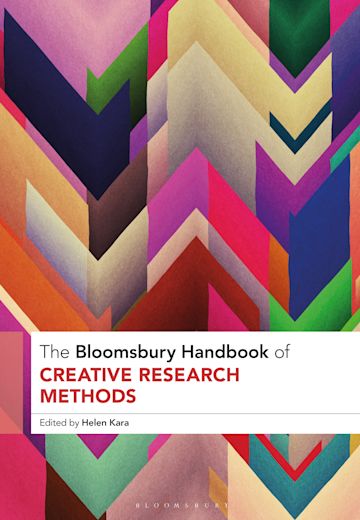
The Bloomsbury Handbook of Creative Research Methods, published last month, is at present only available in hardback at a recommended retail price of £140, or as an ebook at £126. Regular readers will know that I have ranted on this blog before about the iniquitous prices charged by some academic publishers, and advocated working with not-for-profit university presses. So, it is reasonable to ask me, as some people have: why did I agree to edit this expensive book for Bloomsbury?
The backstory is this: Maria Brauzzi, an editor at Bloomsbury who I did not know, emailed me in late 2021 to invite me to edit a Handbook of Creative Research Methods for them. At the time I had started work on editing a creative data analysis book for Policy Press with Dawn Mannay and Ali Roy, and chapter proposals were landing in my inbox. We received over 60 proposals, most of which were good. We had originally intended to produce a normal-sized book with around 12 chapters, but with so many good proposals to choose from, Policy Press agreed to produce a Handbook of Creative Data Analysis with around 30 chapters. (I’m delighted to say that is now in production and will be published in early September.)
Even so, selecting the chapters to include in the Policy Press Handbook was tough. Then I had a brainwave! I hadn’t replied to Maria at Bloomsbury because I couldn’t decide whether to accept her invitation. So, I emailed back and told her I had too many good proposals to fit into the Handbook I was doing with Policy Press, and asked whether I could pivot some of them into the Handbook she wanted to commission for Bloomsbury. She said ‘yes!’ so I ended up being sole editor of one Handbook and lead editor of another at the same time.
I do not recommend this course of action unless you have, as I had then (and I’m glad to say, have again now), a solid, competent, and reliable support worker or other assistant. I could not have edited this Handbook without my support worker’s help. But editing it meant I was able to offer publishing opportunities to people who deserved them, including some people from marginalised groups. I’m glad I could do that, even though it meant working for a publisher who screws royalties down to the bone, lower than any of my other publishers, while earning a massive profit by selling books at prices that most people can’t afford.
So, to redress the balance a tiny little bit, I am offering a free copy of the Handbook to one of my blog followers. If you’re not a follower yet, you should be able to see a ‘Follow Blog Via Email’ notice with space to enter your email address. Any blog follower who wants a chance of a free copy needs to comment below and check back here a week after this blog has been posted to see who has won. My support worker will put all the names in a hat and pick one at random, then add a comment stating who will receive the free copy. I will post a book to that person, wherever they are in the world.
Congratulations to Lucia 🎉 our winner of the prize draw for a free copy of The Bloomsbury Handbook of Creative Research Methods!
In case you missed it, here is the start of a new ‘back to basics’ series on Youtube!
Let’s talk about ‘What is…?’!
The first 5 videos in the series are here:
In addition to all that, here is a new video introducing the Independent Research Ethics Committee: (Intersectional Ethics, Not Just Risk Management – irec.org.uk)
I am delighted to announce the publication of this book which I have edited. I am sorry it is very expensive – I hope Bloomsbury will produce a paperback in due course, and in the meantime, you should be able to get hold of a copy if you have access to an academic library.
The book has 22 chapters in nine sections with 2-4 chapters per section. The first section is an overview with chapters on creative research methods and ethics, creative research methods in the geo-political south, digital tools for creative data analysis, and human geography and creative methods. The other sections are on narrative inquiry, poetic analysis, visual methods, creating visual art, participatory textiles, embodied performative methods, participants as experts, and creative collaboration. I chose these divisions. The content of the book is so rich that there are many other ways I could have divided the chapters. For example, I could have had a section on digital methods, or one on multi-modal methods, or one on feminist research. I made the choices I did with two key aims: first, to make the book flow as well as possible from start to finish, and second, to highlight some of the key points that were coming through in the chapters. Of course this book is in no sense exhaustive, but it does provide some useful insight into the scope and range of creative methods in the 2020s.
The authors come from Australia, Canada, Belgium, India, Ireland, Nepal, the UK and the US, and include doctoral students, independent researchers, practice-based researchers and senior professors. Each chapter is excellent, important, and potentially useful for researchers. They all tell previously untold stories. Perhaps because of my interest in research ethics, Caroline Aldridge’s chapter seems particularly important to me. It highlights some of the barriers that can still face researchers wanting to use creative methods. Caroline is a former social worker and a bereaved mother whose son died as a result of mental illness. She wanted to investigate how other similarly bereaved parents experienced professional and organisational responses and investigations following their child’s death. Caroline worked with potential participants, via a private Facebook group, to co-create a research design which used participatory textiles. These would include a mixed-media quilt co-created with participants, plus researcher-created mixed-media visual vignettes. Both are tried and tested techniques. Caroline did this work carefully, respectfully, and ethically, using all her trauma-sensitive professional social work and insider researcher skills. Then her proposed approach, with all its supporting evidence, was rejected by her university’s research ethics committee. They wanted her to use more conventional methods where the researcher retains more power and the participants are simply providers of data. This left Caroline with a choice of doing her work ethically while disobeying the ethics committee, or obeying the ethics committee and, paradoxically, doing less ethical research. She made a third and very difficult choice and, with considerable sadness, suspended her doctoral research. Many researchers have faced similar dilemmas but they are rarely reflected in the literature. I am grateful to Caroline for agreeing to write a rather different chapter than she had originally proposed, because I think these stories need to be heard.
The overview chapters are important too. Su-ming Khoo, from the National University of Ireland, explores the relationships between creativity, art and science, with an unflinching look at the dark side of creativity, and demonstrates the place of creativity in ethical decision-making as well as research methods. Bibek Dahal and Suresh Gautam, from Nepal, show us where the differences and similarities lie in creative research methods in the geo-political North and South of the world. Christina Silver, Sarah L. Bulloch and Michelle Salmona, from the UK and Australia, outline the role of computer-assisted qualitative data analysis software packages in creative data analysis. Nadia von Benzon from the UK traces the development and use of creative research methods in geography, and considers some ways in which creative research methods transcend disciplinary boundaries. Taken together, these lenses – ethical, global, digital and disciplinary – tell us a lot about where the field of creative research methods is at present.
Overall the book gives us a good insight into a global field in which people are reviewing and developing methods, identifying new ethical difficulties and finding ways to overcome them, making good use of technology, and working across disciplines. It also shows that creative research methods are local, manual, and applicable within single disciplines. And it clearly demonstrates that creative methods are not only useful for gathering data but can also be useful at every point from research design to dissemination.
I would love to know which chapter (or chapters) of this book seems most important to you, and why. Perhaps you could tell me in a comment.
Conventional research methods are good methods. Creative research methods, in themselves, are not better than conventional research methods. Sometimes all you need is to do some interviews and, if that’s the case, there’s not much point deciding to design an app and ask participants to use it to create multi-media data. But I have argued for many years that it is worth knowing about as many methods as you can, because that gives you a better chance of answering your research questions. Methods are tools, and the more tools we have in our toolboxes – within reason – the better equipped we are to do the work we need to do.
Several client meetings recently have gone like this:
Client: We need to use more research methods, not just surveys and interviews. Can you help? Me: Yes indeed I can. I think methods X, Y and Z might suit you. Client: But it will take us time to learn those methods and we don’t have any spare time. Me: 🤦♀️
In these situations it is my job to find helpful arguments that will encourage my clients to find the time they need for the work they want to do. Here are four of the main arguments I use in this situation.
1. You will get better quality data.
Study after study after study, using creative methods, report that their authors are absolutely sure they have richer, more useful data than they would have been able to obtain using conventional methods. Of course there is a difficulty here that any researcher will recognise: no control group. Even so, the sheer number of times this appears in the literature, from sources independent of each other and with experience of using both conventional and creative methods, suggests that there is some truth in the assertion.
2. Funders and commissioners often appreciate a more creative approach these days.
A sensible and well thought through creative approach can help your work to stand out from the crowd. After all, there will be lots of other people who think they can’t find the time to learn about the creative methods that might help them to do their work more effectively. And this means that funders and commissioners will read lots of applications recommending surveys, interviews, and focus groups. If your application recommends collage, digital storytelling, and poetic analysis – OK there is no guarantee of success, but it should at least pique the readers’ interest and be more memorable than most.
3. After the initial set-up stage, some creative methods can save you time.
This applies particularly to creative methods that give participants a high level of control over creating data. These may be low tech, such as diaries, or high tech, such as apps. Getting participants to keep a diary is potentially a big win, with lots of data being generated with little or no researcher involvement. It’s a good idea to provide some structure, e.g. asking participants to answer three questions each week, or to record their reflections on a particular issue on one weekday and one weekend day – whatever works for your research project. And diaries may be written, or audio-recorded, or even drawn or stitched. Using apps in research can be expensive, especially if you need to commission a bespoke app, but can also have big potential advantages. For many participants, apps are user-friendly (though not for all, so you need to offer an analogue alternative too). And data generated using an app is immediately available to the researchers for analysis. So, for both of these methods and many others besides, there is a chunk of work to be done in setting up the method, but once that is done, they really can save you time in the long run.
4. Creative methods can be more ethical.
Please note I am definitely not saying creative methods are more ethical. But they can be, and where they are, this is an argument worth making. For example, some creative methods of gathering data can facilitate the involvement of participants in the initial phase of data analysis. Enhanced interviewing is one such method, where the interview can include questions about participants’ interpretations of the photos they have taken, or the artefact they have brought, or whatever is being used to enhance the interviews. Creative methods of presentation can be more engaging for audiences, and help them to understand more fully and remember better the messages you convey. There are plenty of other such examples of ways in which creative methods can support and augment researchers’ ethical work.
So those are the four main arguments I use. If you know of others, please share them in the comments.




 Helen Kara