Let’s Talk About The Day Rates

coins on handI was halfway through a post in response to Debs’ latest blog in the ongoing conversation with her and Naomi Barnes and Katie Collins when I was stricken with a chest infection. One of my disabilities is asthma, so these things hit me hard, and I’m now in bed, on steroids, coughing and wheezing and waiting to feel better. My brain isn’t working too well so I’m going to write a post inspired by a real-life conversation with my friend and collaborator Katy Vigurs earlier this week, about day rates. Katy told me it would be useful if I explained how they work. So here goes.

My day rates are between £250 and £550. Generally speaking, I offer the lowest rates to small charities, medium rates to national charities or charitable funders, and the highest rates to the private sector, central government and universities. Having said that, I will negotiate, and may offer a lower rate if it’s work I particularly want to do, or I’m feeling flush and it’s a good cause, or it’s a low-hassle job I can do from home. I may charge more for work I don’t really want to do or which will involve lots of travel or unfunded collaborative extras.

So my median rate is £400. That’s fairly low by the standards of most of my competitors, but seems high to salaried people. They wonder how, if I am self-employed and work from home, I can justify charging so much. Partly this is because I am an expert and have a wide range of skills and abilities to offer. More prosaically, it’s because of the economics.

Let’s start with holiday pay. If I take a standard level of holiday – 4 weeks per year, 8 bank holidays, and 104 weekend days – that leaves 233 working days in the year over 48 weeks. In theory, therefore, I could bring in £93,200 each year. In practice it doesn’t work that way.

I need an average of one day per week for essential business-related tasks: marketing (including writing these blog posts), keeping up to date with my field (oh the never-ending reading!), administrative management of my finances, my office, and my paperwork. So now I’m down to 185 chargeable days per year. But there is other work I can’t charge for. Lots of other work. Pre- and post-contract work, hold-ups caused by clients who cancel meetings at short notice or don’t meet agreed deadlines, writing journal articles, replying to queries via email and Twitter, my own professional development. Nobody pays me for any of that. If I do a day’s work at your university, it’ll be around two days’ work in reality, with all the planning, preparation, and follow-up work. And travel. There’s lots of travel. Sometimes it’s included in the day rate, but I would estimate about half of it isn’t. So overall that’s another day a week, so now I’m down to 137 working days. (Actually it’s more like another two days, which probably explains why I mostly only have one day off at the weekend.)

Then there’s sickness. The average annual sickness absence in the UK at present is just 4.4 days per worker, though there are suspicions that this hides ‘presenteeism’ i.e. turning up when you’re not fit. I certainly do this, because I hate letting people down, because if I don’t turn up I don’t get paid, and because I need people to know I’m reliable. Though sometimes, like today, I just can’t. I’m supposed to be chairing an event in Cardiff tonight for the SRA – expenses only as I’m on the Board, so at least I’m not losing income, but I am gutted to miss it and to let them all down. So let’s say another five days per year on average for sickness, leaving 132 working days.

At £400/day on average, in theory I could make £52,800 per year – though that would be pre-tax turnover, not profit. But it is very rarely possible to secure paid work, at my median rate, for every available working day. In reality, last year, my turnover was just over £25,000. To work out how much I can pay myself, I have to deduct all my business expenses: heat and light for my office, accountants’ fees, subscriptions, IT equipment, telecomms costs, stationery, books, etc. I have to put away a big chunk of my turnover, usually around 20%, for tax, which I pay once a year. And I need to keep 6-12 months’ running costs in the bank in case of lean periods or cash-flow problems. For the last year I’ve been able to afford to pay myself £1,000 per month. I’m hoping I can continue to do so, as dropping below that means some belt-tightening. But there are no guarantees.

I’m not writing this post as a complaint. I love my lifestyle. It buys me my greatest luxuries: time and space. I am writing this post to debunk the assumptions people have about me: that because I’m an expert, a published author, a Fellow of the Academy of Social Sciences, my income is commensurate with all those status markers. It’s not. The world doesn’t work like that any more.

Showing My Workings

keep-calm-and-show-your-workings-14

Image credit

There’s a principle that I learned in primary school maths classes which I think also belongs in research: the principle of showing my workings. “Don’t just give me the answer,” my teacher told me. “Show me how you got there. Then even if your answer is wrong, I can understand your thinking.”

With primary school maths, it was easy to show my workings. At my current level of academic writing it’s rather more complicated. As so often happens, others in my network are thinking about this at the same time as me, and Naomi Barnes aka @nomynjb published a blog post yesterday on a similar topic.

I think it is particularly important to show my workings because my next traditionally published book will be on research ethics. I have not yet come across a sole authored book on research ethics with a reflexive element. The closest I’ve found is Alice Dreger’s book Galileo’s Middle Finger, which is beautifully written, incisive, and about research ethics among other things. It is a page-turner which is very rare among research books. I want to write a book on research ethics as compelling and insightful.

Dreger shows her workings – or, as the qualitative researchers say, positions herself – throughout the book. Using a novelist’s technique, she drip-feeds the information to the reader. I’m not yet at a point where I can do that, and anyway, this is a blog, not a book. So you’re going to get the main points in a single download. Here goes.

I was born into a Catholic family. I lost my faith in my early teens, and have never got it back, though I guess one day I might reconnect with it. Or not. But I still hanker after rules and the apparent clarity they bring, and have to work to counteract my tendency to look for and follow an external imperative. I also hold many Christian values, such as valuing love, kindness, and compassion. And, like many Christians, I set myself high standards, frequently fail to meet them, and then give myself a hard time.

I was the oldest in my generation, so I’m independent, hard-headed, and intelligent. Now in my 50s, I’m beginning to feel my age, and most days there is more about that which I like than which I don’t like.

I am happily female, not very feminine, and thoroughly feminist. I can’t be bothered with make-up, hair dye, jewellery, or other trappings of femininity. I’ve never wanted to be a mother; I’ve never regretted not having children. But I am not a trans woman; I could probably claim the title ‘queer’, but have never felt the need.

I am bisexual. I have known this is what I am ever since I knew such a thing existed. It’s about who I am attracted to, not about what I do. I’m attracted to a person first, their gender second. I have always been bisexual: through times of celibacy, singledom, relationships with women or men or both. I will always be bisexual.

I am disabled, mostly invisibly. I have asthma and rheumatoid arthritis. My hands and feet are deformed but you have to look fairly closely to notice. My disabilities affect my life far more than you might guess from the outside. I have given up many things such as knitting, crochet, cycling, reading hardback books, driving long distances, DIY, gardening (these last two no hardship for me, but a bit tough on my partner). My focus, though, is not on what I can’t do, but on what I can do. And I can still do so many things that bring me joy. That’s what counts.

I am white and British. I’m not interested in genealogy, though I bet if I was, I’d find a big genetic mix in my heritage. I know that recent generations encompass English, Welsh, Irish and Scots lineages, and one side of my family has a strong suspicion of Jewish blood in there too. I have relatives buried in Wrexham churchyard; I’m entitled to wear the Sutherland tartan; and I’m told there is a community in the Mountains of Mourne with eyebrows just like mine. I like this mixing; mongrel status suits me fine. I like being indigenous – a term usually used in research to refer to people of colour, but it is what I am too. I love my country and her people: I see very many imperfections and injustices, yet overall I see more good than bad.

I have been with my partner for 20 years. He strengthens me and enhances my life. I aim, I try, to do the same for him.

I worked as a humanist funeral celebrant for 14 years, alongside my research work, from 1997 to 2011. This enhanced my understanding of grief and my appreciation of life.

There are many more workings I could show at increasing levels of granularity. But at the big picture level I think these are the key points I need to make. I want to weave these into my ethics book, to show my workings in a way that hasn’t been done before. I don’t know whether I can, but I’m going to try.

Some of the narrative may change. As an ethical researcher, I believe it is important to be open to changing, and willing to change, my mind, and to explain when and why any such change took place. So this is not a manifesto, it’s a statement of where I’m at with all this right now. (I wish our politicians could work this way – or, perhaps, that they could own up to working this way. Maybe one day.)

Traditionally, the academy has eschewed the personal. People who have tried to make explicit links between their lives, standpoints, beliefs etc and their research work have been written off as self-indulgent. Though that is not a view I hold in the abstract, I have read some work which has come across that way. And other work which has not – for me, the difference is in the analysis. Personal disclosure is all very well but there has to be a point beyond the narcissistic. In my book, I will be aiming to synthesise the data I gather from my own life with the data I gather from interviews and texts. I don’t yet know how to do this, or whether I can do it effectively, but I’m keen to find out. I want my readers to understand how I think, so they can see what has led me to any conclusions I may reach. I want to show my workings.

Gathering Data For Your PhD – New Book Launch!

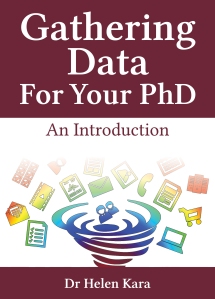
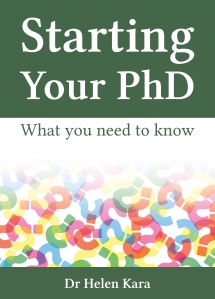
GDFYPhD_red_data_LC_multi_RGBYou may remember that just two months ago, on this very blog, I announced the start of my indie publishing career. I’m publishing a range of short e-books for doctoral students, and the first one was Starting Your PhD: What You Need To Know, launched on 8 September. I’m delighted to launch the second one today: Gathering Data For Your PhD: An Introduction.

Again, it’s around 11,000 words, and is suitable for all doctoral students, whether studying for a scholarly PhD or a professional doctorate. Here is the blurb:

You can’t do research without data. But what kind of data will help you answer your research question? Where can you find that data? And how much data do you need? If you’re doing doctoral research, particularly in the social sciences, arts, or humanities, this book will help you answer those questions. It offers an overview of traditional and innovative methods of gathering quantitative, qualitative, secondary and primary data. The book also outlines the pros and cons of devising your own method of gathering data, and lists a range of resources for further exploration of the methods that interest you most.

Just like the last book, it’s available for the price of a coffee: $2.99/£1.99/E2.99 or thereabouts – exact prices may vary slightly with different distributors. Talking of which, it’s available (or will be any minute) from all the major players: Kindle, iBooks, Kobo, Nook etc.

This seems a perfect time to launch my latest oeuvre, as it’s the first ever Academic Book Week here in the UK. There are loads of events and discussions happening all over the country. There’s very little, though, about indie publishing – perhaps because Academic Book Week mostly involves traditional publishers and booksellers. I want to emphasise here that I don’t see indie publishing as a rival to traditional publishing, though I guess there may be some booksellers who wish digital books had never been invented. I love p-books and I don’t want, or expect, them to disappear. But I think there is also room for e-books in academia, and it surprises me that so few academics and alt-acs are taking up this opportunity.

Many New Experiences

Forget-me-not Pond

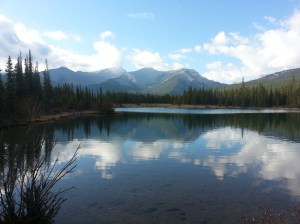
Forget-me-not Pond, near Calgary, Canada

I’ve just had an unforgettable couple of weeks in Canada, with lots of new experiences.

My first time in Calgary. Not a beautiful city, all grids and skyscrapers and right-angles, but the friendliest people I’ve ever met. And I loved the way that people of all races, genders, and ages met my gaze equitably, smiled, and spoke to me as an equal. I hadn’t realised how depressing I find the suspicion I often encounter in England: from older people because I’m younger, from younger people because I’m older, from non-white people because I’m white, from some women because I’m the wrong kind of woman… no-one seems to do any of that in Calgary.

My first keynote speech, at a public multi-agency conference at Calgary Public Library, on Creative Research Methods: Finding Ways To Prove Impact. I will confess to you that I was really nervous about doing a keynote, but you know what? I loved it! I was afraid I might not have enough to say, but in fact I had the opposite problem (probably no surprise to anyone who knows me in person).

My first time teaching in Canada. I taught creative research methods to staff and students at Mount Royal University and the University of Calgary. They were gratifyingly keen to engage with new ideas, ask intelligent questions, and think laterally about how they might apply different methods. And they were so welcoming! I was taken out for breakfast, coffee, lunch, dinner – and given the huge portion sizes in Canada, I’m amazed I can still fit in my trousers.

My first time falling in love with mountains. I’ve been to the Alps, the Pyrenees, the Alpujarras, the mountains of Oman and Turkey and Greece, probably others I’ve forgotten, and they’re all beautiful and amazing but I didn’t love any of them and long to return. The Rockies, though, are a whole different deal. From the way they rise out of the prairie, to their pristine air and water – I lost my heart to those magnificent mountains.

My first time in an airplane window seat. I never flew till I was in my 20s, and to my surprise I was terrified. It took me decades to get over the fear, but I’m there now; nevertheless, I always choose an aisle seat. When I’d finished work in Calgary, I flew to Vancouver Island to visit a friend for a few days. I knew the flight would take in the prairie, the mountains, and the ocean, and was only 75 minutes long, so I plucked up my courage and asked for a window seat. It was worth it, too; I spent most of my time glued to the view.

My first time hiring a car in my own name. I’ve co-hired with my partner before, but never on my own, and I was a little nervous as I’ve also never driven in Canada. However, my friend who I’m visiting doesn’t drive, the public transport on Vancouver Island is all but non-existent, and we wanted to take a little road trip. I got a free upgrade, and I think the car rental person was expecting me to be pleased, but it just made the whole thing more daunting – though it all worked out OK.

My first time driving an automatic. With push-button ignition and push-button handbrake. That took some getting used to, and I was glad of my sister’s advice to drive six times round the car park before tackling the traffic. But by the end of the trip, I was a convert, and now I want an automatic of my own.

My first time visiting Quadra Island. A friend of mine in England grew up there, and has always spoken warmly of the island, but honestly, it’s so beautiful, friendly, and relaxed. The friend I was staying with and I rented a little hobbit house right by the water’s edge, a geodesic dome with living quarters on the ground floor and an attic bedroom above, and an extension with utility room and another bedroom, and a deck reaching out over the beach with table, chairs, and gas barbecue. We spent a couple of very happy days on ‘island time’, exploring the trails through forests and by the ocean, eating yet more delicious food, reading, talking, and laughing.

And of course in the middle of all this I got last week’s astonishing news that I’ve been made a Fellow of the Academy of Social Sciences. It’s been such a high-octane fortnight that I’m not quite sure who I actually am, but I expect it will all sink in over the next few days and weeks.

An unexpected honour – and a dilemma

acss-large-header-logoThis was not the post I expected to write this week. I had planned to tell you all about my experiences in Canada and my first keynote speech. But that will have to wait. Because I have astonishing news: I have been made a Fellow of the Academy of Social Sciences.

In the UK, most academic subject areas have their own Academy. Some have been around for centuries – some are even Royal Academies – and some are newer. The Academy of Social Sciences (AcSS for short) was formed in the 1970s, so it is one of the newest. Its members are learned societies, such as the Social Research Association, the Association of Social Anthropologists, and the British Psychological Society, as well as around 1,000 individual Fellows.

The individual Fellows are almost all Professors (93%), mostly male (70%), and I suspect predominantly white. The first person who explained to me about how the AcSS worked, who was a senior academic and a Fellow of the Academy, said quite matter-of-factly that it wasn’t for people like me. So when a kind Professor and Fellow I’ve been working with asked if I would like to be nominated, I said ‘no, thank you’. He gently suggested that I think about it, which I rather grumpily agreed to do, though I couldn’t really see the point. In the course of my thinking, I telephoned a colleague who is also a Fellow but not an academic, and she told me firmly that I should go for it. So I agreed to be nominated, sent the kind Professor my CV, and heard nothing further.

The selection process involves ‘a thorough process of peer review’ to assess potential Fellows for ‘the excellence and impact of their work in the social sciences’ (quote from this week’s AcSS press release). And it all happens behind closed doors. I couldn’t imagine that they would accept me as a Fellow – but they did. Apparently the AcSS send out letters to new Fellows, to notify them, before the news is released to the public. But I’ve been working in Canada for the last week so I didn’t get the letter. I did get an email to congratulate me on my ‘conferment’ and say the press release had been issued, but there wasn’t much other information, except that I was invited to the President’s lunch where I could receive my certificate. It’s not the kind of invitation I’m used to, because mostly when people invite me to lunch I don’t have to pay £85 for the privilege. EIGHTY-FIVE QUID!!! That’s a fortnight’s food budget in my life. I like eating out, and have even been known to go out for dinner with several courses and drinks on occasion, but I’ve never spent as much as £85 on one of those, let alone on a lunch. Also, I think there is more financial commitment, because there was a direct debit form with the email, but it didn’t say what for; presumably that information is in the welcome pack on my doormat at home.

I guess all those Professors have universities to pay their costs for them because of the prestige it brings. Or, if they have to pay for themselves, they’re on the kind of salary that means it’s possible to spend £85 on lunch. The average salary for a Professor in the UK is around £66,500. Over the last five years, I’ve averaged £14,000 take-home per year, which is approximately equivalent to an employed person’s salary of £16,500 – around a quarter of what a Professor earns. I can live on my income, but it doesn’t support an £85 lunch habit. Though, as a prudent businesswoman, I aim to keep 6-12 months’ running costs in my business account to protect me against lean times. So I could draw from my reserves, treat the cost as a business expense, and set it off against my tax bill. But would that be any kind of ethical?

I want to go to the lunch. I want to advocate for the value of independent researchers in social science, and it seems that eminent social scientists think I’m fit to be their representative. There aren’t many others – in fact there’s only one Fellow who describes himself as an ‘independent academic’, and he used to be a Professor. Those who are not Professors or attached to a university seem mostly to be attached to, or retired from, research organisations or Government departments. So I may be the only Fellow who is, and has been throughout my research career, completely independent of any institution.

I am truly delighted to receive this unexpected honour, but it does bring new ethical dilemmas. Even if I decide I can afford the £85 plus the train fare to Cardiff, is it ethical to spend that much on a glitzy lunch when desperate refugee people are freezing and starving at our gates, and increasing numbers of people within our borders are seeking help from food banks? Which is the greater good, me advocating for independent researchers within the Academy or my £85 providing food for those who have none?

A Day In My Life

BSA logoThis post comes to you in rather a hurry as I have to leave for the airport in less than an hour. So I don’t have time to write much, but luckily for me, I already wrote a blog post this week for the nice people at the British Sociological Association postgraduate forum. I chat to them on Twitter, they’re all kinds of helpful and supportive, and they have a rather excellent blog. I was delighted to be the first in their new ‘day in the life’ series. So if you want to know about a representative kind of day from my working life (there’s no such thing as a typical one), click here. Meanwhile, today in my working life will mostly be spent on a plane, as I’m off to Calgary in Canada. I’ll be working there, too – tell you about it next week!

Knowing And Remembering

Creative research methods in the social sciences [FC]Over the next three weeks I will be doing eight presentations about creative research methods, in Edinburgh, London, and Calgary, to audiences of practitioners, postgraduate students, and academics. I like doing presentations, once I get going, but this is a little daunting because each presentation is slightly different from the others. For example, one is for evaluation practitioners at the NSPCC, so they will want to know how to use creative methods in evaluation research focusing on children and families. Another is for MA students at the University of Calgary, who need to know about arts-based methods and research using technology. A third is for the Social Research Association in Edinburgh, which is likely to generate a mixed audience of practitioners and postgraduate students with a variety of learning needs.

Although I’ll be the one doing the teaching, the prospect of giving these presentations feels rather like the prospect of doing a bunch of exams. This is partly because I’ve had to do a whole load of revision. Although creative methods have always been part of my practice, I finished writing the book a year ago, and I seem to have forgotten a surprisingly large proportion of its contents. I feel rather as though I need to learn it off by heart – including the 500+ references – before I do the first presentation. Which is tomorrow morning. So that’s not going to happen, particularly as I already have rather a lot of work to do on the train to Edinburgh today.

Luckily I’ve had time to refresh my memory to some extent. When I re-read the book I wrote, I remember some parts vividly, while others almost feel like new information. I find myself thinking ‘Ooh, that’s a good point’, as if it had been written by someone else, and ‘Did I really write this?’ because I don’t remember.

This is a strange phenomenon, and I wonder whether other authors have similar experiences. I suspect at least some of them do. It’s not entirely new for me, either. I’ve never been one for hanging on to old papers, but some years ago I came across an essay I’d written for A level geography, all about fluvio-glaciation and peri-glaciation. I couldn’t remember ever knowing those words, let alone what they meant.

So I’ve been thinking about the difference between knowing and remembering. Sometimes I know I know something, such as the name of a tune I am hearing on the radio, but I can’t bring it to mind – we say, ‘It’s on the tip of my tongue’. Sometimes I don’t know I ever knew something, such as the geographic terminology above. Some things I know fairly indelibly, such as how to drive my car, make a veggie chilli, or write an email. Yet there must be lots of things I’ll never know I ever knew, which is a strange thought.

I did remember some things about exams which made me feel a bit better about my forthcoming ordeal-by-presentation. I remembered that I used to have the same feeling, that I needed to memorise everything in my schoolbooks, and the same lurching internal near-panic because I knew I couldn’t. And I remembered that I had actually been quite good at exams, and one thing I’d learned from doing exams that was still applicable now is that I don’t need to remember everything, but to remember enough, and to know what to do with what I remember. In fact, to be creative.

I can do that.

Are You An Ethical Writer?

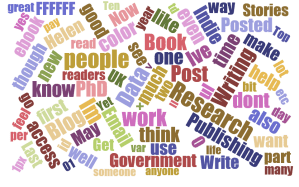
word cloud of this blog, to date

Professional writers and speakers know that the way we think and feel influences the words we choose to write or speak. We may not understand so clearly that the words we choose to use can influence the thoughts and feelings of others.

A generation ago, women lobbied for changes to terminology which gave the impression that men were dominant – as indeed they were in Western society at that time. Up to 1978, for example, a woman could be fired from her job in the US for being pregnant, and up to 1982 UK pubs could refuse to serve women. But at the same time, women were beginning to take roles traditionally assigned to men, which led to some linguistic oddities. I remember feeling rather uncomfortable with being designated the ‘chairman’ of a committee, when ‘chairperson’ or simply ‘chair’ would have served as well. There were fierce arguments between those who believed that traditional language use supported the discriminatory status quo, and those who thought it made no difference.

Some people went further than I thought was sensible, replacing ‘history’ with ‘herstory’ (I can see the point of that in some circumstances, but the etymology of the word suggests that it’s much more about the ‘story’ than the ‘his’) or ‘woman’ with ‘womyn’ (I didn’t get that one at all). This kind of terminological tinkering led to the phrase ‘political correctness’ being used to discredit all attempts to replace sexist terms with existing, sensible, neutral terms. I still wince when I see reports of women ‘manning a stall’ – what’s wrong with ‘staffing’? But it’s now quite usual to speak of a ‘police officer’ rather than ‘policeman’ or ‘policewoman’, and a ‘flight attendant’ rather than an ‘air hostess’ or ‘steward’. These changes in terminology have moved in parallel with increasing opportunities and equality for women in the Western world over recent decades.

However, there is some new terminology that I think is unhelpful for some sections of society. I read an interesting article in the Guardian last week in which the non-fiction writer Steven Poole gave a very thoughtful analysis of the unintentional difficulties caused by the phrase ‘first world problems’. The article is worth reading if you have time. He shows how the reductive use of ‘first world’, with its implicit opposition to the ‘third world’ (which is itself an unfashionable term these days), enables people to condescend, patronise, humblebrag, sidestep compassion, and generally dehumanise pretty much everyone.

Also last week, on social media, I questioned someone’s use of the American phrase ‘wife beater’ to describe a sleeveless t-shirt. I’m not naming the person here because they didn’t welcome my questioning and I don’t want them to think I’m trying to start some kind of online war. The person I questioned is someone I follow because, in my view, they do valuable work online to highlight social inequality. Their casual use of the phrase ‘wife beater’, with its implication that domestic violence can be acceptable, seemed to sit oddly with their pro-equality stance. I am sure this was unintentional on their part; I can think of a number of other words and phrases that I’m sure they wouldn’t use at all because of the discriminatory implications.

Another one is the new-ish way of designating something as in some way poor by saying ‘it gets old really fast’. I am getting old, rather faster than I would like, and I am becoming increasingly aware of the discrimination and difficulties experienced by the older members of our society. I would prefer colloquial usage of the word ‘old’ to have positive connotations.

These examples have become stock phrases, akin to cliches. And cliches are evidence of lazy thinking. All this has implications for us as writers. Writing is a creative process, and that includes academic writing. Stories must be told, words and structures chosen, and these processes are permeated with creativity. Academics, altacs and researchers, earn our livings with our brains. I would argue that we have an ethical responsibility to avoid the lazy cliche and express our new thinking in fresh language. Also, we should try to remain aware of the potential effects of our creative choices on our readers. It is our responsibility to ensure, as far as possible, that we don’t use language in a way that could support discriminatory actions or practices.

Indie Publishing for Academia – Ten Top Tips

SYPhD_green_SQmarks_noblend_LC2_RGBThree weeks ago I became an indie publisher as well as an indie researcher and writer. In that time, my embryonic publishing company, Know More Publishing (see what I did there?!), has gained a website. Also, my first short affordable e-book, Starting Your PhD: What You Need To Know, has gained three five-star reviews on Amazon UK and a fourth on Amazon US. I didn’t bribe a single reviewer!

It’s around a year since I decided to go down this road, and I’ve learned a lot along the way. I think there’s a great deal of potential in indie publishing for academics, altacs, doctoral students and others. Indie publishing doesn’t figure in organisational performance metrics, which creates a barrier for some people, though perhaps one day it will. But it’s a great way to produce work which is too long for academic journals, or doesn’t fit their requirements, but is shorter than a traditionally published book. And it’s open access – you can make your work available for free if you wish, or at a very low cost.

On the down side, there is no quality control. I know there are arguments about whether the peer review system actually enhances quality, but editors certainly do, if they’re doing their jobs properly. With indie publishing, it is possible to plonk any old drivel online for sale. That’s not the kind of indie publishing I advocate. I worked in traditional publishing, I write for traditional publishers, and I have loved books all my life. So I want to see good quality indie publishing from academia and its associates, and to publish good quality books myself. Here are my ten top tips for anyone who shares my aims.

  1. Write something nobody else has written. As an academic or altac, you should be used to spotting gaps in literature. Your work will gain much more interest from others if it’s the only one of its kind.
  1. Get feedback on your writing. Starting Your PhD went through three sets of beta readers, from potential doctoral students to experienced supervisors. It wouldn’t have been worth publishing without their input.
  1. Use a professional editor. It doesn’t matter how experienced a writer you are, you will have blind spots. I know I did. I will always pay to have my books edited by a skilled professional who can bring fresh eyes and a keen brain to improving my text.
  1. Unless you are really good at design yourself, use a professional cover designer. You need someone who knows about book covers, how to make them stand out even at thumbnail size on a mobile device.
  1. Join the Alliance of Independent Authors. This worldwide organisation has approved ‘partner members’ including editors and cover designers which is useful if you don’t have people in your networks with those skills. They also have an active and ALLiEthicalAuthor_Badgesupportive closed group on Facebook where you can get help with all aspects of indie writing and publishing. And they have an Ethical Author code, as well as a publicly accessible searchable blog full of sound advice.
  1. Be prepared to do lots of promotional work. As an indie publisher, you’re not only the author, you’re also the sales and marketing departments for your work. This could involve anything from chatting on Twitter to lugging print copies around with you. You will need to decide what you can do, when, and how. It doesn’t have to be much – but if you don’t do anything to promote your work, it will sink beneath the ocean of available literature.
  1. Buy ISBNs, aka International Standard Book Numbers. These are the 10 or 13 digit numbers used by cataloguing systems to identify each unique book. You can only buy them from one organisation in each country, they’re not cheap (though the more you buy, the cheaper each number becomes), and you can’t transfer them between publishers or even leave them in your will. Also they take ten days to issue, so don’t leave this until the last minute, or you’ll have to postpone your book launch (like I did, ahem). You can get free identifiers such as ASINs from distributors such as Amazon, Kobo, and Barnes & Noble (Nook), but these are distribution codes, not unique book identifiers – or if they are actual ISBNs, they are owned and assigned by the distributor, not by you. This effectively means you are giving away part of the control you have over your work, and having control of your own work is a big part of the rationale for publishing independently in the first place. There’s a more detailed explanation of this on the Alliance of Independent Authors’ blog.
  1. Research the different ways you can publish your work – and expect to spend a considerable amount of time on this, as there are a lot of options. To begin with: e-book only, print only, or both? I’ve gone for e-book only, as I’m writing short books for students who will be comfortable with technology, and e-books are more affordable than print books. So then I decided to publish via Kindle Direct Publishing. This is a no-brainer even if you regard Amazon as the evil empire, because you will sell most of your work from this platform, so if you’re not willing to do business with Amazon at all, don’t publish independently. I also decided to use Draft2Digital, who take a small commission from your income for distributing through most of the other major channels – Kobo, Barnes & Noble (Nook), iBooks, Scribd etc – and they’re very helpful when you get stuck with your uploading, as I did. You could upload your work with each platform individually, and save yourself the commission; it’s your decision whether the hassle is worth the benefit. I decided that, for me, it wasn’t – and my sales figures, so far, bear this out (see below). I might decide to produce print books one day, in which case I’d use CreateSpace on the advice of fellow members of the Alliance of Independent Authors.
  1. Launch your book with some kind of a fanfare – then relax. I had a virtual launch day with a dedicated blog post and a lot of tweeting. Ten days later I went on holiday, which was excellent timing, as the process of preparing and publishing the e-book was much more difficult, stressful, and exhausting than I anticipated. I won’t be able to take a holiday every time, but I’m going to build in at least a weekend off after each one from now on.
  1. Write another book. Full disclosure: in the first three weeks, I’ve made £56.48 from sales on Amazon and $6.30 from sales through Draft2Digital. Not bad for a first e-book priced at £1.99/$2.99. However, given that I’ve shelled out around £500 on editing, cover design, and ISBNs, at this rate it will be six months before I break even. But I have a cunning plan for world domination: the next book in this series, Gathering Data For Your PhD, will be out in November, and I have four more planned for 2016. There is clear evidence that the more you publish and promote, the more readers you will acquire. This applies in the same way to free material.

I hope my learning over the last year will benefit others. If you decide to go down the indie publishing road, do let me know. At present I only know of two other academic types who are doing this: Dr Nathan Ryder, who has published a couple of very useful short e-books on preparing for your viva, and Dr Jenna Condie, who has a book of blog posts on sustainable urbanisation. If you know of other academic indie publishers, please leave a comment. Let’s start a movement!