Teaching Creative Research Methods for GEDIS

I got an email through my contact form in mid-December. Would I like to spend a day teaching creative research methods to an EU-funded project team, at the University of Barcelona, in the middle of March – on a Friday?

Would I ever!

This was my first time teaching creative research methods to an EU-funded project team. However, I have been part of an EU-funded project team, and I work with EU-funded project teams as an ethics expert, so I am familiar with the terrain. It was also my first time working in Spain, and fortunately my client and his colleagues were able and willing to help me find my way through the maze of Spanish bureaucracy.

My client, Juan-José Bo, is a Professor at the University of Barcelona. He is also the project lead for GEDIS, which stands for Gender Diversity in Information Science, a project that began work at the start of 2025. Juanjo had a copy of my book on creative research methods which had led him to ask for my help. He wanted a day of awareness-raising, with some hands-on practice, and an emphasis on gender. So that’s what we did.

Juanjo kindly arranged for me to stay at a comfortable hotel very close to the university. On the morning of our session he came to meet me at the hotel to show me the way to the university and the room where we would be working. Before we got around to the business of the day, Juanjo showed me a marvellous three-dimensional ‘toolkit for librarians’ he had created with help from an artist, which is designed to fold down flat for easy transport to conferences.

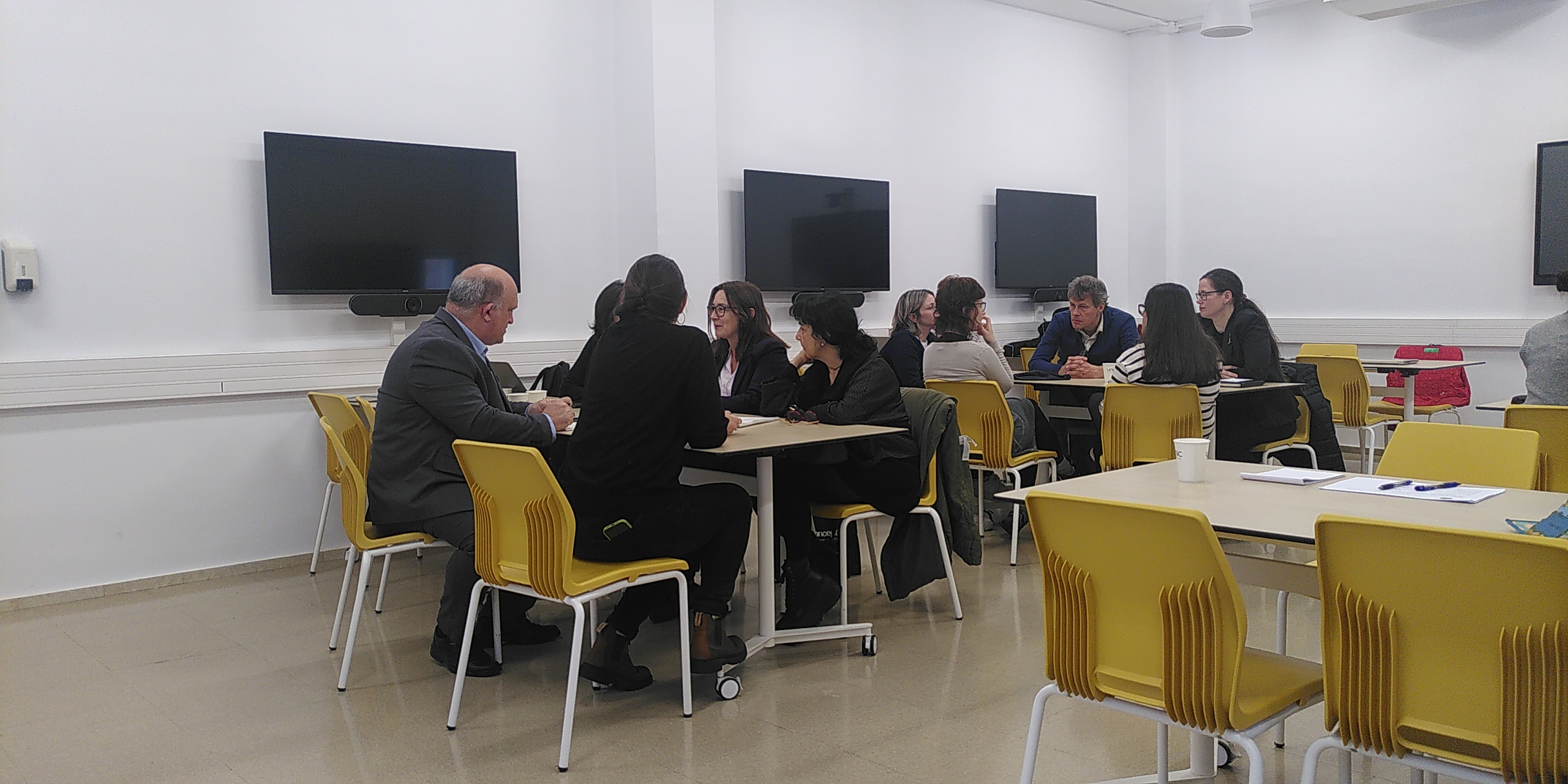
There were 21 people in the group, who came from a range of countries including Czechia, Austria, Bosnia, Germany, Croatia, Spain and Mexico. I began, as I always do, by asking people to introduce themselves and say what they wanted to get out of the day. It turned out that most were quite senior, including librarians and Professors, and several were also teachers of research methods. I had a moment of internal ‘eek!’, wondering whether I had taken on an assignment I couldn’t fulfil, but it turned out to be fine.

Our day together came at the end of a week of intensive co-working, and everyone was tired, but they all concentrated hard and asked really good questions. The discussions were focused on how creative methods could help GEDIS, and the group generated some excellent ideas.

Juanjo emailed me the following week to say:

“Partners told me that they were really happy with the session. It reported to them new and fresh ideas, to use not only at GEDIS at some point but also to their projects. In my case, I enjoyed the session so much.”

I was particularly pleased, in this global moment, to be able to assist a project working to strengthen gender diversity. And on a personal level I was delighted to be able to spend the weekend in Barcelona!

Eight Misconceptions About Creative Research Methods

There are still a lot of people who don’t really understand what creative research methods are, or what they are for, or when you might use them. These people are usually labouring under one misconception or another. So I thought it might be helpful to run through these misconceptions and explain why they are wrong.

1. Creative research methods are a new fad.

In fact research has always been a creative endeavour. The first clinical trial was conducted in the mid-18th century. The questionnaire was invented in 1838, interviews were first used by researchers in the early 20th century, and focus groups were devised in the 1940s. So the questionnaire was created less than 200 years ago, and the focus group was created within living memory. And no doubt ingenious humans were devising a whole bunch of other ways to try to find out new information since long before the clinical trial was born.

2. Creative is the same as innovative.

This is more arguable; there is certainly a lot of overlap between creation and innovation. However, there is also scope for creativity in the use of conventional methods. A questionnaire may include appealing visual elements and be creatively laid out on the page or screen. It is still a questionnaire, but a more creative one than the usual online or paper form.

3. Creative research methods are only useful for qualitative research.

Actually a lot of quantitative and multi-modal researchers do very creative work. Much of this is at the further reaches of disciplines such as physics and electronics, but some is more accessible. Piper Harron wrote her pure maths doctoral dissertation in a very creative way. Daina Taimina solved a centuries-old problem in hyperbolic geometry using crochet. And field biologist Colleen Campbell uses artistic techniques alongside her scientific work with bears and coyotes.

4. Creative research is the same as arts-based research.

Arts-based research is a big sub-set of creative research methods, but not the whole story. There is some very creative work being done with digital methods, embodied methods, and methods in multi-modal research.

5. Arts-based research is all about visual methods.

This is perhaps understandable because we are such a visual species, but it is incorrect. Arts-based methods do include visual methods, for sure, but also writing, music, drama, dance, textile arts – the lot.

6. Creative methods do not involve rigour.

This is closely aligned to the misperception that states creative research methods are antithetical to good research practice. This is absolutely not the case. The key principles of good research practice – designing carefully, working systematically, disseminating widely etc – apply whether you are using creative or conventional methods, or a mix of the two.

7. Only creative people can use creative research methods.

This implies that some people are not creative; a viewpoint I do not embrace. I believe everyone is creative. We all co-create our relationships with other people, for a start. Making and maintaining relationships is a creative process because no two relationships are the same, and the different relationships we have with different people demand different responses from us. Also, you do not need any formal qualifications or recognised skills to be creative: you don’t need an arts degree to use arts-based methods effectively, or great technical acumen to use digital methods well.

8. Creative research methods are only useful for gathering data.

I think this misconception arises because of the general conflation of research with data gathering. It is the visible part of research; the part we are all, regularly, asked to participate in; the part that research ethics committees focus on. But it is far from the only stage of research where creative methods can be useful. In fact, creative methods can be used effectively at all stages of the research process.

Creative Research Methods in Practice

I have an exciting new venture to share with you. For the last couple of years I have been working with Policy Press on a new series of short affordable books on creative research methods in practice. And we have just gone public! The first book is on its way: Photovoice, Reimagined by Nicole Brown. And there are several more books in the pipeline. Two are being written right now – one on fiction in research, and one on phenomenography – and four other book proposals are under review.

I wanted to edit this series because there are no such books available to help researchers learn in detail about why, when, and how to use a new research method. There are several books giving an overview of creative research methods, within or across academic disciplines; some sole-authored, some edited collections. These are useful texts but they do not generally offer enough depth of information to enable readers to try out the methods for themselves with confidence. The main rationale for this new series is to do just that.

One of the hardest things to sort out was the design for the covers and webpage. That took months and a lot of emails, discussions, and meetings (most of which I didn’t need to attend, thank goodness). We almost agreed on some covers and then the sales and marketing people at Policy Press said the designs weren’t good enough. They were absolutely right. So we went back to the actual drawing board and started again. I am so pleased with the final result. I think hot air balloons are a delightful combination of science and art, innovation and exploration and adventure – just like creative research methods. (Let’s not focus too closely on the ‘hot air’ part, OK?!) Also Policy Press likes to have a Bristol element to their designs, and Bristol holds an annual International Balloon Fiesta – Europe’s largest event of its kind – so the design works from that viewpoint too.

I am so happy to be able to tell you about this new book series. And if you would like to propose a book for the series, do get in touch!

This blog and the videos on my YouTube channel are funded by my beloved Patrons. Patrons receive exclusive content and various rewards, depending on their level of support, such as access to my special private Patreon-only blog posts, bi-monthly Q&A sessions on Zoom, free e-book downloads and signed copies of my books. Patrons can also suggest topics for my blogs and videos. If you want to support me by becoming a Patron click here. Whilst ongoing support would be fantastic you can make a one-time donation instead, through the PayPal button on this blog, if that works better for you. If you are not able to support me financially, please consider reviewing any of my books you have read – even a single-line review on Amazon or Goodreads is a huge help – or sharing a link to my work on social media. Thank you!

International Creative Research Methods Conference

This may be the most exciting blog post I have ever written. I am founding a conference! This is an audacious move for an independent researcher, and there are several reasons why I have decided to make the leap.

First, I want to go to a conference on creative research methods! I helped to organise one in May 2015, with the Social Research Association and the British Library. It was a one-day conference and it was a great success. We had around 100 submissions for presentations, from four continents – and the creative research methods field has expanded massively since then. But, to the best of my knowledge, there hasn’t been another one since.

Second, I have tried to persuade various organisations and institutions to host a conference on creative research methods, but none of them have been willing and able to do so.

Third, I am confident that there will be enough interest in this conference. There is no conference on creative research methods anywhere in the world. There are a couple of conferences on visual methods, and a few conferences on qualitative methods that will include creative methods. But that’s all. And I know a lot of people are working in this area now.

Fourth, I have saved enough money to take the financial risk of signing a contract with the venue. And this is a risk – it’s a five-figure sum – I do not want to lose that much money, but I could. Yet this is how confident I am that this conference will succeed: I am literally betting on it with my very own cash.

I have spent the summer picking people’s brains and making plans. I have organised events before, so I have some useful experience, but I am also grateful for the input of a whole bunch of people whose advice and support has been invaluable.

It will be a two-day conference at The Studio in Manchester, starting mid-morning on Monday 11 September 2023, finishing mid-afternoon on Tuesday 12 September 2023. Save the dates! And it will be a hybrid conference, so people can attend in person or online.

I am delighted that my first choices of speakers have agreed to give the keynote each day: highly experienced and creative experts Pam Burnard for Day 1, and Caroline Lenette for Day 2.

If you are interested in contributing to the conference, you can download the call for contributions here. The deadline for proposals is 1 December 2022, and all the details you need should be on the call, including an email address for any queries you may have.

I am so excited about this project! It has been such a struggle to keep it secret; I am delighted I can tell the world at last. Please help me pass the word around – and I hope you can join us in September of next year.

This blog and the videos on my YouTube channel are funded by my beloved Patrons. Patrons receive exclusive content and various rewards, depending on their level of support, such as access to my special private Patreon-only blog posts, bi-monthly Q&A sessions on Zoom, free e-book downloads and signed copies of my books. Patrons can also suggest topics for my blogs and videos. If you want to support me by becoming a Patron click here. Whilst ongoing support would be fantastic you can make a one-time donation instead, through the PayPal button on this blog, if that works better for you. If you are not able to support me financially, please consider reviewing any of my books you have read – even a single-line review on Amazon or Goodreads is a huge help – or sharing a link to my work on social media. Thank you!

Bake Your PhD

cakeI’ve written on this blog before about the wonderful Dance Your PhD contest which has been running annually since 2008 for STEM and social scientists. I love that there’s now a spin-off at some universities called Bake Your PhD, Bake Your Thesis or Bake Your Research. This is presumably influenced by the success of television baking contests.

I can’t figure out where this started but it hasn’t been around for long and it’s not yet happening in many places. Bake Your PhD is embedded as an annual competition at the Australian National University and at the University of Southampton in England. Bake Your Thesis takes place at Memorial University in Canada and at Otago University in New Zealand. Bake Your Research is happening at Dublin City University in Ireland, and at Warwick University in England. The Twitter hashtags #BakeYourPhD, #BakeYourThesis and #BakeYourResearch show evidence of lots of other universities joining in, with some scrumptious-looking pictures.

So now we have Dance Your PhD and Bake Your PhD (or Thesis, or Research). What next? Sculpt Your Inbox? Weave Your Ethics Approval Application? Climb Your Admin Mountain?

It’s easy to take the mickey but there is a serious point to all of this creativity: to make academic work more accessible. Holly Neill, from Ulster University in Northern Ireland, expressed this beautifully in a tweet:


I’m sure there will be many offshoots of, or alternatives to, dancing and baking. Yet I think baking will be hard to beat, as cake is both attractive and edible – what more could anyone ask?!

This blog, and the monthly #CRMethodsChat on Twitter, is funded by my beloved patrons. It takes me at least one working day per month to post here each week and run the Twitterchat. At the time of writing I’m receiving funding from Patrons of $44 per month. If you think a day of my time is worth more than $44 – you can help! Ongoing support would be fantastic but you can also make a one-time donation through the PayPal button on this blog if that works better for you. Support from Patrons and donors also enables me to keep this blog ad-free. If you are not able to support me financially, please consider reviewing any of my books you have read – even a single-line review on Amazon or Goodreads is a huge help – or sharing a link to my work on social media. Thank you!

Creative Research Methods chat on Twitter

chat for twitterNewsflash! I’m announcing new Twitter hashtags for a creative research methods chat which I will be hosting on the second Tuesday of every month. Starting today! At 8 pm BST – and if that’s not a convenient time for you, don’t worry; I plan to vary the time of day across different months to help as many people as possible to join in.

But, I hear you asking, Helen, what is the new hashtag? In fact there are two: #crmethods, which we can use for general discussion on the topic in between the monthly chats, and #crmethodschat for the actual chat itself. These hashtags have not yet been used on Twitter.

There’s another new hashtag which may be of interest to some readers: #alt_dissertations which was started by @balloonleap. It’s certainly of interest to me; as regular readers will know, I’ve written some posts on creative dissertation and thesis writing, and I’m hoping the hashtag will help me write more in future.

If you’re not on Twitter, maybe sign up and give it a try? Unless you’re in a country where it’s blocked, in which case, I’m sorry but you won’t be able to join in with the chats. However, I plan to make a Wakelet of each chat, which will have a non-Twitter URL, so I hope you will at least be able to follow along. And of course this will also be useful for people who can’t make the date/time of any given chat.

So, are you going to join me in a few hours’ time? I’m excited to see who will be there! Or, if you can’t make it and want notification of the Wakelet URL, please leave your Twitter ID (or, if you don’t have one, your email address) in the comments below.

This blog, and the Twitterchat, are funded by my beloved patrons. It takes me around one working day per month to post here each week. At the time of writing I’m receiving funding of $34 per month. If you think a day of my time is worth more than $34 – you can help! Ongoing support would be fantastic but you can also make a one-time donation through the PayPal button on this blog if that works better for you. Support from Patrons and donors also enables me to keep this blog ad-free. If you are not able to support me financially, please consider reviewing any of my books you have read – even a single-line review on Amazon or Goodreads is a huge help – or sharing a link to my work on social media. Thank you!

Getting Creative with your Thesis or Dissertation #3

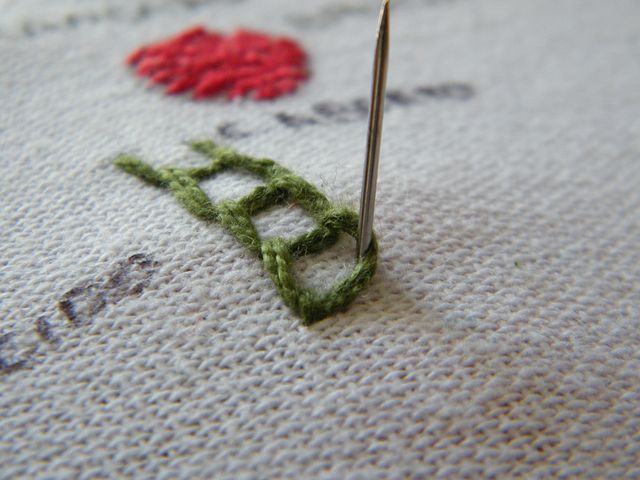
embroideryI have some more examples of creative doctoral work for you, and this time they’re all from the UK. (If you haven’t seen my previous posts on this topic, which include examples from other parts of the globe, they’re here and here.) They are also all from Twitter without which my work and life would be very much harder.

Chris Bailey, from Sheffield Hallam University, investigated the lived experience of an after-school Minecraft club. (For the uninitiated, Minecraft is a computer game which is itself creative and educational.) Chris wrote his thesis abstract as a comic strip. Parts of the thesis are conventional text and other parts are in comic strip form. He also uses the comic format to present data excerpts. Further, Chris uses images and a soundscape as integral parts of his thesis, and even represents the soundscape visually in a variety of ways.

Kate Fox, herself a poet and stand-up comedy and poetry performer, included comedy and poetry in her thesis from the University of Leeds. She was studying resistance in solo stand-up performance by Northern English women. There are poems in every chapter, and Kate uses an ‘interrupting voice’ throughout her thesis, in italic text, to illustrate the dialogic nature of stand-up in some very funny ways. For Kate, stand-up ‘can function as an academic methodology and critical pedagogy’ – I think many of us would like to see more of that!

Jenny Hall, from the University of the West of England (though now at Bournemouth University), used creative inquiry to study ‘the essence of the art of a midwife’ for her EdD. Jenny collected written personal histories, conducted ‘educational sessions’ that involved making, and used photo-elicitation with her participants. She also kept a reflexive research diary and used this to create a textile quilt with squares made as a response to individual diary entries, in a form of creative autoethnography. Jenny’s ‘Midwifery Quilt’ now has its own website.

Clare Danek is currently investigating ways in which people learn amateur craft making skills in community making spaces for a PhD from the University of Leeds. So this is something of a departure as she doesn’t yet have a finished thesis or dissertation, though I’m sure that day will come. Clare is keeping a diary of her PhD which is relevant here as it’s a ‘stitch journal’, as she calls it, using textile art. Also, she is documenting the process online. I am increasingly interested in the ways in which researchers are using creative methods for process as well as output. However, this is not generally well documented so it’s great to see Clare making her journal available as she creates. I’m sure this will help and inspire others.

It seems to me that doctoral students are increasingly finding their creative voices, and that more supervisors and examiners are willing to support this process. I am sure that part of this is due to the existence of precedents such as those listed here and in previous posts. These precedents – and, I’m told, also my book on creative research methods and its bibliography – enable doctoral students to build convincing academic arguments for the use of creative approaches that help to persuade reluctant supervisors. I am delighted to be able to witness and support this quiet revolution in academia.

This blog is funded by my beloved patrons. It takes me around one working day per month to post here each week. At the time of writing I’m receiving funding of $12 per month. If you think 4-5 of my blog posts is worth more than $12 – you can help! Ongoing support would be fantastic but you can also support for a single month if that works better for you. Support from Patrons also enables me to keep this blog ad-free. If you are not able to support me financially, please consider reviewing any of my books you have read – even a single-line review on Amazon or Goodreads is a huge help – or sharing a link to my work on social media. Thank you!

Why Research Participants Rock

dancingI wrote last week about the creative methods Roxanne Persaud and I used in our research into diversity and inclusion at Queen Mary University of London last year. One of those was screenplay writing, which we thought would be particularly useful if it depicted an interaction between a student and a very inclusive lecturer, or between a student and a less inclusive lecturer.

I love to work with screenplay writing. I use play script writing too, sometimes, though less often. With play script writing, you’re bound by theatre rules, so everything has to happen in one room, with minimal special effects. This can be really helpful when you’re researching something that happens in a specific place such as a parent and toddler group or a team sport. Screenplay, though, is more flexible: you can cut from private to public space, or include an army of mermaids if you wish. Also, screenplay writing offers more scope for descriptions of settings and characters, which, from a researcher’s point of view, can provide very useful data.

Especially when participants do their own thing! Our screenplay-writing participants largely ignored our suggestions about interactions between students and lecturers. Instead, we learned about a south Asian woman, the first in her family to go to university, who was lonely, isolated, and struggling to cope. We found out about a non-binary student’s experience of homophobia, sexism and violence in different places on campus. We saw how difficult it can be for Muslim students to join in with student life when alcohol plays a central role. Scenes like these gave us a much richer picture of facets of student inclusion and exclusion than we would have had if our participants had kept to their brief.

Other researchers using creative techniques have found this too. For example, Shamser Sinha and Les Back did collaborative research with young migrants in London. One participant, who they call Dorothy, wanted to use a camera, but wasn’t sure what to capture. Sinha suggested exploring how her immigration status affected where she went and what she could buy. Instead, Dorothy went sightseeing, and took pictures of Buckingham Palace. The stories she told about what this place and experience meant to her enriched the researchers’ perceptions of migrant life, not just the ‘aggrieved’ life they were initially interested in, but ‘her free life’ (Sinha and Back 2013:483).

Katy Vigurs aimed to use photo-elicitation to explore different generations’ perceptions of the English village where they lived. She worked with a ladies’ choir, a running club, and a youth project. Vigurs asked her participants to take pictures that would show how they saw and experienced their community. The runners did as she asked. The singers, who were older, took a few photos and also, unprompted, provided old photographs of village events and landmarks, old and new newspaper cuttings, photocopied and hand-drawn maps of the area with added annotations, and long written narratives about their perceptions and experiences of the village. The young people also took some photos, mostly of each other, but then spent a couple of hours with a map of the village, tracing the routes they used and talking with the researcher about where and how they spent time. Rather than standard photo-elicitation, this became ‘co-created mixed-media elicitation’ as Vigurs puts it (Vigurs and Kara 2016:520) (yes, I am the second author of this article, but all the research and much of the writing is hers). Again, this provided insights for the researcher that she could not have found using the method she originally planned.

Research ethics committees might frown on this level of flexibility. I would argue that it is more ethical than the traditional prescriptive approach to research. Our participants have knowledge and ideas and creativity to share. They don’t need us to teach them how to interact and work with others. In fact, our participants have a great deal to teach us, if we are only willing to listen and learn.

Creative Research In Practice

like cloudIt’s not often I get to share an output from the commissioned research I do. Sometimes clients don’t want to share publicly for reasons of confidentiality, and sometimes there are other reasons they don’t publish. As a commissioned researcher, I can’t publish the work someone else has paid for without their agreement. But I’m glad to say that Queen Mary University of London (QMUL) has published the full report of the research I did for them last year with my colleague Roxanne Persaud.

The research question was: How can QMUL improve students’ experience with respect to the inclusivity of their teaching, learning, and curricula? The original brief focused on the protected characteristics covered by the UK Equality Act 2010: age, disability, gender reassignment, marriage and civil partnership, pregnancy and maternity, race, religion and belief, and sexual orientation. Roxanne and I advised QMUL to take a more holistic approach to inclusivity, as the protected characteristics don’t cover some factors that we know can lead to discrimination and disadvantage, such as socioeconomic status and caring responsibilities. We recommended Appreciative Inquiry as a methodological framework, because it doesn’t start from a deficit perspective emphasising problems and complaints, but focuses on what an organisation does well and what it could do better. (It doesn’t ignore or sideline problems and complaints, either; it simply starts from the standpoint that there are assets to build on.)  And of course we suggested creative techniques, particularly for data-gathering and sense-making, alongside more conventional methods.

Roxanne and I were both keen to do this piece of work because we share an interest in diversity and inclusion. Neither of us had worked with QMUL before and we weren’t sure whether they would appreciate our approach to their brief. Sometimes commissioners want to recruit people who will do exactly what they specify. Even so, I’d rather say how I think a piece of work needs to be done; if the commissioner doesn’t want it done that way, then I don’t want the job.

QMUL shortlisted six sets of applicants. The interview was rigorous. Roxanne and I came out feeling we’d done ourselves justice, but with no clue as to whether we might have got the work or not. But we did!

The research was overseen by a Task & Finish group, made up of staff from different departments, who approved the methods we had put forward. We conducted a targeted literature review to identify key issues and best practice for inclusivity in the UK and overseas, and set the research in an institutional, societal, and theoretical context. The theoretical perspectives we used began with the theory of intersectionality developed by the law professor Kimberlé Crenshaw, which we then built on using the diffraction methodology of the physicist and social theorist Karen Barad. These two theories together provided a binocular lens for looking at a very complex phenomenon.

The timescale for the research was tight, and data gathering collided with Ramadan, exams, and the summer holidays. So, not surprisingly, we struggled with recruitment, despite strenuous efforts by us and by helpful colleagues at QMUL. We were able to involve 17 staff and 22 students from a wide range of departments. We conducted semi-structured telephone interviews with the staff, and gave students the option of participating in face-to-face interviews or group discussions using creative methods. These methods included:

  • The life-sized lecturer: an outline figure on a large sheet of paper, with a label indicating what kind of person they are e.g. ‘a typical QMUL lecturer’ and ‘an ideally inclusive lecturer’, which students could write and draw on.
  • Sticker maps: a map of organisational inclusivity, which we developed for QMUL, on which students could place small green stickers to indicate areas of good practice and small red stickers to indicate areas for further improvement.
  • Empathy maps: tools to help participants consider how other students or staff in different situations think and feel; what they might see, say, and do; and where they might experience ‘pain or gain’ with respect to inclusive learning.
  • Screenplay writing: a very short screenplay depicting an interaction between a student and a very inclusive lecturer, or between a student and a less inclusive lecturer. The screenplay will include dialogue and may also include information about characters’ attributes, the setting, and so on.

We generated over 50,000 words of data, which we imported into NVivo. Roxanne and I spent a day working together on emergent data coding, discussing excerpts from different interviews and group sessions, with the aim of extracting maximum richness. Then I finished the coding and carried out a thematic analysis while Roxanne finished the literature review.

We wrote a draft report, and then had two ‘review and refine’ meetings for sense-making, which were attended by 24 people. The first meeting was with members of the Task & Finish group, and the second was an open meeting, for participants and other interested people. We presented the draft findings, and put up sheets on the walls listing 37 key factors identified in the draft report. We gave participants three sticky stars to use to indicate their top priorities, and 10 sticky dots to use to indicate where they would allocate resources. People took the resource allocation incredibly seriously, and it was interesting to see how collaboratively they worked on this. I heard people saying things like, ‘That’s important, but it’s already got five dots on, so I’m going to put another one here.’ I wish I could have recorded all their conversations! We did collect some further data at these meetings, including touch-typed notes of group discussions and information about the relative frequency of occurrence, and importance, of the 37 key factors. All of this data was synthesised together with the previously collected data in the final report and its recommendations.

The comparatively small number of participants was a limitation, though we did include people from all faculties and most schools, and we certainly collected enough data for a solid qualitative study. We would have liked some quantitative data too, but the real limitation was that most of the people we reached were already concerned about inclusivity. We didn’t reach enough people to be able to say with certainty whether this was, or was not, the case more widely at QMUL. Also, while none of our participants disagreed unduly with our methodology or methods, others at QMUL may have done so. In a university including physicists, mathematicians, engineers, social scientists, artists, doctors, dentists and lawyers, among others, it seems highly unlikely that anyone could come up with an approach to research that would receive universal approval.

Yet I’m proud of this research. It’s not perfect – for example, I’ve realised, in the course of writing this blog post, that we didn’t explicitly include the research question in the research report! But its title is Inclusive Curricula, Teaching, and Learning: Adaptive Strategies for Inclusivity, which seems clear enough. I’m sure there are other ways it could be improved. But I’m really happy with the central features: the methodology, the methods, and the flexibility Roxanne and I offered to our client.

How to evaluate excellence in arts-based research

This article first appeared in Funding Insight on 19 May 2016 and is reproduced with kind permission of Research Professional. For more articles like this, visit www.researchprofessional.com.
judgementResearchers, research commissioners, and research funders all struggle with identifying good quality arts-based research. ‘I know it when I see it’ just doesn’t pass muster. Fortunately, Sarah J Tracy of Arizona State University has developed a helpful set of criteria that are now being used extensively to assess the quality of qualitative research, including arts-based and qualitative mixed-methods research.

Tracy’s conceptualisation includes eight criteria: worthy topic, rich rigour, sincerity, credibility, resonance, significant contribution, ethics, and meaningful coherence. Let’s look at each of those in a bit more detail.

A worthy topic is likely to be significant, meaningful, interesting, revealing, relevant, and timely. Such a topic may arise from contemporary social or personal phenomena, or from disciplinary priorities.

Rich rigour involves care and attention, particularly to sampling, data collection, and data analysis. It is the antithesis of the ‘quick and dirty’ research project, requiring diligence on the part of the researcher and leaving no room for short-cuts.

Sincerity involves honesty and transparency. Reflexivity is the key route to honesty, requiring researchers to interrogate and display their own impact on the research they conduct. Transparency focuses on the research process, and entails researchers disclosing their methods and decisions, the challenges they faced, any unexpected events that affected the research, and so on. It also involves crediting all those who have helped the researcher, such as funders, participants, or colleagues.

Credibility is a more complex criterion which, when achieved, produces research that can be perceived as trustworthy and on which people are willing to base decisions. Tracy suggests that there are four dimensions to achieving credibility: thick description, triangulation/crystallization, multiple voices, and participant input beyond data provision. Thick description means lots of detail and illustration to elucidate meanings which are clearly located in terms of theoretical, cultural, geographic, temporal, and other such location markers. Triangulation and crystallisation are both terms that refer to the use of multiplicity within research, such as through using multiple researchers, theories, methods, and/or data sources. The point of multiplicity is to consider the research question in a variety of ways, to enable the exploration of different facets of that question and thereby create deeper understanding. The use of multiple voices, particularly in research reporting, enables researchers more accurately to reflect the complexity of the research situation. Participant input beyond data provision provides opportunities for verification and elaboration of findings, and helps to ensure that research outputs are understandable and implementable.

Although all eight criteria are potentially relevant to arts-based research, resonance is perhaps the most directly relevant. It refers to the ability of research to have an emotional impact on its audiences or readers. Resonance has three aspects: aesthetic merit, generalisability, and transferability. Aesthetic merit means that style counts alongside, and works with, content, such that research is presented in a beautiful, evocative, artistic and accessible way. Generalisability refers to the potential for research to be valuable in a range of contexts, settings, or circumstances. Transferability is when an individual reader or audience member can take ideas from the research and apply them to their own situation.

Research can contribute to knowledge, policy, and/or practice, and will make a significant contribution if it extends knowledge or improves policy or practice. Research may also make a significant contribution to the development of methodology; there is a lot of scope for this with arts-based methods.

Several of the other criteria touch on ethical aspects of research. For example, many researchers would argue that reflexivity is an ethical necessity. However, ethics in research is so important that it also requires a criterion of its own. Tracy’s conceptualisation of ethics for research evaluation involves procedural, situational, relational, and exiting ethics. Procedural ethics refers to the system of research governance – or, for those whose research is not subject to formal ethical approval, the considerations therein such as participant welfare and data storage. Situational ethics requires consideration of the specific context for the research and how that might or should affect ethical decisions. Relational ethics involve treating others well during the research process: offering respect, extending compassion, keeping promises, and so on. And exiting ethics cover the ways in which researchers present and share findings, as well as aftercare for participants and others involved in the research.

Research that has meaningful coherence effectively does what it sets out to do. It will tell a clear story. That story may include paradox and contradiction, mess and disturbance. Nevertheless, it will bring together theory, literature, data and analysis in an interconnected and comprehensible way.

These criteria are not an unarguable rubric to which every qualitative researcher must adhere. Indeed there are times when they will conflict in practice. For example, you may have a delightfully resonant vignette, but be unable to use it because it would identify the participant concerned; participants may not be willing or able to be involved beyond data provision; and all the diligence in the world can’t guarantee a significant contribution. So, as always, researchers need to exercise their powers of thought, creativity, and improvisation in the service of good quality research, and use the criteria flexibly, as guidelines rather than rules. However, what these criteria do offer is a very helpful framework for assessing the likely quality of research at the design stage, and the actual quality of research on completion.

Next week I will post a case study demonstrating how these criteria can be used.