The Importance Of Creative Research Methods

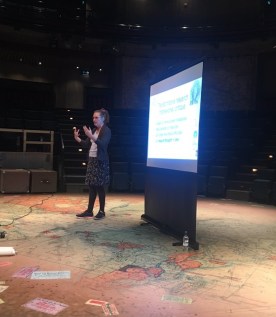
me presenting at CRMSS17Last Thursday, Friday and Saturday I was privileged to facilitate the inaugural Creative Research Methods summer school run by Keele University‘s Cultural Animation and Social Innovation Centre (CASIC) working with the New Vic Theatre in nearby Newcastle-under-Lyme. Around 40 people came, travelling from America and South Africa, Sweden and Poland, no doubt other countries I’ve forgotten, and all around the UK.

On the first two mornings we were lucky enough to get to work in the theatre’s auditorium, a wonderful space with plenty of room to move around and interact with people in all sorts of ways. On the first day we used pipecleaners to model journeys both literal and metaphorical, and on the second day we explored issues of power in research using Open Space Technology.

For the first two afternoons, we crossed the car park to the theatre’s Workspace rehearsal room, another great space – with a balcony! On the first afternoon we learned about cultural animation, used buttons to create community maps, then added frames and artefacts to help us come up with research questions. Then we devised and performed creative group presentations – that was so much fun! On the second afternoon we mapped pathways through participation in universities, using flip chart paper, coloured Post-It notes and pens, pipecleaners and tape – by now the creative juices were really flowing.

On the third day we were at the beautiful Keele campus, where (as it was a Saturday) we could use some of the university’s technology facilities: the KAVE for virtual reality and gaming, the Claus Moser studio for soundscapes, and the Turing Lab to make digital circuits. In the afternoon we focused on creative academic writing, hearing about ethnography as advocacy for the animals who are often invisible in social research, and geopoetics, before doing a geopoetics exercise.

We crammed in a great deal, yet there was so much else we could have included. Perhaps the richest part of the summer school was its discussions: between any two people, or a group, or all of us together. I was delighted and astonished by the calibre of the students: an enormously intelligent, creative, dynamic bunch; it was an honour to spend three days in their company.

I love to teach creative research methods, and I’m looking forward to my next gig this Friday at LSE for the National Centre for Research Methods (fully booked I’m afraid). I find a lot of my teaching involves giving people permission to work creatively – or perhaps enabling them to give themselves permission – and advising people on how to convince supervisors and ethics committees that it is legitimate to take a creative approach to research. There is a long hard fight ahead to convince people in certain quarters that useful knowledge exists beyond the bounds of academic convention. In this fight, we are on the same side as Indigenous researchers around the world who find their methodologies are sidelined or ridiculed by the academy. Anishnabe researcher Kathy Absolon, in conversation with Plains Cree and Salteaux researcher Margaret Kovach, said this:

If you go on a water walk or quest, that is your methodology. I was reflecting when you were talking about yours [methodology]. If I said I am doing my PhD and my methodology is my dreams, and I am going to go on a fast every year, and after that fast I had somebody come and visit me and talk to me about my fast and take [teachings] with them. I wouldn’t propose that because I wouldn’t want that to [be] measured. I know that is Indigenous methodologies, but I wouldn’t propose it as a methodology within a mainstream setting because I don’t want them to have the power to say that that’s not research. But it is. (Absolon in Kovach 2009:152-3)

There is a parallel here with creative research in the Euro-Western paradigm, where supervisors, ethics committees, journal editors and reviewers, and others have the power to say ‘this is not research’ to people who know perfectly well that their textile art, ice-skating, or poetry, is indeed research. Patricia Leavy has written eloquently of ‘the ache of false separation’ that some people feel when required to keep their art separate from their research work (2010:240).

Some people have said to me that one reason I can write the books I write is that I’m not an academic. As an independent researcher, I have much less power than many academics, in many ways. But I do have the power to say ‘this is research’, and to collect the evidence that this is research, and put it in a scholarly book, so that other people can cite that work, which helps to convince doubting/frightened/threatened supervisors and others. And I will stand with Indigenous researchers, though their methods are not my methods, because I recognise that knowledge comes from more places and in more ways in this complex and beautiful world than those I can access myself.

Still it feels lonely sometimes. So having the opportunity to spend three days with a group of lively-minded people, who are not only open to this but engaging with it, excited by it, and pushing its boundaries in fascinating ways, was an absolute delight.

The Variety Of Indie Research Work

varietyOne of the things I love about being an independent researcher is the sheer variety of projects I work on and tasks I might do in a day. Yesterday, I was only in the office for the afternoon, yet I worked on at least seven different things. Here’s what I did.

First, I checked Twitter, and found a tweet with a link to a blog post I wrote about an event that is part of a project I’m working on with and for the forensic science community. This is a new departure for me, in that I haven’t worked with forensic scientists before, though the work itself is straightforward. I’m supporting a small group of people with research to identify the best way to create a repository for good quality student research data, and it’s surprisingly interesting. So I retweeted the tweet.

Second, I dealt with the morning’s emails. The arrival of a purchase order I’d been waiting for weeks to receive – hurrah! I formulated the invoice and sent it off to the client. Then some correspondence about the creative research methods summer school I’m facilitating at Keele in early July – just three weeks away now, so the planning is hotting up (and there are still some places left if you’d like to join us – it’ll be informative and fun). The most interesting email was a blog post from Naomi Barnes, an Australian education scholar who is considering what it means to be a white educator in the Australian school system. This chimes with the work I am doing on my next book, so I leave a comment and tweet the link.

While on Twitter, I got side-tracked by a tweet announcing #AuthorsForGrenfell, an initiative set up by authors for authors to donate items for auction to raise funds for the Red Cross London Fire Relief Fund to help survivors of the Grenfell Tower fire. I’d been wanting to help: my father is a Londoner, I have always had family in London, I lived in London myself from 1982-1997, and one member of my family is working in the tower right now to recover bodies. So it feels very close to home. But I’m not in a position to give lots of money, so I was delighted to find this option which I hope will enable me to raise more money than I could give myself. I have offered one copy of each of my books plus a Skype consultation with each one. My items aren’t yet up on the site, but I hope they will be soon because bidding is open already. If you’re one of my wealthy readers, please go over there and make a bid!

Then I spent some time researching aftercare for data. Yes, indeed there is such a thing. So far I’ve come up with two ways to take care of your data after your project is finished: secure storage and open publication. They are of course diametrically opposed, and which you choose depends on the nature of your data. Open publication is the ethical choice in most cases, enabling your data to be reused and cited, increasing your visibility as a researcher, and reducing the overall burden on potential research participants. In some cases, though, personal or commercial sensitivities will require secure storage of data. There may be other ways to take care of data after the end of a project, and I’ll be on the lookout for those as I work on my next book.

By now it was 6 pm so I did a last trawl of the emails, and found one from Sage Publishing with a link to a Dropbox folder containing 20 research methods case studies for me to review. They publish these cases online as part of their Methodspace website. I like this work: it’s flexible enough to fit around other commitments and, like other kinds of review, it tests my knowledge of research methods while also helping me to stay up to date. Best of all, unlike other kinds of review, Sage pay for my expertise. So I downloaded all the documents, checked and signed the contract, and emailed it back with a ‘thank you’. By then it was 6.30 pm and time to go home.

As the old saying goes, variety is the spice of life. I certainly like the flavour it gives to my work. Some days I work on a single project all day; those days are fun too. Yesterday I worked in my own office, today I’m out at meetings locally, tomorrow I’m off to London. It’s always ‘all change’ and I wouldn’t have it any other way.

Concentric Circles for Gathering Research Data

concentric-circlesMost people, when they think about gathering primary data for research, think of the ‘Big Three’ methods: questionnaire surveys, interviews, and focus groups. This is rather limiting when there are so many other methods that can help to answer research questions. One example is concentric circles. They are used quite frequently in market research, and have also been used in social research for several decades, yet I am frequently surprised to come across people who have no knowledge of this approach.

Concentric circles are generally used to investigate people’s relationships with other people, objects, or phenomena. There are two main ways to use concentric circles. One way is to put something at the centre – in market research, usually a product or brand – and ask the participant to make a cross, or drag-and-drop a digital image, to a point within the circles that they feel represents their closeness to that product or brand. So, for me, if the brand was Nestlé I’d put myself right on the outer edge, whereas with a product such as the Co-op’s fairly traded wine, I’d be close to the centre.

The other option is to put the participant at the centre, and ask them to use the concentric circles to map relationships such as the people or agencies who support them, with those they feel closest to placed nearest to the centre and vice versa. This can be done in evaluation research as part of a pre-post design to document changes. For example, if part of the point of a service is to act as a gateway or signpost to other relevant agencies, it might be useful to ask users of that service to map their relationship with other agencies at the first point of contact, and again after a suitable period of time. That would help to assess the impact of the service in increasing users’ links with other agencies.

The concept of this is easy for participants to grasp, perhaps because the circles provide a recognisable structure but are not prescriptive. They are appealing because they give the participant a lot of choice and flexibility in how they respond. This avoids difficulties that can be raised by a standard type of research question such as, ‘How supportive is your spouse or partner?’ Some participants would find a question like this difficult to answer, say if their spouse or partner was unsupportive, or abusive, or recently deceased. If such a participant met this question in a survey, interview, or focus group, at best they would provide no or inaccurate data, and they could suffer serious embarrassment or upset. However, with the concentric circles, a participant can choose which of the people in their lives they include in the discussion.

Perhaps because of their ease and sensitivity, concentric circles have been used effectively in research with children, the elderly, and people with learning disabilities, among other groups. They are rarely the only method used, but they add an interesting and useful dimension to an investigation. In fact, the potential applications of concentric circles are many and varied. For example, they could be used in:

  • Nutritional research to explore people’s relationships with different foodstuffs
  • Tourism research to investigate people’s relationships with different modes of travel
  • Sports research to assess people’s relationships with different types of exercise

And that’s just off the top of my head.

Completed concentric circles can provide powerful illustrations for research reports and presentations, although care should be taken to ensure that participants and others who may be mentioned cannot be identified as a result. One option here is for a researcher to recreate a participant’s concentric circles with different names and/or with changes to other identifying details.

I’ve just put in a proposal to a potential client including concentric circles. I hope they like the idea. Do you use concentric circles? Or do you think you might use them in the future?

Creative Research Methods on Video

Last week I was so poorly I did very little work, so this week I’m playing catch-up as hard as I can go. I wasn’t sure where I’d find the time to write a blog post, but luckily I don’t have to, because those nice people at the UK’s National Centre for Research Methods have made a video of a seminar on creative research methods I gave at the University of Southampton last month.

This video references two other videos which I will include here for your viewing pleasure. They are both creative research outputs, coincidentally both from Canada, though they are very different from each other. The first is ‘The 7,024th Patient’, and talks about an exhibition created to disseminate research into people’s experiences of open-heart surgery.

The second is ‘Have We Waited Too Long?’, a digital story about some of the effects of climate change on the remote northern community of Rigolet in Labrador.

Together, these videos will give you a sense of the breadth and possibilities offered by creative research methods. Grab the popcorn, sit back, and enjoy!

Creative Research Methods

Creative research methods in the social sciences [FC]I have always been interested in creative research methods: not at the expense of traditional methods, but to augment them. I have used a variety of creative methods, when appropriate, such as storytelling and photo-elicitation for gathering data, fictionalisation and photo-essays for writing research, and drama for presenting findings. I have also combined methods where necessary, used technology in research, and worked within a participatory framework where possible.

A couple of years ago, for reasons I can’t now remember, I went looking for a book on creative research methods. I searched all the usual online booksellers but couldn’t find anything that fitted the bill. So I decided to write one.

In the process of writing this book, I read hundreds of journal articles, book chapters, sometimes whole books. I didn’t read everything there is to read – that wouldn’t be possible – but I learned a lot. And it slowly dawned on me that the field of creative research methods could be conceptualised as having four broad categories:

  1. Arts-based research – e.g. visual arts, performance arts, textile arts
  2. Research using technology – e.g. social media, apps, computer/video games
  3. Mixed methods research – traditionally qual+quant, but also quant+quant and qual+qual
  4. Transformative research frameworks – e.g. participatory research, feminist research, decolonising methodologies, activist research

Clearly I am not suggesting that these categories are mutually exclusive. In fact I did find some examples of research employing tools from all four categories. But they do provide a useful way of thinking about the subject for now (I say ‘for now’ as the field is developing fast, so may need a new conceptualisation in time).

I found many fabulous, inspiring, examples of research across all of these categories and from all over the world. There are over 100 boxed examples in my book, with others scattered throughout the text, and I still didn’t have room to include everything I would have liked to cover. I also realised that ‘creative methods’ doesn’t always mean ‘innovative methods’ (though it often does). It may mean being creative with traditional methods, such as by combining those methods in an unusual way or taking a new look at an existing method. For example, in recent years researchers using focus groups realised that they could get more out of the data by analysing the interactions between people in each group, as well as the content of the text yielded by the transcripts.

I’m delighted to say that even though the book isn’t out yet, it has received a good reception from academics around the world. It has been described, among other things, as an ‘inspiration’, a ‘treasure trove’, and ‘ground-breaking’. And most wonderful of all, especially as my first degree was in psychology, my creative research heroes Kenneth Gergen and Mary Gergen have very kindly written a foreword.

So publication day is 10 April in the UK, May 15 in the US. Here’s a very short book trailer I made for you.

If you would like a copy, you can buy direct from the publisher, Policy Press, at a 35% discount, by signing up to their monthly e-newsletter. This applies wherever you are in the world, and the discount is on all their books, not just mine. They publish some excellent work so I’d recommend checking this out.

If you want to know more about creative research methods, I hosted a twitterchat on 26 March, on the #ecrchat hashtag, and the storify is here.

The book will be formally launched at a one-day conference at the British Library Conference Centre on 8 May. The conference has four workshop streams and I’ll bet you can guess what they’re on… yep: arts-based research, research using technology, mixed methods research, and transformative research frameworks. There seems to be a real appetite for this topic, as we had an unprecedented number of abstracts – four for each presentation – so we have a terrific selection of workshops. Over half of the places are already booked. So if you’d like to come to the conference, please don’t leave it till the last minute, as it is likely to sell out. I hope to see you there!