Analysing Data For Your PhD: New Book Launch!

ADFYPhD_darkbrown_neurons_LC_RGBToday sees the launch of the third in my Phd Knowledge series. The subject of data analysis is close to my heart. It is at the core of our work as researchers, yet it’s often poorly understood. Doctoral students can find themselves facing the analysis of a sizeable amount of data without really knowing what it is they’re supposed to do. My new e-book, Analysing Data For Your PhD: An Introduction, is designed to help in this situation – or, if you read it in time, to prevent you reaching such a stressful impasse. This book follows on from the previous books, Starting Your PhD: What You Need To Know and Gathering Data For Your PhD: An Introduction, but it works equally well as a stand-alone volume for anyone who only wants to delve into this part of the process. It is concise – around 10,000 words – and clearly written (says my editor – in fact, he said ‘As usual, this was a beautifully written little document to work on’). And, as with the others, it costs less than the price of a coffee: £1.99/$2.99 and equivalent prices in other jurisdictions.

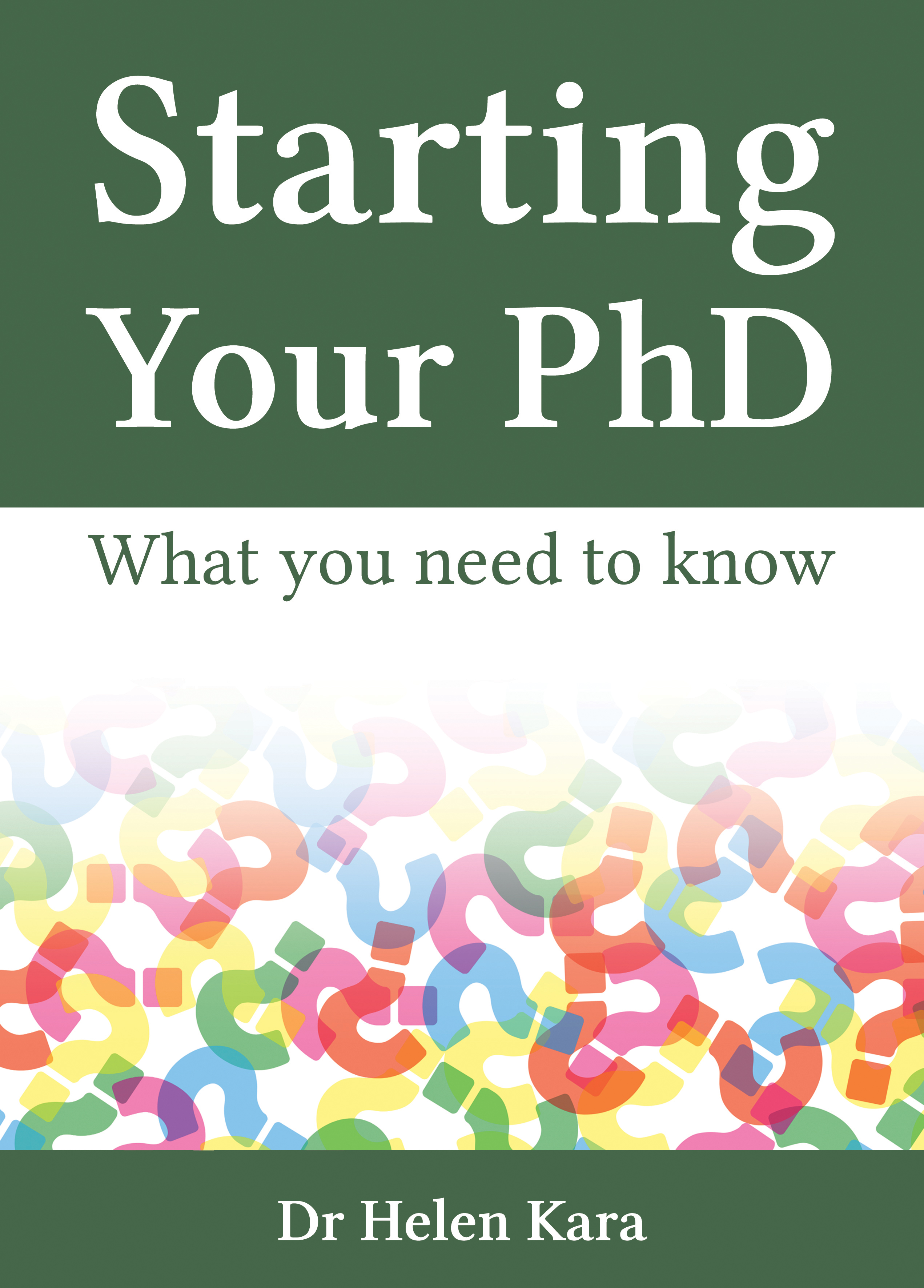
But wait! There’s more! To celebrate the launch, and in recognition of the new academic semester starting soon in Australia and New Zealand, I have reduced the price of Starting Your PhD to £0.99/$1.49. This is a time-limited offer for one week only, so get downloading. And happy reading!


Ten Ways To Get Hold Of Academic Literature

https://www.flickr.com/photos/jdickert/2570185865One of the big barriers to doing academic work when you’re not a salaried academic is lack of access to academic literature. Books are one problem, though you can often get hold of them through inter-library loans, national libraries, or (if they’re not too new) cheap second-hand copies online. But academic journals are the major difficulty.

People outside academia often don’t realise that even salaried academics won’t have access to everything. University libraries have budgets and have to decide which journals to subscribe to. Even professors sometimes need to use the techniques in this post. But those of us outside academia need to use them all the time. So, for those who don’t yet know, here are my top ten methods for getting hold of academic literature.

  1. Use openly accessible literature. Much of this can be found online. You may find relevant ‘grey’ (non-academic) literature through conventional search engines: anything from commercial research reports to zines. But for journal articles, I’d recommend starting with the Directory of Open Access Journals. This independent directory includes over 2 million articles in over 10,000 open access journals, more than half of which are searchable at article level, and more are being added all the time. The journals cover most topics and must be subject to peer review or editorial quality control.
  1. Look for conventionally published articles that are openly accessible. Publishers such as Sage, Taylor & Francis, Elsevier, Emerald, Wiley, and Springer are quietly making more and more content open access. Follow them on Twitter for the latest news. Sometimes a publisher will open its electronic doors completely for a limited period of time, which gives you a chance to get in and harvest pdfs to your heart’s content. More often they will offer a selection of openly accessible articles which you can find by digging around in their websites. And some have initiatives such as SpringerOpen which encompasses a range of fully open access journals in science, technology, and mathematics.
  1. When you search using Google Scholar, look beneath each search result for the small print that says ‘all X versions’ (X being a number). Click on that link and sometimes you will find that one or more of the versions includes a pdf you can download. This may be a pre-print or draft article, but it will be close enough to the final paper for you to assess whether you want to cite it.
  1. Academic social media sites, such as ResearchGate and Academia.edu, act as repositories for pre-prints and other openly accessible formats of articles which are uploaded by their authors. Anyone can sign up to these sites and they can be a useful way of keeping track, particularly of new literature by people whose work you respect.
  1. Google Books is a project for scanning and digitizing books. If a book is out of copyright, or the author has given consent, you can search and see full pages. Otherwise you can search and see small sections of text around the search string; sometimes this can be enough for your purposes.
  1. Amazon lets you ‘look inside’ some books, and again you can search and see parts of the text around the search string. Amazon is also handy for tracking down citation details as you can always look at the copyright page of any book with the ‘look inside’ feature.
  1. For much fuller access to academic literature, you could consider securing an affiliation with a university department. Universities can offer honorary titles such as Associate Fellow or Visiting Fellow. These don’t come with a salary attached, but they do come with benefits including access to electronic and hard copy literature, seminars, collaborations, and perhaps some mentoring. Also, it looks good on your CV. You might be asked to do some teaching or other academic work in return. If you know of a department where there are people in your field, you could ask whether they would take you on as an associate.
  1. Another option is to ask people you know in universities to get pdfs for you. If you’re going to do this, make sure first that the university concerned has access to the journal from which you want articles; you should be able to do this via the journal’s website, or the university library’s website, or both. It’s probably best not to ask people too often, though, as that can get annoying.
  1. Twitter is also a great place for sourcing articles. You can either put out a general tweet, perhaps with the ubiquitous ‘pls RT’ at the end, or you can use a hashtag such as #ICanHazPDF which will put your tweet in front of a wider audience. Do include the link for the article you want, and use a link shortener such as bitly to make more space in your tweet.
  1. If all else fails, email the corresponding author and ask for a copy of the article. Keep your email short, and polite, but try to say something about why you want the article and what you’ll be using it for. Authors are usually pleased if someone shows an interest in their work and will be happy to email an article to you.

However, there is a big question, for me, about the extent to which all this is ethical. And there are certainly some very unethical ways of accessing academic information, such as downloading pirated e-books – though I do realise that, in some countries, people have few or no alternatives. So next week I’ll say more about the ethics of academic publishing.

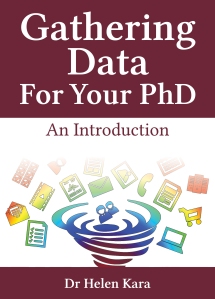
Gathering Data For Your PhD – New Book Launch!

GDFYPhD_red_data_LC_multi_RGBYou may remember that just two months ago, on this very blog, I announced the start of my indie publishing career. I’m publishing a range of short e-books for doctoral students, and the first one was Starting Your PhD: What You Need To Know, launched on 8 September. I’m delighted to launch the second one today: Gathering Data For Your PhD: An Introduction.

Again, it’s around 11,000 words, and is suitable for all doctoral students, whether studying for a scholarly PhD or a professional doctorate. Here is the blurb:

You can’t do research without data. But what kind of data will help you answer your research question? Where can you find that data? And how much data do you need? If you’re doing doctoral research, particularly in the social sciences, arts, or humanities, this book will help you answer those questions. It offers an overview of traditional and innovative methods of gathering quantitative, qualitative, secondary and primary data. The book also outlines the pros and cons of devising your own method of gathering data, and lists a range of resources for further exploration of the methods that interest you most.

Just like the last book, it’s available for the price of a coffee: $2.99/£1.99/E2.99 or thereabouts – exact prices may vary slightly with different distributors. Talking of which, it’s available (or will be any minute) from all the major players: Kindle, iBooks, Kobo, Nook etc.

This seems a perfect time to launch my latest oeuvre, as it’s the first ever Academic Book Week here in the UK. There are loads of events and discussions happening all over the country. There’s very little, though, about indie publishing – perhaps because Academic Book Week mostly involves traditional publishers and booksellers. I want to emphasise here that I don’t see indie publishing as a rival to traditional publishing, though I guess there may be some booksellers who wish digital books had never been invented. I love p-books and I don’t want, or expect, them to disappear. But I think there is also room for e-books in academia, and it surprises me that so few academics and alt-acs are taking up this opportunity.

Are You An Ethical Writer?

word cloud of this blog, to date

Professional writers and speakers know that the way we think and feel influences the words we choose to write or speak. We may not understand so clearly that the words we choose to use can influence the thoughts and feelings of others.

A generation ago, women lobbied for changes to terminology which gave the impression that men were dominant – as indeed they were in Western society at that time. Up to 1978, for example, a woman could be fired from her job in the US for being pregnant, and up to 1982 UK pubs could refuse to serve women. But at the same time, women were beginning to take roles traditionally assigned to men, which led to some linguistic oddities. I remember feeling rather uncomfortable with being designated the ‘chairman’ of a committee, when ‘chairperson’ or simply ‘chair’ would have served as well. There were fierce arguments between those who believed that traditional language use supported the discriminatory status quo, and those who thought it made no difference.

Some people went further than I thought was sensible, replacing ‘history’ with ‘herstory’ (I can see the point of that in some circumstances, but the etymology of the word suggests that it’s much more about the ‘story’ than the ‘his’) or ‘woman’ with ‘womyn’ (I didn’t get that one at all). This kind of terminological tinkering led to the phrase ‘political correctness’ being used to discredit all attempts to replace sexist terms with existing, sensible, neutral terms. I still wince when I see reports of women ‘manning a stall’ – what’s wrong with ‘staffing’? But it’s now quite usual to speak of a ‘police officer’ rather than ‘policeman’ or ‘policewoman’, and a ‘flight attendant’ rather than an ‘air hostess’ or ‘steward’. These changes in terminology have moved in parallel with increasing opportunities and equality for women in the Western world over recent decades.

However, there is some new terminology that I think is unhelpful for some sections of society. I read an interesting article in the Guardian last week in which the non-fiction writer Steven Poole gave a very thoughtful analysis of the unintentional difficulties caused by the phrase ‘first world problems’. The article is worth reading if you have time. He shows how the reductive use of ‘first world’, with its implicit opposition to the ‘third world’ (which is itself an unfashionable term these days), enables people to condescend, patronise, humblebrag, sidestep compassion, and generally dehumanise pretty much everyone.

Also last week, on social media, I questioned someone’s use of the American phrase ‘wife beater’ to describe a sleeveless t-shirt. I’m not naming the person here because they didn’t welcome my questioning and I don’t want them to think I’m trying to start some kind of online war. The person I questioned is someone I follow because, in my view, they do valuable work online to highlight social inequality. Their casual use of the phrase ‘wife beater’, with its implication that domestic violence can be acceptable, seemed to sit oddly with their pro-equality stance. I am sure this was unintentional on their part; I can think of a number of other words and phrases that I’m sure they wouldn’t use at all because of the discriminatory implications.

Another one is the new-ish way of designating something as in some way poor by saying ‘it gets old really fast’. I am getting old, rather faster than I would like, and I am becoming increasingly aware of the discrimination and difficulties experienced by the older members of our society. I would prefer colloquial usage of the word ‘old’ to have positive connotations.

These examples have become stock phrases, akin to cliches. And cliches are evidence of lazy thinking. All this has implications for us as writers. Writing is a creative process, and that includes academic writing. Stories must be told, words and structures chosen, and these processes are permeated with creativity. Academics, altacs and researchers, earn our livings with our brains. I would argue that we have an ethical responsibility to avoid the lazy cliche and express our new thinking in fresh language. Also, we should try to remain aware of the potential effects of our creative choices on our readers. It is our responsibility to ensure, as far as possible, that we don’t use language in a way that could support discriminatory actions or practices.

Indie Publishing for Academia – Ten Top Tips

SYPhD_green_SQmarks_noblend_LC2_RGBThree weeks ago I became an indie publisher as well as an indie researcher and writer. In that time, my embryonic publishing company, Know More Publishing (see what I did there?!), has gained a website. Also, my first short affordable e-book, Starting Your PhD: What You Need To Know, has gained three five-star reviews on Amazon UK and a fourth on Amazon US. I didn’t bribe a single reviewer!

It’s around a year since I decided to go down this road, and I’ve learned a lot along the way. I think there’s a great deal of potential in indie publishing for academics, altacs, doctoral students and others. Indie publishing doesn’t figure in organisational performance metrics, which creates a barrier for some people, though perhaps one day it will. But it’s a great way to produce work which is too long for academic journals, or doesn’t fit their requirements, but is shorter than a traditionally published book. And it’s open access – you can make your work available for free if you wish, or at a very low cost.

On the down side, there is no quality control. I know there are arguments about whether the peer review system actually enhances quality, but editors certainly do, if they’re doing their jobs properly. With indie publishing, it is possible to plonk any old drivel online for sale. That’s not the kind of indie publishing I advocate. I worked in traditional publishing, I write for traditional publishers, and I have loved books all my life. So I want to see good quality indie publishing from academia and its associates, and to publish good quality books myself. Here are my ten top tips for anyone who shares my aims.

  1. Write something nobody else has written. As an academic or altac, you should be used to spotting gaps in literature. Your work will gain much more interest from others if it’s the only one of its kind.
  1. Get feedback on your writing. Starting Your PhD went through three sets of beta readers, from potential doctoral students to experienced supervisors. It wouldn’t have been worth publishing without their input.
  1. Use a professional editor. It doesn’t matter how experienced a writer you are, you will have blind spots. I know I did. I will always pay to have my books edited by a skilled professional who can bring fresh eyes and a keen brain to improving my text.
  1. Unless you are really good at design yourself, use a professional cover designer. You need someone who knows about book covers, how to make them stand out even at thumbnail size on a mobile device.
  1. Join the Alliance of Independent Authors. This worldwide organisation has approved ‘partner members’ including editors and cover designers which is useful if you don’t have people in your networks with those skills. They also have an active and ALLiEthicalAuthor_Badgesupportive closed group on Facebook where you can get help with all aspects of indie writing and publishing. And they have an Ethical Author code, as well as a publicly accessible searchable blog full of sound advice.
  1. Be prepared to do lots of promotional work. As an indie publisher, you’re not only the author, you’re also the sales and marketing departments for your work. This could involve anything from chatting on Twitter to lugging print copies around with you. You will need to decide what you can do, when, and how. It doesn’t have to be much – but if you don’t do anything to promote your work, it will sink beneath the ocean of available literature.
  1. Buy ISBNs, aka International Standard Book Numbers. These are the 10 or 13 digit numbers used by cataloguing systems to identify each unique book. You can only buy them from one organisation in each country, they’re not cheap (though the more you buy, the cheaper each number becomes), and you can’t transfer them between publishers or even leave them in your will. Also they take ten days to issue, so don’t leave this until the last minute, or you’ll have to postpone your book launch (like I did, ahem). You can get free identifiers such as ASINs from distributors such as Amazon, Kobo, and Barnes & Noble (Nook), but these are distribution codes, not unique book identifiers – or if they are actual ISBNs, they are owned and assigned by the distributor, not by you. This effectively means you are giving away part of the control you have over your work, and having control of your own work is a big part of the rationale for publishing independently in the first place. There’s a more detailed explanation of this on the Alliance of Independent Authors’ blog.
  1. Research the different ways you can publish your work – and expect to spend a considerable amount of time on this, as there are a lot of options. To begin with: e-book only, print only, or both? I’ve gone for e-book only, as I’m writing short books for students who will be comfortable with technology, and e-books are more affordable than print books. So then I decided to publish via Kindle Direct Publishing. This is a no-brainer even if you regard Amazon as the evil empire, because you will sell most of your work from this platform, so if you’re not willing to do business with Amazon at all, don’t publish independently. I also decided to use Draft2Digital, who take a small commission from your income for distributing through most of the other major channels – Kobo, Barnes & Noble (Nook), iBooks, Scribd etc – and they’re very helpful when you get stuck with your uploading, as I did. You could upload your work with each platform individually, and save yourself the commission; it’s your decision whether the hassle is worth the benefit. I decided that, for me, it wasn’t – and my sales figures, so far, bear this out (see below). I might decide to produce print books one day, in which case I’d use CreateSpace on the advice of fellow members of the Alliance of Independent Authors.
  1. Launch your book with some kind of a fanfare – then relax. I had a virtual launch day with a dedicated blog post and a lot of tweeting. Ten days later I went on holiday, which was excellent timing, as the process of preparing and publishing the e-book was much more difficult, stressful, and exhausting than I anticipated. I won’t be able to take a holiday every time, but I’m going to build in at least a weekend off after each one from now on.
  1. Write another book. Full disclosure: in the first three weeks, I’ve made £56.48 from sales on Amazon and $6.30 from sales through Draft2Digital. Not bad for a first e-book priced at £1.99/$2.99. However, given that I’ve shelled out around £500 on editing, cover design, and ISBNs, at this rate it will be six months before I break even. But I have a cunning plan for world domination: the next book in this series, Gathering Data For Your PhD, will be out in November, and I have four more planned for 2016. There is clear evidence that the more you publish and promote, the more readers you will acquire. This applies in the same way to free material.

I hope my learning over the last year will benefit others. If you decide to go down the indie publishing road, do let me know. At present I only know of two other academic types who are doing this: Dr Nathan Ryder, who has published a couple of very useful short e-books on preparing for your viva, and Dr Jenna Condie, who has a book of blog posts on sustainable urbanisation. If you know of other academic indie publishers, please leave a comment. Let’s start a movement!

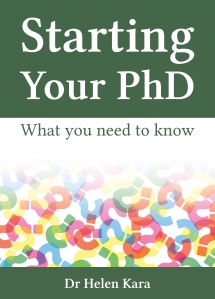
Starting Your PhD – New Book Launch!

SYPhD_green_SQmarks_noblend_LC2_RGBI’m launching my Top Secret Project today. It is a short e-book (11,000 words) called Starting Your PhD: What You Need To Know. I published this e-book myself, under the Know More Publishing imprint (see what I did there?!), which I set up for the purpose. The book is available via Kindle, Kobo, Nook, iBooks, Scribd, and Inktera. So as well as being an indie researcher and writer, I’m now an indie publisher too!

I wrote three drafts of the e-book, each of which received feedback from a small group of different beta readers, including people who might do a PhD one day, current doctoral students, and experienced supervisors. The final version was professionally edited. I am very grateful to my beta readers and to my editor, each of whom provided input which improved the book’s quality. And you can buy the fruits of all this labour and experience for the price of a coffee: approx £1.99/$2.99/E3.29 or equivalent (actual prices may vary slightly due to circumstances beyond my control).

So why did I take up indie publishing, you may ask? There are times I’ve been wondering that myself over the last year or so, as it’s been a massive learning curve. I think if I’d known how much work was involved, I probably wouldn’t have started the process. But now that the curve is beginning to flatten out, I’m very glad I did. There are a number of reasons I decided to publish independently. In no particular order, the main ones are:

  • I spotted a gap in the market that a short e-book would fill
  • I’m intrigued by indie publishing; it seems to fit with being an indie researcher and writer
  • Short e-books are increasing in popularity
  • I wanted to offer good quality and affordable help for doctoral students

I expect you’re wondering whether I’ve done all this work just to produce one short e-book. No, I haven’t. ‘Starting Your PhD’ is the first in the ‘PhD Knowledge’ series, with other volumes of similar length to include:

  • Gathering Data for your PhD: An Introduction
  • Analysing Data for your PhD: An Introduction
  • Writing Your PhD: An Introduction
  • Research Ethics for your PhD: An Introduction
  • Finishing Your PhD: What You Need To Know

The second volume is scheduled for publication in November, and I aim to publish the others in the course of 2016.

ALLiEthicalAuthor_BadgeThis is an exciting new venture for me. I’ve had loads of help already: from friends, colleagues, people I’ve met online, and the Alliance of Independent Authors. I’m proud to be a member, and would recommend them to anyone; their closed Facebook group is an invaluable source of support. Also, I’m particularly pleased that they have a code of ethics for indie authors, with the guiding principle of putting the reader first – a principle that guides all my writing.

With that in mind, I need your help too, because there are some things you can do for potential readers that I can’t: tell them about the book, and write honest reviews to help people decide whether the book would be useful for them. Of course I can tell some people, but with my traditionally published books, I’ve had access to an established publishing firm which employed a range of professionals to help spread the word. As an indie publisher I am my own marketing, distribution, and sales departments. So it would be enormously helpful if you could talk about this e-book to people who might find it useful: people considering doctoral study, people embarking on doctoral study, or people supporting someone else through their doctoral study. When I say ‘talk’ I mean the virtual kind too, i.e. tweeting, blogging, Facebook etc. And I absolutely can’t, and wouldn’t, review the book I’ve written; that would be most unethical, so I’m completely reliant on others to give their honest opinion in a way that will help prospective readers decide whether it’s worth investing a few of their hard-earned coins.

Doing a PhD – or a professional doctorate; the e-book is applicable to either – is an enormous undertaking. It can be really difficult even to start on this long, complex process, much of which is incomprehensible at the start. I began mine, back in the early 2000s, with a complete false start which cost me a year and a lot of wasted time and effort; I ended up at a different university with a completely different topic, supervisor, and discipline than I’d originally planned. I guess that is another reason I wrote the e-book: to help others make a more sure-footed start, and to save them timchampagne launche and effort.

If this works for you, please do let me know, either in the comments or on Twitter where I always love to hear from my readers. But for now: I declare my indie publishing career in general, and the Starting a PhD e-book in particular, open!

Loving Your PhD

love PhDI was surprised, and pleased, by the positive reaction to last week’s post. One commenter said, ‘I like how you have started a conversation about the good things in academic life, not just the bad.’

Last week I was co-opted into a Twitter chat between Katy Vigurs (@drkatyvigurs) and the British Sociological Association’s Postgraduate Forum (@BSAPGForum). Katy tweeted that she had signed up for the new MOOC being run by the Thesis Whisperer called ‘Survive your PhD’. BSAPGF responded asking, ‘Do we always ‘survive’ our PhDs? Is it possible to enjoy them without the narratives of desperation?’ Short story shorter, I agreed to write a blog post about the positive side of the PhD experience.

Please note: this is not intended in any way as criticism of the MOOC or the Thesis Whisperer – the MOOC looks great and, if you’re a PhD student and you haven’t yet signed up, I’d recommend checking it out. But I think BSAPGF has a point: negative discourses about academia seem to outweigh the positive right now, and it would be good to redress the balance.

One of last week’s commenters on this blog described her PhD experience as ‘resoundingly positive’, and another said she had had only ‘encouraging and nurturing experiences’. This chimes with my own experience. In the three years of my doctoral study I had very few negative or difficult experiences. A couple of bereavements close together led to a taxing few months, and later one of my supervisors lost a parent which, quite understandably, meant she was not at her best for a while. My supervisors and I didn’t always agree about the best way forward, but we worked through and mostly learned from our disagreements. It was a real intellectual stretch, and I remember whingeing to my partner about how hard it was – not that I got much sympathy; he usually replied, ‘It’s supposed to be hard, it’s a PhD!’.

But generally my PhD was a very positive and enjoyable experience. I loved having the opportunity to do my own research for once, rather than dancing to a commissioner’s tune. I adored spending whole days reading, writing, and thinking. My supervisors were supportive and helpful. And I had such a good time at my viva: full details in a podcast here.

I’ve been pondering why my PhD experience was so good. I think some of this was circumstance and luck. As a doctoral student I had two big advantages: I was already a researcher, and I was already a writer. This meant I was well acquainted with the inverted curve of the research project:

research curve diagram 2

And I had already co-written a book, so the amount of writing required for a PhD thesis didn’t feel daunting. Also, I was used to working alone a lot of the time. Plus I had support from several friends who were already doing PhDs when I started. And I was self-employed, with no dependents, which meant I could find time to work on my PhD more easily than some people.

I think that even if you’re in a very different position, there are things you can do to maximise the chances of loving your PhD. Here are my top five:

1. Choose a research area you’re passionate about
2. Be relentlessly organised: with planning, time, record-keeping – in fact everything
3. Build and maintain a good relationship with your supervisor
4. Write early and often and throughout the process
5. Practise self-care: exercise, eat well, reward yourself for achievement, take breaks

Some people, for all sorts of reasons, have a terrible time while doing, or trying to do, a PhD. Too many who register fail to complete – something the MOOC is aiming to address. But a lot of people have a fine time: not without hurdles to overcome (no project spanning years is ever likely to be completely free of difficulty) but, overall, a positive and enjoyable experience. And I think we forget how very privileged we are as doctoral students, to be able to work towards the highest academic qualification in existence. Surely this is not an opportunity to take for granted, but one to celebrate and relish.

Untold Stories of Academia

Para-cover-v07-resizeI’ve heard a number of stories, in the last couple of weeks, which suggest that the academy is hurting people. Some of these stories have been in the mainstream media, e.g. the Guardian article on the inability of universities to support students who are the victims of sexual violence. Some have been on social media, e.g. this blog post on the experiences of people with disabilities in academia or the comments on this blog ‘About Me’ page, whose author describes himself as having run ‘the whole gamut of the academic track (degree-postgrad-PhD-postdoc-despair)’. And some have been in person, mostly stories of managers who are unsympathetic at best, discriminatory or bullying at worst, and staff who are at serious risk of buckling under the strain.

The Para-Academic Handbook, edited by Alex Wardrop and Deborah Withers, tells more of these stories. Its subtitle is A Toolkit for Making, Learning, Creating, Acting, which sounds positive, but much of the text uses strong language to bemoan the state of higher education today. Staff are ’emotionally drained’, students are ‘burdened by extortionate debt’, para-academics are ‘subjected to the callous mediocrity of temporary contracts that offer absolutely nothing in terms of “career development”, or any kind of rung on the ruthless academic ladder’. This is a ‘landscape where ideals and values are devastated’.

This is fighting talk, though I’m not entirely sure where the battle lies, because I hear other stories too. For example, in the last couple of months alone, one academic has told me of promotion, pleased at the likelihood of being able to use their increased seniority to lever better outcomes for students. I spent time with another academic celebrating their successful research funding bid, and heard about the social problems that research team will now be able to investigate and address. And a young friend found a job just before she graduated with a good degree and a manageable amount of debt; she is happily embarking on her new life this very week.

These stories paint a picture of a landscape where ideals and values are alive, well, and possibly even flourishing. So why are there such opposing experiences? And why do we hear so much more about the negative than the positive?

I wonder whether some people may have a particular set of expectations about academia, which it no longer lives up to – if it ever did. I’m sure there are people who have similar experiences in other professional fields: who want to work on a cruise ship, say, or in a hospital, but when they get there, they find it’s not what they thought it would be and they have to move on. Also, those who interact with academia have specific skills. In particular, they tend to be articulate and good at writing, which may explain why we hear more from those unhappy with academia than we might from those unhappy with cruise ships or hospitals. And, of course, misery is regarded as newsworthy, whereas people doing their work well or getting good results is never going to make the headlines.

Most of the unhappy stories seem to be presented in terms of people struggling with academia. Yet it seems to me that what matters is not the relationship between person and institution, but the relationships between people. For sure, there are real problems caused by the managerialist, corporate, performance assessment culture that has developed in academia. But from the stories I have heard and read, it looks to me as though part of the trouble lies with some managers who dump these difficulties onto junior academics, offloading the problems without providing commensurate support. Conversely, other managers shield junior academics from those difficulties as far as they are able, and help them to navigate the rest.

Again, I’m sure this is not the whole story – but it is a story I don’t see in the mainstream or social media. I hope the negative press that academia is getting at present doesn’t damage the morale of the good managers, as has happened in other professions such as social work. There are a lot of good managers, working hard, mostly unseen, to make their small corner of academia function as well as possible for students, colleagues, para-academics, research participants, and all the people they come into contact with. I know this because I’m lucky enough to work with some of them, and ‘callous mediocrity’ has never been my experience. They are resilient and creative, and they don’t cause harm, they help people. Let’s tell their stories, too.

Ten Top Tips for Successful Collaboration

collaborationWorking in collaboration with others can be a wonderful experience. Writing a journal article with a colleague, or working in a research team with people from other organisations, can be life-enhancing. Ideas build on ideas; tasks are allocated according to people’s strengths and abilities; the results are loads better than anything you could achieve alone.

Collaborative working can also be a monumental pain in the neck. Misunderstandings, missed deadlines, and poor communication can sabotage a project, morphing it from a promising outset into a morass of time-consuming frustration and annoyance, sometimes with nothing to show for all the grief you’ve gone through. That can be particularly galling when you end up apologising for something that was not at all your fault and entirely outside your control.

And you know the really weird thing about working collaboratively? Nobody ever tells you how to do it; you’re supposed to know. But my experience is that many people don’t know how to collaborate well. So here are ten top tips for successful collaboration.

  1. Set sensible deadlines. If you’re happy to write a book chapter that you think will take you a week, but you don’t have that much spare time till six months from now, say so. And if you think it will take you a week, allow a fortnight. Over-committing doesn’t help you or anyone else.
  1. Manage your time well, from day to day and week to week, and at monthly and yearly levels too. Plan, schedule, re-schedule as necessary. Do what you say you’re going to do, when you say you’re going to do it – or explain why you can’t at the earliest opportunity.
  1. Communicate, communicate, communicate. Problems arise in everyone’s life. If you encounter a problem that will affect your ability to meet your commitments, tell everyone who needs to know as soon as you can, and give them a realistic revised date when you’ll be able to get the work done.
  1. If someone else is causing a delay, you may need to take control, particularly if you have contractual or other inflexible deadlines and the delaying person isn’t communicating well – or at all. In that case, the best approach is to send a polite email with appropriate cc’s so everyone knows where the delay originates. But do word your message carefully: the aim is to protect your own reputation without damaging anyone else’s, so stick to the facts.
  1. Don’t throw good time after bad. If you’re collaborating with people who are missing deadlines and not answering your emails, chase them once or twice then stop. Don’t stress about it, just focus on other work.
  1. Accept feedback gracefully, even if it seems unpalatable at first. Don’t take it personally because it isn’t personal, even if it feels personal, even if it looks personal. It’s an opportunity to learn things you’d be very unlikely to learn any other way, even if they’re not the things you wanted to learn. So thank whoever gave you the feedback and make the best use of it you can.
  1. Reflect on your collaborations – with your collaborators if possible, on your own if not. What went well? Why? What didn’t go so well? Why? What would you do differently another time?
  1. celebrationMake time to celebrate a collaboration that goes well, or even well enough. If you can meet up with your collaborators, so much the better: go for a drink or a meal together and congratulate each other in person. If not, celebrate online, in a private meeting or via email or social media. Or simply send a card to say ‘thank you’ or ‘well done’.
  1. Whether your collaborators are your colleagues, your students, your staff or your friends, be as professional with each of them as you would be with the most senior person in your field or in your organisation.
  1. When you’re planning a new collaboration, share these tips with your potential collaborators at the earliest possible stage and ask whether they’re willing to sign up to them. If they’re not, don’t go ahead with the proposed collaboration.

Of course sometimes life gets in the way and things go wrong. But when you have a strongly functional collaboration, it is much easier to deal with unexpected difficulties. When unforeseen problems occur and your collaboration is floundering, life can be very miserable indeed. If you and your collaborators follow these ten top tips, none of your collaborations will be the ‘pain in the neck’ variety. They should all work smoothly, at the very least, and may well be wonderful and life-enhancing.

The Art Of Asking

theartofasking_imageFollowing on from last week’s blog post, I’ve been reflecting on the art of asking, why it can be so difficult, and how to make it easier.

I used to find it difficult to ask for help. I am naturally independent, and grew up on second-wave feminism which preached self-reliance. Asking can be hard because it’s a risk: you’re making yourself vulnerable, exposing your wishes or your needs, and the person you are asking might say ‘no’. You could experience that ‘no’ as a rejection or a slap in the face, as derogatory to your very being in the world. Alternatively, you could reflect that nothing major has changed, you’re still in the same position you were in before, and you have lost nothing. Or you could land up somewhere in between.

Asking can be easier in professional than personal contexts. Asking a librarian to help you track down a book, or the IT support desk to help you solve a techie problem, should be stress-free. You’re entitled to ask and it’s their job to help. But when you’re an indie researcher, those organisational networks of obligation don’t exist. So asking for things in professional contexts can be weird, even paralysing: why would anyone want to help me? Why would anyone be willing to put themselves out on my behalf?

I found myself on a steep learning curve in asking when I developed rheumatoid arthritis a couple of years ago and needed help with opening jars and bottles, moving furniture, doing DIY etc. The writer Laura James expresses the necessity of this eloquently and, like her, I have become shameless about asking for help. This has probably helped me learn to ask in other areas. Amanda Palmer’s wonderful book also provided a timely shove in the right direction.

I’ve learned other things as a result of learning to ask for help. For example, some people are incredibly helpful. Professor Rosalind Edwards is one of these people. I met Ros at a conference in Leicester in early 2014 (which, incidentally, I got to go to because I asked, on Twitter). The previous week I’d been to a meeting at the British Library, where I’m on an advisory panel for the Social Welfare Portal, and Ros’s name was mentioned as someone we could ask for help with publicity through her role as Co-Director of the National Centre for Research Methods (NCRM). So when I realised she was at the conference, I went to ask her for help on behalf of the Portal, and found out that she’s warm and helpful and funny. We chatted on Twitter in the weeks and months following the conference. Another kind and helpful person, Kandy Woodfield, invited me to be on a panel at the 2014 Research Methods Festival, which Ros helps to organise, so we met again then and had a lovely chat on a bench in the sunshine.

A couple of months ago I decided that I would really like to be a Visiting Fellow at NCRM. I had a look online, but couldn’t find evidence of any opportunities. So I asked Ros. She said NCRM didn’t have visiting fellows, but they’d been thinking about whether to start. I said was there any chance they could start with me? She went away and talked to the other directors, and they said ‘yes’.

They said ‘yes’!

So as from this very day, I am a Visiting Fellow at NCRM. Because I asked. I wouldn’t be one, otherwise.

Another incredibly helpful person, Gemma Noon, is currently Impact Evaluation lead at Calgary Public Library. I met her online in the noughties, we met in person once before she emigrated from the UK, and we’ve kept in touch. She stunned me by inviting me to give a keynote in Canada, all expenses paid – my first international speaking engagement! I didn’t even ask! But I did ask Gemma whether she had any contacts with local universities, and she put me in touch with Carol Shepstone at Mount Royal University, and I asked her whether she would like me to do any work for them while I was in the area, and she said ‘yes’. Then, at the creative research methods conference a couple of months ago, I saw Barbara Schneider present her excellent research. Barbara works at the University of Calgary, so I asked her whether she would like me to do any work for her while I was in the area – and she said ‘yes’. So in late October I’m off to Canada, to work for the library service and two universities in Calgary.

They said ‘yes’!

Some of this, of course, is sheer luck, and being in the right place at the right time. And there is an old saying: ‘the harder you work, the luckier you get’, and I do work hard, so I figured that was the other influencing factor. I sent Ros a draft of this post, as a courtesy because it features her, and she told me firmly that my analysis was incomplete. She wrote,blush

“Of course, we don’t just give out fellowships because we get asked, and I bet you wouldn’t be invited to Calgary if it wasn’t because people think you are rather good at this research thing. You miss that bit of the story!”

*blush*

Even so, if I hadn’t asked for help, I wouldn’t be where I am today. I’m also finding that the more I practice asking, the easier it becomes. I now regularly ask people for help: old friends and new, professional contacts, random strangers on Twitter. Of course they don’t all say ‘yes’ – but a surprisingly large number of people are able and willing to help.

If the prospect of asking repels you, ask yourself this: how do you respond when someone asks you for help? Are you generally willing to help others? I bet you are; it probably makes you feel good. And if that’s the case, why aren’t you willing to give other people that feel-good sensation by asking them for help in turn? Go on, give it a try – the results can be surprising and delightful.