
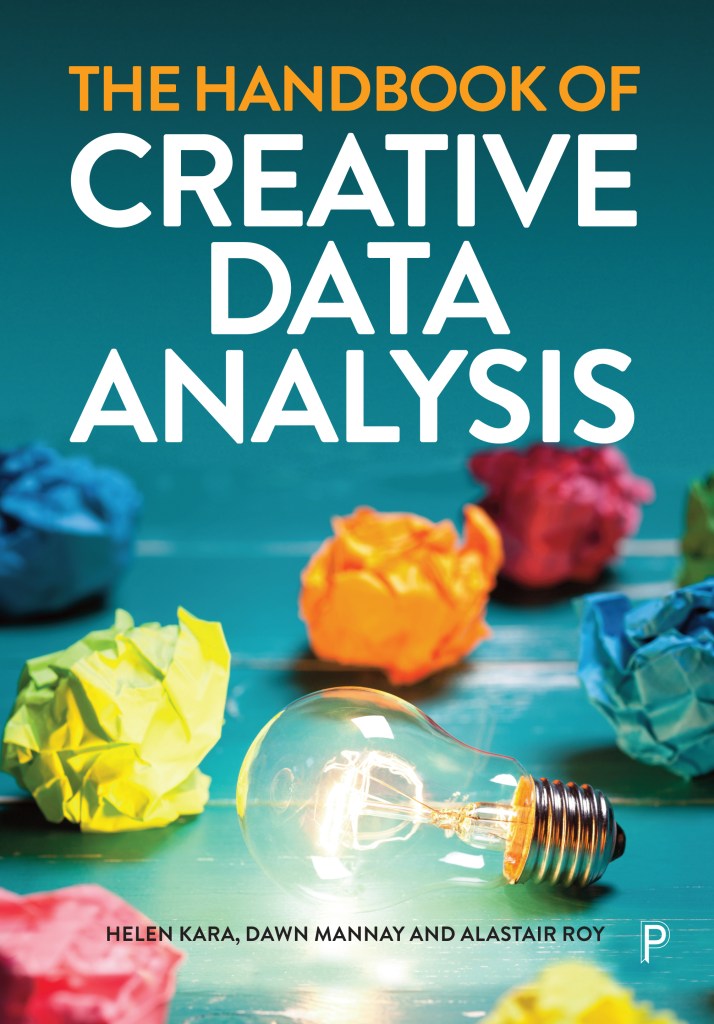
The Handbook of Creative Data Analysis

I am delighted to say that The Handbook of Creative Data Analysis was published this month. It’s a chunky tome with 29 substantive chapters, each outlining a creative method and its implications, plus introductory and concluding chapters by the editors.

Here’s how it came about. I first wanted to do this book in 2016. I knew it wasn’t a book I could write myself unless I could get some funding to research it – I applied for a grant from Leverhulme in 2017, for which independent researchers were eligible, but I was unsuccessful. I didn’t think it was a book that could be co-written, either. I thought of an edited collection, but wasn’t confident of doing that well enough on my own. And I didn’t have any good ideas about who to ask to co-edit with me.

Then in February 2021 I chaired a webinar on creativity in research for Policy Press with Dawn Mannay (Professor of Creative Research Methodologies at Cardiff) and Ali Roy (Professor of Social Research at UCLan). I already knew them both and it was a pleasure to do the webinar with them. We were surprised by the number of questions about data analysis, and after the webinar it occurred to me that they would be good co-editors for the book I had in mind. Then I considered their busy academic lives and figured they probably wouldn’t be interested. Then I thought I could just send an email to ask – nothing ventured, nothing gained… and they both said yes!

We decided Policy Press should publish the book and we put together a call for proposals. At this stage we were envisaging a standard-sized book with maybe 12 chapters. What we weren’t envisaging was around 60 proposals, most of which were really good. So we asked Policy Press if we could do a Handbook instead and they said yes. (Around this time I had also been asked to edit the Bloomsbury Handbook of Creative Research Methods. Fortunately I was able to divert a lot of the good proposals we couldn’t fit into the Policy Press Handbook to the Bloomsbury Handbook, so we didn’t have to reject too many outright.)

The process of editing this Handbook was a joy for several reasons. Dawn and Ali were great to work with – we named ourselves ‘good cop’ (me), ‘bad cop’ (Dawn), and ‘ambivalent cop’ (Ali)! I wanted to say yes to as much as possible, Dawn had a keen eye for quality standards, and Ali was great at seeing the merits of, and balancing, different arguments. And the combination of those three attributes was, in practice, greater than the sum of its parts. Then our contributors were, without exception, terrific, responsive, collegial people to work with. And Policy Press were thoroughly supportive throughout.

The part I liked best, though, was the learning. Each individual chapter held fascinating lessons and made me want to have a go at doing analysis with emojis, or reflective stitching, or word clouds. But there were some overall learning points, each made by several authors, that I found particularly interesting. The first is that any data can be analysed creatively: quant or qual, conventionally collected or creatively generated. The second is that analysis is not a discrete phase of research which falls between acquiring data and reporting results. Analytic work begins at the design stage of research and continues through dissemination and beyond. The third overall learning point is that doing analysis differently helps us to find new insights, learning, and understanding. The fourth is that analysing data often requires creativity, whether or not this is explicit.

Researchers use tacit as well as acknowledged creative practices to support their analytic work, and this is highlighted in several chapters. These tacit creative practices have always fascinated me. When I get stuck in the analytic mire, I write poems or create diagrams to help me move forward. Sometimes only half a poem or diagram, and my analytic poems never see the light of day though occasionally my diagrams do. But these techniques help my analytic thought processes. I was interested to discover other tacit creative practices, such as visual arts (doodling, drawing, collage etc), making (models, installations etc), music (to accompany and promote thought), and embodied practices such as walking, running and swimming. No doubt there are others too.

The fifth overall learning point is that analytic processes do not need to be fixed or rigid. This book demonstrates, in many ways, that analytic work can be experimental, playful, and fun.

At present the book is only available in hardback and digital versions. The digital version is much cheaper than the hardback, and you can get a 25% discount on either version by signing up to the publisher’s e-newsletter. If you are at college or university you should be able to get hold of a copy from the library. And there will be a paperback in due course. I am so happy that this book is out in the world because I think it will help a lot of people.

NCIS Guide for Independent Scholars 

NCIS stands for the National Coalition for Independent Scholars which is in fact a global institution that includes independent researchers as well as independent scholars. I have been a member for some years and was very grateful when they supported the inaugural International Creative Research Methods Conference with sponsorship plus a conference chairperson and someone to manage the online chat.  

I am grateful to them again because they have produced an open-access Guide for Independent Scholars which is free to download. It is a full-length book with 17 chapters in five sections (full disclosure: two of the chapters are by me). The Guide was edited by Amanda Haste and Linda Baines, former and current Presidents of NCIS, and they did a fine job. 

The main reason I am grateful is because I think now people will stop asking me to write a book about and for indies. Or at least, if anyone does ask me, I can say no because it’s already been done – and done very well. I think it is a much better book than I could have written, because independent research and scholarship is an incredibly wide and varied profession, and multiple voices of people from around the world give a much clearer view of this breadth and variety than I could have done alone. I think this is part of the reason why I didn’t want to write a book for indies. I have a strong instinct for which books I can write by myself, and which need a pair or team of authors or to be an edited collection. I guess maybe I could have edited a collection of chapters, but Amanda and Linda are far better placed to do that, with their extensive NCIS networks, than I would have been. 

Also, I have been glad to be able to read this book! It contains a lot of valuable stories and nuggets of information, useful even for someone like me who has been independent for 25 years, and invaluable for someone starting out or early in their independent career. I recommend this book if you are independent yourself, or you work with indies, or you know an independent researcher or scholar, or you are considering moving into independent work. I am pleased to be able to tell you that it is a good read – at least, the chapters not by me are; you will have to judge mine for yourself. 

Why Did I Edit Such an Expensive Book?

The Bloomsbury Handbook of Creative Research Methods, published last month, is at present only available in hardback at a recommended retail price of £140, or as an ebook at £126. Regular readers will know that I have ranted on this blog before about the iniquitous prices charged by some academic publishers, and advocated working with not-for-profit university presses. So, it is reasonable to ask me, as some people have: why did I agree to edit this expensive book for Bloomsbury?

The backstory is this: Maria Brauzzi, an editor at Bloomsbury who I did not know, emailed me in late 2021 to invite me to edit a Handbook of Creative Research Methods for them. At the time I had started work on editing a creative data analysis book for Policy Press with Dawn Mannay and Ali Roy, and chapter proposals were landing in my inbox. We received over 60 proposals, most of which were good. We had originally intended to produce a normal-sized book with around 12 chapters, but with so many good proposals to choose from, Policy Press agreed to produce a Handbook of Creative Data Analysis with around 30 chapters. (I’m delighted to say that is now in production and will be published in early September.)

Even so, selecting the chapters to include in the Policy Press Handbook was tough. Then I had a brainwave! I hadn’t replied to Maria at Bloomsbury because I couldn’t decide whether to accept her invitation. So, I emailed back and told her I had too many good proposals to fit into the Handbook I was doing with Policy Press, and asked whether I could pivot some of them into the Handbook she wanted to commission for Bloomsbury. She said ‘yes!’ so I ended up being sole editor of one Handbook and lead editor of another at the same time. 

I do not recommend this course of action unless you have, as I had then (and I’m glad to say, have again now), a solid, competent, and reliable support worker or other assistant. I could not have edited this Handbook without my support worker’s help. But editing it meant I was able to offer publishing opportunities to people who deserved them, including some people from marginalised groups. I’m glad I could do that, even though it meant working for a publisher who screws royalties down to the bone, lower than any of my other publishers, while earning a massive profit by selling books at prices that most people can’t afford.

So, to redress the balance a tiny little bit, I am offering a free copy of the Handbook to one of my blog followers. If you’re not a follower yet, you should be able to see a ‘Follow Blog Via Email’ notice with space to enter your email address. Any blog follower who wants a chance of a free copy needs to comment below and check back here a week after this blog has been posted to see who has won. My support worker will put all the names in a hat and pick one at random, then add a comment stating who will receive the free copy. I will post a book to that person, wherever they are in the world. 

Congratulations to Lucia 🎉 our winner of the prize draw for a free copy of The Bloomsbury Handbook of Creative Research Methods!

How To Find A Collaborator

The question to ask first is, when might you want to find a collaborator? Some work needs to be done alone, such as most doctoral research. Some work is sometimes best done alone, such as writing an opinion piece for a high-profile blog. But some work definitely needs to be done in collaboration. Most research benefits from collaboration. When I am commissioned to do a piece of research alone or with one other colleague, I always recommend that the commissioner set up a small group of relevant people to advise and steer the research project. And writing often benefits from collaboration too. In fact academic writing is always more or less collaborative: even if only one person is named as the author, the work will have been influenced by other scholars, colleagues, reviewers, editors – the list is long. And if more than one author is named, the work is likely to have benefited from the sustained engagement of more than one person.

Some work really needs collaborators. Three colleagues and I wrote Creative Research Methods in Education, and it was a better book, as a result, than it would have been if any three or two of us had worked on the project. I often receive requests to collaborate with others on research, or writing or both. Sometimes they are from friends or colleagues, and I always consider those carefully. Narelle Lemon from Swinburne University in Melbourne, Australia, suggested we work together on the education book when we first met in person. Sometimes requests to collaborate come from people I don’t know. The reception those ones get will vary depending on what the person is proposing and how they put that across. If the email is from a free email provider such as gmail, with lots of spelling mistakes, asking me to collaborate on research to help prove that hemlock cures cancer – and to contribute to the funding of that research – I will reach swiftly for the delete button. Conversely, if the email is from an organisational address, well written, and asking me to collaborate on work that is within one of my areas of expertise, I will respond – and if the enquirer mentions that they have a budget, I am likely to respond positively.

The best collaboration request I have had from a stranger came from Richard Phillips of Sheffield University. His initial message, in July 2018, simply said: “Dear Helen, I would like to explore the possibility of involving you in a workshop on creative writing and social research, and have a budget for this. It would be great to hear from you and discuss. Thanks, Richard.” Short, to the point, and very interesting indeed. I emailed straight back, and in his reply he told me he liked my book on creative research methods. Better and better! We spoke a couple of days later, met a couple of weeks after that, ran the workshop in November 2018, and our book on Creative Writing for Social Research was published in January 2021.

If you want to find a collaborator, the most important thing is to do your homework. If you want someone to co-write a journal article about the role of manicures in ex-convict rehabilitation, you need to find someone who shares that niche interest. And when you do find someone who seems suitable, make sure your potential collaborator likes to write; not everyone does. There should be no need to introduce yourself, because the person you are contacting should be able to find information about you online; if they can’t, they are much less likely to agree to collaborate with you.

Overall, people are more likely to agree to collaborate if you are their peer or above, the work you are proposing is within their areas of interest, and you have a budget. If you have nothing but passion for a project, it is still worth asking suitable people if they are willing to collaborate, but be prepared for rejection. Also, please be aware that offering to collaborate for free could put you at risk of being exploited. However much you care about an issue, it is equally important to take care of yourself.

This blog, the monthly #CRMethodsChat on Twitter, and the videos on my YouTube channel, are funded by my beloved Patrons. Patrons receive exclusive content and various rewards, depending on their level of support, such as access to my special private Patreon-only blog posts, bi-monthly Q&A sessions on Zoom, free e-book downloads and signed copies of my books. Patrons can also suggest topics for my blogs and videos. If you want to support me by becoming a Patron click here. Whilst ongoing support would be fantastic you can make a one-time donation instead, through the PayPal button on this blog, if that works better for you. If you are not able to support me financially, please consider reviewing any of my books you have read – even a single-line review on Amazon or Goodreads is a huge help – or sharing a link to my work on social media. Thank you!

Qualitative Research for Quantitative Researchers

My new book on Qualitative Research for Quantitative Researchers was published last week. It came about in an odd kind of way. Some conversations online, mostly with members of the Women in Academia Support Network, plus various comments in client meetings, and a few things I’d read, coalesced in my head into an idea. Then it just so happened that I was at a meeting for the PRO-RES project, in London, in November 2019, and also present was Katie Metzler, a vice-president of SAGE Publishing. I had met Katie before and we had chatted on Twitter. While we were catching up over pre-meeting coffee, I told her of my idea. The next thing I knew, she had whipped out her phone and asked a commissioning editor to work with me on the book.

It was an interesting book to write, tracing a journey I had made myself – if I hadn’t, I don’t think I could have written the book. My first degree, a BSc in Social Psychology at the London School of Economics in the early 1980s, was pure quantitative research. One of the things I most enjoyed was following reference trails down interesting paths in the library, and during one of these intellectual expeditions I found out about qualitative research. It fascinated me even then, and I asked if I could do a qualitative dissertation in my third year, but the answer was a resounding, rather shocked, and very firm ‘no’.

That seemed illogical to me, and slightly annoying, but there was nothing I could do. I didn’t realise I had been caught up in the paradigm wars until I learned about them, much later, when I was doing an MSc in Social Research Methods in the early 2000s. The MSc covered both quant and qual methods, and you could specialise in either or both. It also taught social theory and the relationship of theory to research and research to practice. This time, my dissertation was qualitative, and I am still in touch with my wonderful dissertation supervisor Maggie O’Neill.

My PhD was mostly qualitative though I sneaked in a few bits of quant – my doctoral supervisors weren’t keen, but I have never seen the point of sticking to one or the other exclusively when some of both could work better. In the early 2000s I regularly met methodological opposition in my commissioned research. My own non-disciplinary and pragmatic approach to methods and theory is to use what is likely to work best to help me answer my research question, within the constraints of budget, timescale and so on. But some people are attached to specific methods or theories, whether through disciplinary or individual preference. I have long thought it is unnecessary and unhelpful to limit your options in that way.

In the later 2000s and early 2010s I observed little increases in flexibility here and there, such as some clinical researchers becoming more amenable to the occasional qualitative element, and some qualitative evaluators conceding that numbers could come in handy now and again. Further into the 2010s this began to pick up pace, and towards the end of the decade I noticed quantitative researchers discussing how difficult they found some aspects of qualitative research. Some comments I saved from online discussions included:

As a medic, I found some challenges personally conducting quali research – I come from a more quant background.”

I’m a biomed scientist who wants to learn and do mixed methods research. We’re not bad people but (gasp) have never been told any other method than the scientific method exists.

I was trained a positivist marine biologist and am now a marine social scientist… the field of social science has multiple philosophies that as natural scientists we rarely get to hear of, let alone understand.”

“I am also biomedical by background and have just started to use mixed methods/qual stuff. I am STRUGGLING it is really hard to wrap your head around if you’re just used to p values.”

I thought I could write a book to help people in these kinds of situations. So I did. And I’m delighted to say the finished book has already had some very good reviews. I am proud of what I have achieved with this book, and I hope it will help a lot of researchers.

By the way, if you’re interested in this subject you might want to join my Qualitative Research for Quantitative Researchers course at the Methods at Manchester summer school in June.

This blog, the monthly #CRMethodsChat on Twitter, and the videos on my YouTube channel, are funded by my beloved Patrons. Patrons receive exclusive content and various rewards, depending on their level of support, such as access to my special private Patreon-only blog posts, bi-monthly Q&A sessions on Zoom, free e-book downloads and signed copies of my books. Patrons can also suggest topics for my blogs and videos. If you want to support me by becoming a Patron click here. Whilst ongoing support would be fantastic you can make a one-time donation instead, through the PayPal button on this blog, if that works better for you. If you are not able to support me financially, please consider reviewing any of my books you have read – even a single-line review on Amazon or Goodreads is a huge help – or sharing a link to my work on social media. Thank you!

Innovation in Academic Publishing

I often get emails from publishing professionals wanting to commission a book. Mostly I reply with a polite version of ‘no, go away’, because I already have loads of writing projects stretching far into the future so it would be idiotic to take on any more. But now and again something piques my interest.

During the holidays I received a message from a commissioning editor at Lived Places Publishing. This is a new venture, based in the US and working globally, aiming to make publishing more inclusive. They are setting up a Disability Studies Collection ‘to increase understanding and advance the social and economic inclusion of people with disability’ and they asked me to write a book for the collection. I replied, true to form, with a polite version of ‘no, go away’, but this time I also said I would publicise the venture on my blog. Because, although I don’t want to write for them at present, you might.

Disability is not the only area they are working on. They are also commissioning work for a Black Studies Collection, an Education Studies Collection, a Latinx Studies Collection, and a Queer and LGBT+ Studies Collection. All of the commissioning editors are experienced and claim to work supportively. They want to commission short books (40,000–50,000 words) that are useful for both education settings and the wider public.

Regular readers will know I bang on about the woeful rates of academic royalties from time to time. One reason I am choosing to publicise Lived Places Publishing is that they are working hard to make improvements for authors. To begin with, they are being entirely transparent about their approach to ‘revenue sharing’. They take 50% to fund the publishing house; 20% goes to authors as royalties; 10% goes to collection editors; 5% is dedicated to funding open access, and 15% is ‘set aside to owner’s equity to be used at the discretion of the ownership to fund the growth of the publishing enterprise once breakeven has been achieved’.

I have a lot of time for this approach. Partly because I am in favour of transparency. In the conventional model, authors can negotiate, but most academic publishers work to keep authors’ royalty rates as low as possible and don’t offer much wriggle room. Also, some forbid authors from discussing their royalty rates with others, so we can never find out what might be possible. And partly because 20% across the board is, in my experience, a much higher royalty than most academic publishers pay.

Of course the whole thing could be a scam, but I don’t think so, for several reasons. First, the commissioning editors are experienced and that is verifiable online. Second, it seems very well thought through and professional. Third, Lived Places Publishing are in a partnership with Newgen, and here I do have some personal experience. Newgen is also a young venture, just over three years old, offering project management services to publishers. They managed the production of Qualitative and Digital Research in Times of Crisis for Policy Press, and they were very good to work with: friendly, helpful, professional.

You can subscribe to Lived Places Publishing to get free articles, written by commissioning editors and authors, in your inbox. They say ‘Hold us accountable and challenge us to remain true to our convictions as we build Lived Places Publishing. If we’re successful, we’ll challenge the rest of the industry to amend their practices.’ And that is something I would love to see.

This blog, the monthly #CRMethodsChat on Twitter, and the videos on my YouTube channel, are funded by my beloved Patrons. Patrons receive exclusive content and various rewards, depending on their level of support, such as access to my special private Patreon-only blog posts, bi-monthly Q&A sessions on Zoom, free e-book downloads and signed copies of my books. Patrons can also suggest topics for my blogs and videos. If you want to support me by becoming a Patron click here. Whilst ongoing support would be fantastic you can make a one-time donation instead, through the PayPal button on this blog, if that works better for you. If you are not able to support me financially, please consider reviewing any of my books you have read – even a single-line review on Amazon or Goodreads is a huge help – or sharing a link to my work on social media. Thank you!

Why writing is never fixed or final

I am working on the third edition of my first research methods book. Books like this, if they sell enough copies, are regularly updated into new editions. There are a few reasons for this. One is that ideas develop and the world changes, which means updates are needed. Another is that a new book usually has a comparatively small word count to help keep the price down; when it is proven to sell well, there is a business case for an increased word count and a slightly higher price. A third is that authors and readers think of more topics which could usefully be included.

The second edition of this book had 12 chapters; the third will have 16. I only have around 12,000 new words to play with, but fortunately some of the new chapters are chapters which were already rather long and still need new material, so have been split into two. There are only two completely new chapters, and one of those also has a chunk of content which I have moved over from another long chapter in the previous version. So, while there will be around 12,000 words of new content, only one of the four new chapters has to be written from scratch.

I regularly teach creative academic writing (aka academic writing it’s all creative), mostly to doctoral students who are faced with the terrifying task of writing a book. It’s called a thesis or a dissertation, depending on which country you are in, which makes it sound different from writing a book. But it’s not really different. Even a shorter thesis or dissertation of 40–50,000 words is equivalent in length to a Mills & Boon novel. An 80,000-word thesis or dissertation is equivalent to a standard paperback, and 100,000 words would be a larger paperback. Nobody tells doctoral students that they have to write a book – but, in effect, that is exactly what they have to do. Most theses and dissertations have chapters, contents, acknowledgements and other such book-like features. As the saying almost goes, if it looks like a book and quacks like a book it is probably a book.

Students often think writing a book is a similar process to reading: start with ‘Chapter One’ and then it’s one word after another until you get to ‘The End’. Nope. It is always difficult to convey the process of writing a book to someone who hasn’t written one, because describing is not the same as doing, and the only way to really understand how it works is to write one yourself. Which is a really difficult task, even if you have written several already. All I can do is to tell my students, in as many ways as I can, that most of us start in the middle even if we think we are starting at the beginning; it is fine to write fragments, or lists, or mind-maps; all of your work will go through at least three drafts; nothing is fixed, even when it’s published. I watch the level of comprehension on people’s faces vary from ‘utterly bemused’ to ‘penny dropped’. I know it’s pretty much impossible to learn about a process without any relevant experience, and I throw out blobs of wisdom hoping some of them will stick. (Some do. I once had a tweet from a former student, 18 months after I taught their class, saying ‘I just realised what you meant when you said…’ – it was lovely to know one of my blobs had landed after all that time.)

Perhaps the part students have most difficulty with is understanding that writing is never fixed or final. It looks so fixed, when you make a mark on a page; it seems indelible. But it’s not. You can move, change, edit, delete, add… Even published work isn’t fixed or final. This published blog post can be changed if I see a need for change. And, as new editions of books show, even published books are not final.

Once you understand this, it is a useful counter to perfectionism. In fact, it is not surprising that perfectionism is an enemy of writing, because writing can hardly ever be perfect (maybe a few shorter poems). Writers need to put down any perfectionism they may be holding, and simply be willing to do the best they can today. We also need to accept that this day’s ‘best’ is rarely the same as the next day’s ‘best’. When you look again at something you wrote last month or last year or last decade, it can make you cringe and wonder what on earth you were thinking. Which does not mean you are, or were, a bad writer; it means you have learned new things since then.

This blog, the monthly #CRMethodsChat on Twitter, and the videos on my YouTube channel, are funded by my beloved Patrons. Patrons receive exclusive content and various rewards, depending on their level of support, such as access to my special private Patreon-only blog posts, bi-monthly Q&A sessions on Zoom, free e-book downloads and signed copies of my books. Patrons can also suggest topics for my blogs and videos. If you want to support me by becoming a Patron click here. Whilst ongoing support would be fantastic you can make a one-time donation instead, through the PayPal button on this blog, if that works better for you. If you are not able to support me financially, please consider reviewing any of my books you have read – even a single-line review on Amazon or Goodreads is a huge help – or sharing a link to my work on social media. Thank you!

A simple guide to ethical co-authorship

This post was originally published on the LSE Impact Blog in March 2021.

Ethical co-authorship is rarely discussed by authors and publishers, and even more rarely by research ethics committees. Yet co-authorship is a notorious site for unethical practices such as: plagiarism, citation manipulation, and ghost, guest and gift authors. For authors setting out on a collaborative writing project, two key aspects to ethical co-authorship need consideration: ethical co-writing and ethical co-publishing.

Ethical co-writing

Being invited to write with one or more others can feel flattering and exciting. Hold on, though, because before you co-write a single sentence, it is sensible to figure out whether you can work well together and to ask yourself some simple questions. Do you share enough priorities and values? If so, do you have similar working practices, such as attitudes to timescales and deadlines? While diversity of authorship will bring richness to your co-authored work, you need enough similarity to ensure that you can work well together. There is no shame in finding you can’t collaborate with someone; it doesn’t devalue your scholarship or theirs. But, it is worth ensuring you make that discovery early, rather than after you have already invested considerable time and effort.

Agree on the format for the work, and who will take the lead on each section or chapter. Different people can have very different ideas about format and structure, and again it is worth establishing this at the outset, rather than ending up with sections or chapters of wildly varying lengths and structures. This won’t impress reviewers and will create an unnecessarily large amount of work at the editing stage.

When you decide on deadlines, always build in contingency time. Things go wrong in people’s lives, particularly during a pandemic, and those affected need time to deal with their difficulties. Be willing to compromise or, in a group collaboration, to be outvoted. If you want to have everything your own way – write alone – though you will still have to deal with others, reviewers and editors; to adapt a famous saying, the sole-authored paper is dead.

Encourage your co-authors to adopt ethical citation practices. This means avoiding citation manipulation, i.e. excessive self-citation, excessive citation of another’s work, or excessive citation of work from the journal or publisher where you want to place your own work. It also means ensuring a good level of diversity within your citations. Who are the marginalised scholars working in your field: the people of colour, the women, the Indigenous scholars, the scholars from the global South, the LGBT+ scholars, and so on? Make sure you read and cite their work, engaging in co-writing can be an opportunity to reassess what literatures have become central to your research.

When you give feedback to your co-authors, make it constructive: tell them what they are doing well, what needs improvement, and how they can make that improvement. When co-authors give you feedback on your writing, accept it gracefully, even if you don’t feel very graceful. Respond positively, or at least politely, or at worst diplomatically. Maintaining relationships with your co-authors can be more important and may even take precedence over being right.

Do what you say you’re going to do, when you say you’re going to do it. If you have a problem that is going to get in the way of your co-authoring, let your co-author(s) know as soon as possible.

Ethical co-publishing

Academic publishing is troubled by ghost, guest and gift authors, if you are in doubt, COPE provides a useful flowchart detailing these practices. Ghost authors are those who have contributed to a publication but are not named as a co-author, perhaps because they are a doctoral student or early career academic and a senior academic has decided to take the credit for their work. This is a form of plagiarism. Guest authors are those who have not contributed to the writing of a publication, though they may have lent equipment or run the organisation where the research took place. Gift authors are those who have made no contribution at all, but are offered co-author status as a favour. None of these practices are ethical. It doesn’t matter if some co-authors do more work than others, as long as everyone involved is happy with that, but you should be clear about each co-author’s contribution to the work, and outline that in a statement in the final draft.

Another ethical issue in co-publication is the order in which authors are named. This varies between disciplines. In economics, co-authors of journal articles are named in alphabetical order, while in sociology the co-author who has made the largest contribution is named first. Heather Sarsons studied this and found that the system used in economics has an adverse effect on academic women’s career prospects, while the sociology system does not.

However, this does not mean the sociology system is perfect. What if two or three authors have contributed equally? An alternative option could be to write enough articles or chapters for each co-author to have first authorship on one of them, but this isn’t always possible or desirable. Some scholars use pseudonyms to ensure that equal contributions are recognised. Economic geographers Julie Graham and Katherine Gibson published several books and journal articles under the joint name J.K. Gibson-Graham, some of which were ‘sole’ authored and some with other co-authors. Geographers Caitlin Cahill, Sara Kindon, Rachel Pain and Mike Kesby have published together under the name Mrs C. Kinpaisby-Hill, and Kindon, Pain and Kesby have collectively used the name Mrs Kinpaisby. Professors EJ Renold and Jessica Ringrose work together as EJ Ringold.

This isn’t always an option, though, as publishers are not always happy to take an unconventional route. Book publishers for instance, will usually want as first author the person whose name they consider most likely to help sell copies. And, journal editors are sometimes reluctant to name participants who have co-authored journal articles, even when they evidently want to be named.

Acting ethically while co-writing is easier than acting ethically to co-publish, because authors have more autonomy while writing. Self-publishing may present opportunities for more creative representations of co-authorship practices, but self-published work is not generally valued by academia. Bumping up against the structures and priorities of big business, whether a publisher or a university, can make it more difficult for people to maintain an ethical course. Perhaps the most ethical option is to place work with a journal or publisher that is not for profit, so you are not contributing to shareholders’ dividends but to organisations that invest any surplus back into research dissemination.

To some extent, co-authorship is an academic virtue in itself. Co-authors learn from each other and help each other develop as researchers and scholars. Co-authored work is often stronger than it would have been if sole-authored. If we can also co-author ethically, that will further improve the quality of our collaborations and our outputs.

This blog, the monthly #CRMethodsChat on Twitter, and the videos on my YouTube channel, are funded by my beloved Patrons. Patrons receive exclusive content and various rewards, depending on their level of support, such as access to my special private Patreon-only blog posts, bi-monthly Q&A sessions on Zoom, free e-book downloads and signed copies of my books. Patrons can also suggest topics for my blogs and videos. If you want to support me by becoming a Patron click here. Whilst ongoing support would be fantastic you can make a one-time donation instead, through the PayPal button on this blog, if that works better for you. If you are not able to support me financially, please consider reviewing any of my books you have read – even a single-line review on Amazon or Goodreads is a huge help – or sharing a link to my work on social media. Thank you!

Creative Data Analysis – Call for Chapter Proposals

I have wanted to make a book on creative methods of analysing data for years. I knew it wasn’t a book I could write on my own unless I did a load of research. I would have loved to do that, but I needed funding, and there are very few funds I can apply to as an independent researcher. I did try Leverhulme but got nowhere. Then I thought about an edited collection, which I probably could have done on my own but I figured it would work better with co-editors. And I wasn’t sure who to ask, so the whole thing stayed on my wishlist.

Then, back in February, I co-hosted a webinar for my publisher Policy Press on creativity in research. My co-hosts were Dawn Mannay from Cardiff University and Alastair Roy from the University of Central Lancashire. We had over 200 attendees on the day, and far more questions than we could answer, including several questions about creative data analysis. This reminded me of my wish to make a book on the subject, so I asked Dawn and Ali if they would co-edit with me. And they both said yes!

Over the summer we have worked with Philippa Grand, my lovely editor at Policy Press, to put together the call for chapter proposals. I am really pleased with what we have produced, not least because we managed to keep it to one page of A4. I can’t wait to see the proposals that come in – though I will have to because the deadline isn’t until 31 December. But I feel so happy about this book because I know researchers in all disciplines around the world are devising and adapting analytic methods in many creative and useful ways, and I am really glad to have an opportunity to help collate some of that information so it can help other researchers in the current and in future generations.

Having said that, there is a whole process to go through. Once we have accepted and organised the chapter proposals, we need to write a proposal for the book, which will be peer-reviewed before Policy Press make a decision on whether or not to publish it. Then we need to work with the chapter authors to help them produce their chapters to a good standard, and write a useful introduction and conclusion. After that the manuscript will be peer reviewed, and then we will need to support chapter authors with their revisions as well as making our own. Then the book will go into production, probably in late 2022 or early 2023, for publication in mid-2023.

After the frenzy of rapid publication last year, this seems almost glacially slow. And I am impatient! But I would rather make a good book than a quick book – I know it is possible to do both, but I also like having a life, so actually this is fine by me.

This blog, and the monthly #CRMethodsChat on Twitter, and my YouTube channel, are funded by my beloved patrons. It takes me more than one working day per month to post here each week, run the Twitterchat and produce content for YouTube. At the time of writing I’m receiving funding from Patrons of $87 per month. If you think a day of my time is worth more than $87 – you can help! Ongoing support would be fantastic but you can also make a one-time donation through the PayPal button on this blog if that works better for you. Support from Patrons and donors also enables me to keep this blog ad-free. If you are not able to support me financially, please consider reviewing any of my books you have read – even a single-line review on Amazon or Goodreads is a huge help – or sharing a link to my work on social media. Thank you!


Academic Journal Article Comic

I am delighted to be able to tell you that I have written an academic journal article in comic form. Even better: it is open access until 31 August 2021.

This came about at the Lakes International Comic Art Festival (LICAF) in 2018. LICAF runs over a weekend in mid-October and during the day on the Friday they hold the Academic Sessions, a day for academics who study, make, and use comics in their work. This is always great fun and very thought-provoking too. (I don’t know whether it will happen this year – there is nothing about it on the website at present, so I asked on Twitter, but they didn’t reply.)

Anyway, two colleagues from Perth, Australia, often come over for LICAF. They are Bruce Mutard, comics maker and doctoral student, and Stuart Medley, arts and design professor at Edith Cowan University. We had met before, then at LICAF 2018 we were all producing conference records: me by live-tweeting, and Bruce and Stuart in comic sketch form. In the bar at the end of the day, where good ideas are often hatched, we were reflecting on the process together, and decided there was scope for a journal article.

The process took a while because of all our other commitments, the pandemic, and the publishing process itself. The article was eventually published on 27 May. It is called Is History Fiction? Conundrums In Graphic Representation. I got an email late that day to tell me I had 50 e-prints to give away, so I tweeted the link that evening, and again the following morning. By lunchtime I heard that they had all gone – within 16 hours of my first tweet, which is fairly amazing in itself. I tweeted about that too, and the lovely Becky Guest from Routledge, who has awesome powers, saw the tweet and decided to make the article open access for the next three months.

One thing Bruce, Stuart and I had been a little apprehensive about was the peer review process, because minor revisions to an article in comic form can mean a major amount of work. This has been discussed quite extensively at the academic sessions. With a text article, if a reviewer points out something the authors have missed, and suggests they add a sentence or two, implementing that is straightforward. With a comic, it might mean adding a new character who would have to be drawn from scratch, or one or more new panels which would affect the layout and page count as well as requiring more time-consuming drawing. So amendments to a comic can be much more complex than amendments to text.

As luck would have it, our reviewers were unanimously positive. Let me share my favourite quote:

“I like how the comic betrays readerly expectations: that is to say that the creators lead you to believe you’re embarking upon a conference review, but then the comic shifts focus and starts reflecting upon the justifications of why comics form is great for capturing/reporting on events (like conferences). The comic has a real sense of fun.”

Regular readers will know I frequently argue for a bigger role for fun in scholarship. It’s lovely to be able to put my money where my mouth is. Not that any actual money was involved in this endeavour – so, as always, thanks to my patrons who support me in producing this kind of work.

Please download, read, and share our article widely.

This blog, and the monthly #CRMethodsChat on Twitter, and my YouTube channel, are funded by my beloved patrons.  It takes me more than one working day per month to post here each week, run the Twitterchat and produce content for YouTube. At the time of writing I’m receiving funding from Patrons of $86 per month. If you think a day of my time is worth more that $86 – you can help!  Ongoing  support would be fantastic but you can also make a one-time donation through the PayPal button on this blog if that works better for you. Support from Patrons and donors also enables me to keep this blog ad-free. If you are not able to support me financially, please consider reviewing any of my books you have read – even a single-line review on Amazon or Goodreads is a huge help – or sharing a link to my work on social media. Thank you!