
Evaluating excellence in arts-based research: a case study

This article first appeared in Funding Insight on 16 June 2016 and is reproduced with kind permission of Research Professional. For more articles like this, visit www.researchprofessional.com.
peacock-536478__340I recently wrote on this topic citing the work of Sarah J Tracy from Arizona State University, who developed a set of eight criteria for assessing the quality of arts-based and other forms of qualitative and mixed-methods research. Now I propose to apply those criteria to an example of arts-based research, to find out how they can work in practice.

The research example I have chosen is by Jennifer Lapum and her colleagues from Toronto in Canada, who investigated 16 patients’ experiences of open-heart surgery. Their work is methodologically interesting because they used arts-based techniques, not only for data generation, but also for data analysis and dissemination. They published an account of their work in Qualitative Inquiry which I will interrogate here.

Lapum  gathered narrative data from two interviews with post-operative patients, one while they were still in hospital and the other some weeks after returning home. Also, journals were kept by patients between the two interviews. She then put together a multi-disciplinary team of people, including artists, researchers, designers, and medical staff, and they spent a year doing arts-based analysis of the patients’ stories. This included metaphor analysis, poetic inquiry, sketching, concept mapping, and construction of photographic images. The team then developed an installation, covering 1,739 square feet, with seven sections representing the seven stages of a patient’s journey. These sections were arranged along a labyrinthine route, with the operating room at the centre, all hung with textile compositions incorporating poems and photographic images that had been generated at the analytic stage. Further dissemination via a short video on YouTube gives some idea of how it would be to visit this installation.

So how does this research fit with Tracy’s eight criteria? First we ask: is the research topic worthy? I would argue that in this case the answer is yes. Open-heart surgery must be a daunting prospect, even though the rewards can be immense. Lapum’s work offers potential patients and carers some insight into the journey they may take, and offers medical and other relevant staff an increased understanding of patients’ experiences. This is likely to improve outcomes for patients.

Second, is this project richly rigorous? The sample size is small, but the data was carefully constructed. Also, the analytic process was extremely thorough, with a multi-disciplinary team spending a year working with the data. Therefore I would conclude that this criterion has been met.

Do we have sincerity? Is the research reflexive, honest, and transparent? The published article is quite explicit about the methods used, and credits several people who have been involved with the process. The article asserts that the research was reflective, though the article itself is not. Nor do the writers outline all the decisions they took in the course of analysis and dissemination. However, space in a journal article is limited – but there is no mention of what was left out and why. So the research as presented here is sincere up to a point, but there is scope for more reflexivity and transparency.

What about credibility? There is certainly thick description and multiplicity of voices and perspectives in this research. Also, while the research team did not include participants as such, contributions were made by ‘knowledge users’ including cardiovascular health practitioners and former heart surgery patients. So, in Tracy’s terms, this research is definitely credible.

The next criterion is resonance. The installation certainly had aesthetic merit. It was generalisable to some extent: certainly to heart surgery patients and practitioners from other geographic locations, and perhaps to patients and practitioners of other kinds of major organ surgery. And it was also transferable: ‘we found people of diverse backgrounds not only resonated with the work but were also able to consider the application of these ideas to their lives and/or professional field’ (Lapum et al 2012:221). So, yes, it was resonant.

Did this research make a significant contribution? It evidently extended the knowledge, and may have improved the practice, of the research team. The project was methodologically unusual, and explicitly aimed to engage the audience’s aesthetic and emotional faculties, as well as their intellectual abilities, in responding to the research findings. However, there is no report of the installation’s impact on its audience but, again, this may be due to lack of space. So I would argue that this criterion was met, and the research may in fact have made a more significant contribution than we can discern from one journal article.

How ethical was the research? The article does not mention ethics, though it seems inevitable that the research must have received formal ethical approval. The level of thought and care applied to the research suggests that it was ethical, though this is implicit rather than explicit. But, once again, this may be due to space constraints.

And finally, does the research have meaningful coherence? The article tells an engaging and comprehensible story, so yes, it does.

It is perhaps unfair to judge a long and complex research project on the basis of a single journal article of just a few thousand words. Lapum and her colleagues have published several articles about their research; to make a full judgement I should really read them all. However, if the authors had carried out an analysis of their article based on Tracy’s criteria, they might have chosen to add a sentence or two about what they left out, a paragraph or two on reflexivity, a short description of the impact of the installation on its audience, and some information about ethics. The article as it stands is excellent; with these amendments, it could have been outstanding. This demonstrates that Tracy’s criteria are useful for assessing not only research itself, but also reports of research.
Indigenous Research Methods: A Reading List

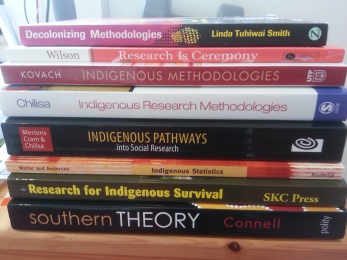
Indigenous methods booksLast week I wrote about challenging the dominance of English in writing for research and academia. That theme is also relevant to this post, though here it’s more about challenging Euro-Western epistemologies and methods than the English language itself. Over the last year I have built a personal library of books about, or relevant to, my investigation of Indigenous research methods and ethics. The point of this, for me, is to bring these methods into my scholarship, alongside creative and conventional methods, as appropriate. The point is not to become an ‘expert’ on Indigenous research; for a white British person, that is not, should not be, an option. At the start of this work, I worried about being extractive, but I found comfort in the words of Margaret Kovach, an Indigenous researcher from Saskatchewan in Canada, who encourages non-Indigenous scholars to help make space for Indigenous methodologies and assess their value on their own terms. This is what I am trying to do.

For those who are new to this topic, ‘Indigenous’ denotes the native peoples of colonised lands, such as Aboriginal Australians or Inuit Alaskans, while ‘indigenous’ denotes the native peoples of non-colonised lands. So I am an indigenous Brit who will never be an Indigenous researcher. Some people described as Indigenous are unhappy with the term because they feel that it makes them seem like one homogeneous group, whereas in fact there is tremendous diversity. For example, there are hundreds of tribal and language groupings in Australia alone. However, as it is the term most commonly used in the literature, I’m sticking with it for now.

The first book is the foundational Decolonizing Methodologies by Linda Tuhiwai Smith, a Maori researcher from New Zealand. In fact I bought the first edition of this soon after it came out in 1999, the year I began my MSc in Social Research Methods. The second edition came out in 2012. This book shows how research was used as a tool of imperialism to help subjugate colonised peoples through, among other things, complete disregard for Indigenous knowledges and Indigenous peoples’ own research methods. It highlights the value of these knowledges and methods, and calls for research to be linked explicitly with social justice.

Shawn Wilson is an Opaskwayak Cree researcher from Canada who has also lived and worked with Indigenous peoples in Alaska and Australia, as well as spending time with Indigenous peoples in New Zealand, Morocco, and elsewhere. His book, Research Is Ceremony: Indigenous Research Methods (2008), is based on his doctoral research and describes a paradigm shared by Indigenous researchers in Canada and Australia. It’s not easy to get hold of; I tracked down a Canadian bookseller who seems to have bought up the last available copies, and I fear it may be going out of print, which would be a great shame as it is readable and insightful. UPDATE: The publisher emailed me in January 2018 to say it’s not out of print (hurrah!) and it is now available through the link above.

Margaret Kovach is a Plains Cree and Salteaux researcher from Canada whose Indigenous Methodologies: Characteristics, Conversations, and Contexts came out in 2009. Her book covers epistemologies, methods, and ethics. It is a work of considerable scholarship that is also accessible and full of wisdom.

Bagele Chilisa is a Professor at the University of Botswana. Her book Indigenous Research Methodologies (2012) gives an uncompromising and international account of some of the theories, epistemologies, ontologies and methods used by Indigenous researchers. While no book on this subject could be completely comprehensive, Chilisa makes a good job of showing the diversity, as well as some of the commonalities, of Indigenous methodology.

Donna Mertens from the US, Fiona Cram from New Zealand, and Bagele Chilisa have edited a collection called Indigenous Pathways into Social Research: Voices of a New Generation (2013). They have contributions from Indigenous researchers from all around the world: Vanuatu, Mexico, Cameroon, Hawai’i, Alaska, Papua New Guinea, and many other countries. These are fascinating accounts, highlighting personal, political, and ethical challenges, and how they have been overcome. They also say a lot about Indigenous methodologies around the world.

Also in 2013, Maggie Walter, a trawlwoolway researcher from Tasmania, and Chris Andersen, a Métis researcher from Canada, brought out Indigenous Statistics: A Quantitative Research Methodology. This book demonstrates the pervasiveness of Euro-Western thought in the construction of statistical research, using national censuses for ilustration. It offers a framework for Indigenous quantitative research, nayri kati or ‘good numbers’, which places an Indigenous standpoint at the centre. There is a short video online of Maggie Walter talking about Indigenous quantitative research.

Lori Lambert is a Mi’kmaq researcher from north-eastern Canada who has also worked with Indigenous peoples from Montana, US; northern Manitoba, Canada; and Queensland, Australia. Her book, Research for Indigenous Survival: Indigenous Research Methodologies in the Behavioral Sciences, was published in 2014. To the best of my knowledge, this is the first book to position Indigenous methods within a Euro-Western disciplinary category. Like other Canadian writers, such as Wilson and Kovach (above), Lambert includes the voices of people she has worked with alongside her own in her narrative.

Another essential text, though not specifically about research methods, is Southern Theory by Australian academic Raewyn Connell (2009). This book is subtitled ‘The global dynamics of knowledge in social science’ and in my view is essential reading for anyone engaging with social theory. During my MSc, I was taught social theory as the preserve of dead white men, and I am sure this is still being taught in many Euro-Western universities today. Connell’s book gives the lie to this approach.

This list is not exhaustive; it is just my personal library. One limitation is that I can’t afford expensive books. While I was writing this blog post, I had a message from my friend and colleague Roxanne Persaud, alerting me to Susan Strega and Leslie Brown’s edited collection Research as Resistance: Revisiting Critical, Indigenous, and Anti-Oppressive Practices (2nd edn 2015). I would love to read this book, but even the paperback is over £60 which puts it out of my reach.

These books are not comfortable reads for Euro-Western scholars, but they are hugely important. We need to know how research has been, and is, misused by Euro-Western cultures in order to learn how to use it better. Indigenous scholars are extraordinarily generous in their assessment of the potential value of Euro-Western methodologies, even those methodologies that have been instrumental in stealing their lands and their cultures and traumatising generations of their peoples. Yet most Euro-Western researchers either ignore Indigenous research entirely, or conclude that Indigenous peoples must have picked up a few tricks from the colonisers. I’m not sure which is worse. Indigenous research methods pre-date Euro-Western research methods by tens of thousands of years, and there is a great deal that Euro-Western researchers can learn from these approaches.