

Review Of The Year 2016

2016By far the most popular post on the blog in 2016 was Ten Ways To Get Hold Of Academic Literature. In fact, thanks to @elfriesen making a great contribution in the comments, it should now be called Fifteen Ways To Get Hold Of Academic Literature. I’m glad this post has proved to be such a useful resource – though it may partly be the most popular because it was posted very early in the year: January 6th, to be precise.

Oddly enough, the second most popular post with readers in 2016 was in fact published in March 2015. It’s the post on Creative Research Methods, which outlines the structure and content of my book Creative Research Methods in the Social Sciences: A Practical Guide. I’m surprised and delighted that this post is still so widely read.

The third most popular is my post on Getting Creative With Your Thesis Or Dissertation, published in July 2016. I’m not so surprised about this one, because I’ve had really good feedback about it, on Twitter, by email, and from people in my workshops. It gives examples of several doctoral dissertations and theses which have been put together in more creative ways than the traditional brick of paper full of dense academic writing. I’m continuing to collect such examples and will write on the topic again when I have enough to merit another post.

The fourth most popular is Ten Top Tips For Becoming An Indie Researcher, published in June. Again, I had a lot of positive feedback about this post. I aimed to provide realistic encouragement, i.e. to make the drawbacks of this lifestyle clear as well as the pleasures. Reading back over the post, I think I succeeded. A lot of people I’ve spoken to this year have been very interested in how I manage to survive and thrive as an indie. For me, and for others who I know, it’s a great way to live. But it has a lot of challenges, and it is definitely not right for everyone.

The fifth of the top five is a post from October, Devising Your Own Research Method. This post explains when, and how, you can create a new method. It’s primarily aimed at doctoral students, who tend to have more time to think about their methods than jobbing researchers do, though it may also be useful for early career and other researchers.

My own top five, in professional terms, don’t have an order of priority, so I’m going to put them in chronological order. The first was the Research Methods Festival at Bath in July, which was a terrific event. I met some great people and learned a lot.

The second was my recent trip to Melbourne, Australia, where I delivered a keynote speech and three workshops on creative research methods, and met some wonderful people in real life who I’d been talking to on Twitter for years. I’d never been to Australia before and it was an amazing experience.

The third was being commissioned to teach a 60-credit module on creative research methods for EdD students at Staffordshire University in the first half of 2017. I’m in the process of planning the module, I’m thoroughly enjoying myself and my intention is that my students will do too. If others want to follow our progress, you can find us on Twitter through the hashtag #StaffsEdD.

The fourth highlight of 2016 was working on the second edition of my book Research and Evaluation for Busy Students and Practitioners: A Time-Saving Guide. This is a heavily revised and updated edition, with a whole new chapter on methodologies, due for publication in April 2017.

The fifth highlight was being asked to facilitate a Summer School on Creative Research Methods for doctoral students in July 2017. This is being run by the Community Animation and Social Innovation Centre (CASIC) at Keele University, and will be held at the New Vic Theatre in Newcastle-under-Lyme and at the Keele campus. We’re in the process of putting the programme together now, and it looks terrific. We’ll be covering arts-based methods, research using technology, mixed methods, transformative research frameworks, and writing creatively for academia. There will be a range of presenters and lots of hands-on and interactive work. Booking opens in January, with a discounted early bird rate; follow me on Twitter @DrHelenKara if you want to find out more.

I’m going to rest this blog, now, till the New Year. I wish you all a happy holiday.

Twelve Top Tips for International Indie Work

plane.jpgMy chosen career has offered me some interesting opportunities to work outside my own country. First I went to Syria, before the conflict began, to teach qualitative research methods to doctors. It was a fascinating experience, I met some wonderful people, and I grieve for the plight of that delightful country. At the time I thought it was a one-off opportunity, but since my book on creative research methods came out last year, several others have arisen. I’ve taught in Scotland and Canada, next year I’m teaching in Wales, and next month I’m off to Australia!

Glamorous, right? Well maybe above the surface, but beneath, the administrative feet are paddling like mad. If you, too, want to do international work as a freelance indie/altac, here are my twelve top tips.

  1. Charge more for international than for national work. You need to factor in at least two unpaid days for pre-trip admin: sorting travel and accommodation, planning work, applying for a visa, getting travel insurance, having vaccinations – there’s a lot to do. I recommend adding 50% to your usual day rate as a minimum.
  1. Find out what you can charge in the country concerned. It may be more than your usual day rate plus 50%. If so, charge the going rate, or a little less. If you charge much less than the going rate, people will think you’re not worth much. Strange, but true.
  1. Make sure any costs you quote include, as extras on top of your day rate, any taxes and/or visa costs payable locally.
  1. Charge half your day rate for travelling time. I usually allocate half a day each way for short haul flights, one day each way for long haul.
  1. Make your own travel arrangements. Otherwise you risk several changes of flight and a hotel that is grotty, or inconveniently located, or with no wi-fi. Making your own arrangements takes more time but it’s worth it because you can suit yourself. Having said that, you can still use an agent for some of the work. I booked all my own travel for Canada and it took ages; for Australia, thanks to a suggestion from my Dad, I used FlightCentre (available worldwide) and I would recommend them highly. They understood my needs and my budget, and evidently have an encyclopaedic knowledge of international flight options.
  1. Don’t take the mick with expenses. I book economy class direct flights: that usually costs a bit more than flights with changes of plane, but I arrive in better condition and am fit for work sooner. I book accommodation that is comfortable and suitable for a business traveller but nowhere near top end (examples: Premier Inn in the UK, Best Western in Canada). I will use taxis, but only if I need to; I’ll use public transport where that’s easily accessible with suitable routes.
  1. Search for more work than the job you are initially offered. There’s no point flying all the way to wherever-it-is simply to deliver one short workshop or keynote speech. Use your contacts, your contacts’ contacts, social media, even cold emailing – any ideas you can come up with to generate more work. Don’t be shy. The very fact that someone wants to bring you to another country to work will impress other people. You need to maximise this opportunity, both financially and interpersonally.
  1. Where jet lag will be a factor, build in an initial day in which you won’t be working to help you acclimatise. Get onto local time as fast as you can: start before you leave for your trip if possible. And similarly, build in at least a day after you get home, before you have to do any substantive work.
  1. Plan for a final day with no commitments, so you can take up people’s offers to ‘grab a coffee’ while you’re in the area. If there are no such offers, you can spend the day exploring and having fun, so it’s a win-win.
  1. Check and double-check all travel arrangements, timings, and contact details. If someone has flown you thousands of miles for work, it’s enormously embarrassing if you don’t actually turn up in the right place at the right time. (I imagine. I’m glad to say I’ve never yet suffered such embarrassment – and I do not intend to in future.)
  1. Prepare your work carefully, and deliver it to the best of your ability. You are, to some extent, on trial. If you do well, you may be asked again.
  1. Do the follow-up work: send the emails you promised to send, pass on the references you mentioned, put people in touch with others as you said you would.

Working internationally is a lot of hard graft. It’s also a great deal of fun. I love to travel, meet new people, and see new places. But I find it helps to be realistic about what is involved, clear about what I can offer, and unambiguous about my terms.

Why And How To Say No

noPeople in our line of work, whether academic or altac, are often at serious risk of over-commitment. This can happen for a number of reasons, including disorganisation, pressure from other people, and the inability to say ‘no’.

Disorganisation is often made up of the best intentions, lack of foresight or planning, unrealistic expectations, and inability to understand how long different jobs actually take. It can be truly difficult to figure out how long it will take to do a given piece of work, but a useful strategy is to make your best guess then add fifty per cent. So if you think you could definitely get an article written in six weeks, tell anyone who needs to know that it will take you nine weeks. One way to keep your expectations realistic is to take care to factor in all your existing commitments – which, don’t forget, include your social life and holidays as well as work. Also, remember that the empty spaces in your calendar in the months to come will fill up as the dates come closer. People often say to me things like, ‘I’m really busy this month and next, but I’ll have lots more time after that.’ I think, ‘No you won’t, you poor deluded fool, because by the time you get there “the month after next” will be “this month” and you’ll be just as busy as ever.’

People often over-commit from the best intentions. They want to help, or they are being offered interesting projects, and they think they’ll find a way to get it done. Often they do find a way, but that can be at the expense of their happiness, their relationships, and their health. I know, personally, two senior academics who have been reduced to taking sizeable portions of sick leave due to over-commitment in the last year alone. Part of this is because of the structure of academia and the ever-increasing demands placed on its staff. The only real solution to that is collective action. Yet, without wanting to sound all neoliberal, there is also scope – and, I would argue, responsibility – for individual action in the interests of protecting our own well-being.

Some people seem completely unable to see what is around the corner. One fairly senior academic I know moved from a research job to a teaching job, and was then astonished to discover that time-consuming preparation and marking were required. Another, a parent of two young children, seems continually surprised by the need to provide care for them. Perhaps over-commitment breeds over-commitment because, when you’re currently over-committed, it’s hard to find the time to give proper thought to potential future commitments and their likely implications. But finding that time is the only way to escape the over-commitment trap. And the only way to find that time is to learn to say ‘no’.

Saying ‘no’ can be really difficult, particularly if the person asking is, for example, senior to you, or someone to whom you owe a favour. So, to begin with, try learning not to say ‘yes’ immediately. Say something like, ‘That’s a really interesting proposition. Can I think about it and get back to you? I need to check my other commitments before I can give you a firm answer.’ Then if you decide you don’t want to say ‘yes’, you can say, for example, ‘I’d love to help but right now I don’t have the time to do the work well, and I don’t want to do a bad job for you.’

When you owe a favour, even this can feel very difficult. It can help simply to acknowledge the fact that you owe a favour. ‘I know you did X for me, and I am still very grateful. I do want to return the favour but I’m afraid it’s a really difficult time for me right now, as I am already fully committed for the next few months. Is there some other way I can pay you back?’ Being up front like this can feel scary for some people, but it is a great way to diffuse the anxiety that unspoken worries can create, and therefore it is worth the effort.

The wider pressure to ‘be collegial’ is another difficulty faced by those working in academia, whether from inside or outside institutions. For example, I recognise that I can’t expect people to peer-review my articles without offering to peer-review the articles of others. However, I can decide how many articles I am able and willing to review, per month or semester or year. Given that there is a need to review articles which are not and never will be fit for publication, as well as those that are or could be publishable, I might decide to review two articles for every article I submit. Or I might decide I can manage one per month, or two per semester, regardless of how many I write myself. The number you can manage will, of course, depend on your other commitments, but the basic principle is the same. You need to think the whole thing through, make a decision, then stick to that decision – and explain it to people where necessary. The same could apply with other regular one-off tasks such as examining theses, reviewing book proposals or typescripts, writing forewords, and so on. You have the right to set a limit on any such task you’re being asked to do more often than you can comfortably manage – and to enforce that limit.

There is an ethical point to this, too. We forget to notice that if we don’t look after ourselves properly, we can’t do our jobs or look after other people. I love Deborah Netolicky’s memorable description of ethics as the ‘unsexy undergarments’ of academia. I think we should pay attention to ethics all the time, just as we remember, every day, to wear our undergarments. People who over-commit are a danger to themselves, risking their health and happiness, and that can damage their families and friends as well. They are also a danger to their colleagues: I know from experience, as someone who is quite good at managing time and workload, that a collaborator who misses deadlines can cause great stress in my life. So for our own benefit, and for the benefit of our colleagues, families, and friends, we have an obligation not to over-commit, and that means learning to say ‘no’.

Things Are Really Happening!

juggling.pngDuring this academic year I’ve been involved in various enterprises on top of my commissioned research work, teaching, and writing commitments: solo self-publishing, collaborative self-publishing, and course development. And they’re all starting to come to fruition!

The course I’ve been involved in developing with Dr Janet Salmons is Path To Publishing, aimed at people who have a completed doctoral thesis or dissertation and want to publish from it to support their career goals, whether academic or otherwise. We opened for registration a few days ago and, even though the course doesn’t begin until October, people are already signing up! Universities are recognising that the course we are offering is excellent value for money and will benefit their early career researchers, and individuals are welcoming the opportunity to receive expert help with a complex process. The course is limited to just 20 participants, to ensure that we can give everyone good quality personalised feedback.

The collaborative self-publishing is a short e-book, co-written with Dr Nathan Ryder, called Self-Publishing For Academics. And it’s available for pre-order! The link is for Kindle books but it is also available via iBooks, Kobo and Nook, with Oyster and Scribd to come. Nathan and I have combined our experience of self-publishing various texts in a range of formats, and written the e-book we wish we’d had when we started out. The formal launch is next Wednesday 18 May, so prepare for whooping and hollering.

The solo self-publishing is my series of short e-books for doctoral students. The first, Starting Your PhD: What You Need To Know, is now permanently free to download. The fifth, Research Ethics for your PhD: An Introduction, is with my editor and should be out next month. I just have the sixth and last one to write, on Finishing Your PhD: What You Need To Know, and I’ll be done!

It’s an exciting time towards the end of a really busy year. I’m still kidding myself next year will be easier, but actually I think it’ll just be different. I’ll be working on my next full-length book, on research ethics (I’m in the middle of preparing for that right now), running Path To Publishing with Janet, and managing my commissioned research work and teaching too. It’s just as well I like my work!


A New Venture: Path To Publishing

pathlogo-purplegreen.jpgTaran-taran-taraaaaa! Drum roll! I have an announcement to make!

I have been plotting with my co-conspirator Dr Janet Salmons of Boulder, Colorado (who I met, like many of my collaborators, on Twitter). We have designed a new online course, Path To Publishing, for people who have been awarded their PhD or equivalent (EdD, DBA etc) and who want to publish from their thesis or dissertation. And not just publish whatever they can, but publish effectively, in a way that will support their career aspirations. (NB: edit as a result of a query from Oxford Dphile in the comments below: if you’ve completed your thesis or dissertation, but haven’t yet had it examined, that’s fine too.)

Path to Publishing will run for six weeks in the first semester of the next academic year, from October 10 to November 18. It is limited to 20 participants to ensure that we can give everyone good quality individual feedback. We are offering a discounted rate for the first course in recognition of the possibility of teething troubles (though we are working hard to try to ensure there won’t be any). The fees will be US$400/£280 payable through PayPal – after this first course, the fees will rise to approx US$500/£375 (exact amounts may change slightly due to currency fluctuations). We will be asking for detailed feedback in exchange for the discount, to help us perfect the course for future participants. Another reason we’re offering a discount to the first cohort is that, along with the course, we will be setting up an online support group for course members and alumni – but the first time around there won’t be any alumni to give advice and support to new members. Nevertheless, there is value in peer support, and we expect the online support group to be well used.

The course will include two live webinars at times as convenient as possible for the class, bearing in mind everyone’s different time zones (and these webinars will be recorded for those who, for whatever reason, can’t attend). Janet and I will provide good quality course materials, weekly lessons, and exercises in planning and writing for publication, plus individual feedback on each exercise. We plan to show you how to assess the publication potential of your thesis or dissertation in the light of your career goals. We will cover all kinds of publishing, including traditional academic publishing (journal articles, book chapters, books), self-publishing, social and mainstream media. By the end of the course, you will have a personal publication strategy for the next 1-2 years which aligns with your own career goals. All you need is a completed thesis or dissertation and a good standard of written English.

Janet and I have extensive experience of academic writing, publishing, and teaching. We have both written full-length books, book chapters, and academic journal articles, and have taught on several continents. Janet has co-edited books, and I have self-published books. Both of us are experienced users of social media and also have some experience of mainstream media. We have enjoyed the process of combining our expertise to create Path To Publishing.

We’ll be starting to publicise the course in earnest soon, but I wanted my blog readers to hear about it at an early stage. As the number of students is limited, if you are interested, put your name on the preliminary class list here for first access to registration. Janet and I are excited about this course and we very much look forward to working with our students.

Knowing And Remembering

Creative research methods in the social sciences [FC]Over the next three weeks I will be doing eight presentations about creative research methods, in Edinburgh, London, and Calgary, to audiences of practitioners, postgraduate students, and academics. I like doing presentations, once I get going, but this is a little daunting because each presentation is slightly different from the others. For example, one is for evaluation practitioners at the NSPCC, so they will want to know how to use creative methods in evaluation research focusing on children and families. Another is for MA students at the University of Calgary, who need to know about arts-based methods and research using technology. A third is for the Social Research Association in Edinburgh, which is likely to generate a mixed audience of practitioners and postgraduate students with a variety of learning needs.

Although I’ll be the one doing the teaching, the prospect of giving these presentations feels rather like the prospect of doing a bunch of exams. This is partly because I’ve had to do a whole load of revision. Although creative methods have always been part of my practice, I finished writing the book a year ago, and I seem to have forgotten a surprisingly large proportion of its contents. I feel rather as though I need to learn it off by heart – including the 500+ references – before I do the first presentation. Which is tomorrow morning. So that’s not going to happen, particularly as I already have rather a lot of work to do on the train to Edinburgh today.

Luckily I’ve had time to refresh my memory to some extent. When I re-read the book I wrote, I remember some parts vividly, while others almost feel like new information. I find myself thinking ‘Ooh, that’s a good point’, as if it had been written by someone else, and ‘Did I really write this?’ because I don’t remember.

This is a strange phenomenon, and I wonder whether other authors have similar experiences. I suspect at least some of them do. It’s not entirely new for me, either. I’ve never been one for hanging on to old papers, but some years ago I came across an essay I’d written for A level geography, all about fluvio-glaciation and peri-glaciation. I couldn’t remember ever knowing those words, let alone what they meant.

So I’ve been thinking about the difference between knowing and remembering. Sometimes I know I know something, such as the name of a tune I am hearing on the radio, but I can’t bring it to mind – we say, ‘It’s on the tip of my tongue’. Sometimes I don’t know I ever knew something, such as the geographic terminology above. Some things I know fairly indelibly, such as how to drive my car, make a veggie chilli, or write an email. Yet there must be lots of things I’ll never know I ever knew, which is a strange thought.

I did remember some things about exams which made me feel a bit better about my forthcoming ordeal-by-presentation. I remembered that I used to have the same feeling, that I needed to memorise everything in my schoolbooks, and the same lurching internal near-panic because I knew I couldn’t. And I remembered that I had actually been quite good at exams, and one thing I’d learned from doing exams that was still applicable now is that I don’t need to remember everything, but to remember enough, and to know what to do with what I remember. In fact, to be creative.

I can do that.

Cross-Cultural Research Ethics

cross-culturalLast week I presented at a seminar at the University of Nottingham hosted by BAICE, aka the British Association for International and Comparative Education. Like the UK and Ireland Social Research Association (SRA), on whose Board I sit, BAICE is a learned society and an organisational member of the UK’s Academy of Social Sciences (AcSS). I was presenting, in my SRA role, on behalf of the AcSS. This always makes me slightly uncomfortable as I’m not a Fellow of the AcSS and don’t really feel qualified to speak for the Academy. Luckily another of my SRA colleagues, who is a Fellow, was at the seminar and was able to help me out.
The seminar was on ‘cross-cultural research ethics in international and comparative education’. Presenting for the AcSS on this topic was an interesting exercise, as the Academy is not a very cross-cultural organisation: the Fellows are 93% professors, 69% male, and my contacts with them suggest that the white middle classes are in a massive majority. My presentation focused on the five generic ethical principles the AcSS has developed for its member societies to use. I’ve been working on a redraft of the SRA’s ethical guidelines based around these principles, and had already registered that they are focused around concepts which are not culturally neutral, such as democracy and inclusivity. There are cultures that despise democracy, seeing it as a discredited belief system, and others that either do not practise inclusivity or practise a very different version from that which the UK educational and social research culture espouses.

Perhaps because BAICE is focused on international matters, ‘culture’ was in danger of being conflated with ‘nationality’, so I argued that it is a much wider issue. The previous day I had been in a workshop for a piece of evaluation research that had included service users, volunteers, staff, partners, and evaluators. That’s five different cultures, right there. Then of course those professionally defined cultures intersect with people’s race, gender, religion, sexual orientation, etc, to create a whole world of cultural complexity.

The other presentations covered a wide range of related questions. How should we manage cultural conflicts within and beyond academic departments? How ethical is it to use RCTs in educational or social research when you know that members of control groups will be disadvantaged? How can we be inclusive as researchers in situations where including marginalised people, or those living in difficult circumstances, may put them at risk? How can we support researchers and teachers who are operating in a global environment, whether physical or virtual, to work in ethical ways?

Then we were asked to discuss whether we thought it would be possible to formulate generic ethical principles for cross-cultural research. We didn’t reach firm conclusions, but we did agree that if such principles were to be devised, the fundamental value should be respect, and the key process would be dialogue. Any generic principles would need to be broad, neither prescriptive nor vacuous, and should be tested in a variety of locations. Generic principles will always be open to interpretation, and may in some contexts conflict with each other, so they would need to be constantly negotiated. But generic principles could be useful in overturning the current myth of cultural neutrality in some academic mechanisms such as anonymous peer review.

We also agreed that ethical research is not, and should not be, only or predominantly about data collection; it is relevant to all stages of the research process. And we agreed that it is not only students, researchers, and teachers who need educating in ethics, but also funders and members of ethical review committees.

As researchers and educators, we have an ethical duty to keep educating ourselves, because ethical approaches to research change as the world changes. It is essential to take a reflexive approach to this, including locating ourselves culturally. It helps to realise that the same ethical issues arise in lots of different types of work in different disciplines and locations, so if you look beyond your professional and geographic boundaries, you can often learn from others rather than re-inventing the ethical wheel.

We concluded that, from an ethical perspective, the quality of human interactions should be fundamental to the quality of research and teaching. This is especially the case in cross-cultural work, where people may be operating with very different assumptions. However, this is not considered relevant by the current arbitrators of quality in research or teaching. Our view, though, is that it would be more ethical all round to shift the focus away from regulations and bureaucracy and towards human well-being.

While I am, generally speaking, irrepressibly optimistic, I do wonder whether that will happen in my lifetime.

Teaching Writing to Doctoral Students

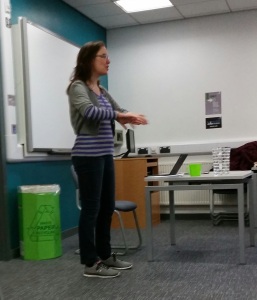
just me teachingI spent last weekend teaching writing to doctoral students at Staffordshire University, and enjoyed it enormously. It was an experiential course that I had devised with input from Dr Katy Vigurs, who hosted the course. We included creative exercises on drafting and redrafting, getting unstuck, the relationship between writing and thinking, and how to find your voice. There was also a short talk from me and several discussion/Q&A sessions. In between these were a dozen half-hour ‘shut up and write’ sessions for students to work on their own writing.

This course demonstrated to the students, very thoroughly, that they can achieve a meaningful amount of writing in just half an hour. And we taught them how to do that, through discussion, example, practice, and review. They had seen the course programme beforehand and planned what they would work on. The half-hour discipline was difficult for them at first; they found it hard to ‘get in’ and ‘get out’, but by the Sunday they were switching between ‘work’ and ‘break’ modes like doctoral ninjas. Several students commented on their evaluation forms that they had achieved more than they had planned.

Before the course, I asked students to complete a form telling me which aspects of academic writing they were good at, and which they wanted to work on. I also asked for a 500-word sample of academic writing from each student. This was partly so I could give individual feedback, and partly so I could get a sense of the individual and overall standard. Generally, the standard was good, particularly as I was seeing excerpts from work in draft. But the students evidently thought they were not good at writing.

This made for a very satisfying moment for me. It went like this:

Me: “I’d like to know who, in this room, thinks they struggle with academic writing because they’re not very good at it. Put your hands up please.”

[Most hands went up, most faces looked miserable]

Me: “I’ve seen examples of your writing, so I can tell you, with some authority, that you’re wrong. You are good at it. The reason you struggle with academic writing is because it’s hard.”

Then I stood in front of the class for a quiet moment, enjoying the war of expressions on people’s faces, as the message began to sink in. It was such a delight to see incredulous smiles break through.

It was also a delight, as always when teaching, to witness students having ‘light bulb’ moments. One woman said to me, with an expression of pure joy, ‘I’ve got it! I just have to write! That’s all I have to do! And if I keep writing, I’ll get my thesis done!’ It’s the kind of statement that can seem obvious after the fact, but it was a huge learning point for her, and I was thrilled to see her happiness.

Of course the true test will come when the students are back in their everyday lives. I think and hope we did enough to embed the practice and motivate the students, and the evaluation forms certainly suggest that we did. But I’ve been involved in training and teaching for far too long to take that for granted. We encouraged the students to form peer networks for support, and suggested that they might set up their own ‘shut up and write’ sessions, whether virtually or in real life. Early signs are that mutual support is growing within the group, and that can only help.

Talking of the virtual dimension, some students from Staffordshire University who couldn’t make the whole weekend, and some from other universities, joined in with our ‘shut up and write’ sessions via the #StaffsAcWri hashtag on Twitter. There are regular ‘shut up and write’ sessions on Twitter (check the #stuw hashtag) which you could join if this interests you – or you could even start your own. It’s amazing how much you can get done in half an hour: one student wrote over 800 words in just one of the half-hours, and most produced several thousand words in the course of the weekend.

My favourite comment from the evaluation forms was: ‘I never drifted off! I have only 2 relevant doodles and have produced work I will be proud to share with my supervisors!’ Further to last week’s post, this is why I think writing can be taught. Not everything about writing, and not to everyone – but those who are engaging with the process, and willing to learn, can certainly be taught the skills and the craft of writing.

On Teaching Writing

quill pen writing womanI love to teach writing. I have taught writing for research in various contexts: to voluntary sector practitioners, statutory sector managers, and postgraduate students. Next weekend, for the first time, I will be running a writing course for doctoral students with Katy Vigurs at Staffordshire University. I can’t tell you how much I’m looking forward to this – I’ve had so much fun already, just doing the preparation.

There is a school of thought that considers writing can’t be taught. I’m afraid I think that’s utter rubbish. For sure, there’s an element of ‘you can lead a horse to water, but you can’t make it drink’, as the saying goes. Ultimately, however much teaching someone has, there comes a point where they have to get on with the writing for themselves – and there are people who continually struggle at that point. Writing is particularly hard, I think, for people who don’t like writing but have to do it anyway. I’m lucky that I like writing, and I’m confident I can pass on some ways to make it less onerous and more fun – or at least more productive.

Writing isn’t easy to teach, and it’s difficult to learn, but there are lots of tricks of the trade which the more experienced writer can pass on. Some people can learn from written advice, whether on blogs like that of the estimable Pat Thomson, or in books by people like Pat or Rowena Murray. But for many, there is no substitute for time in a classroom with a group of other learners and a skilful tutor or two.

I learned a lot, years ago, from attending courses myself. I went on three Arvon courses, and a doctoral writing workshop at the University of the West of England (UWE). Two of the Arvon courses focused on novel writing and were useful for my fiction work. The other Arvon course, and the workshop at UWE, both focused on the permeability of the boundary between fiction and non-fiction, and the way some writing techniques can be used for both.

I attended these two courses during my doctoral studies and they were inspirational. I’d already been grappling with ideas around truth versus authenticity, the function of creativity in research, and the role of storytelling in human communication. I had read Sol Stein’s book Solutions for Writers: Practical Craft Techniques for Fiction and Non-Fiction which also suggests that fiction writing techniques can benefit non-fiction writing, and vice versa. This concept has been a huge influence on my work ever since. I have written about it in academic journals and books, and now I’m going to teach it, properly, for the first time.

Among the learning outcomes I’ve set for my students are: writing non-fiction is a creative process, writing is hard even when you’re skilled and experienced, and thinking and writing are inextricably linked. I have also promised them that they will come away from the weekend with between 1,000 and 5,000 new words of their thesis, depending on how far advanced they are in the process. The group includes students at every stage, from those who have only recently begun to those in their final months. I would expect students to write more slowly at first, more quickly in the later stages.

They will be doing creative writing exercises. Not just for fun, though I hope there will be some of that too. The exercises are designed to teach students about overcoming resistance to writing, the purpose of rewriting, how writing helps thinking, and voice. There will also be a number of ‘shut up and write’ sessions where we will all write together, as well as plenty of time for questions and discussion, not to mention cake. And in the evenings we will, as writers often do, patronise a nearby hostelry.

It may be a working one – but I am so looking forward to the weekend!