Indie Publishing for Academia – Ten Top Tips

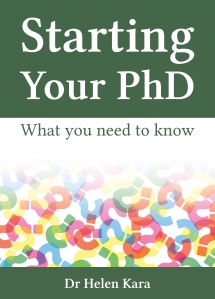
SYPhD_green_SQmarks_noblend_LC2_RGBThree weeks ago I became an indie publisher as well as an indie researcher and writer. In that time, my embryonic publishing company, Know More Publishing (see what I did there?!), has gained a website. Also, my first short affordable e-book, Starting Your PhD: What You Need To Know, has gained three five-star reviews on Amazon UK and a fourth on Amazon US. I didn’t bribe a single reviewer!

It’s around a year since I decided to go down this road, and I’ve learned a lot along the way. I think there’s a great deal of potential in indie publishing for academics, altacs, doctoral students and others. Indie publishing doesn’t figure in organisational performance metrics, which creates a barrier for some people, though perhaps one day it will. But it’s a great way to produce work which is too long for academic journals, or doesn’t fit their requirements, but is shorter than a traditionally published book. And it’s open access – you can make your work available for free if you wish, or at a very low cost.

On the down side, there is no quality control. I know there are arguments about whether the peer review system actually enhances quality, but editors certainly do, if they’re doing their jobs properly. With indie publishing, it is possible to plonk any old drivel online for sale. That’s not the kind of indie publishing I advocate. I worked in traditional publishing, I write for traditional publishers, and I have loved books all my life. So I want to see good quality indie publishing from academia and its associates, and to publish good quality books myself. Here are my ten top tips for anyone who shares my aims.

  1. Write something nobody else has written. As an academic or altac, you should be used to spotting gaps in literature. Your work will gain much more interest from others if it’s the only one of its kind.
  1. Get feedback on your writing. Starting Your PhD went through three sets of beta readers, from potential doctoral students to experienced supervisors. It wouldn’t have been worth publishing without their input.
  1. Use a professional editor. It doesn’t matter how experienced a writer you are, you will have blind spots. I know I did. I will always pay to have my books edited by a skilled professional who can bring fresh eyes and a keen brain to improving my text.
  1. Unless you are really good at design yourself, use a professional cover designer. You need someone who knows about book covers, how to make them stand out even at thumbnail size on a mobile device.
  1. Join the Alliance of Independent Authors. This worldwide organisation has approved ‘partner members’ including editors and cover designers which is useful if you don’t have people in your networks with those skills. They also have an active and ALLiEthicalAuthor_Badgesupportive closed group on Facebook where you can get help with all aspects of indie writing and publishing. And they have an Ethical Author code, as well as a publicly accessible searchable blog full of sound advice.
  1. Be prepared to do lots of promotional work. As an indie publisher, you’re not only the author, you’re also the sales and marketing departments for your work. This could involve anything from chatting on Twitter to lugging print copies around with you. You will need to decide what you can do, when, and how. It doesn’t have to be much – but if you don’t do anything to promote your work, it will sink beneath the ocean of available literature.
  1. Buy ISBNs, aka International Standard Book Numbers. These are the 10 or 13 digit numbers used by cataloguing systems to identify each unique book. You can only buy them from one organisation in each country, they’re not cheap (though the more you buy, the cheaper each number becomes), and you can’t transfer them between publishers or even leave them in your will. Also they take ten days to issue, so don’t leave this until the last minute, or you’ll have to postpone your book launch (like I did, ahem). You can get free identifiers such as ASINs from distributors such as Amazon, Kobo, and Barnes & Noble (Nook), but these are distribution codes, not unique book identifiers – or if they are actual ISBNs, they are owned and assigned by the distributor, not by you. This effectively means you are giving away part of the control you have over your work, and having control of your own work is a big part of the rationale for publishing independently in the first place. There’s a more detailed explanation of this on the Alliance of Independent Authors’ blog.
  1. Research the different ways you can publish your work – and expect to spend a considerable amount of time on this, as there are a lot of options. To begin with: e-book only, print only, or both? I’ve gone for e-book only, as I’m writing short books for students who will be comfortable with technology, and e-books are more affordable than print books. So then I decided to publish via Kindle Direct Publishing. This is a no-brainer even if you regard Amazon as the evil empire, because you will sell most of your work from this platform, so if you’re not willing to do business with Amazon at all, don’t publish independently. I also decided to use Draft2Digital, who take a small commission from your income for distributing through most of the other major channels – Kobo, Barnes & Noble (Nook), iBooks, Scribd etc – and they’re very helpful when you get stuck with your uploading, as I did. You could upload your work with each platform individually, and save yourself the commission; it’s your decision whether the hassle is worth the benefit. I decided that, for me, it wasn’t – and my sales figures, so far, bear this out (see below). I might decide to produce print books one day, in which case I’d use CreateSpace on the advice of fellow members of the Alliance of Independent Authors.
  1. Launch your book with some kind of a fanfare – then relax. I had a virtual launch day with a dedicated blog post and a lot of tweeting. Ten days later I went on holiday, which was excellent timing, as the process of preparing and publishing the e-book was much more difficult, stressful, and exhausting than I anticipated. I won’t be able to take a holiday every time, but I’m going to build in at least a weekend off after each one from now on.
  1. Write another book. Full disclosure: in the first three weeks, I’ve made £56.48 from sales on Amazon and $6.30 from sales through Draft2Digital. Not bad for a first e-book priced at £1.99/$2.99. However, given that I’ve shelled out around £500 on editing, cover design, and ISBNs, at this rate it will be six months before I break even. But I have a cunning plan for world domination: the next book in this series, Gathering Data For Your PhD, will be out in November, and I have four more planned for 2016. There is clear evidence that the more you publish and promote, the more readers you will acquire. This applies in the same way to free material.

I hope my learning over the last year will benefit others. If you decide to go down the indie publishing road, do let me know. At present I only know of two other academic types who are doing this: Dr Nathan Ryder, who has published a couple of very useful short e-books on preparing for your viva, and Dr Jenna Condie, who has a book of blog posts on sustainable urbanisation. If you know of other academic indie publishers, please leave a comment. Let’s start a movement!
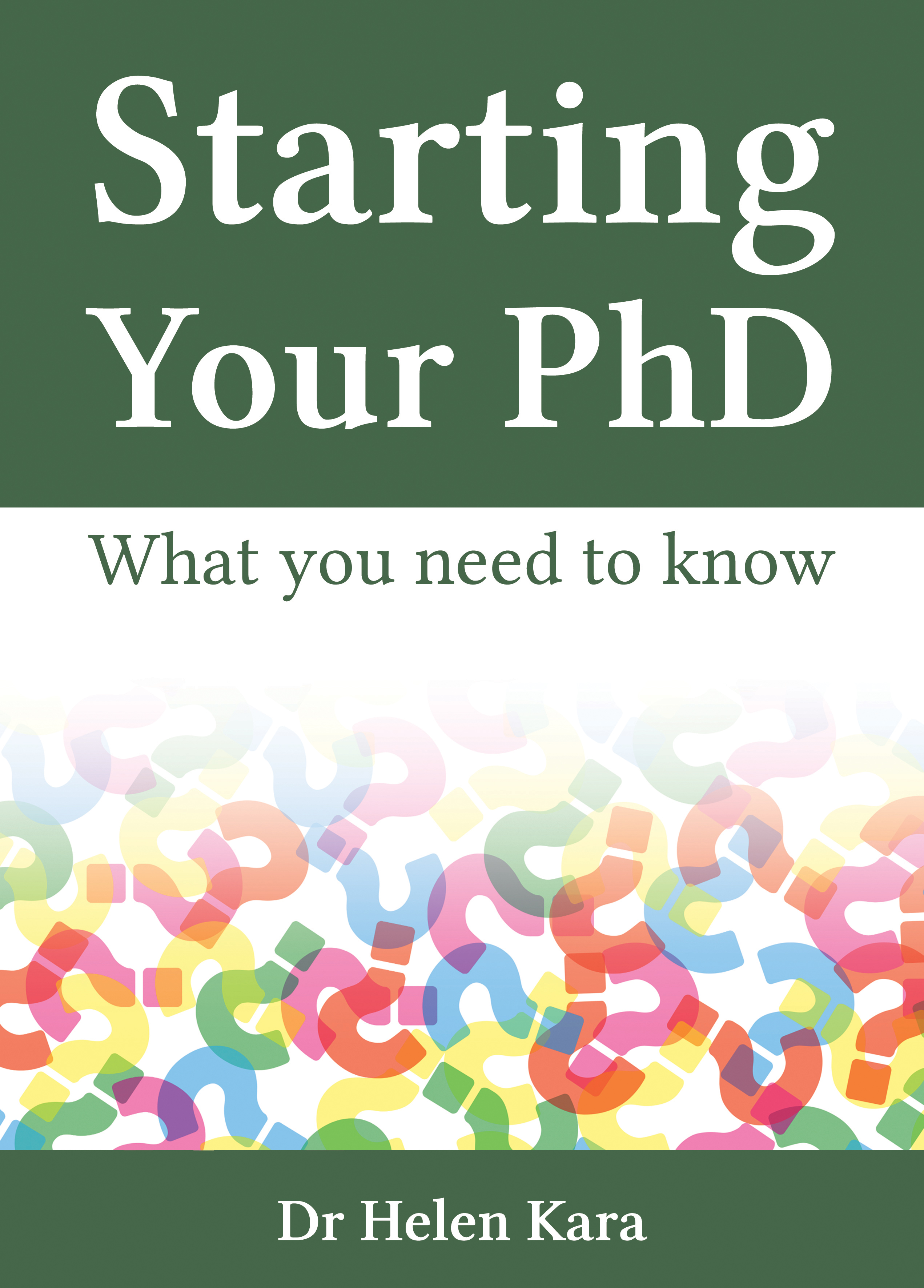
Starting Your PhD – New Book Launch!

SYPhD_green_SQmarks_noblend_LC2_RGBI’m launching my Top Secret Project today. It is a short e-book (11,000 words) called Starting Your PhD: What You Need To Know. I published this e-book myself, under the Know More Publishing imprint (see what I did there?!), which I set up for the purpose. The book is available via Kindle, Kobo, Nook, iBooks, Scribd, and Inktera. So as well as being an indie researcher and writer, I’m now an indie publisher too!

I wrote three drafts of the e-book, each of which received feedback from a small group of different beta readers, including people who might do a PhD one day, current doctoral students, and experienced supervisors. The final version was professionally edited. I am very grateful to my beta readers and to my editor, each of whom provided input which improved the book’s quality. And you can buy the fruits of all this labour and experience for the price of a coffee: approx £1.99/$2.99/E3.29 or equivalent (actual prices may vary slightly due to circumstances beyond my control).

So why did I take up indie publishing, you may ask? There are times I’ve been wondering that myself over the last year or so, as it’s been a massive learning curve. I think if I’d known how much work was involved, I probably wouldn’t have started the process. But now that the curve is beginning to flatten out, I’m very glad I did. There are a number of reasons I decided to publish independently. In no particular order, the main ones are:

  • I spotted a gap in the market that a short e-book would fill
  • I’m intrigued by indie publishing; it seems to fit with being an indie researcher and writer
  • Short e-books are increasing in popularity
  • I wanted to offer good quality and affordable help for doctoral students

I expect you’re wondering whether I’ve done all this work just to produce one short e-book. No, I haven’t. ‘Starting Your PhD’ is the first in the ‘PhD Knowledge’ series, with other volumes of similar length to include:

  • Gathering Data for your PhD: An Introduction
  • Analysing Data for your PhD: An Introduction
  • Writing Your PhD: An Introduction
  • Research Ethics for your PhD: An Introduction
  • Finishing Your PhD: What You Need To Know

The second volume is scheduled for publication in November, and I aim to publish the others in the course of 2016.

ALLiEthicalAuthor_BadgeThis is an exciting new venture for me. I’ve had loads of help already: from friends, colleagues, people I’ve met online, and the Alliance of Independent Authors. I’m proud to be a member, and would recommend them to anyone; their closed Facebook group is an invaluable source of support. Also, I’m particularly pleased that they have a code of ethics for indie authors, with the guiding principle of putting the reader first – a principle that guides all my writing.

With that in mind, I need your help too, because there are some things you can do for potential readers that I can’t: tell them about the book, and write honest reviews to help people decide whether the book would be useful for them. Of course I can tell some people, but with my traditionally published books, I’ve had access to an established publishing firm which employed a range of professionals to help spread the word. As an indie publisher I am my own marketing, distribution, and sales departments. So it would be enormously helpful if you could talk about this e-book to people who might find it useful: people considering doctoral study, people embarking on doctoral study, or people supporting someone else through their doctoral study. When I say ‘talk’ I mean the virtual kind too, i.e. tweeting, blogging, Facebook etc. And I absolutely can’t, and wouldn’t, review the book I’ve written; that would be most unethical, so I’m completely reliant on others to give their honest opinion in a way that will help prospective readers decide whether it’s worth investing a few of their hard-earned coins.

Doing a PhD – or a professional doctorate; the e-book is applicable to either – is an enormous undertaking. It can be really difficult even to start on this long, complex process, much of which is incomprehensible at the start. I began mine, back in the early 2000s, with a complete false start which cost me a year and a lot of wasted time and effort; I ended up at a different university with a completely different topic, supervisor, and discipline than I’d originally planned. I guess that is another reason I wrote the e-book: to help others make a more sure-footed start, and to save them timchampagne launche and effort.

If this works for you, please do let me know, either in the comments or on Twitter where I always love to hear from my readers. But for now: I declare my indie publishing career in general, and the Starting a PhD e-book in particular, open!

Being My Own Patron

love writingYou’ve probably worked out by now that I love to write. I still remember the joy of winning a class story competition when I was 7 or 8 years old. I filled most of an exercise book with the story of four children who had adventures in a flying car. It was an incredibly derivative Chitty Chitty Bang Bang/Swallows and Amazons mash-up, but I didn’t know, then, that you’re not supposed to nick other people’s ideas. I did know that writing, for me, was enormously satisfying.

It was a habit I never lost. As a young adult I found that I couldn’t not write: I wrote on buses, in bed, on holiday and at work, and when I wasn’t writing I was often thinking about writing. There’s a game I still play with myself when I have a bit of spare brain: which words would I use to describe the way sunlight shimmers on that wheat field, the taste of this flavoursome curry, how I feel when my partner is unexpectedly late home and I don’t know why. I’m looking for precision. I don’t want to conjure up any old wheat field, curry, or emotion, I want to describe the quality of light on that wheat field, the joy of this spice mix making my taste buds sing, the bittersweet combination of love and anxiety I’m experiencing right now.

I love to rewrite, too. In the previous paragraph, I originally wrote of the spice mix ‘exploding on my tongue’. That was a bit too cliched even for a disposable blog post. Then I tried ‘colonising my taste buds’, which pleased me because of the reverse colonisation implication for this UK resident, but then I began to doubt that phrase in case, even though I had associated it with joy, it could be read in the opposite way by someone with racist tendencies. So I went for ‘sing’ which has pleasing links with joy and mouth. As this is a blog post, which I am writing when I should be doing client work, I plumped for the third idea. If I was writing a book, I might have run through many more possibilities before making my choice.

If I didn’t love to write, I wouldn’t write. I certainly don’t do it for the money. When people find out that I’m a writer, they sometimes assume I’m rich, JK Rowling-style. Nope. It’s particularly dumb being an academic writer, whose average annual earnings are the lowest of all the categories at an average of £3,826 per year in the UK. I’m not sure of my own exact average, but in the 12 years since my first book was published, I know it is somewhere around £350 per year. I don’t earn anything for book chapters or, usually, academic journal articles, though I did get paid £1,500 for writing one in 2014. If I count my average earnings from writing over the three years since my first research methods book came out in 2012, that one single payment pushes it up to somewhere around £850 per year.

However, the calculation of direct earnings is not the whole story. In academic circles, my writing confers credibility and, quite literally, authority. I know I have obtained paid work, from academic and non-academic institutions (including, ironically given recent events, HM Government), as a direct result of my writing. But writing takes a lot of time and, when you’re self-employed, time is money. One of the really, really annoying things about being an indie researcher is that you can’t get funding from anywhere. Research councils will only fund institutions, I’m not arty enough for the Arts Council, not literary enough for a Royal Literary Fellowship, and even the Independent Social Research Foundation doesn’t do what I thought it did. I got all excited when I saw the name, but it seems to be the Foundation which is independent, not the researchers it funds who are all employed by academic institutions.

I have wondered whether to try using the web for its potential rather than its usefulness and go for some kind of crowdfunding. I’ve thought about Kickstarter, or Unbound, or Patreon. They all have slightly different models. With Kickstarter, you propose a project, set a funding limit, and offer ‘rewards’ which can be as nominal as funders getting their name in the acknowledgements/credits or as tangible as you like: a copy of the book, dinner with the author, feedback on a draft of your own work – whatever you want to offer for varying levels of contribution. Unbound is a bit like Kickstarter but specifically for books. And Patreon is a way in which fans of artists can pay a set amount per week, per month, or per output, again in return for rewards chosen by the artist to suit the size of the contribution.

cliffhangerI think these are interesting, useful platforms for creative people. I don’t think they’ll work for me. For a start, I don’t have millions of fans. Some projects get funded even though their generators don’t have millions of fans, because they have an idea that captures enough people’s imaginations. I don’t think my current project, a multi-disciplinary research ethics book, is going to capture many people’s imaginations. My ideas aren’t earth-shaking, though they may cause a small bounce in a few odd corners of academia. But they matter to me. And that’s why I am my own patron.

I am lucky that I can use my income to fund my writing habit – and that writing is the habit I want to fund; far more destructive habits are available. I am also lucky that I’m not materialistic. But I’m also not completely stupid when it comes to running a business. So I’ve decided that, where my writing is concerned, it’s time to diversify. I alluded to my Top Secret Project back in April, and now it’s almost ready to… ooh, is that the time? I’ll have to tell you the rest next week!

My Next Book

Having got my creative research methods book safely launched, and cleared away most of the smaller writing projects that piled up while I was writing that, I’m slowly starting to get into gear for my next book. I’ve written several books now, including two on research methods, and the process for each book is different. For my first research methods book, essentially I wrote down what I knew about research methods and doing research, worked out where the gaps were in my knowledge, learned what I needed to know to fill those gaps, and wrote that down too. The second one was more of a stretch (at one point I found myself whingeing on Facebook about ‘that difficult second research methods book’) but primarily involved collation, as there was a huge amount of relevant work in journal articles and a few pertinent books. It did involve some hard thinking – in fact, they both did but, like childbirth, the pain is soon forgotten.

Unlike childbirth, I expect the labour for my third research methods book to be more painful than for either of its older siblings. This is because my third book will be on ethics. Writing down what I know about ethics wouldn’t take long, and collating other people’s work on ethics would be fairly pointless. For this next book, I need to read, and think, and take it slow, and learn, and think some more, and come up with some new and different ideas and approaches. My embryonic ideas are that I want to show how research ethics is linked with wider-world ethics, at individual, institutional/organisational, and national/political levels. Also, I’d like to unpack the impact of wider-world ethics on ethical thinking, acting, and decision-making in research. This may be ridiculously ambitious, but it feels compelling; it’s something I want to understand, and would like to communicate in a useful way.

ethics bookshelf

My ethics bookshelf

So far, I’ve collected a load of books and some journal articles. I’ve read about a third of one book and about a quarter of another. I haven’t written a word yet, and have barely thunk a thought. I haven’t blogged the process of writing a book before, so this is new, too. It’s quite difficult to write about a process from such an early stage that I don’t really know what I think yet. Also, publishers tend to advise authors to keep ideas close to their chests, in case someone else steals the idea and writes the book faster and better than the author can. So blogging the process feels a bit weird – but I figure this is hardly a commercial bestseller in progress, and it’ll be more useful all round if I share my ideas rather than keeping them to myself.

I’ve started interviewing some experienced researchers, in academia and in practice, to find out how they get on with trying to do ethical research. I want to learn some stuff about how this works, both in terms of research ethics governance and ethical review, and in people’s actual practice. I am regularly frustrated by the over-emphasis on ethics at the data-gathering stage, and the narrow focus on the welfare of participants, at the expense of ethical considerations at other stages of the research process and the welfare of people other than participants. In my view, there are ethical considerations to take into account at all stages of the research process, and everyone touched by a research project deserves to be thought about and cared for. That includes researchers themselves: research can be a stressful and difficult undertaking, and we do nobody any favours if we don’t look after our own welfare as well as that of others.

Remember when I said writing down what I know about ethics wouldn’t take long? That’s pretty much it. Well, OK, maybe there’s a little more. I could probably pontificate about deontologicalism versus consequentialism for a sentence or two, but I’m not that keen to lose readers. This reminds me of another aim for my book: that it should be readable. I talked to my partner about this recently, and he suggested I have an early chapter called ‘The Academic Verbiage’ (actually he used a rather less polite word than ‘verbiage’), so I could put all the complicated words in one place. Then, he said, I’d be able to write the rest of the book in ordinary language. I’m not sure I’ll go quite that far, but I do intend to try to make it clear and understandable. At least, I hope I can…

Ten Top Tips for Successful Collaboration

collaborationWorking in collaboration with others can be a wonderful experience. Writing a journal article with a colleague, or working in a research team with people from other organisations, can be life-enhancing. Ideas build on ideas; tasks are allocated according to people’s strengths and abilities; the results are loads better than anything you could achieve alone.

Collaborative working can also be a monumental pain in the neck. Misunderstandings, missed deadlines, and poor communication can sabotage a project, morphing it from a promising outset into a morass of time-consuming frustration and annoyance, sometimes with nothing to show for all the grief you’ve gone through. That can be particularly galling when you end up apologising for something that was not at all your fault and entirely outside your control.

And you know the really weird thing about working collaboratively? Nobody ever tells you how to do it; you’re supposed to know. But my experience is that many people don’t know how to collaborate well. So here are ten top tips for successful collaboration.

  1. Set sensible deadlines. If you’re happy to write a book chapter that you think will take you a week, but you don’t have that much spare time till six months from now, say so. And if you think it will take you a week, allow a fortnight. Over-committing doesn’t help you or anyone else.
  1. Manage your time well, from day to day and week to week, and at monthly and yearly levels too. Plan, schedule, re-schedule as necessary. Do what you say you’re going to do, when you say you’re going to do it – or explain why you can’t at the earliest opportunity.
  1. Communicate, communicate, communicate. Problems arise in everyone’s life. If you encounter a problem that will affect your ability to meet your commitments, tell everyone who needs to know as soon as you can, and give them a realistic revised date when you’ll be able to get the work done.
  1. If someone else is causing a delay, you may need to take control, particularly if you have contractual or other inflexible deadlines and the delaying person isn’t communicating well – or at all. In that case, the best approach is to send a polite email with appropriate cc’s so everyone knows where the delay originates. But do word your message carefully: the aim is to protect your own reputation without damaging anyone else’s, so stick to the facts.
  1. Don’t throw good time after bad. If you’re collaborating with people who are missing deadlines and not answering your emails, chase them once or twice then stop. Don’t stress about it, just focus on other work.
  1. Accept feedback gracefully, even if it seems unpalatable at first. Don’t take it personally because it isn’t personal, even if it feels personal, even if it looks personal. It’s an opportunity to learn things you’d be very unlikely to learn any other way, even if they’re not the things you wanted to learn. So thank whoever gave you the feedback and make the best use of it you can.
  1. Reflect on your collaborations – with your collaborators if possible, on your own if not. What went well? Why? What didn’t go so well? Why? What would you do differently another time?
  1. celebrationMake time to celebrate a collaboration that goes well, or even well enough. If you can meet up with your collaborators, so much the better: go for a drink or a meal together and congratulate each other in person. If not, celebrate online, in a private meeting or via email or social media. Or simply send a card to say ‘thank you’ or ‘well done’.
  1. Whether your collaborators are your colleagues, your students, your staff or your friends, be as professional with each of them as you would be with the most senior person in your field or in your organisation.
  1. When you’re planning a new collaboration, share these tips with your potential collaborators at the earliest possible stage and ask whether they’re willing to sign up to them. If they’re not, don’t go ahead with the proposed collaboration.

Of course sometimes life gets in the way and things go wrong. But when you have a strongly functional collaboration, it is much easier to deal with unexpected difficulties. When unforeseen problems occur and your collaboration is floundering, life can be very miserable indeed. If you and your collaborators follow these ten top tips, none of your collaborations will be the ‘pain in the neck’ variety. They should all work smoothly, at the very least, and may well be wonderful and life-enhancing.

Writing Retreat

writing retreatI am on a solo writing retreat, on the south coast of England. The photograph shows my workspace for this week and next. I’m in an unfashionable area so it’s comparatively cheap. I looked at Cornwall, initially, and found a sea view meant that even a studio flat would cost over £1,000 for a fortnight at this time of year. Here I’ve been able to rent a whole house for much less, and that means I can have friends to visit at the weekend which will be fun.

But from Sunday to Friday of this week, then Monday to Friday of next, I have 11 uninterrupted days to write. I know some people prefer communal writing retreats, but I’m such a compulsive communicator that if I went on one of those, I’d probably spend more time talking to people than typing words. Despite being a sociable person, I also enjoy my own company, so some solitude is a welcome change from my usual densely populated life.

There are 15 tasks on my to-do list ranging from guest blog posts to books. Of course I don’t expect to finish them all – indeed, five depend on input from other people which may or may not arrive during this fortnight. But I do expect to make significant progress with several, tick off at least three, and reach ‘next draft’ stage with at least two others.

Having a bunch of tasks to choose from helps my productivity. If I’m growing weary of one task, and losing interest, I can turn to a different challenge. And when I simply get tired of writing altogether, a little reading or a short walk will refresh my mental muscles.

rough sea picI love to write with a sea view. Some people find it distracting, but I find it relaxes me and all the space of sky and depth of sea somehow offers more room for creativity. Though today, with gales and huge waves striking the shingle shelf opposite so hard that the spray hits the second-floor window in front of me and I can feel tremors through the house where I’m sitting, it is a tad distracting at times. But I’ve ticked off the first of the items to tick off, this morning, so I’m allowing myself a little sea-gazing now and then.

I also enjoy the way in which working on one task can shed light on another, seemingly unrelated, task. There’s a feeling I experience when I’m making meaning, as if everything is connected to everything else in a myriad of beautiful ways. I can never see or know the whole, but sometimes, through the interaction of thoughts and words and being and doing, I can comprehend a little more of the pattern than usual. It is not, and will never be, within my grasp, but now and again I can almost touch it, and maybe, if I reach a little further, think more, move more… I find that sensation addictive, and it’s a big part of what keeps me writing.

I am very, very lucky to be able to give myself this space to write. It’s not often I have both the money and the time. And I wouldn’t want to work like this always, but I find it really helpful, now and again, for making a good deal of progress in a short time. So it’s both self-indulgent and productive, which is a rare combination.

Sometimes the writing is smooth and steady, sometimes words spill onto the screen as my fingers hammer the keys. Sometimes I can see my way ahead clearly, other times my view is obscured. But, like the waves, the words keep coming.

Writing: Progress and Process

I finished writing my book at the end of last October. My aim since then has been to produce one written output per month, such as a completed first draft of a writing project, or a submitted journal article or book chapter. So far, so not too bad:

writing on keyboardOne sole authored book chapter submitted, reviews received and dealt with

One co-authored book chapter submitted, waiting for reviews

One sole authored journal article submitted, waiting for reviews

One first draft of a voluntary writing project sent out for feedback

One first draft of a top secret writing project sent out for feedback

I have also made progress on five other outputs: two sole authored journal articles, two co-authored journal articles, and a working paper intended for publication by the Third Sector Research Centre on their website.

The voluntary writing project is an update of the Social Research Association‘s research ethics guidelines. I am on the Board of the SRA, and lead on ethics for them, so it is my responsibility to see that the update gets done. It’s a daunting responsibility, too, as the last version has been – and still is – highly regarded by academics and practitioners alike, and so is a very hard act to follow. But the last version was published in 2003 and, therefore, in great need of an update. It seems odd to think that in 2003, not everyone had email, the BlackBerry was only just being released, and smartphones with touchscreens hadn’t even been invented. The updated guidelines will need to cover topics such as research using technology, social media, and the ethical implications of innovative methods. Though one great advantage we have now, which the authors of the 2003 guidelines didn’t have, is that we can signpost readers to existing online resources such as the invaluable wiki hosted by the Association of Internet Researchers which contains a wealth of resources for ethical decision-making in internet-related research.

This week I will mostly be writing, as the Easter holidays mean it’s quiet on the client work front. I have the first set of feedback on the SRA guidelines, so I want to work towards a second draft of those, which will then be sent out to different people for more feedback. I also want to make progress on one of the sole authored journal articles, one of the co-authored journal articles, and the working paper.

This may seem like an onerous workload, but actually I prefer having a variety of writing tasks on the go. It is quite difficult for writers to sustain productivity for several hours at a time, and I find it helps to be able to switch between projects. I use the same approach when I’m writing a book, by treating each chapter as a separate project. In terms of productivity, once you know how, you can often work more skilfully and more effectively in a concentrated half-hour than in a relaxed couple of hours. I don’t time myself, though; my method is to start with one project, work until I notice my concentration slipping, then switch to another project. That works well for me.

top secretAs for the top secret project: it’s something I’m really excited about, and it won’t be top secret for ever. As soon as I’m ready to go public, you, my dear blog readers, will be the first to know.

Desperate Soliciting from Academic Journals

begging and pleadingWhen you’ve published an academic journal article or two, you start getting emails which, at first sight, seem very flattering. They praise your previous work, or your expertise, or both, then invite you to write an article for their journal, or to edit a special issue, or produce an e-book. But when you look more closely, these emails start to look a bit odd. Some ask me to write for journals in medicine, life sciences, or STEM disciplines, all areas in which I have little knowledge and no expertise. Others want me to take on onerous editing responsibilities, sourcing articles from prestigious scholars in return for one whole free electronic journal issue or e-book. And some are verging on the surreal. Here is an example I did not make up:

“Dear Dr. H Helen,

Tranquil greets from [name of] Journal… We would be truly fortunate if you could assist us to successfully release the issues by your active and enthusiastic submission of manuscript which will be processed & published under [name of] Journal for upcoming glorious year…. It would be grateful if you would submit your manuscript by [date in three weeks’ time]… It would be our honor to be associated with such an intent, expeditious personality like you for future endeavours.”

Maybe it’s my intent and expeditious personality that causes me to be somewhat suspicious of these emails – particularly as they always seem to want me to produce an article in three weeks or thereabouts. Now I’m a fairly swift reader, thinker, and writer, but producing a journal article in three weeks from a standing start is a request I would find virtually impossible to grant. So it’s just as well I have more sense than to try.

Interestingly, these are not predatory journals. None of them ask me to pay for publication, and they don’t appear on Beall’s List. They seem to be desperate journals. One emailed me on 17 February, giving me a most generous deadline of 15 March, and finishing, ‘If it is not feasible for you to submit paper in the month of February, then kindly let us know your feasible time of contribution. Anticipating your quick response.’ They didn’t get any response, let alone a quick one. So the cheeky blighters emailed again on 16 March, giving me a revised deadline of 31 March.

When I check out the journals online, they appear to be for real. So why are they so desperate? “I wonder if you could submit Research article, Mini review, Case reports, short commentary, letter to the editor, book review for publication in our upcoming issue, to spread the essence of your eminent efforts throughout the world.” Despite the strange language they use, many are based in the US – or at least that’s what their websites say.

And who responds to these poorly targeted requests? I write on research methods in the social sciences, and there is some overlap with health services. So, at a stretch, you could excuse journals focusing on medicine from thinking I might like to write for them, particularly as I’ve published articles in journals such as the Journal of Public Mental Health and Perspectives in Public Health. But life sciences? STEM disciplines? No chance.

I’m on the editorial board of the International Journal of Social Research Methodology which has never been short of submissions. If we weren’t getting enough submissions, I’d suggest we should stop publishing the journal – and I’m sure the publisher would be there before me. Or we could try soliciting submissions, if we thought it was a temporary blip, but I’d want to be targeting people much more carefully than these almost random emails.

I once responded to a request to submit a journal article. I was at the inaugural meeting of the Arts and Sciences Research Forum, at CRASSH, University of Cambridge. In a plenary session, for reasons I can’t remember, I was banging on about the need to do participatory research properly if you’re going to do it at all (must blog about that one of these days). At the break, a man came up and introduced himself to me as Woody Caan. He said he edited a journal, and was very interested in what I’d been saying about involving service users in research, and would I like to consider maybe writing something about this for his journal? He thought it would interest his readers, and perhaps I could think about it and we could discuss it more by email in the coming days and weeks.

When I checked out Woody Caan online, this self-effacing and charming man turned out to be an eminent Professor. We did discuss options by email and I ended up writing the article. He was completely relaxed about the fact that it took me several months.

That, in my view, is a good way to solicit an article for an academic journal. But mostly I decide what I want to write, for which journal. Then they can decide whether they want to publish it. That works for me.

Creative Research Methods

Creative research methods in the social sciences [FC]I have always been interested in creative research methods: not at the expense of traditional methods, but to augment them. I have used a variety of creative methods, when appropriate, such as storytelling and photo-elicitation for gathering data, fictionalisation and photo-essays for writing research, and drama for presenting findings. I have also combined methods where necessary, used technology in research, and worked within a participatory framework where possible.

A couple of years ago, for reasons I can’t now remember, I went looking for a book on creative research methods. I searched all the usual online booksellers but couldn’t find anything that fitted the bill. So I decided to write one.

In the process of writing this book, I read hundreds of journal articles, book chapters, sometimes whole books. I didn’t read everything there is to read – that wouldn’t be possible – but I learned a lot. And it slowly dawned on me that the field of creative research methods could be conceptualised as having four broad categories:

  1. Arts-based research – e.g. visual arts, performance arts, textile arts
  2. Research using technology – e.g. social media, apps, computer/video games
  3. Mixed methods research – traditionally qual+quant, but also quant+quant and qual+qual
  4. Transformative research frameworks – e.g. participatory research, feminist research, decolonising methodologies, activist research

Clearly I am not suggesting that these categories are mutually exclusive. In fact I did find some examples of research employing tools from all four categories. But they do provide a useful way of thinking about the subject for now (I say ‘for now’ as the field is developing fast, so may need a new conceptualisation in time).

I found many fabulous, inspiring, examples of research across all of these categories and from all over the world. There are over 100 boxed examples in my book, with others scattered throughout the text, and I still didn’t have room to include everything I would have liked to cover. I also realised that ‘creative methods’ doesn’t always mean ‘innovative methods’ (though it often does). It may mean being creative with traditional methods, such as by combining those methods in an unusual way or taking a new look at an existing method. For example, in recent years researchers using focus groups realised that they could get more out of the data by analysing the interactions between people in each group, as well as the content of the text yielded by the transcripts.

I’m delighted to say that even though the book isn’t out yet, it has received a good reception from academics around the world. It has been described, among other things, as an ‘inspiration’, a ‘treasure trove’, and ‘ground-breaking’. And most wonderful of all, especially as my first degree was in psychology, my creative research heroes Kenneth Gergen and Mary Gergen have very kindly written a foreword.

So publication day is 10 April in the UK, May 15 in the US. Here’s a very short book trailer I made for you.

If you would like a copy, you can buy direct from the publisher, Policy Press, at a 35% discount, by signing up to their monthly e-newsletter. This applies wherever you are in the world, and the discount is on all their books, not just mine. They publish some excellent work so I’d recommend checking this out.

If you want to know more about creative research methods, I hosted a twitterchat on 26 March, on the #ecrchat hashtag, and the storify is here.

The book will be formally launched at a one-day conference at the British Library Conference Centre on 8 May. The conference has four workshop streams and I’ll bet you can guess what they’re on… yep: arts-based research, research using technology, mixed methods research, and transformative research frameworks. There seems to be a real appetite for this topic, as we had an unprecedented number of abstracts – four for each presentation – so we have a terrific selection of workshops. Over half of the places are already booked. So if you’d like to come to the conference, please don’t leave it till the last minute, as it is likely to sell out. I hope to see you there!

Teaching Writing to Doctoral Students

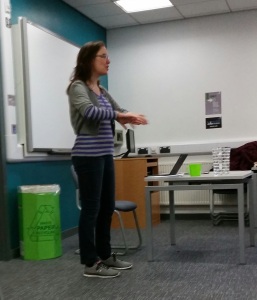
just me teachingI spent last weekend teaching writing to doctoral students at Staffordshire University, and enjoyed it enormously. It was an experiential course that I had devised with input from Dr Katy Vigurs, who hosted the course. We included creative exercises on drafting and redrafting, getting unstuck, the relationship between writing and thinking, and how to find your voice. There was also a short talk from me and several discussion/Q&A sessions. In between these were a dozen half-hour ‘shut up and write’ sessions for students to work on their own writing.

This course demonstrated to the students, very thoroughly, that they can achieve a meaningful amount of writing in just half an hour. And we taught them how to do that, through discussion, example, practice, and review. They had seen the course programme beforehand and planned what they would work on. The half-hour discipline was difficult for them at first; they found it hard to ‘get in’ and ‘get out’, but by the Sunday they were switching between ‘work’ and ‘break’ modes like doctoral ninjas. Several students commented on their evaluation forms that they had achieved more than they had planned.

Before the course, I asked students to complete a form telling me which aspects of academic writing they were good at, and which they wanted to work on. I also asked for a 500-word sample of academic writing from each student. This was partly so I could give individual feedback, and partly so I could get a sense of the individual and overall standard. Generally, the standard was good, particularly as I was seeing excerpts from work in draft. But the students evidently thought they were not good at writing.

This made for a very satisfying moment for me. It went like this:

Me: “I’d like to know who, in this room, thinks they struggle with academic writing because they’re not very good at it. Put your hands up please.”

[Most hands went up, most faces looked miserable]

Me: “I’ve seen examples of your writing, so I can tell you, with some authority, that you’re wrong. You are good at it. The reason you struggle with academic writing is because it’s hard.”

Then I stood in front of the class for a quiet moment, enjoying the war of expressions on people’s faces, as the message began to sink in. It was such a delight to see incredulous smiles break through.

It was also a delight, as always when teaching, to witness students having ‘light bulb’ moments. One woman said to me, with an expression of pure joy, ‘I’ve got it! I just have to write! That’s all I have to do! And if I keep writing, I’ll get my thesis done!’ It’s the kind of statement that can seem obvious after the fact, but it was a huge learning point for her, and I was thrilled to see her happiness.

Of course the true test will come when the students are back in their everyday lives. I think and hope we did enough to embed the practice and motivate the students, and the evaluation forms certainly suggest that we did. But I’ve been involved in training and teaching for far too long to take that for granted. We encouraged the students to form peer networks for support, and suggested that they might set up their own ‘shut up and write’ sessions, whether virtually or in real life. Early signs are that mutual support is growing within the group, and that can only help.

Talking of the virtual dimension, some students from Staffordshire University who couldn’t make the whole weekend, and some from other universities, joined in with our ‘shut up and write’ sessions via the #StaffsAcWri hashtag on Twitter. There are regular ‘shut up and write’ sessions on Twitter (check the #stuw hashtag) which you could join if this interests you – or you could even start your own. It’s amazing how much you can get done in half an hour: one student wrote over 800 words in just one of the half-hours, and most produced several thousand words in the course of the weekend.

My favourite comment from the evaluation forms was: ‘I never drifted off! I have only 2 relevant doodles and have produced work I will be proud to share with my supervisors!’ Further to last week’s post, this is why I think writing can be taught. Not everything about writing, and not to everyone – but those who are engaging with the process, and willing to learn, can certainly be taught the skills and the craft of writing.