
Like many, many others, I met Raul on Twitter some time around 2010. Social media was Raul’s natural habitat; it could have been made for him with his burning desire to communicate and demystify. Later we communicated via Facebook and Instagram, until I gave up almost all things Meta in 2019 (I’m reluctantly still on WhatsApp; no idea why everyone doesn’t move to Signal, it’s so similar to use and much less unethical). And we emailed. Not often, not at length, mostly to share resources. Raul was endlessly frustrated by difficulties in accessing academic materials, because of paywalls and because many publishers won’t ship books to Mexico. I was able to help him by emailing PDFs and occasionally sending books.
Raul’s big passion was justice, particularly around water, public policy, and governance. Those are not my areas of expertise or scholarship, but our interests coincided around methods and ethics. And here he has left us a marvellous legacy, in his voluminous blog and his published work. The strapline for his blog is “Understanding and solving intractable resource governance problems” but he couldn’t resist also working to understand and solve all sorts of scholars’ and researchers’ problems with academic and research processes.
I tracked down his published work via Google Scholar where I was shocked to see how little his work has been cited. He was so visible that I was expecting to see tens of thousands of citations. In a beautiful ‘in memoriam’ post by Raul’s friend Jo VanEvery, she suggests that one of the best things we can do in his memory is to read and cite scholars from the majority world. I endorse Jo’s suggestion 100%, and would add that citing Raul’s own work should be part of this. He wrote about methods for the open access International Journal of Qualitative Methods, and about teaching in various book chapters and encyclopaedia entries. Here are his key methods texts, all open access:
2018: with Kate Parizeau, article on the opportunities and challenges of doing ethnography with vulnerable populations
2018: open access editorial showcasing six writing books to improve your qualitative methods prose
2019: open access editorial on why and how to write fieldnotes
I will be using and citing these works, and I feel ashamed that I have not already done so.
But for Raul it was never just about the work or the public persona. He brought his whole self to social media, for better, for worse, in sickness and in health, to love and to cherish. We don’t often speak of love in professional scholarly circles, but it seems to me that love underpinned all of Raul’s life and work. When I was looking through our email correspondence, I found a message he sent me in early April 2020, when my mother had just died from Covid. Raul and I knew each other; I feel confident in saying we liked and respected each other; but we never met and we were not close. And yet, at a time when all the world was shocked and afraid, he made the effort to send me this kind and loving message.
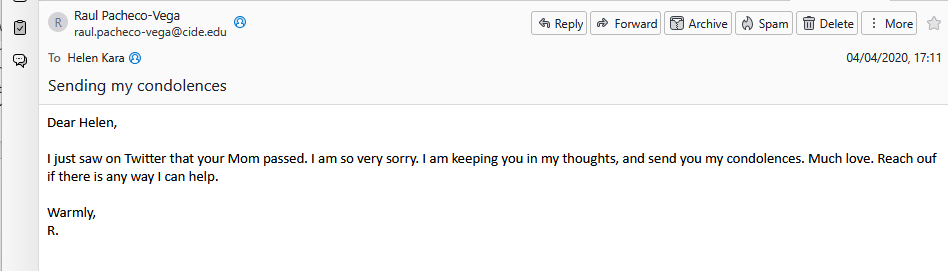
To me, these heartfelt words seem like the essence of Raul. I have seen similar posts elsewhere in recent days, which makes me realise that as well as his tangible legacy of written work, he has also left us a wonderful bequest of kindness.
There is an ongoing debate about kindness, and the lack of it, in scholarly life. I have written about this myself. Through the ways he chose to live, work, and communicate, Raul exemplified kindness, in academia and beyond. So I think another way we can honour his memory is to spread and amplify that kindness in our own lives, work, and communications with others. And maybe even, here and there, some love.


What a lovely tribute. And I agree that love was at the centre of so much of what he did. Thank you for tracking down and sharing those published works, too. The blog is wonderful but requires someone to keep paying the hosting fees and I’m not sure how long that will happen.
LikeLiked by 1 person
Thanks, Jo. I hope someone will archive it in the Wayback Machine, or some of it at least.
LikeLike
Helen, A wonderful tribute. Although I was never fortunate enough to meet Raul, I read his blog and social media posts avidly. He shared his knowledge and expertise with great kindness with many of us and I will miss his wisdom, kindness and compassion that shone through all hie work.
LikeLiked by 1 person
Thank you, beatirce. I will too.
LikeLike