 Yesterday afternoon I came home at the end of a week away teaching and speaking at universities in Southampton (England) and Stavanger (Norway). It was an odd week: last Sunday emails were whizzing back and forth about whether events might be cancelled; by Wednesday night the organisers in Stavanger decided to cancel the last half-day of their conference scheduled for the next morning; and on Thursday morning they got so worried by rumours in Norway that Oslo airport was about to close, that they booked me a new flight back to Heathrow that afternoon and a hotel at the airport (I’d previously booked myself onto an early flight the next day to Manchester).
Between Monday morning and Friday afternoon I went through three airports (one of them twice) and eight train stations (three of them twice). I travelled in two planes, one tube train, eight regular trains, and four taxis. I stayed in three hotels, and had two work-related restaurant dinners with other travelling professionals. One was with a single colleague who had flown from South Africa to the UK to attend the course I ran in Southampton and the other was with around 35 people in Stavanger, many of whom had travelled a considerable distance on planes and/or trains to get to the conference.
Even so, considering the current stage of the pandemic, I would be unlucky to have contracted the virus. I took all the precautions I could; my hands have never been so clean. People in Norway were being very careful: elbow bumps replaced handshakes; hotel workers wore disposable gloves to serve food and drink and to collect used crockery and cutlery. But I won’t know for sure whether I have caught the virus for at least 14 days, maybe longer – and if I have caught it, then during those days I could infect tens or hundreds or even thousands of other people. Preventing this would save potential misery for individuals and families, and potentially also reduce – or, at least, help to spread – the burden on the health service. As the NHS has been undermined by ten years of austerity, plus the impact of Brexit, it is not in the best shape to manage a pandemic. Our hospitals were already full before this pandemic hit.
Making the decision to self-isolate, in the absence of official requirements for me to do so, wasn’t easy. Several things helped. Conversations with family members – some in their later years, others with several serious and complex health conditions including immunosuppression – were useful. These people are also self-isolating; like me, as much for others’ protection as for their own. One family member sent me this really well argued article which also helped. And my partner’s willingness to support my wishes was crucial. Also the requirements in other countries such as Canada, Norway and now New Zealand for self-isolation in circumstances like mine were helpful too. (I can’t find links for the Canadian and Norwegian requirements so my evidence there is anecdotal: I have family in Canada who recently returned from the Caribbean and are being required to self-isolate for 14 days, and an airport official at Heathrow told me of a similar requirement in Norway for travellers returning from the UK.) This photo, posted on Facebook, also helped – I’m interested in Ireland’s response because their Taoiseach, Leo Varadkar, is a doctor, as is his partner.
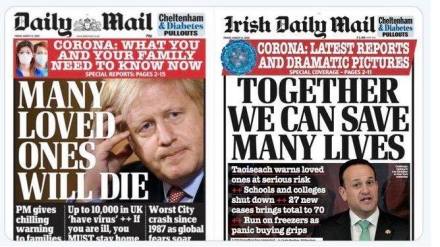
(I usually source reusable photos from Pixabay, or use my own. I don’t know who generated this image; if it was you, and you want me to credit you or you’re unhappy with my use of the image, please get in touch.)
I am lucky that my work allows me to self-isolate. All my forthcoming speaking and teaching engagements have been postponed, most of them indefinitely, which means a loss of thousands of pounds of income over the next few months. However I have desk research to do for clients, and research teams I’m on are considering changes to planned fieldwork as bringing groups of – mostly older – people together in the UK and the EU doesn’t look like an option any more. Meetings are being moved online, though that can come with its own problems as tech providers deal with unexpected spikes in demand. So I can still earn a living, albeit a smaller one.
Then there’s the question of how to self-isolate. Usually when I get home from a trip I turn to domestic tasks such as shopping. My partner agreed to do that instead of me, so I offered to put everything away. While I was waiting I read some more and learned that the virus may be able to survive on hard surfaces for days. So, after putting away the shopping, I washed my hands again – and resolved to continue my frequent and regular hand washing during this period of self-isolation.
I won’t be going to shops or to the gym; I’ll be doing my grocery shopping online and doing yoga and lifting weights at home. I’ll call my hairdresser and discuss my planned appointment for Tuesday – if it’s just him and me in the salon, and I wear gloves throughout, maybe that would be OK. (I’m aware that he runs a small business and needs the work, so at this stage I’ll take the decision with him rather than unilaterally.) I will be using contactless payment and bank transfers for everything so as not to handle cash, in accordance with WHO advice. And so on.
There are so many decisions to make. How much distance do I need to keep from my partner? That’s a really hard one. We hugged when we were reunited yesterday, but we haven’t hugged since, though that’s not a firm decision. We are due to visit friends down south next weekend; I guess we won’t go, but we haven’t actually decided. A nearby friend had a baby recently and I’ve been longing to visit but now I doubt that will be happening any time soon. I miss my friends already, but at least I can talk to people on the phone, or text, or tweet.
I’m looking forward to Monday morning when I can go to my office in my usual work routine. I’m looking forward to a time when conversations don’t centre on the pandemic. I’m looking forward to feeling able to move freely again. But in the meantime, while my Government seems to be looking the other way, and the press supporting the Government have suggested that a coronavirus-induced ‘cull’ of elderly people could benefit the economy, I will be self-isolating because I am persuaded, by the evidence, that it is the most sensible course of action.
If you would like to quote from or share this post, please do. Let’s support our health services. Let’s save lives.
This blog, and the monthly #CRMethodsChat on Twitter, is funded by my beloved patrons. It takes me at least one working day per month to post here each week and run the Twitterchat. At the time of writing I’m receiving funding from Patrons of $52 per month. If you think a day of my time is worth more than $52 – you can help! Ongoing support would be fantastic but you can also make a one-time donation through the PayPal button on this blog if that works better for you. Support from Patrons and donors also enables me to keep this blog ad-free. If you are not able to support me financially, please consider reviewing any of my books you have read – even a single-line review on Amazon or Goodreads is a huge help – or sharing a link to my work on social media. Thank you!
 The ‘blurb’ is the text on the back of a book’s cover which tells you what the book is about. It’s not simply a description, though; it is also a sales tool. For this reason
  I only know one person, now, who shares Facebook posts saying things like ‘share this post and your dearest wish will come true by midnight’. I haven’t seen a really horrible digital chain reaction (“share this or one of your friends will DIE”) for a long time. Most digital chains seem to have morphed into forms of niceness, particularly among women, at least in my corner of the cybersphere. But I still don’t pass them on.
 Taking to Twitter this morning as usual, I discovered that today is Random Acts of Kindness Day (aka #RandomActsOfKindnessDay). My first thought was bah, just one day? One out of 365 (or even 366 in this leap year)? That’s rubbish; let’s commit random acts of kindness EVERY day!
 Recently I’ve been writing books in collaboration with other authors. I collaborated with
 I was doing a telephone interview for a client this morning and my interviewee, let’s call them Ali, said something that made me stop and think. Ali had spent around 35 years working for local government and was talking about the devastation of public service budgets in the UK which has left some local areas with no services for those in need of support as a result of mental health problems, domestic violence, chronic illness, and so on.
 There’s lots I could write about this week. I could write a post around my new book, out this very week:
  This has been a helluva year workwise. I could focus on that: calculate how many train journeys I’ve taken, how many beds I’ve slept in – it would be a lot. That’s mainly why I’m so tired, I think. I’m not short of material for this blog; I’m short of energy. I need a break. So I’m going to have one. Beginning on Friday, when I won’t have done all the jobs I wanted to do, but I will have done all that I can. I’ll start work again on Monday 30 December, but I’m going to take a slightly longer digital break – I’ve already ducked out of Instagram, and I’ll be weaning myself off Twitter and Facebook over the next few days. I’ll be back online, in the New Year, when I’m ready. This blog, too, will be quiet now until the first full week of January. I wonder what I’ll post about then… I envy my fellow bloggers who can generate several posts in one go; I almost always write mine the same week as I publish them. It’ll be a whole new decade. I wonder if I will feel any different. I doubt it, really – except for, I hope, a little less tired.
 I’ve been writing steadily since 2011, and I’ve just done my accounts for 2018-19. I have published three full-length books (one in 2018) and one second edition (in 2017) for my main publisher. I’m now writing for two other publishers and have received several small advances for those books. When I say ‘small’, I mean between £125 and £500, so nice to have in the bank but not at all representative of the amount of time I spend writing the books.
 This is a crazy year of writing. A
  I am all in favour of people asking for what they want and need. It’s useful for each of us to figure out what we really want, what we need, how much of that we can sort out for ourselves, and what we need to ask from others. However, as my work has become more widely known, I have begun to receive more and more requests for help from people I have never met offline or interacted with online. I want to help where help is needed, but some of the requests I get are quite unreasonable. For example, I got an email from a stranger asking me to write their doctoral thesis for them, because they were unwell, and because God would reward me in heaven for my good deed. There is so much wrong with this request. To begin with, I would never write someone else’s doctoral thesis for them, or even part of one, because that would be highly unethical. I do take writing assignments on a professional basis – which means I get paid in actual money (or I don’t take the work). Also, assuming someone shares the same beliefs as you is not sensible and, I would argue, not ethical.
