
 Back in May, I was surprised and delighted to be contacted by a research methods editor from SAGE Publishing, Mila Steele, who asked me to write books for their new Little Quick Fix series on research methods. I had met Mila several times at conferences and other events, and we’d had some good chats, but her email came quite out of the blue.
The series is a new departure for SAGE. It’s also a new departure for me, as the books are intended for undergraduates and I’ve only written for postgraduates before (though some enterprising third-year undergraduates have used, and kindly given me good feedback on, Research and Evaluation for Busy Students and Practitioners: A Time-Saving Guide). There are two other authors currently writing for the series: Zina O’Leary, who is covering the project management side of things, and John MacInnes, who is writing on statistics. Mila wanted me to focus on data, and we agreed that I would start with two books: Do Your Interviews and Write A Questionnaire.
The books are short, pocket-sized, colourful, and interactive. They have a template for consistency, but there is also scope for varying that template as needed. There is no peer review; instead, authors work closely with their editor. In one way this is a joy, though in another way it has caused me problems because I don’t work with undergraduates myself. Luckily I have a colleague/friend who teaches interviewing to undergraduates and was willing to let me pick her brains over lunch. Twitter helped me find another contact who teaches questionnaires to undergraduates and, as she was in Australia, Skype allowed us to speak. I was grateful to both people for alerting me to important points I might otherwise have missed.
Before these, the last book I wrote was Research Ethics in the Real World: Euro-Western and Indigenous Perspectives which took three-and-a-quarter years to complete. So it was a joy to find that I could write a Little Quick Fix book in just a few weeks. They’re not easy, though, because – as anyone who has written for an academic journal knows – ‘easy’ and ‘short’ are not the same thing. Each of these little books is like a puzzle. The text has to be both distilled and accessible; there are strict word counts for different sections; you need to cover the same ground three ways – in under 25, 130 and 600 words – without being repetitive. And then you have to devise interactive exercises to reinforce and embed the points you’ve made. Plus, with the first two, the timescales were tight. SAGE approached me in May, I signed a contract in June, delivered Do Your Interviews in July, Write A Questionnaire in August, they went into production in September and will be published in December. That is a blisteringly fast schedule by traditional publishing standards.
The really good news, from my point of view, is that SAGE has a design team who are doing a proper professional job on the books’ covers and contents. Look at my covers! Aren’t they lovely?

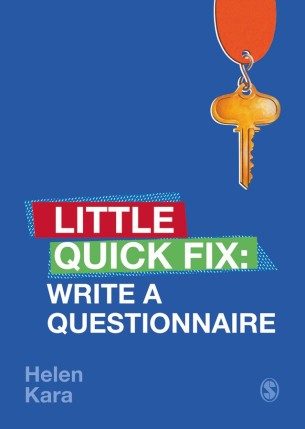
I can’t wait to see the contents.
While I was writing, I made some design suggestions, and it will be interesting to see which the team take up and which they ignore or change. Design is not my strong point, to say the least. I can’t bear to show you the flow chart I cobbled together in Word which I could only be proud of if I was five years old. But I have seen these designers’ outputs and I know they are going to make my work look good.
I am also pleased that the books will be very accessibly priced at £6.99, US$9.50, and equivalent prices around the world. Perhaps the best news of all is that I have now contracted to write two more books in the series: Use Your Interview Data and Use Your Questionnaire Data. Plus these have much more relaxed timescales; the first is due by 1 December and the second by 25 February, for publication next July. I love my life!
![Research ethics in the real world [FC]](https://helenkara.com/wp-content/uploads/2018/08/research-ethics-in-the-real-world-fc.jpg?w=242&h=363)
 Last week I posted
  As an independent researcher I feel lucky because bad debt is a problem I rarely have to face. My clients are charities, local authorities, government departments, universities – all organisations with money in the bank and not much chance of going bankrupt. Of course that’s always a possibility, but people who work for private sector organisations or private clients are much more likely to find themselves owed money they will never receive.
 I have seen several pieces written online about impostor syndrome (
 Last week, for reasons best known to one of my clients, I was reading a bunch of systematic reviews and meta-analyses. A systematic review is a way of assessing a whole lot of research at once. A researcher picks a topic, say the effectiveness of befriending services in reducing the isolation of housebound people, then searches all the databases they can for relevant research. That usually yields tens of thousands of results, which of course is far more than anyone can read, so the researcher has to devise inclusion and/or exclusion criteria. Some of these may be about the quality of the research. Does it have a good enough sample size? Is the methodology robust? And some may be about the topic. Would the researcher include research into befriending services for people who have learning disabilities but are not housebound? Would they include research into befriending services for people in prison?
![Research ethics in the real world [FC]](https://helenkara.com/wp-content/uploads/2018/08/research-ethics-in-the-real-world-fc.jpg?w=226&h=339) I am delighted to have been invited to launch my forthcoming book,
I am delighted to have been invited to launch my forthcoming book,  When does a research project end? When a report has been written? When a budget has been spent? When the last discussion of a project has taken place? It’s not clear, is it?
 I have been an independent researcher for almost 20 years, yet I still find the gear changes difficult.
 Helen Kara