
 The gender pay gap is much in the news at present. The BBC is under scrutiny following the resignation of its senior editor Carrie Gracie on the grounds of unequal pay; large companies in the UK pay women less than men; Iceland has just become the first country in the world to pass a law making it illegal to pay men more than women. I could cite plenty more instances. And this got me thinking: what is the situation for academic authors?
I belong to several Facebook groups for people in or connected with academia. In one group recently, a doctoral student in some financial difficulty – as so many doctoral students are – bemoaned the need to read a chapter from a book costing US$52. “Is this how academics make their money?” the student asked.
The idea that all people who write books are rich is a complete misperception. A few writers are rich, and some of them are women: JK Rowling and Jodi Picoult, to name just two. But they are not academic writers. Some academics who are writers are rich, but that’s mostly because they receive generous academic salaries. (NB: I’m not saying all academic salaries are generous. I’m saying rich academics are the ones on generous salaries, and some of them are also writers.)
In America writers are treated with more respect than in most countries. The Textbook & Academic Authors’ Association is open to members from any country but it is based in America and 80% of its members are American. In 2015 the T&AAA conducted a survey of 403 textbook authors which showed that average royalties were in the band of 9%–18%. So it seems there may be a geographic pay gap for academic writers, because this range is higher than academic royalties I have heard about from the UK. But there was no breakdown of the survey findings by gender.
My publishing contracts contain confidentiality clauses which make it illegal for me to tell you, or anyone else, what my own royalty rates are. This is standard practice in the publishing industry. I can tell you that one young British academic of my acquaintance recently told me, pre-contract, that they had been offered royalties of 7.5% on sales. If that person’s book retailed at US$52, you might think they would therefore earn US$3.90 per sale. Not so. Royalties are paid on the amount the bookseller pays to the publisher, not the amount the customer pays the bookseller. A book with a retail price of US$52 would probably sell to the retailer at around US$36, so the author’s royalty per sale would be US$2.70.
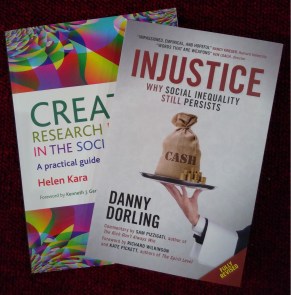
Many academic books retail for less than US$52. Mine are currently listed on amazon.com at $39.93 for Research and Evaluation for Busy Students and Practitioners (2nd edn) and $33.66 for Creative Research Methods in the Social Sciences. Some retail for much more, though they are often edited collections. For example, the Sage Handbook of Applied Social Research Methods is an eye-watering $490.48. I have never heard of anyone earning anything for contributing a chapter to an edited collection. It seems likely that books at these prices are only bought by the libraries of rich institutions. (At least that means students and staff at those institutions can use the books, and a few other libraries provide wider access. For example, the British Library in the UK holds copies of every book published in the UK, and anyone can register to read those books for free. The snag is that you have to go to London, which isn’t easy or possible even for every UK resident, let alone people based further afield. Some other countries have national and regional libraries which are publicly accessible, but again they are bricks-and-mortar institutions and you have to go to them.)
Some publishing contracts offer no royalties at all on the first 250 or 500 (or some other figure) of books sold. Given that some academic books only sell a few hundred copies, these kinds of contracts could result in authors earning no royalties at all. I can’t find any reliable statistics about sales of academic books, which is a finding in itself.
I can tell you how much I earned in total royalties last year, on the two books I have in print, one of which is a second edition. For 2016-17 I earned £1,236.70 in royalties. Earlier this decade, Queen Mary University of London reported on the earnings of almost 2,500 professional writers in the UK. Academic writers had the lowest average annual income, at £3,826, behind travel writers, non-fiction writers, children’s fiction writers and adult fiction writers, respectively. I aspire to become average one day.
So publishing is not how academics make their money; it’s how academic publishers make their money. But is there a gender pay gap in academic authors’ royalties? With the current secrecy around royalty rates, there is no way of knowing. But given the prevailing interest in the gender pay gap, I hope that next time the Textbook and Academic Authors’ Association, or the Society of Authors, or a similar body conducts a survey, they will ask about, and report on, gender parity or disparity.
 My last post on this topic


 Last week I wrote about
  Given that evidence is such a slippery, contentious topic, how can researchers begin to address its ethical aspects? A working definition might help: evidence is ‘information or data that people select to help them answer questions’ (
 I inadvertently caused a minor Twitterstorm last week, and am considering what I can learn from this.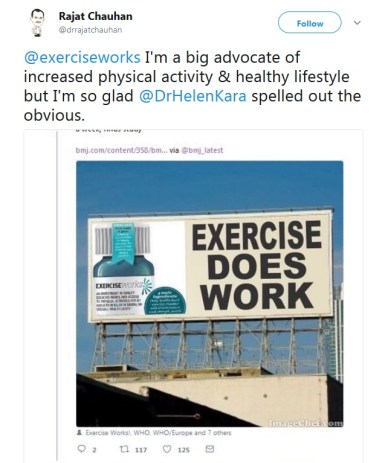

 Crowdfunding is a way of raising money, from anyone you can persuade to give you money, for anything you like. You can crowdfund for personal needs, projects, charities, disaster appeals, creative endeavours – anything from pet food to space travel. Some projects that have been successfully funded through Kickstarter alone include
