
 Crowdfunding is a way of raising money, from anyone you can persuade to give you money, for anything you like. You can crowdfund for personal needs, projects, charities, disaster appeals, creative endeavours – anything from pet food to space travel. Some projects that have been successfully funded through Kickstarter alone include combat cookware, amusing rap songs about the iconic television character Doctor Who, and bacon-scented soap.
There are quite a few crowdfunding sites now and they have different USPs. For example, Teespring was set up specifically for crowdfunding unique t-shirt designs, though it now also enables the design and creation of other products such as beach towels, phone cases, and mugs. Unbound is for publishing books (though not academic ones, sadly). GoFundMe is mostly used for medical, memorial, and charitable fundraising, though it is also used by a lot of doctoral students around the world to help fund part or all of their studies.
Kickstarter is for creative projects, including those related to academia. Indiegogo is for innovations in technology and design; its links with academia seem more tenuous, but nevertheless exist. However, unlike GoFundMe and Kickstarter, it does include quite a few research projects. All of these websites take a small percentage of any funds raised, to cover their costs.
Although people doing academic work are free to use any crowdfunding website, there one that seems particularly applicable is Patreon. This is for ‘creators’ who can crowdfund per ‘thing’ they create (song, podcast, etc), or per month (which is more predictable for donors). Patreon is increasingly being used by researchers, such as Brian Danielak who creates free open source software for research; Asia Murphy who researches wildlife in remote forests (with great photos and videos!); and Kylie Budge who is researching creativity in cities.
Crowdfunding is not a soft option. Yes, you can slap together a web page, sit back, and wait for the donations to roll in. But if you do that, they won’t. For any chance of success, you need an appealing offer, a well-made fundraising page, healthy personal and professional networks, and no shame at all about asking people for money, over and over again. On Patreon, your offer is made up of goals and rewards. Goals need to be intriguing and credible, and rewards need to be enticing (to potential fundraisers), achievable (for you), and ongoing rather than one-offs, with at least one reward per year even for people who fund you at the lowest level. This all takes a lot of thought and research. Then, once you have your page up, you need to promote, promote, promote.
Talking of which: I am launching my own Patreon page this very day! I am lucky to have a great mentor for this project, Jonathan O’Donnell of RMIT University in Melbourne, Australia. He is currently doing a PhD in academic crowdfunding, and will be producing a guide to this in due course. If you appreciate my blog, please consider supporting me for one dollar per month – or more, if you wish. Whether or not you think you might want to support me, I’d be grateful if you could take a look at my page. All feedback welcome, either here or there. Thank you.
 I
I  It’s not often I get to share an output from the commissioned research I do. Sometimes clients don’t want to share publicly for reasons of confidentiality, and sometimes there are other reasons they don’t publish. As a commissioned researcher, I can’t publish the work someone else has paid for without their agreement. But I’m glad to say that
  I recently wrote on this topic citing
  Researchers, research commissioners, and research funders all struggle with identifying good quality arts-based research. ‘I know it when I see it’ just doesn’t pass muster. Fortunately,
 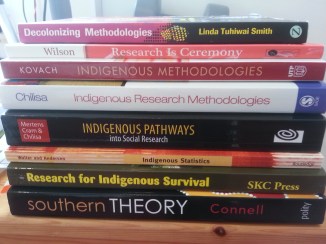 I have been working with Indigenous literature on research methods and ethics for over a year now: reading, annotating, thinking, re-reading, and writing from this literature alongside Euro-Western literature on the same topics. During this process I have been reflecting on how I should, and how I do, work with Indigenous literature.
 I wrote a post in December 2014 about
  I posted a book list earlier this month, and a surprisingly large number of people have shown interest. So I thought maybe I should explain myself, as best I can.
 Feedback can feel like a very mixed blessing at times. Positive feedback is a delight to receive, while even the most constructive criticism can come as a crushing blow. Writers are particularly susceptible to this, especially novice writers who haven’t yet learned to separate critique of their writing from critique of themselves. I often meet doctoral students who are very reluctant to show their work to their supervisors, fearing criticism because they’re worried that it’s not very good. If it’s a first draft, of course it’s not very good, and a second draft will also contain problems that have to be fixed. Supervisors need to see this work so they can give feedback, which should include information about:
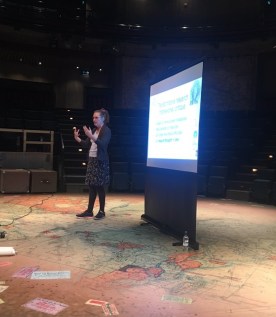 Last Thursday, Friday and Saturday I was privileged to facilitate the inaugural Creative Research Methods summer school run by
