

Review Of The Year 2016

2016By far the most popular post on the blog in 2016 was Ten Ways To Get Hold Of Academic Literature. In fact, thanks to @elfriesen making a great contribution in the comments, it should now be called Fifteen Ways To Get Hold Of Academic Literature. I’m glad this post has proved to be such a useful resource – though it may partly be the most popular because it was posted very early in the year: January 6th, to be precise.

Oddly enough, the second most popular post with readers in 2016 was in fact published in March 2015. It’s the post on Creative Research Methods, which outlines the structure and content of my book Creative Research Methods in the Social Sciences: A Practical Guide. I’m surprised and delighted that this post is still so widely read.

The third most popular is my post on Getting Creative With Your Thesis Or Dissertation, published in July 2016. I’m not so surprised about this one, because I’ve had really good feedback about it, on Twitter, by email, and from people in my workshops. It gives examples of several doctoral dissertations and theses which have been put together in more creative ways than the traditional brick of paper full of dense academic writing. I’m continuing to collect such examples and will write on the topic again when I have enough to merit another post.

The fourth most popular is Ten Top Tips For Becoming An Indie Researcher, published in June. Again, I had a lot of positive feedback about this post. I aimed to provide realistic encouragement, i.e. to make the drawbacks of this lifestyle clear as well as the pleasures. Reading back over the post, I think I succeeded. A lot of people I’ve spoken to this year have been very interested in how I manage to survive and thrive as an indie. For me, and for others who I know, it’s a great way to live. But it has a lot of challenges, and it is definitely not right for everyone.

The fifth of the top five is a post from October, Devising Your Own Research Method. This post explains when, and how, you can create a new method. It’s primarily aimed at doctoral students, who tend to have more time to think about their methods than jobbing researchers do, though it may also be useful for early career and other researchers.

My own top five, in professional terms, don’t have an order of priority, so I’m going to put them in chronological order. The first was the Research Methods Festival at Bath in July, which was a terrific event. I met some great people and learned a lot.

The second was my recent trip to Melbourne, Australia, where I delivered a keynote speech and three workshops on creative research methods, and met some wonderful people in real life who I’d been talking to on Twitter for years. I’d never been to Australia before and it was an amazing experience.

The third was being commissioned to teach a 60-credit module on creative research methods for EdD students at Staffordshire University in the first half of 2017. I’m in the process of planning the module, I’m thoroughly enjoying myself and my intention is that my students will do too. If others want to follow our progress, you can find us on Twitter through the hashtag #StaffsEdD.

The fourth highlight of 2016 was working on the second edition of my book Research and Evaluation for Busy Students and Practitioners: A Time-Saving Guide. This is a heavily revised and updated edition, with a whole new chapter on methodologies, due for publication in April 2017.

The fifth highlight was being asked to facilitate a Summer School on Creative Research Methods for doctoral students in July 2017. This is being run by the Community Animation and Social Innovation Centre (CASIC) at Keele University, and will be held at the New Vic Theatre in Newcastle-under-Lyme and at the Keele campus. We’re in the process of putting the programme together now, and it looks terrific. We’ll be covering arts-based methods, research using technology, mixed methods, transformative research frameworks, and writing creatively for academia. There will be a range of presenters and lots of hands-on and interactive work. Booking opens in January, with a discounted early bird rate; follow me on Twitter @DrHelenKara if you want to find out more.

I’m going to rest this blog, now, till the New Year. I wish you all a happy holiday.
Twitter Can Make Your Dreams Come True

I’m at the end of a working week in Melbourne, sitting in my hotel room; all I have to do is write this blog post and pack. It’s been a great week. One keynote, three workshops and six meetings. Miles and miles of pavement-pounding, including four bookshops (only one book bought due to luggage weight restrictions; several others noted) and the best pistachio gelato I ever ate. Free trams! Melbourne has free trams in the city centre! I didn’t figure out how to use them till day four of six, but my feet have been grateful to me since. And lots of lovely drinks and snacks and dinners. Melbourne likes its grub, and so do I.

The best part about this week, though, is the people I have met. People I’ve only known on Twitter up to now. Not all of them from Melbourne, either: Naomi Barnes (@DrNomyn) from Brisbane and Deborah Netolicky (@debsnet) from Perth were both in town for the Australian Association for Research in Education conference, and it was great to hang out with them. They have both, since, written considered and scholarly blog posts: Deb wrote about the conference, and commented that one thing she loves about Twitter is that it helps her feel as though she knows people, even if they’ve never met in person. Naomi reflected on whether Twitter really creates or enables communities.

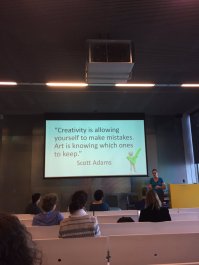
I came to Melbourne this week entirely as a result of Twitter. The photo at the top of this blog post was harvested from Twitter. I’ve been doing work generated through Twitter, and people have been tweeting that work out into the Twittersphere. Twitter supports my work in a lot of different ways. This week I have met and talked with eight people who I only knew online up to now. With each of them we went straight into real conversation: when you already know someone online, you can dispense with all the ‘how was your journey?’ and ‘did you find us OK?’ type small talk. This means that when you only have a couple of hours with someone, that time is much more useful. So I get where Deb is coming from with her comment.

Naomi makes a distinction between communities and, as sub-sets of communities, tribes. This is pretty much how I experience Twitter. There is a community of researchers that flocks around hashtags such as #ecrchat (early career researchers chat), #phdchat (PhD chat) and #acwri (academic writing). And there are smaller tribes. I have felt for some time that there’s a little Australian tribe that I belong to, made up of ten or a dozen people. Twitter tribes aren’t necessarily co-located, and indeed my Australian Twitter tribe is scattered around Perth, Brisbane, Sydney, Melbourne, and Canberra. But the biggest concentration is in Melbourne, and the others either have spent time in Melbourne or visit the city fairly regularly. So this feels like the geographical heart of the tribe. Also, not everyone in my Australian Twitter tribe knows everyone else. I was able to introduce Naomi and Deb to another tribe member. And there’s one tribe member who, despite being at one of the universities where I taught this week, doesn’t know any of the others. And to be fair, I first got to know her through her work, rather than through Twitter; our Twitter contact came later. But that doesn’t matter; she’s still part of my tribe.

Meeting these people in person has, without exception, been an absolute delight. They have introduced me to wonderful bars and restaurants. We have talked non-stop, planned projects, generated ideas, and laughed immoderately. I have wanted to meet them for years but thought it could never happen. It has, quite literally, been a dream come true.

How I Charge For Work

money-budgetingThis post was inspired by @CClements29 who posted a question on Twitter last week. I was on my way to Australia at the time, via London and Tokyo, so I couldn’t answer directly. But Charlotte’s tweet, plus various other recent queries, made me realise I should write about how I charge for work.

What I can’t tell you is how much you should charge for any work you’re being asked to do. However, I hope that by explaining how I work out my charges – a system developed over 17 years in business – I can at least give you some pointers on how to think about charging, and what kinds of questions to ask yourself and others.

First, I charge by the day (or, at the minimum, half a day). My rates depend on: the type of client and/or source of funding; the complexity, location, and interestingness of the work; and (to some extent) my capacity. For example, if I don’t have much on and I could do with the work, I’m more likely to accept less interesting work at a lower fee; conversely, if I’m maxed out, it doesn’t matter how interesting or well-paid a gig might be, I’m not going to say yes.

As a rule of thumb, I charge more for more complex work, work that involves more travelling, and boring work. If there’s something interesting I can do in my office, I’ll be happy to charge less. I often reduce my day rate somewhat for a longer piece of work, on the basis that if a client buys, say, 20 days of my time or more at one go, they deserve a discount. Sometimes the client sets the day rate: if that’s higher than I would set it myself, I won’t argue; if it’s lower, I probably will (unless there’s some other reason I want to do the work).

In terms of client type, I charge the least to small, local charities, or for any work funded by public donations. I charge the most to national governments, or for work funded by national governments, and to wealthy organisations such as universities. Larger charities and local governments get charged at an intermediate level.

In terms of what my day rate actually is: for UK work, it currently varies between £120 (small local charity, work funded from public donations) and £1,000 (rate set by a client for training when the course is full). I charge £800 for a day’s teaching in UK universities, which seems to be pretty much the going rate; £500-£600 to central government or for work funded by central government; £350-£450 to larger charities and funders; and £200-£250 to smaller charities and funders. This sounds like a lot to some people; the rationale is here.

The other part of the equation is working out what you can actually do in a day. This takes some experience, as everyone works at different rates, and the time things take can vary. For example, not all interviews will take the same length of time: an interview with five questions is likely to take less time, on average, than one with 15 questions. Sometimes, too, there’s a chunk of the work where you need to invest some time updating your knowledge and/or skills. I don’t think it’s fair to charge a client for the time you spend doing this, because the update will only help them for this particular job, while it will help you more widely. Occasionally the two will combine, e.g. when a client wants a literature review, as part of the work, about the exact topic on which you need to update your knowledge to do the whole job effectively. That kind of serendipity does happen, but it’s rare.

I can’t tell you what you can do in a day, but I can tell you it will help if you are able to work fast, as then your work will represent better value for money. I touch-type at 90 wpm, I read fast, and I make good use of time. All of this means I can offer my clients a lot of work in each day.

I charge for some expenses on top of my day rate: travel (second-class, taxis where necessary, mileage at Inland Revenue rates if I need to drive) and accommodation when required. I don’t generally charge subsistence to clients, but I do write it off against tax. I absorb all other expenses – stationery, printing etc – within my day rate.

Some clients want a ‘job rate’ so they can budget – or they tell you what their budget is, and ask you to work out how you can do the job within the available resources. Either way, you have  to decide whether and, if so, how you can meet their needs. Sometimes you simply can’t: I’ve lost count of the jobs I’ve turned down because the client wants, say, a three-year evaluation of a publicly funded project for a total budget of £5,000. It’s just not feasible to do a good piece of work, of that duration, for that price.

Charging for work abroad is different: info here.

People may, at times, ask you to work for nothing, or for ‘exposure’ or ‘the experience’ or ‘the contacts’. It is up to you whether or not you take up these opportunities. If you’re at the very start of your indie career, some may be worth the effort; I benefited from such things myself. I still work for nothing at times: I offer free support to groups of service users, community members, activists etc who want help and advice in relation to research. But I’m long past the point of working for ‘exposure’ or ‘experience’. I doubt any of my clients would ask a car mechanic, or a hairdresser, or a window cleaner to work in return for ‘exposure’, so why do they feel it’s OK to ask a researcher to do this? Beats me. And I already have 17 years of paid experience, so I hardly need more unpaid experience.

Whatever you decide, don’t sell yourself short. We all need to value our own knowledge, experience, and skills. This isn’t always easy: the day rates I now charge are this year’s rates, as my post about the rationale shows. I could only bring myself to charge these rates after, quite literally, years of people I respect (including several clients) telling me I wasn’t charging enough for the work I was doing. Yet I now realise that under-selling myself didn’t do me any good, and it doesn’t do the rest of us any good either, because it can lead clients to have unrealistic expectations. So do the necessary thinking and research, take a deep breath, and charge what your work is worth.

Second Edition Finished!

Pages from Research and evaluation for busy students and practitioners FC.jpgI mentioned before that I’ve been working on the second edition of my first full-length research methods book. And I’ve just finished! It’s been quite a chunk of work. I’m sure some people turn out second editions that just have a few new paragraphs, some updated references and a different cover. Not this one. This second edition has a whole new chapter, several new sections, lots of updated references, and all the work that goes with shuffling the old bits to make the text cohere and the narrative flow smoothly around the new bits. We’ve even updated the cover – isn’t it lovely?

I’ve also corrected a few small errors (ahem) and tried very hard not to make any new ones (fingers crossed). Luckily I’ve had help, from friends and colleagues, my lovely editor and others at Policy Press, and the useful constructive criticism I collected from some of the kind people who took the time to write reviews of the first edition. Many books have just one name on the cover but I don’t think any book worth reading or using can really be produced by one person entirely alone. It’s too complex a task. In these days of indie publishing, authors can do more themselves, and have more control of the process, if they choose. I support that – I even do it, at times – but I would still use beta readers and a professional editor, as a minimum. Plus there are all the people I bounce ideas off as I go along.

You might think the work is done at the point when I email the typescript off to the publisher. If only! These days, if you write a textbook, you need also to write a companion website. So these last few weeks I’ve been devising discussion topics and essay questions, quizzes and scenarios, and searching out resources to add to the companion website for the second edition.

There are still tasks ahead: respond to queries from my editor, respond to queries from the copy editor, read the proofs, probably other things I’ve forgotten. Then there will be marketing, in the New Year, ahead of publication in April. I’ve learned a lot about marketing in the last few years but I still know very little, and I’ll be interested to learn how to market a second edition.

But before all that, I’m off on my travels! A stop-over in Tokyo this weekend, Sydney next week, then Melbourne the week after for work. I’m aiming to blog at least once when I’m away, and will be interested to see who’s around to chat to on Twitter when I’m usually asleep. My aim was to finish the substantive work on the second edition before I left the UK, and I’m very glad I have.

Twelve Top Tips for International Indie Work

plane.jpgMy chosen career has offered me some interesting opportunities to work outside my own country. First I went to Syria, before the conflict began, to teach qualitative research methods to doctors. It was a fascinating experience, I met some wonderful people, and I grieve for the plight of that delightful country. At the time I thought it was a one-off opportunity, but since my book on creative research methods came out last year, several others have arisen. I’ve taught in Scotland and Canada, next year I’m teaching in Wales, and next month I’m off to Australia!

Glamorous, right? Well maybe above the surface, but beneath, the administrative feet are paddling like mad. If you, too, want to do international work as a freelance indie/altac, here are my twelve top tips.

  1. Charge more for international than for national work. You need to factor in at least two unpaid days for pre-trip admin: sorting travel and accommodation, planning work, applying for a visa, getting travel insurance, having vaccinations – there’s a lot to do. I recommend adding 50% to your usual day rate as a minimum.
  1. Find out what you can charge in the country concerned. It may be more than your usual day rate plus 50%. If so, charge the going rate, or a little less. If you charge much less than the going rate, people will think you’re not worth much. Strange, but true.
  1. Make sure any costs you quote include, as extras on top of your day rate, any taxes and/or visa costs payable locally.
  1. Charge half your day rate for travelling time. I usually allocate half a day each way for short haul flights, one day each way for long haul.
  1. Make your own travel arrangements. Otherwise you risk several changes of flight and a hotel that is grotty, or inconveniently located, or with no wi-fi. Making your own arrangements takes more time but it’s worth it because you can suit yourself. Having said that, you can still use an agent for some of the work. I booked all my own travel for Canada and it took ages; for Australia, thanks to a suggestion from my Dad, I used FlightCentre (available worldwide) and I would recommend them highly. They understood my needs and my budget, and evidently have an encyclopaedic knowledge of international flight options.
  1. Don’t take the mick with expenses. I book economy class direct flights: that usually costs a bit more than flights with changes of plane, but I arrive in better condition and am fit for work sooner. I book accommodation that is comfortable and suitable for a business traveller but nowhere near top end (examples: Premier Inn in the UK, Best Western in Canada). I will use taxis, but only if I need to; I’ll use public transport where that’s easily accessible with suitable routes.
  1. Search for more work than the job you are initially offered. There’s no point flying all the way to wherever-it-is simply to deliver one short workshop or keynote speech. Use your contacts, your contacts’ contacts, social media, even cold emailing – any ideas you can come up with to generate more work. Don’t be shy. The very fact that someone wants to bring you to another country to work will impress other people. You need to maximise this opportunity, both financially and interpersonally.
  1. Where jet lag will be a factor, build in an initial day in which you won’t be working to help you acclimatise. Get onto local time as fast as you can: start before you leave for your trip if possible. And similarly, build in at least a day after you get home, before you have to do any substantive work.
  1. Plan for a final day with no commitments, so you can take up people’s offers to ‘grab a coffee’ while you’re in the area. If there are no such offers, you can spend the day exploring and having fun, so it’s a win-win.
  1. Check and double-check all travel arrangements, timings, and contact details. If someone has flown you thousands of miles for work, it’s enormously embarrassing if you don’t actually turn up in the right place at the right time. (I imagine. I’m glad to say I’ve never yet suffered such embarrassment – and I do not intend to in future.)
  1. Prepare your work carefully, and deliver it to the best of your ability. You are, to some extent, on trial. If you do well, you may be asked again.
  1. Do the follow-up work: send the emails you promised to send, pass on the references you mentioned, put people in touch with others as you said you would.

Working internationally is a lot of hard graft. It’s also a great deal of fun. I love to travel, meet new people, and see new places. But I find it helps to be realistic about what is involved, clear about what I can offer, and unambiguous about my terms.

Devising Your Own Research Method


yesI’ve had several emails recently from people asking whether they can devise their own research method. The answer is yes – in the right circumstances.

If you’re an undergraduate or a Masters’ student, you’ll have difficulty convincing your tutors that it’s a good idea for you to devise your own research method. They’re likely to say, with some justification, that you need to learn about existing research methods and practise doing research first. The possible exception is if you’re studying for a Masters’ degree in research methods and you want to use your dissertation to try out something new. But otherwise you probably need to leave the devising of a new method for your doctoral study or professional research.

Devising your own research method very rarely means creating a whole new method. Mostly it means tweaking an existing method, or layering two methods together, or some other form of adaptation. For example, Jacqueline Belzile and Gunilla Öberg, from the University of British Columbia, took a new look at focus group data. They found that it was usually treated in the same way as interview data, i.e. the content of the text was the focus of analysis while interactions between participants were generally ignored. Belzile and Öberg came up with new ways to analyse interactions in focus group data, and so moved analytic methods forward.

This usefully demonstrates that devising your own research method does not and need not apply only to data gathering. You can also experiment with writing, as I have done alongside many others, and there’s loads of room for creativity in presenting and disseminating findings. Art installations, theatrical performances, interactive multimedia – these are just a few of the options available to anyone who wants to go beyond the conventional conference presentation, thesis, journal article, or research report.

However, my inbox suggests that data gathering is the phase where people are most inclined to be experimental. And by ‘people’, I mean doctoral students. When I was doing the background reading for my book Creative Research Methods in the Social Sciences: A Practical Guide, I found that a surprisingly high proportion of papers on innovative methods were written by people who had developed those methods during their doctoral studies. This applied right across the methodological spectrum, from people developing new scales or algorithms, apps or computer games, or ways of mixing methods, to people developing new arts-based techniques. I myself developed a new method of gathering data using oral storytelling during my own doctoral studies. I guess this is at least in part because doctoral study provides enough time to research and develop methods – for those who have the inclination.

Some doctoral students find that their supervisors are nervous about the idea of a new method. The key to soothing supervisory anxiety is to construct a solid argument for the methodological move. So, let’s say a student, Ali, wants to research the effect of living close to mainline railway lines on outdoor social opportunities. Ali decides to create two three-dimensional models of small towns, identical except in one respect: one of the towns has a mainline railway running through the middle while the other has a stream with a path alongside. Ali also makes a collection of small figures and objects (barbecue, picnic blanket, bicycles etc) that participants can place on the model to show what kinds of outdoor social opportunities they would expect to see in which locations. However, Ali’s supervisors favour traditional methods of data collection such as interviewing. Ali needs to come up with some kind of precedent to demonstrate that the plans are viable, but there is no direct precedent – in fact, Ali can’t find anything anywhere in the methods literature about people using three-dimensional maps or model towns for qualitative research.

This means Ali needs to do some lateral thinking. There is some information in the methods literature about using maps with research participants, and there is also information about using objects to support interviewing. Ali collects and reads both sets of literature and uses the arguments therein to build a new argument in support of the planned method. Very sensibly, Ali also identifies some potential weaknesses of that method, and outlines plans to pilot and review the method as the first stage in its development.

So, if you want to devise a new method, whether for academic or other research, start by reading widely in the methods literature. Be prepared to think laterally, and to use a variety of search terms. At the methods frontiers, terminology is often unclear, and it would be embarrassing to claim you’d invented a new method then find several other people had invented it first but called it something different. Also, allow enough time to test your method thoroughly, through a pilot or a series of pilots, before you use it for real.

Devising a new method of gathering data – or, more likely, extending the boundaries of an existing method – is not for everyone, and it is certainly not necessary to do this to gain a doctoral qualification. But it can be great fun and very satisfying.

University Bureaucracy Is Driving Me Mad!!!

I understand that where there are institutions, there must also be bureaucracy. I know that when I work with a new university, I need to fill in a New Supplier Form for their records, and someone will have to raise a purchase order before I can get paid. This is how most universities work. The initial form-filling can be a bit of a pain, and it can take a while to get set up on the system, but once that’s done, the admin is usually straightforward. I do a job, a purchase order arrives in my inbox, I create an invoice for the specified amount bearing the purchase order number, email it off, then some time later the money appears in my bank account.

That kind of administrative overhead seems reasonable and proportionate for the kind of work I do and the amounts I charge. Most of my invoices are in three figures or the small end of four. However, some universities have a massive administrative overhead for new suppliers. I’ve just come across one at the other end of a very long spectrum. Nameless University requires me to do the following:

  1. Complete a New Supplier Form
  2. Complete a Vendor Appraisal Questionnaire
  3. Read and understand their Terms and Conditions for Purchase
  4. Complete a Supplier Engagement Tool online

The New Supplier Form is on a spreadsheet and has 22 questions. The Vendor Appraisal Questionnaire is two pages of A4 and has several of the same questions that are on the New Supplier Form.

The Terms and Conditions for Purchase are 11 pages long. Being savvy in these matters, I skipped straight to the insurance section, where I found that they want me to hold £5m in public liability insurance and £1m in professional indemnity insurance. My own insurers, in whose interests it is to sell me as much insurance as possible, have told me that I only need £2m in public liability and £250,000 in professional indemnity for the kind of work I do. To raise my cover to the levels demanded by Nameless University would cost me more than I will earn from my work with them.

The online Supplier Engagement Tool was the icing on the cake. Sample question: ‘Is there someone in your organisation who is responsible for sustainability? To qualify, sustainability must form 50% or more of the person’s job role.’ Yes, there is someone in my organisation who is responsible for sustainability. It’s me. I make sure we buy recycled paper and compost our teabags. But is that 50% of my job role? Is it heck. For a start it only takes about one minute a week to ensure that my business is as sustainable as possible, and for a second thing, if I spent half my time on sustainability, I wouldn’t be able to earn a living.

Most of the questions in the Supplier Engagement Tool were irrelevant to me, so I ended up answering almost all of them with the ‘other, please specify’ option. At the end of the process I got a personalised action plan for my business. This turned out to be a pdf of a single page with my company name at the top and NOTHING ELSE AT ALL.

I said in an email to the person commissioning my work that Nameless University was by far the most bureaucratic I had come across (it is). That person forwarded my email to the Head of Procurement. The HoP wrote me a lengthy email saying, among other things, that it is ‘standard business practice’ to operate in this way for any contract over £1,000 in value. (As this is the first university which has done this to me, I’m not sure what the standard is here, let alone the business; even the local authorities I used to work with didn’t operate like this for costs under five figures.)

The HoP did acknowledge that there was duplication between the spreadsheet and the questionnaire, and said they are ‘looking to merge the documents into one in the future’ (a job that could be done in five minutes flat). The HoP also said that ‘insurances can be negotiated… with suppliers such as yourself’ – so why not put that in the Terms and Conditions of Purchase? Some suppliers will reach that point and conclude that they are ineligible. Bureaucracy is not only a nuisance, it can also exclude, which is unlikely to be in anyone’s best interests.

Apparently the Supplier Engagement Tool will enable Nameless University to ensure that all their suppliers ‘fully comply with the recently introduced Modern Slavery Act‘. I know I can drive myself hard at times, but I didn’t realise I was at risk of enslaving myself. More seriously, this Act is only applicable to businesses with a turnover above £36million. The UK Government evidently understands the need to keep red tape to a minimum for small and micro businesses; why can’t Nameless University get its head around this too?

Most galling of all, it will take me a couple of hours to jump through all their hoops. I’m debating whether to reply to the HoP asking who I should invoice for my time. What do you think? Is that a good way to make a point? Or is it a good way to shoot myself in the foot?

Working On A Second Edition

2nd-ednI’m working on the second edition of Research and Evaluation for Busy Practitioners: A Time-Saving Guide. This was my first full-length research methods book, published by Policy Press in 2012, and it’s ready for an update. I’ve never worked on a second edition before and it’s an interesting process. One of the problems I had with the first edition was that the typescript review was not at all helpful – just half a page of text with only one point that I ended up implementing. That was frustrating at the time. I wanted more input this time around, and my lovely publisher agreed that this would be a good idea.

First they asked for a couple of unstructured pre-proposal reviews from people currently using the book. One was half a page and the other was 2.5 pages, and they were both helpful, with a useful balance of praise and constructive criticism. Of course authors need praise like plants need water, but also it’s handy when revising work to know which aspects I don’t need to worry about.

My next job was to write a proposal for the second edition, saying why I thought there was a need for a new edition, and what the key features of the new edition would be. This went out to five reviewers for structured responses, which again were very helpful and balanced. All seven reviewers had lots of ideas – two full pages of bullet points when I compiled them into a Word document – to add to the ideas I’d already had myself, and some that readers and reviewers had contributed after the first edition came out.

The second edition will be around 10,000 words longer than the first, with a whole new chapter on research approaches and methodologies. I can’t quite believe that didn’t go in the first edition! One of the main criticisms I received from the reviewers, which was also made in some of the published reviews when the book came out, was that while the book has ‘evaluation’ in the title, there is only one mention of evaluation in the text. That is not in fact the case, though it is what the index says. In 2012, when the first edition came out, I didn’t know how to check an index. I have more idea now! Evaluation is threaded through the text: for example, in the introductory chapter it is referred to seven times, on pages 1, 5, 6 (three times), 9, and 11. This time I will be making sure that evaluation is fully covered in the index, and that it appears in the contents list – another mistake we made. This is partly because the contents list only includes the chapter titles, and it’s easy to miss out the word ‘evaluation’ at that level, because you can’t say ‘research and evaluation’ every single time or it becomes very wearing for your readers. (I was comforted to find that other books have the same problem, e.g. the new edition of  Michael Quinn Patton‘s Qualitative Research and Evaluation Methods – though that book does have a full indexing of ‘evaluation’.)

I was worried that I wouldn’t be able to recapture the ‘voice’ of Research and Evaluation for Busy Practitioners. The voice of Creative Research Methods in the Social Sciences was very different. But I started writing yesterday and it came straight back, as familiar as the voice of an old friend. I have a lot of work to do, but it’s work I love, and I’m excited about it, because I think I can make a good book better.

Finishing Your PhD: What You Need To Know

fyphd_teal2_flags2_multi_lc_rgbAs you know from my last post, the fifth e-book in my PhD Knowledge series is out. And so is the sixth! Phew!! I’m done!!!

I know, right? You wait ages for another e-book launch, then two come along at once! The sixth e-book is Finishing Your PhD: What You Need To Know. The final phase of doctoral study can be one of the most challenging phases, even though you’re almost there. This e-book has been vetted by expert beta readers, themselves in the final stages of the doctoral process.

While doctoral study doesn’t start (or finish) in line with the academic year, I find it satisfying that I managed to write and publish all the e-books in my PhD Knowledge series in time for the new semester. I’m also really happy that the first in the series, Starting Your PhD: What You Need To Know, is – and always will be – free to download. (Pretty happy about the reviews, too.) One of the things that book is designed to do is to help people figure out whether or not doctoral study is the right thing for them to do. I loved my PhD years, but it’s a massive commitment, and it’s not right for everyone. I know people who have worked towards a doctorate for years before they realised it wasn’t what they should have been doing. If I can help just one person to avoid that kind of frustrating and painful experience, the book will have been worth writing.

That series was last year’s new venture, now I can turn my attention to this year’s new venture: supporting late-stage and post-doctoral students with their writing. More information about that in my next post!

Research Ethics For Your PhD

REFYPhD_purple_compasses_LC_RGB.jpgWhile I’ve been away on holiday (yes, lovely, thank you!) a lot has been happening on the writing front. To begin with, the fifth e-book in my PhD Knowledge series is out. For my new followers (hello, new followers!) this is a series of six short e-books, each around 10,000 words, for potential and actual doctoral students in the social sciences, arts, and humanities. Although the titles mention PhDs, the books are also relevant for those doing professional doctorates such as EdDs, DBAs and so on. These e-books are designed to be readable by anyone with internet access – you don’t need a separate e-reader, you can download free software such as the Kindle App for your laptop, tablet, or phone. The first e-book in the series, Starting Your PhD: What You Need To Know, is free to download, and the others are each around the same price as a take-away coffee. They are: Gathering Data For Your PhD, Analysing Data For Your PhD, and Writing Your PhD. I have produced them separately to keep them affordable, and so that doctoral students can have the information and advice they need, when they need it, rather than having to buy a whole big expensive book all at once.

The fifth in the series is Research Ethics For Your PhD: An Introduction. Whether or not you have to go through a formal process of ethical review, your examiners are likely to want to see evidence that you have at least considered ethical issues during your doctoral research. Research ethics is a large and complex topic. This e-book offers a straightforward introduction that will help you decide how far you want and need to engage with ethics during your doctoral study.

Some people think ethics is a dry, boring subject. I find it endlessly fascinating because, for me, it’s about people and the choices they make. I’m working on a full-length book about ethics and I’m determined that it won’t be dull and turgid; I want it to be lively and readable, even – if I can manage it – compelling. I lead on ethics for the UK and Ireland Social Research Association and, due to my interest in ethics, Dr Katy Vigurs asked me to collaborate on a journal article. Which has just been published in the International Journal of Social Research Methodology! It’s called Participants’ productive disruption of a community photo-elicitation project: improvised methodologies in practice; there are some free downloads available and you might get one if you’re quick.

I have other writing news, as well, but that will have to wait for the next post. I hope you, too, have had a pleasant and productive summer, and I wish you all the best for the new academic year.