
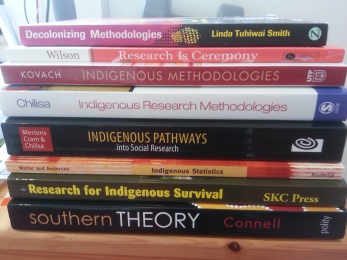
 Last week I wrote about challenging the dominance of English in writing for research and academia. That theme is also relevant to this post, though here it’s more about challenging Euro-Western epistemologies and methods than the English language itself. Over the last year I have built a personal library of books about, or relevant to, my investigation of Indigenous research methods and ethics. The point of this, for me, is to bring these methods into my scholarship, alongside creative and conventional methods, as appropriate. The point is not to become an ‘expert’ on Indigenous research; for a white British person, that is not, should not be, an option. At the start of this work, I worried about being extractive, but I found comfort in the words of Margaret Kovach, an Indigenous researcher from Saskatchewan in Canada, who encourages non-Indigenous scholars to help make space for Indigenous methodologies and assess their value on their own terms. This is what I am trying to do.
For those who are new to this topic, ‘Indigenous’ denotes the native peoples of colonised lands, such as Aboriginal Australians or Inuit Alaskans, while ‘indigenous’ denotes the native peoples of non-colonised lands. So I am an indigenous Brit who will never be an Indigenous researcher. Some people described as Indigenous are unhappy with the term because they feel that it makes them seem like one homogeneous group, whereas in fact there is tremendous diversity. For example, there are hundreds of tribal and language groupings in Australia alone. However, as it is the term most commonly used in the literature, I’m sticking with it for now.
The first book is the foundational Decolonizing Methodologies by Linda Tuhiwai Smith, a Maori researcher from New Zealand. In fact I bought the first edition of this soon after it came out in 1999, the year I began my MSc in Social Research Methods. The second edition came out in 2012. This book shows how research was used as a tool of imperialism to help subjugate colonised peoples through, among other things, complete disregard for Indigenous knowledges and Indigenous peoples’ own research methods. It highlights the value of these knowledges and methods, and calls for research to be linked explicitly with social justice.
Shawn Wilson is an Opaskwayak Cree researcher from Canada who has also lived and worked with Indigenous peoples in Alaska and Australia, as well as spending time with Indigenous peoples in New Zealand, Morocco, and elsewhere. His book, Research Is Ceremony: Indigenous Research Methods (2008), is based on his doctoral research and describes a paradigm shared by Indigenous researchers in Canada and Australia. It’s not easy to get hold of; I tracked down a Canadian bookseller who seems to have bought up the last available copies, and I fear it may be going out of print, which would be a great shame as it is readable and insightful. UPDATE: The publisher emailed me in January 2018 to say it’s not out of print (hurrah!) and it is now available through the link above.
Margaret Kovach is a Plains Cree and Salteaux researcher from Canada whose Indigenous Methodologies: Characteristics, Conversations, and Contexts came out in 2009. Her book covers epistemologies, methods, and ethics. It is a work of considerable scholarship that is also accessible and full of wisdom.
Bagele Chilisa is a Professor at the University of Botswana. Her book Indigenous Research Methodologies (2012) gives an uncompromising and international account of some of the theories, epistemologies, ontologies and methods used by Indigenous researchers. While no book on this subject could be completely comprehensive, Chilisa makes a good job of showing the diversity, as well as some of the commonalities, of Indigenous methodology.
Donna Mertens from the US, Fiona Cram from New Zealand, and Bagele Chilisa have edited a collection called Indigenous Pathways into Social Research: Voices of a New Generation (2013). They have contributions from Indigenous researchers from all around the world: Vanuatu, Mexico, Cameroon, Hawai’i, Alaska, Papua New Guinea, and many other countries. These are fascinating accounts, highlighting personal, political, and ethical challenges, and how they have been overcome. They also say a lot about Indigenous methodologies around the world.
Also in 2013, Maggie Walter, a trawlwoolway researcher from Tasmania, and Chris Andersen, a Métis researcher from Canada, brought out Indigenous Statistics: A Quantitative Research Methodology. This book demonstrates the pervasiveness of Euro-Western thought in the construction of statistical research, using national censuses for ilustration. It offers a framework for Indigenous quantitative research, nayri kati or ‘good numbers’, which places an Indigenous standpoint at the centre. There is a short video online of Maggie Walter talking about Indigenous quantitative research.
Lori Lambert is a Mi’kmaq researcher from north-eastern Canada who has also worked with Indigenous peoples from Montana, US; northern Manitoba, Canada; and Queensland, Australia. Her book, Research for Indigenous Survival: Indigenous Research Methodologies in the Behavioral Sciences, was published in 2014. To the best of my knowledge, this is the first book to position Indigenous methods within a Euro-Western disciplinary category. Like other Canadian writers, such as Wilson and Kovach (above), Lambert includes the voices of people she has worked with alongside her own in her narrative.
Another essential text, though not specifically about research methods, is Southern Theory by Australian academic Raewyn Connell (2009). This book is subtitled ‘The global dynamics of knowledge in social science’ and in my view is essential reading for anyone engaging with social theory. During my MSc, I was taught social theory as the preserve of dead white men, and I am sure this is still being taught in many Euro-Western universities today. Connell’s book gives the lie to this approach.
This list is not exhaustive; it is just my personal library. One limitation is that I can’t afford expensive books. While I was writing this blog post, I had a message from my friend and colleague Roxanne Persaud, alerting me to Susan Strega and Leslie Brown’s edited collection Research as Resistance: Revisiting Critical, Indigenous, and Anti-Oppressive Practices (2nd edn 2015). I would love to read this book, but even the paperback is over £60 which puts it out of my reach.
These books are not comfortable reads for Euro-Western scholars, but they are hugely important. We need to know how research has been, and is, misused by Euro-Western cultures in order to learn how to use it better. Indigenous scholars are extraordinarily generous in their assessment of the potential value of Euro-Western methodologies, even those methodologies that have been instrumental in stealing their lands and their cultures and traumatising generations of their peoples. Yet most Euro-Western researchers either ignore Indigenous research entirely, or conclude that Indigenous peoples must have picked up a few tricks from the colonisers. I’m not sure which is worse. Indigenous research methods pre-date Euro-Western research methods by tens of thousands of years, and there is a great deal that Euro-Western researchers can learn from these approaches.
 In a
In a  One of the things I love about being an independent researcher is the sheer variety of projects I work on and tasks I might do in a day. Yesterday, I was only in the office for the afternoon, yet I worked on at least seven different things. Here’s what I did.
 Research misconduct is on the rise, certainly within hard science subjects, quite possibly elsewhere. Researchers around the world are inventing data, falsifying findings, and plagiarising the work of others. Part of this is due to the pressure on some researchers to publish their findings in academic journals. There is also career-related pressure on researchers to conduct accurate polls, produce statistically significant results, and get answers to questions, among other things. Some clients, managers, funders and publishers have a low tolerance for findings that chime with common sense or the familiar conclusion of ‘more research is needed’. They may expect researchers to produce interesting or novel findings that will direct action or support change.
 Evaluation is a particular type of applied research designed to assess the value of a service, intervention, policy or other such phenomenon. This is relevant to all of us as it forms the basis for many decisions about public service provision. Despite being applied research, evaluation also has a significant academic profile, with dedicated journals, many books, and university departments with professors of evaluation in countries around the world.
 Last week I wrote a post
  The university sector in the UK is in a shaky state at present. Several
  I don’t believe in writer’s block. I think it’s an umbrella term for a whole bunch of problems, each of which has a solution. For sure, writing is difficult, and it is perfectly possible to get stuck. That happens to me all the time. But a complete block? I don’t think so. Seems to me ‘writer’s block’ is a lazy catch-all term which conveniently shifts responsibility from the writer to the ‘block’. That’s certainly not going to help.
 Well, whaddaya know? You wait ages for someone to show you a book proposal, then two come along together. Three, in fact, as there are two book proposals for you to download from this post.
 When a book is first published, it’s a strange and slightly confusing time. Exhilaration, panic, longing and impostor syndrome all collide in a big smash of emotions. There’s often a formal launch – sometimes more than one – and an anxious wait for feedback from readers and the first review.
