Starting Your PhD – New Book Launch!

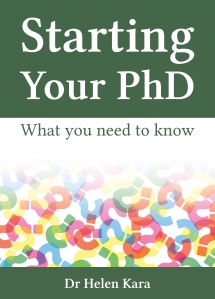
SYPhD_green_SQmarks_noblend_LC2_RGBI’m launching my Top Secret Project today. It is a short e-book (11,000 words) called Starting Your PhD: What You Need To Know. I published this e-book myself, under the Know More Publishing imprint (see what I did there?!), which I set up for the purpose. The book is available via Kindle, Kobo, Nook, iBooks, Scribd, and Inktera. So as well as being an indie researcher and writer, I’m now an indie publisher too!

I wrote three drafts of the e-book, each of which received feedback from a small group of different beta readers, including people who might do a PhD one day, current doctoral students, and experienced supervisors. The final version was professionally edited. I am very grateful to my beta readers and to my editor, each of whom provided input which improved the book’s quality. And you can buy the fruits of all this labour and experience for the price of a coffee: approx £1.99/$2.99/E3.29 or equivalent (actual prices may vary slightly due to circumstances beyond my control).

So why did I take up indie publishing, you may ask? There are times I’ve been wondering that myself over the last year or so, as it’s been a massive learning curve. I think if I’d known how much work was involved, I probably wouldn’t have started the process. But now that the curve is beginning to flatten out, I’m very glad I did. There are a number of reasons I decided to publish independently. In no particular order, the main ones are:

  • I spotted a gap in the market that a short e-book would fill
  • I’m intrigued by indie publishing; it seems to fit with being an indie researcher and writer
  • Short e-books are increasing in popularity
  • I wanted to offer good quality and affordable help for doctoral students

I expect you’re wondering whether I’ve done all this work just to produce one short e-book. No, I haven’t. ‘Starting Your PhD’ is the first in the ‘PhD Knowledge’ series, with other volumes of similar length to include:

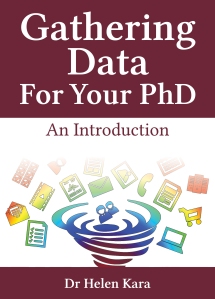
  • Gathering Data for your PhD: An Introduction
  • Analysing Data for your PhD: An Introduction
  • Writing Your PhD: An Introduction
  • Research Ethics for your PhD: An Introduction
  • Finishing Your PhD: What You Need To Know

The second volume is scheduled for publication in November, and I aim to publish the others in the course of 2016.

ALLiEthicalAuthor_BadgeThis is an exciting new venture for me. I’ve had loads of help already: from friends, colleagues, people I’ve met online, and the Alliance of Independent Authors. I’m proud to be a member, and would recommend them to anyone; their closed Facebook group is an invaluable source of support. Also, I’m particularly pleased that they have a code of ethics for indie authors, with the guiding principle of putting the reader first – a principle that guides all my writing.

With that in mind, I need your help too, because there are some things you can do for potential readers that I can’t: tell them about the book, and write honest reviews to help people decide whether the book would be useful for them. Of course I can tell some people, but with my traditionally published books, I’ve had access to an established publishing firm which employed a range of professionals to help spread the word. As an indie publisher I am my own marketing, distribution, and sales departments. So it would be enormously helpful if you could talk about this e-book to people who might find it useful: people considering doctoral study, people embarking on doctoral study, or people supporting someone else through their doctoral study. When I say ‘talk’ I mean the virtual kind too, i.e. tweeting, blogging, Facebook etc. And I absolutely can’t, and wouldn’t, review the book I’ve written; that would be most unethical, so I’m completely reliant on others to give their honest opinion in a way that will help prospective readers decide whether it’s worth investing a few of their hard-earned coins.

Doing a PhD – or a professional doctorate; the e-book is applicable to either – is an enormous undertaking. It can be really difficult even to start on this long, complex process, much of which is incomprehensible at the start. I began mine, back in the early 2000s, with a complete false start which cost me a year and a lot of wasted time and effort; I ended up at a different university with a completely different topic, supervisor, and discipline than I’d originally planned. I guess that is another reason I wrote the e-book: to help others make a more sure-footed start, and to save them timchampagne launche and effort.

If this works for you, please do let me know, either in the comments or on Twitter where I always love to hear from my readers. But for now: I declare my indie publishing career in general, and the Starting a PhD e-book in particular, open!

Being My Own Patron

love writingYou’ve probably worked out by now that I love to write. I still remember the joy of winning a class story competition when I was 7 or 8 years old. I filled most of an exercise book with the story of four children who had adventures in a flying car. It was an incredibly derivative Chitty Chitty Bang Bang/Swallows and Amazons mash-up, but I didn’t know, then, that you’re not supposed to nick other people’s ideas. I did know that writing, for me, was enormously satisfying.

It was a habit I never lost. As a young adult I found that I couldn’t not write: I wrote on buses, in bed, on holiday and at work, and when I wasn’t writing I was often thinking about writing. There’s a game I still play with myself when I have a bit of spare brain: which words would I use to describe the way sunlight shimmers on that wheat field, the taste of this flavoursome curry, how I feel when my partner is unexpectedly late home and I don’t know why. I’m looking for precision. I don’t want to conjure up any old wheat field, curry, or emotion, I want to describe the quality of light on that wheat field, the joy of this spice mix making my taste buds sing, the bittersweet combination of love and anxiety I’m experiencing right now.

I love to rewrite, too. In the previous paragraph, I originally wrote of the spice mix ‘exploding on my tongue’. That was a bit too cliched even for a disposable blog post. Then I tried ‘colonising my taste buds’, which pleased me because of the reverse colonisation implication for this UK resident, but then I began to doubt that phrase in case, even though I had associated it with joy, it could be read in the opposite way by someone with racist tendencies. So I went for ‘sing’ which has pleasing links with joy and mouth. As this is a blog post, which I am writing when I should be doing client work, I plumped for the third idea. If I was writing a book, I might have run through many more possibilities before making my choice.

If I didn’t love to write, I wouldn’t write. I certainly don’t do it for the money. When people find out that I’m a writer, they sometimes assume I’m rich, JK Rowling-style. Nope. It’s particularly dumb being an academic writer, whose average annual earnings are the lowest of all the categories at an average of £3,826 per year in the UK. I’m not sure of my own exact average, but in the 12 years since my first book was published, I know it is somewhere around £350 per year. I don’t earn anything for book chapters or, usually, academic journal articles, though I did get paid £1,500 for writing one in 2014. If I count my average earnings from writing over the three years since my first research methods book came out in 2012, that one single payment pushes it up to somewhere around £850 per year.

However, the calculation of direct earnings is not the whole story. In academic circles, my writing confers credibility and, quite literally, authority. I know I have obtained paid work, from academic and non-academic institutions (including, ironically given recent events, HM Government), as a direct result of my writing. But writing takes a lot of time and, when you’re self-employed, time is money. One of the really, really annoying things about being an indie researcher is that you can’t get funding from anywhere. Research councils will only fund institutions, I’m not arty enough for the Arts Council, not literary enough for a Royal Literary Fellowship, and even the Independent Social Research Foundation doesn’t do what I thought it did. I got all excited when I saw the name, but it seems to be the Foundation which is independent, not the researchers it funds who are all employed by academic institutions.

I have wondered whether to try using the web for its potential rather than its usefulness and go for some kind of crowdfunding. I’ve thought about Kickstarter, or Unbound, or Patreon. They all have slightly different models. With Kickstarter, you propose a project, set a funding limit, and offer ‘rewards’ which can be as nominal as funders getting their name in the acknowledgements/credits or as tangible as you like: a copy of the book, dinner with the author, feedback on a draft of your own work – whatever you want to offer for varying levels of contribution. Unbound is a bit like Kickstarter but specifically for books. And Patreon is a way in which fans of artists can pay a set amount per week, per month, or per output, again in return for rewards chosen by the artist to suit the size of the contribution.

cliffhangerI think these are interesting, useful platforms for creative people. I don’t think they’ll work for me. For a start, I don’t have millions of fans. Some projects get funded even though their generators don’t have millions of fans, because they have an idea that captures enough people’s imaginations. I don’t think my current project, a multi-disciplinary research ethics book, is going to capture many people’s imaginations. My ideas aren’t earth-shaking, though they may cause a small bounce in a few odd corners of academia. But they matter to me. And that’s why I am my own patron.

I am lucky that I can use my income to fund my writing habit – and that writing is the habit I want to fund; far more destructive habits are available. I am also lucky that I’m not materialistic. But I’m also not completely stupid when it comes to running a business. So I’ve decided that, where my writing is concerned, it’s time to diversify. I alluded to my Top Secret Project back in April, and now it’s almost ready to… ooh, is that the time? I’ll have to tell you the rest next week!

Positive Disruptive Practice

This blog post is part of a messy, asynchronous, stimulating conversation that I’m lucky enough to be part of, along with @debsnet and @nomynjb and @jennacondie and @cj13. The conversation was influenced by the man with the best Twitter name in the multiverse, @timbuckteeth, who started the #blimage process. The idea of that is to write a blog post inspired by an image, then challenge someone else to write a blog post inspired by a different image. I was challenged by @debsnet and I then challenged @nomynjb – but @debsnet was inspired by the spiderwebs image I’d picked for @nomynjb, so she wrote another blog post inspired by spiderwebs and incorporating that image. Then @nomynjb wrote her post, referencing @debsnet’s post, also incorporating that image, and asking, ‘Anyone want to blog about a spider’s web?’

best spiderwebsYes. I do.

The post by @debsnet is about ‘technology which connects’, and it’s also about disruption: breaking or bending rules. From making good use of accidents, to ‘colouring outside the lines’, @debsnet praises and celebrates the positive power of disruption. So does @nomynjb, though from a different angle. She traces the development of mass asynchronous communication from Gutenberg to today’s boundary-crossing multimedia, and suggests that people who are breaking the Gutenberg rules are the ones who help us all move forward.

This so resonated with me. I grew up in a wordy household: my father was an English teacher, we didn’t have a TV, and I lived in a world of conversation and storytelling. Disruptive use of language – puns, neologisms, etc – was encouraged. My mother taught me to read when I was three, mainly I think to equip me to amuse myself while she dealt with my newly arrived sister. Since then I have never been without a book on the go and often have half a dozen half-read: a literary novel, an escapist novel, short pieces of non-fiction, long non-fiction, poetry, and a research methods book, so I can pick up and read whichever suits my mood. I also started writing very young and have never stopped. I’m in love with text, and am a compulsive communicator. So perhaps it’s not surprising that I was an early adopter of blogging, starting in 2005, and I’ve been on Twitter since 2009; like @debsnet I find it helps me learn to be more concise. I was a bit more reluctant about Facebook and LinkedIn, but eventually got involved in 2010. I am on Pinterest but have never really got the hang of it, though I’m doing better with Instagram; I’m not a very visual person, but Instagram is helping me learn to see more beyond the oh-so-compelling text.

Many of my offline non-social-media friends and colleagues think I’m amazingly digitally skilled. I know this is not the case. I’ve never Tumblred or Flickred, I didn’t LiveJournal or MySpace, I don’t SnapChat or WhatsApp, and I know there are a hundred others I can’t even remember – if I ever heard of them in the first place.

In @debsnet’s post, she wrote about how she’s using and valuing Voxer. I’d never heard of Voxer, which evoked a familiar feeling of near-despair. Another one! I can’t keep up! Other people I know online are upping Periscope with enthusiasm. I want to join in with all this and I have loads of ideas for content but I struggle with the process. For example, I’ve been trying really hard with YouTube for over a year now, and I’m rubbish at making videos. I can see that if I spent several hours a week working on it, I would slowly improve, but I’m struggling to find the time or, perhaps more accurately, the motivation. As with writing, I enjoy the editing process, but find the first draft a chore. With writing, you only have to do one first draft, but with video, you (or, at least, I) have to do loads of them till you get one that’s good enough to edit. And it’s so complicated: you have to juggle light, and sound, and visuals, and appearance, and performance. Every time I play back something I’ve recorded, I can see what’s wrong with it, but I don’t have the skills to fix it quickly and effectively like I can fix clunky text, so I get frustrated. And no, I’m not being a perfectionist; if I show my videos to my friends, they say things like, ‘Why are you so wooden? You’re not like that on the mainstream media or when you speak at conferences,’ and I want to go and hide in a hole and cry.

I agree with @nomynjb that we need to break the Gutenberg rules of privileging unchangeable print and linear modes of communication. I have loads of ideas about how to do this. For example, I want to make and embed short videos and comic strips in my blogs, and I want to know how to do all this on my phone, on the move, as well as from my laptop at a desk. I long to embrace the new technologies, not still be struggling with the old ones, and – as @nomynjb put it – ‘access this new technology for its potential, not for its usefulness’. But I don’t have the skills and I can’t afford to pay other people to help me. I can’t even afford the software I want to use for comic strips.

For every iota of skill I acquire, a whole new online platform develops. I find this hugely frustrating! I want to be in the middle of the interwebs, connected to everything, because I can see, and hear, and almost feel and smell and taste, the opportunities and the fun and the creativity available to those who can use technology for its potential. I long to plunge in and disrupt and play. But, without the skills I need to move toward the centre, I’m stuck on the edge.

Then again, there’s still scope for positive disruptive practice on the edge of the web, and in text-based communication. Much of my last book showcased the work of people who bent the rules of research methods, and I’ve just co-written a paper on disruptive methodologies. So maybe it makes sense for me to let go of my longing for the technological playground and, instead, use technology for its usefulness and play to my textual strengths. Also, I suspect nobody, or very few people, can actually keep up with all the technological developments. So perhaps the answer for most of us is to practice positive disruption wherever we usefully can.

Why I Am Saying No To The UK Government

just say noA few months ago I wrote a post called ‘Why I Am Saying No To Some Universities’ in which I demonstrated that universities are wealthy organisations and explained that, therefore, I was not prepared to work them for free.

This week I got an email from a UK Government department, from a civil servant who had been at the creative research methods conference last May where my most recent book was launched. The email, and my thought processes as I read it, went like this:

Email: That conference was great

Me: It was, wasn’t it?

Email: As a result, I bought your book

Me: I think I love you

Email: I’m a researcher in the UK government

Me: And?

Email: We have a cross-departmental group looking at creative research methods

Me: That’s interesting, and new information for me

Email: I’m very enthusiastic about this, and my colleagues would like to meet you

Me: Yay! This sounds exciting!

Email: And perhaps you could speak at one of our seminars

Me: Woo-hoo! That would be great!

Email: Though we don’t really have a budget

Me: Uh-oh, I might be falling out of love…

Email: But could you come anyway?

Me: I very much want to, but… I don’t think so.

Email: We can reimburse travel expenses

Me: Oh Here We Go Again *grinds teeth with rage*

The meeting is, of course, in London. With travel time, it takes me a whole day to go to a meeting in London. So the UK Government are asking me to write off a whole working day in exchange for… well, nothing. No pay. Nada. Zilch. And their offer of reimbursing my travel expenses is somehow supposed to make that OK.

This is the Government that allegedly supports small businesses. The coalition trumpeted their support for small businesses in the UK, and for micro-businesses like mine, though the relevant web pages now have big banners on saying that they were published under the coalition government. But I wouldn’t expect the Tories to backtrack on coalition commitments to small businesses. Indeed, the 2015 Conservative manifesto included a pledge to increase the percentage of Government funds spent with small and medium-sized enterprises (SMEs) from one-quarter of goods and services to one-third. Yet now, it seems, they’re asking at least some micro-businesses to provide services to the Government for nothing. How does that constitute support? And how will that help the Government achieve their stated aim of spending more with SMEs?

I’ve discovered that it’s harder to say no to the Government than to universities. This is partly because there are lots of universities and only one Government. It’s also because, well, it feels a bit scary. I know we live in a kind of a democracy with fairly free speech most of the time. Particularly as I’m a native Brit, I don’t think anyone is likely to knock on my door in the night and drag me off to a bunker somewhere for a serious telling-off. But it is… y’know… the Government. The people with the power. There’s a bit of me that thinks I should have rolled over, said yes, at least it would have looked good on my CV. And that, if I’m not going to say yes, I should at least keep quiet, not speak out.

But really, that raises a question I’ve asked my clients more than once when they’ve wanted to suppress some research findings they thought might be politically unpopular. Should we work for our Government? Or should our Government work for us?

I really would like to contribute to their creative research methods group, and I think it’s fair to say that, right now, I may be the person in the country who is best placed to provide support to that group. But I think, I believe, that our Government should work for us, and not the other way around. So, with a heavy heart, I am saying no to the UK Government.

***Update: a few minutes after publishing the above post, I got another email saying oops, sorry, we can’t even pay travel expenses. ***

Loving Your PhD

love PhDI was surprised, and pleased, by the positive reaction to last week’s post. One commenter said, ‘I like how you have started a conversation about the good things in academic life, not just the bad.’

Last week I was co-opted into a Twitter chat between Katy Vigurs (@drkatyvigurs) and the British Sociological Association’s Postgraduate Forum (@BSAPGForum). Katy tweeted that she had signed up for the new MOOC being run by the Thesis Whisperer called ‘Survive your PhD’. BSAPGF responded asking, ‘Do we always ‘survive’ our PhDs? Is it possible to enjoy them without the narratives of desperation?’ Short story shorter, I agreed to write a blog post about the positive side of the PhD experience.

Please note: this is not intended in any way as criticism of the MOOC or the Thesis Whisperer – the MOOC looks great and, if you’re a PhD student and you haven’t yet signed up, I’d recommend checking it out. But I think BSAPGF has a point: negative discourses about academia seem to outweigh the positive right now, and it would be good to redress the balance.

One of last week’s commenters on this blog described her PhD experience as ‘resoundingly positive’, and another said she had had only ‘encouraging and nurturing experiences’. This chimes with my own experience. In the three years of my doctoral study I had very few negative or difficult experiences. A couple of bereavements close together led to a taxing few months, and later one of my supervisors lost a parent which, quite understandably, meant she was not at her best for a while. My supervisors and I didn’t always agree about the best way forward, but we worked through and mostly learned from our disagreements. It was a real intellectual stretch, and I remember whingeing to my partner about how hard it was – not that I got much sympathy; he usually replied, ‘It’s supposed to be hard, it’s a PhD!’.

But generally my PhD was a very positive and enjoyable experience. I loved having the opportunity to do my own research for once, rather than dancing to a commissioner’s tune. I adored spending whole days reading, writing, and thinking. My supervisors were supportive and helpful. And I had such a good time at my viva: full details in a podcast here.

I’ve been pondering why my PhD experience was so good. I think some of this was circumstance and luck. As a doctoral student I had two big advantages: I was already a researcher, and I was already a writer. This meant I was well acquainted with the inverted curve of the research project:

research curve diagram 2

And I had already co-written a book, so the amount of writing required for a PhD thesis didn’t feel daunting. Also, I was used to working alone a lot of the time. Plus I had support from several friends who were already doing PhDs when I started. And I was self-employed, with no dependents, which meant I could find time to work on my PhD more easily than some people.

I think that even if you’re in a very different position, there are things you can do to maximise the chances of loving your PhD. Here are my top five:

1. Choose a research area you’re passionate about
2. Be relentlessly organised: with planning, time, record-keeping – in fact everything
3. Build and maintain a good relationship with your supervisor
4. Write early and often and throughout the process
5. Practise self-care: exercise, eat well, reward yourself for achievement, take breaks

Some people, for all sorts of reasons, have a terrible time while doing, or trying to do, a PhD. Too many who register fail to complete – something the MOOC is aiming to address. But a lot of people have a fine time: not without hurdles to overcome (no project spanning years is ever likely to be completely free of difficulty) but, overall, a positive and enjoyable experience. And I think we forget how very privileged we are as doctoral students, to be able to work towards the highest academic qualification in existence. Surely this is not an opportunity to take for granted, but one to celebrate and relish.

Untold Stories of Academia

Para-cover-v07-resizeI’ve heard a number of stories, in the last couple of weeks, which suggest that the academy is hurting people. Some of these stories have been in the mainstream media, e.g. the Guardian article on the inability of universities to support students who are the victims of sexual violence. Some have been on social media, e.g. this blog post on the experiences of people with disabilities in academia or the comments on this blog ‘About Me’ page, whose author describes himself as having run ‘the whole gamut of the academic track (degree-postgrad-PhD-postdoc-despair)’. And some have been in person, mostly stories of managers who are unsympathetic at best, discriminatory or bullying at worst, and staff who are at serious risk of buckling under the strain.

The Para-Academic Handbook, edited by Alex Wardrop and Deborah Withers, tells more of these stories. Its subtitle is A Toolkit for Making, Learning, Creating, Acting, which sounds positive, but much of the text uses strong language to bemoan the state of higher education today. Staff are ’emotionally drained’, students are ‘burdened by extortionate debt’, para-academics are ‘subjected to the callous mediocrity of temporary contracts that offer absolutely nothing in terms of “career development”, or any kind of rung on the ruthless academic ladder’. This is a ‘landscape where ideals and values are devastated’.

This is fighting talk, though I’m not entirely sure where the battle lies, because I hear other stories too. For example, in the last couple of months alone, one academic has told me of promotion, pleased at the likelihood of being able to use their increased seniority to lever better outcomes for students. I spent time with another academic celebrating their successful research funding bid, and heard about the social problems that research team will now be able to investigate and address. And a young friend found a job just before she graduated with a good degree and a manageable amount of debt; she is happily embarking on her new life this very week.

These stories paint a picture of a landscape where ideals and values are alive, well, and possibly even flourishing. So why are there such opposing experiences? And why do we hear so much more about the negative than the positive?

I wonder whether some people may have a particular set of expectations about academia, which it no longer lives up to – if it ever did. I’m sure there are people who have similar experiences in other professional fields: who want to work on a cruise ship, say, or in a hospital, but when they get there, they find it’s not what they thought it would be and they have to move on. Also, those who interact with academia have specific skills. In particular, they tend to be articulate and good at writing, which may explain why we hear more from those unhappy with academia than we might from those unhappy with cruise ships or hospitals. And, of course, misery is regarded as newsworthy, whereas people doing their work well or getting good results is never going to make the headlines.

Most of the unhappy stories seem to be presented in terms of people struggling with academia. Yet it seems to me that what matters is not the relationship between person and institution, but the relationships between people. For sure, there are real problems caused by the managerialist, corporate, performance assessment culture that has developed in academia. But from the stories I have heard and read, it looks to me as though part of the trouble lies with some managers who dump these difficulties onto junior academics, offloading the problems without providing commensurate support. Conversely, other managers shield junior academics from those difficulties as far as they are able, and help them to navigate the rest.

Again, I’m sure this is not the whole story – but it is a story I don’t see in the mainstream or social media. I hope the negative press that academia is getting at present doesn’t damage the morale of the good managers, as has happened in other professions such as social work. There are a lot of good managers, working hard, mostly unseen, to make their small corner of academia function as well as possible for students, colleagues, para-academics, research participants, and all the people they come into contact with. I know this because I’m lucky enough to work with some of them, and ‘callous mediocrity’ has never been my experience. They are resilient and creative, and they don’t cause harm, they help people. Let’s tell their stories, too.

Data

blimageLast week I received a #blimage challenge from @debsnet aka the édu flâneuse. When I came to the photo she had posted to inspire her challengees, it only took me a moment to link those overflowing hands with the data we researchers love to gather.

Data is a Latin plural word meaning ‘things that are given’, though it is used in English as plural or singular (e.g. ‘a piece of data’). In English it refers to information of various kinds: numbers, words, facts, opinions, pictures, tweets – the list is long. Social scientists can amuse themselves for hours by arguing about what constitutes data. There is a popular saying that ‘anecdote is not data’ although, when a qualitative researcher collects anecdotes from interview and focus group participants, data is exactly what they become.

Different types of researchers have different ideas about what constitutes data. To an anthropologist, an interview transcript may be only interesting for its textual content, while for a conversation analyst, the length of the pauses may be a fascinating aspect of that data. Some researchers treat focus group data just like interview data, while others see the interactions between people in the focus group as an enriching layer of extra data. For some people, data is collected; for others, it is constructed. I use ‘gathered’ when I want to encompass both perspectives.

Then there is ‘big data’: data generated by national governments, or by technology, which is so copious that it requires whole new methods of analysis and new words to describe its size like exabyte, zettabyte, or snakebyte (I might have made up one of those). Big data challenges the etymological suggestion that data is ‘given’ because big data is often a by-product of other activity, such as using social media or loyalty cards. This is an ethical minefield. For example, people may not realise that their data is of value to the companies running the facilities they use, and it can be difficult to track individuals down to seek consent for their data to be used in research.

You can do all sorts of things with data. For example, you can prepare data, code data, analyse data, synthesise data, visualise data, present data – and, if you’re like me, you can love data. In fact, I adore data! A new dataset to explore is so exciting because I never know what I might discover. I guess it’s the same feeling an archaeologist gets when they’re starting a dig, or an antiques dealer opening a box from a house clearance. There might be treasure in here! And even if there isn’t, even if there are only mundane things, I will still have seen something I hadn’t seen before, and maybe learned something new, or at least increased my experience.

You can also abuse and misuse data, by picking out the parts that support the argument you want to make, rather than preparing, coding, and analysing data as rigorously and honestly as possible. We are all susceptible to biases such as confirmation bias and hindsight bias, and there is only so much any one of us can do to counteract these. This is part of the reason for the scholarly peer review process, where others can scrutinise your work to check for bias. It is also why researchers encourage each other to track the links in our writing from research design, through data collection and analysis, to findings and conclusions, so that our processes and influences are clear to readers and they can make their own mind up about any biases they may perceive in our work.

It’s not only individual researchers, though, who abuse and misuse data. Research commissioners in every sector regularly bury data-based findings that don’t align with their political or organisational aims. And the media is notorious for putting spin on such findings. This has led to the establishment of independent fact-checking organisations such as Fact Check in the US and Full Fact in the UK.

It is easy to develop conspiracy theories about the ways in which governments, corporations, and the media use and misuse data. It is harder to do the tough research work necessary to counteract this, as far as we can, by producing firm findings, based on enough good-quality data, and presenting those findings in clear and understandable ways. To do that, we have to gather our data carefully, with a solid rationale for why we gathered it in the ways we did, so that we can be confident about the status and limitations of our data and about the findings we draw from its analysis. This is not easy – but it is possible, and it is our responsibility as researchers to do this work to the best of our abilities.

best spiderwebsNow, a #blimage challenge for Naomi Barnes: I look forward to seeing what she makes from this picture. And if anyone else would like to use it for inspiration: help yourself!

International work: the glamour and the reality

photo by Prayitno via Flickr

photo by Prayitno via Flickr

My first international assignment was in Damascus, Syria, in 2008. I went on behalf of Liverpool John Moores University and they made most of the arrangements. I was teaching qualitative research methods to postgraduate doctors. The journey and the first day were terrifying, but overall it was an amazing, worthwhile experience. I’m so glad I was able to experience a little of that beautiful country before it was torn apart by war. And by sheer luck my experience was quite glamorous. The Centre for Strategic Health Studies, where I was teaching, had a flat in Damascus where they accommodated international teachers. There were four single bedrooms with a shared bathroom and kitchen, a bit like student housing. And there was no air-conditioning, just a couple of sleepy fans. But when I arrived, all four bedrooms were full, so they had to put me up in a hotel, which turned out to be the Sheraton. Result! Aircon, swimming pool, room service… I’d never stayed anywhere so posh in my life, and I loved the luxury.

My second international assignment is this coming autumn in Calgary, Canada. Of course Canada is very different from Syria: politics, weather, level of freedom, food – pretty much everything. But this trip is also different because I am making the arrangements myself. I’ll be teaching postgrads at the University of Calgary and at Mount Royal University, and practitioners for the library service, as well as giving a keynote speech at a conference. That’s a whole lot of organising to do. I didn’t factor this in to my costs – a useful learning point for me!

I know another freelance writer and teacher who works internationally and charges £3,000 per day, with no discounts under any circumstances, not even for charity. I’m beginning to understand why. There is a huge amount of preparation, you lose days to jet lag, and there is also, inevitably, follow-up work. If you work independently, and don’t factor this into your costs, it all has to be done in your own time.

For each teaching assignment I need to know a whole bunch of stuff. How many people do you expect? What are their subjects/professions? What level are they? What is the teaching room like? Is this a stand-alone session or e.g. part of a wider module? If the latter, can I have details please?

I need to know these things so I can deliver a session which is appropriately pitched and focused. If I’m doing a half-day on creative research methods, the content may be similar, but the event will look very different if it’s a stand-alone session for 80 mid-career practitioners in a lecture theatre than if it’s part of a research methods module for 10 first-year doctoral students in a classroom.

Then there are all the bookings: flights, internal travel, accommodation, all of which needs to be reasonably priced as I’m being paid from public money. And there are the arrangements to meet up with people. PowerPoint presentations to create. And the emails! Oh, the emails!! Everything from ‘can you provide a reading for the students?’ (I expect so) to ‘can I take you out to dinner while you’re here?’ (yes indeedy!). These emails have been flying back and forth for weeks now, and it’s still three months till I go. And sometimes I need to speak to people; I had a 40-minute call with one woman last week, and I’m sure there will be other calls and Skype chats in the coming months.

I hope you don’t think I’m complaining, because I’m truly not. I’m excited about going to Calgary, it’s a great opportunity for me, and I’m looking forward to the trip. But I didn’t quite realise how much unpaid work I was taking on, alongside the paid work. As a result, I am going to need to rethink my charging structure for next time – though I won’t be charging anywhere near £3,000 per day.

Many people, I know, are envious of my luck in landing this Calgary gig. I feel lucky, and grateful for the opportunity. I’m sure there will be moments of glamour. But honestly, most of it is, and will be, hard graft.

My Next Book

Having got my creative research methods book safely launched, and cleared away most of the smaller writing projects that piled up while I was writing that, I’m slowly starting to get into gear for my next book. I’ve written several books now, including two on research methods, and the process for each book is different. For my first research methods book, essentially I wrote down what I knew about research methods and doing research, worked out where the gaps were in my knowledge, learned what I needed to know to fill those gaps, and wrote that down too. The second one was more of a stretch (at one point I found myself whingeing on Facebook about ‘that difficult second research methods book’) but primarily involved collation, as there was a huge amount of relevant work in journal articles and a few pertinent books. It did involve some hard thinking – in fact, they both did but, like childbirth, the pain is soon forgotten.

Unlike childbirth, I expect the labour for my third research methods book to be more painful than for either of its older siblings. This is because my third book will be on ethics. Writing down what I know about ethics wouldn’t take long, and collating other people’s work on ethics would be fairly pointless. For this next book, I need to read, and think, and take it slow, and learn, and think some more, and come up with some new and different ideas and approaches. My embryonic ideas are that I want to show how research ethics is linked with wider-world ethics, at individual, institutional/organisational, and national/political levels. Also, I’d like to unpack the impact of wider-world ethics on ethical thinking, acting, and decision-making in research. This may be ridiculously ambitious, but it feels compelling; it’s something I want to understand, and would like to communicate in a useful way.

ethics bookshelf

My ethics bookshelf

So far, I’ve collected a load of books and some journal articles. I’ve read about a third of one book and about a quarter of another. I haven’t written a word yet, and have barely thunk a thought. I haven’t blogged the process of writing a book before, so this is new, too. It’s quite difficult to write about a process from such an early stage that I don’t really know what I think yet. Also, publishers tend to advise authors to keep ideas close to their chests, in case someone else steals the idea and writes the book faster and better than the author can. So blogging the process feels a bit weird – but I figure this is hardly a commercial bestseller in progress, and it’ll be more useful all round if I share my ideas rather than keeping them to myself.

I’ve started interviewing some experienced researchers, in academia and in practice, to find out how they get on with trying to do ethical research. I want to learn some stuff about how this works, both in terms of research ethics governance and ethical review, and in people’s actual practice. I am regularly frustrated by the over-emphasis on ethics at the data-gathering stage, and the narrow focus on the welfare of participants, at the expense of ethical considerations at other stages of the research process and the welfare of people other than participants. In my view, there are ethical considerations to take into account at all stages of the research process, and everyone touched by a research project deserves to be thought about and cared for. That includes researchers themselves: research can be a stressful and difficult undertaking, and we do nobody any favours if we don’t look after our own welfare as well as that of others.

Remember when I said writing down what I know about ethics wouldn’t take long? That’s pretty much it. Well, OK, maybe there’s a little more. I could probably pontificate about deontologicalism versus consequentialism for a sentence or two, but I’m not that keen to lose readers. This reminds me of another aim for my book: that it should be readable. I talked to my partner about this recently, and he suggested I have an early chapter called ‘The Academic Verbiage’ (actually he used a rather less polite word than ‘verbiage’), so I could put all the complicated words in one place. Then, he said, I’d be able to write the rest of the book in ordinary language. I’m not sure I’ll go quite that far, but I do intend to try to make it clear and understandable. At least, I hope I can…

Ten Top Tips for Successful Collaboration

collaborationWorking in collaboration with others can be a wonderful experience. Writing a journal article with a colleague, or working in a research team with people from other organisations, can be life-enhancing. Ideas build on ideas; tasks are allocated according to people’s strengths and abilities; the results are loads better than anything you could achieve alone.

Collaborative working can also be a monumental pain in the neck. Misunderstandings, missed deadlines, and poor communication can sabotage a project, morphing it from a promising outset into a morass of time-consuming frustration and annoyance, sometimes with nothing to show for all the grief you’ve gone through. That can be particularly galling when you end up apologising for something that was not at all your fault and entirely outside your control.

And you know the really weird thing about working collaboratively? Nobody ever tells you how to do it; you’re supposed to know. But my experience is that many people don’t know how to collaborate well. So here are ten top tips for successful collaboration.

  1. Set sensible deadlines. If you’re happy to write a book chapter that you think will take you a week, but you don’t have that much spare time till six months from now, say so. And if you think it will take you a week, allow a fortnight. Over-committing doesn’t help you or anyone else.
  1. Manage your time well, from day to day and week to week, and at monthly and yearly levels too. Plan, schedule, re-schedule as necessary. Do what you say you’re going to do, when you say you’re going to do it – or explain why you can’t at the earliest opportunity.
  1. Communicate, communicate, communicate. Problems arise in everyone’s life. If you encounter a problem that will affect your ability to meet your commitments, tell everyone who needs to know as soon as you can, and give them a realistic revised date when you’ll be able to get the work done.
  1. If someone else is causing a delay, you may need to take control, particularly if you have contractual or other inflexible deadlines and the delaying person isn’t communicating well – or at all. In that case, the best approach is to send a polite email with appropriate cc’s so everyone knows where the delay originates. But do word your message carefully: the aim is to protect your own reputation without damaging anyone else’s, so stick to the facts.
  1. Don’t throw good time after bad. If you’re collaborating with people who are missing deadlines and not answering your emails, chase them once or twice then stop. Don’t stress about it, just focus on other work.
  1. Accept feedback gracefully, even if it seems unpalatable at first. Don’t take it personally because it isn’t personal, even if it feels personal, even if it looks personal. It’s an opportunity to learn things you’d be very unlikely to learn any other way, even if they’re not the things you wanted to learn. So thank whoever gave you the feedback and make the best use of it you can.
  1. Reflect on your collaborations – with your collaborators if possible, on your own if not. What went well? Why? What didn’t go so well? Why? What would you do differently another time?
  1. celebrationMake time to celebrate a collaboration that goes well, or even well enough. If you can meet up with your collaborators, so much the better: go for a drink or a meal together and congratulate each other in person. If not, celebrate online, in a private meeting or via email or social media. Or simply send a card to say ‘thank you’ or ‘well done’.
  1. Whether your collaborators are your colleagues, your students, your staff or your friends, be as professional with each of them as you would be with the most senior person in your field or in your organisation.
  1. When you’re planning a new collaboration, share these tips with your potential collaborators at the earliest possible stage and ask whether they’re willing to sign up to them. If they’re not, don’t go ahead with the proposed collaboration.

Of course sometimes life gets in the way and things go wrong. But when you have a strongly functional collaboration, it is much easier to deal with unexpected difficulties. When unforeseen problems occur and your collaboration is floundering, life can be very miserable indeed. If you and your collaborators follow these ten top tips, none of your collaborations will be the ‘pain in the neck’ variety. They should all work smoothly, at the very least, and may well be wonderful and life-enhancing.