
Writing Retreat

writing retreatI am on a solo writing retreat, on the south coast of England. The photograph shows my workspace for this week and next. I’m in an unfashionable area so it’s comparatively cheap. I looked at Cornwall, initially, and found a sea view meant that even a studio flat would cost over £1,000 for a fortnight at this time of year. Here I’ve been able to rent a whole house for much less, and that means I can have friends to visit at the weekend which will be fun.

But from Sunday to Friday of this week, then Monday to Friday of next, I have 11 uninterrupted days to write. I know some people prefer communal writing retreats, but I’m such a compulsive communicator that if I went on one of those, I’d probably spend more time talking to people than typing words. Despite being a sociable person, I also enjoy my own company, so some solitude is a welcome change from my usual densely populated life.

There are 15 tasks on my to-do list ranging from guest blog posts to books. Of course I don’t expect to finish them all – indeed, five depend on input from other people which may or may not arrive during this fortnight. But I do expect to make significant progress with several, tick off at least three, and reach ‘next draft’ stage with at least two others.

Having a bunch of tasks to choose from helps my productivity. If I’m growing weary of one task, and losing interest, I can turn to a different challenge. And when I simply get tired of writing altogether, a little reading or a short walk will refresh my mental muscles.

rough sea picI love to write with a sea view. Some people find it distracting, but I find it relaxes me and all the space of sky and depth of sea somehow offers more room for creativity. Though today, with gales and huge waves striking the shingle shelf opposite so hard that the spray hits the second-floor window in front of me and I can feel tremors through the house where I’m sitting, it is a tad distracting at times. But I’ve ticked off the first of the items to tick off, this morning, so I’m allowing myself a little sea-gazing now and then.

I also enjoy the way in which working on one task can shed light on another, seemingly unrelated, task. There’s a feeling I experience when I’m making meaning, as if everything is connected to everything else in a myriad of beautiful ways. I can never see or know the whole, but sometimes, through the interaction of thoughts and words and being and doing, I can comprehend a little more of the pattern than usual. It is not, and will never be, within my grasp, but now and again I can almost touch it, and maybe, if I reach a little further, think more, move more… I find that sensation addictive, and it’s a big part of what keeps me writing.

I am very, very lucky to be able to give myself this space to write. It’s not often I have both the money and the time. And I wouldn’t want to work like this always, but I find it really helpful, now and again, for making a good deal of progress in a short time. So it’s both self-indulgent and productive, which is a rare combination.

Sometimes the writing is smooth and steady, sometimes words spill onto the screen as my fingers hammer the keys. Sometimes I can see my way ahead clearly, other times my view is obscured. But, like the waves, the words keep coming.

Cross-Cultural Research Ethics

cross-culturalLast week I presented at a seminar at the University of Nottingham hosted by BAICE, aka the British Association for International and Comparative Education. Like the UK and Ireland Social Research Association (SRA), on whose Board I sit, BAICE is a learned society and an organisational member of the UK’s Academy of Social Sciences (AcSS). I was presenting, in my SRA role, on behalf of the AcSS. This always makes me slightly uncomfortable as I’m not a Fellow of the AcSS and don’t really feel qualified to speak for the Academy. Luckily another of my SRA colleagues, who is a Fellow, was at the seminar and was able to help me out.

The seminar was on ‘cross-cultural research ethics in international and comparative education’. Presenting for the AcSS on this topic was an interesting exercise, as the Academy is not a very cross-cultural organisation: the Fellows are 93% professors, 69% male, and my contacts with them suggest that the white middle classes are in a massive majority. My presentation focused on the five generic ethical principles the AcSS has developed for its member societies to use. I’ve been working on a redraft of the SRA’s ethical guidelines based around these principles, and had already registered that they are focused around concepts which are not culturally neutral, such as democracy and inclusivity. There are cultures that despise democracy, seeing it as a discredited belief system, and others that either do not practise inclusivity or practise a very different version from that which the UK educational and social research culture espouses.

Perhaps because BAICE is focused on international matters, ‘culture’ was in danger of being conflated with ‘nationality’, so I argued that it is a much wider issue. The previous day I had been in a workshop for a piece of evaluation research that had included service users, volunteers, staff, partners, and evaluators. That’s five different cultures, right there. Then of course those professionally defined cultures intersect with people’s race, gender, religion, sexual orientation, etc, to create a whole world of cultural complexity.

The other presentations covered a wide range of related questions. How should we manage cultural conflicts within and beyond academic departments? How ethical is it to use RCTs in educational or social research when you know that members of control groups will be disadvantaged? How can we be inclusive as researchers in situations where including marginalised people, or those living in difficult circumstances, may put them at risk? How can we support researchers and teachers who are operating in a global environment, whether physical or virtual, to work in ethical ways?

Then we were asked to discuss whether we thought it would be possible to formulate generic ethical principles for cross-cultural research. We didn’t reach firm conclusions, but we did agree that if such principles were to be devised, the fundamental value should be respect, and the key process would be dialogue. Any generic principles would need to be broad, neither prescriptive nor vacuous, and should be tested in a variety of locations. Generic principles will always be open to interpretation, and may in some contexts conflict with each other, so they would need to be constantly negotiated. But generic principles could be useful in overturning the current myth of cultural neutrality in some academic mechanisms such as anonymous peer review.

We also agreed that ethical research is not, and should not be, only or predominantly about data collection; it is relevant to all stages of the research process. And we agreed that it is not only students, researchers, and teachers who need educating in ethics, but also funders and members of ethical review committees.

As researchers and educators, we have an ethical duty to keep educating ourselves, because ethical approaches to research change as the world changes. It is essential to take a reflexive approach to this, including locating ourselves culturally. It helps to realise that the same ethical issues arise in lots of different types of work in different disciplines and locations, so if you look beyond your professional and geographic boundaries, you can often learn from others rather than re-inventing the ethical wheel.

We concluded that, from an ethical perspective, the quality of human interactions should be fundamental to the quality of research and teaching. This is especially the case in cross-cultural work, where people may be operating with very different assumptions. However, this is not considered relevant by the current arbitrators of quality in research or teaching. Our view, though, is that it would be more ethical all round to shift the focus away from regulations and bureaucracy and towards human well-being.

While I am, generally speaking, irrepressibly optimistic, I do wonder whether that will happen in my lifetime.

Why I Am Saying No To Some Universities

piggy bank and coinsIn the last few weeks I have been asked to deliver seminars at the universities of York and Leicester. I had the time and would have enjoyed the experiences. Also, in both cases, the people inviting me were my friends. So why did I say ‘no’?
I was asked to work for nothing.

Both universities offered to pay my travel expenses. This has been standard practice for many years, designed to ensure that academics would not be out of pocket when visiting another institution. Visiting academics don’t need to be paid by their host institution because they are already drawing a good salary from their own institution.

Independent researchers are not drawing a salary and often don’t earn a great deal. I have been open about my income. As I thought about the invitations from York and Leicester, it occurred to me that universities were probably open about their income, too. So I did some research and found that, although often buried deep within layers of web pages, they do indeed publish their financial statements.

In 2013/14, the income of the University of York was £305.4m and its expenditure was £297.2m. It has total net assets of £243.8m, and a retained surplus of £10.5m.

In the same financial year, the income of the University of Leicester was £286.7m and its expenditure was £279.2m. It has total net assets of £172.6m, and a retained surplus of £7.6m.

Clearly universities must exercise sound financial stewardship. They have staff to pay and to provide pensions for, and I believe that university staff work hard and should be paid appropriately. There are buildings to be maintained and refurbished, equipment costs, perhaps debts to service, and so on. But these are wealthy institutions with an annual surplus of millions of pounds. Yet, while they evidently want my expertise, they won’t pay me a couple of hundred.

I found it embarrassing to refuse my friends’ requests. In both cases they said they had no budget to pay visiting scholars. Clearly universities hold on tight to their cash. But in doing so, they minimise the types of expertise available to their students. Is that a sensible educational strategy?

In recent weeks, I have been cheerfully paid a sensible fee for work at Staffordshire University, which is significantly less wealthy than York or Leicester (income: £118.4m, expenditure: £116m, net assets £44.2m, surplus £3.6m). I have also been paid by Swansea University (income £205.8m, expenditure £182.3m, net assets £156.5m, surplus £7.2m). And I am in discussions with Birmingham City University, who said my fee was what they were expecting (income: £173.8m, expenditure £153.6m, net assets £219.9m, surplus £23.2m).

Although this is not any kind of a representative sample, I used my researcher’s eye to try to discern a pattern. York is a Russell Group university; Leicester and Swansea were founded around the same time in the early 1920s; Staffordshire and Birmingham City are post-92. So there is no apparent consistency here.

I wonder what prospective students might think. Would you like to go to a university that will encourage you to learn from a wide variety of expert people? Or would you prefer one that will restrict you to learning from its own faculty and some volunteers?

Creative Research Methods conference – 8 May 2015

This SRA conference, where my latest book was formally launched, was a wonderful gathering of diverse researchers. We had academic researchers, government researchers, researchers working in research companies and charities and other organisations, and independent researchers. There were researchers from North and South America, Canada, and other European countries as well as the UK. And we had researchers from across the arts, humanities, and social sciences: from media, design, law, sociology, psychology, and geography, among others. This diversity made for an incredibly stimulating environment. A delegate commented to me that the conference could easily have run over three days, not one, and I think they were right.

Some of the delegates during the pipe-cleaner exercise (photo by David Gauntlett)

Some of the delegates during the pipe-cleaner exercise (photo by David Gauntlett)

The keynote speaker was Professor David Gauntlett. He spoke about the ethical imperative of reciprocity and dialogue in research, and how making and discussing metaphorical artefacts could provide a positive experience for participants. David often uses Lego, but on this occasion he used the pipe cleaners in delegates’ packs to involve us in a participatory demonstration, asking us to build a metaphor of our feelings on our journey that morning to the British Library conference centre. This short exercise was entertaining and instructive, and David built on that to show how making things and talking about them could yield richer data for researchers than simply asking questions. His presentation was dynamic and set the tone for the day.

The morning and afternoon workshop presentations made up a wonderful patchwork with 24 vibrant blocks of colour. They were in four concurrent streams, which regular readers of this blog will recognise: arts-based research, research using technology, mixed methods research, and transformative research frameworks. Presentations included:

This is only a small selection, chosen because they had further information online that I could link to for anyone who wanted more than just a headline. Details of all the workshop presentations can be found in the conference storify which was ably created by our official live-tweeter, Annika Coughlin. The presentations I went to (in the transformative research frameworks stream) were excellent, and I gather from those in other workshop streams that the quality was consistent throughout.

One of the most exciting moments for me came just before lunch, when I discovered the conference hashtag #CRM15 was trending on Twitter! After lunch Jude England, Head of Research Engagement at the British Library, gave a talk on ‘The Pleasures and Perils of Digital’. She encouraged researchers to find, use, and reference secondary data, and gave some good tips on how to do this, as well as explaining how the Library works and how it can help researchers.

At the end of the conference, I gave a short speech to launch my book, Creative Research Methods in the Social Sciences: A Practical Guide. This was immediately followed by a celebratory wine reception, kindly sponsored by my publisher Policy Press. Overall it was a wonderful and inspiring day. I can hardly imagine a better conference, or a more enjoyable book launch.

Walking to work: me and my treadmill desk

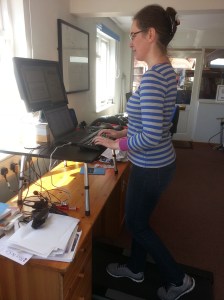
me at treadmill desk picI guess by now pretty much everyone knows that it’s not a great idea to spend the majority of your time sitting down. But when you’re a researcher and a writer, that’s exactly what you do, at your desk, often all day every day. Now and again you get to go out and sit down in your car, or on a train, till you get to a meeting where you sit down and talk to people. Not a great improvement, as I’m sure you’ll agree.

A couple of years I heard about standing desks, and was interested, though unsure I’d be able to stand for hours at a time. I asked around on Twitter and found some people who liked them and said I’d get used to it. But I still wasn’t sure. Then I found out about sit-stand desks, which let you swap between sitting and standing. That sounded more manageable, but I still wasn’t entirely convinced, and the price was prohibitive with (at the time) nothing available for under £1,000.

Also, the received wisdom is that we should all walk ten thousand steps a day. I don’t have a gadget to count my steps for me, so I did some old-fashioned counting and sums a while back and worked out that I rarely hit 10K, most days landing somewhere between 2K and 5K. I couldn’t see how a desk that simply enabled me to stand would help much with my overall fitness.

Then I heard about treadmill desks. And I really, really wanted one. But the prices were even more eye-watering than for the sit-stand desks. Also, I was worried about how many electrical components could go wrong – which, in a worst-case scenario, could mean shelling out for a whole new ensemble.

Social media came to my rescue, specifically the lovely Nicola Morgan (@nicolamorgan), eminent writer, speaker, haver of bright ideas, and all-round Good Egg. She in turn had been alerted by her friend Vee Frier to the possibility of using a standing desk with an office treadmill. Nicola implemented this ensemble and found that it worked really well for her.

And now I have one too. Specifically: a Stand Steady desk, which sits on top of my old desk (I don’t usually shop at Amazon but they’re the only UK stockist), and an Office Fitness walking treadmill. The treadmill goes up to more than 4 miles per hour; Nicola is happily working at 2.5 mph and I’ve accelerated from 1.5 to 2 mph over the last few weeks. At that speed, I do 76 steps a minute, or 4,560 in an hour. Which means that, in just two hours a day, I do 9,120 steps – and suddenly my 10k target is very achievable indeed. And I have no trouble typing while walking slowly and steadily, as this video demonstrates:

I have no idea whether I’ve lost weight, as I don’t use scales, but I feel a little more toned in places. And fitter. Also, like Nicola, I don’t need to use the heating so much, as moving keeps me warm. The sound of the treadmill doesn’t worry me at all, in fact it’s quite soothing. The only thing I don’t like is that the treadmill stops, after 30 minutes, very suddenly with no warning. I think some beeping and a gradual slow-down would be safer and more pleasant. But I do like the textured footplates on either side of the treadmill, which make it easy and safe to move to a standing position, so I can e.g. reach down to my old desktop for my headphones when the phone rings, and then step back onto the moving treadmill while I chat with whoever has called me.

I can’t walk all the time I’m working – I tried that to begin with, and wore myself out – so I’ve had to create another workstation for sitting (I have arthritis which affects my hands and they don’t work well enough for me to shift everything around when I want to change position). Luckily I have another desk, which already had a computer screen and most of a docking station so, a few accessories later, I was sorted. I can’t imagine going back to sitting all day. I love my treadmill desk!

Creative research methods in the social sciences [FC]There are two other things I love this week. One is the first review of my new book on Creative Research Methods, which I was glad and relieved to see is a positive review. And the other is the conference on Creative Research Methods at the British Library conference centre, this Friday, where the book will be officially launched. I can’t wait!

The Importance Of Networking

networkingI began work as an indie researcher in 1999. Over the next seven years I completed dozens of research contracts, an MSc, and a PhD. I also built up a good professional network, mostly in the English Midlands where I live. The people in my network ran local government departments and charities. They liked me and I liked them: we would meet for coffee, or lunch, and talk shop. After I was awarded my PhD in 2006, I rarely had to apply for work; mostly I was simply offered small contracts that I could complete alone, or slightly larger ones where I might sub-contract some of the work to a colleague. And on the rare occasions when I did write a tender for a local organisation, sometimes I was the only applicant, or the commissioner would have two or three to choose from.

Then in 2010 we had a change of government, the cuts began, and my network imploded. Every single person either took redundancy, or early retirement, or accepted a demotion to a non-managerial post. I was left as high and dry as a spine on a cactus in the desert. Lots of people who had lost or given up their jobs declared themselves to be available for independent work, while a number of my peers who had been indie researchers for some time found, like me, that the work dried up. At one point I did a tender for one piece of work, for an existing client, a national organisation, and I didn’t win. When I asked for feedback, I learned that they had had 26 applications. That is nothing compared to some of the employment recruitment numbers I’ve heard of in the last few years, but it’s a lot more than the half-dozen tenders they might have received in the noughties.

The silver lining was that I had time, which I used to write my first book and to start building new networks. In particular, I began to network with academics, and to network more actively online. In 2011 I applied to the Third Sector Research Centre at the University of Birmingham for an Associate Research Fellowship, and in 2012 they took me on. Twitter is an environment I enjoy and it’s a great place to network with academics, worldwide, who also enjoy the exchanges there. I also like offering help with research methods to people who are struggling; it’s amazing how much pertinent advice you can fit into 140 characters (or 280, or 420, or…!) And I also kept my personal friends informed about my work – at least, until they started to glaze over – because, well, you never know.

Remember those three gigs I landed in one day, two weeks ago? They all came through networking, even the one where we wrote a tender. For that one, I was recommended to the lead organisation by my mentor at the Third Sector Research Centre. The gig in Calgary came through a woman I met online, a fellow fiction writer. I met her in real life once, in England, shortly before she emigrated to Canada. We’ve kept in touch via Facebook, and at times I’ve been able to give her advice and support with her postgraduate studies. She wrote a very kind review of my first research methods book, and has been delightfully encouraging about my second. But I was gobsmacked when she announced that she wanted to pay me to go and do some work with her in Calgary.

And the Swansea gig came through an even more modern route. A woman in Canada, who I have only ever spoken to on Twitter, recommended me to an American woman in Swansea, who had never heard of me nor I of her. But she evidently trusted the woman in Canada, because she emailed an enquiry, then we spoke on the phone, and I taught a very enjoyable session there last week, helping her postgraduate students to formulate their research questions.

So, if you want to be an indie researcher, you need to be comfortable with networking, both in person and online. And you need to carry on doing it even when you don’t know where it may lead. I had no idea, when I started building new networks in 2010, that they would lead to Swansea or Calgary. And I have no idea where else they may lead. But that’s the indie researcher’s life: exciting, unpredictable, and forever uncertain.

The Indie Researcher Rollercoaster

rollercoasterWhen I’m teaching research methods to postgraduate students, I encourage them to be comfortable with uncertainty. After all, research is a quest to discover the unknown, so if you’re already certain about everything you’re probably not doing it right. But if you want to be an indie researcher, you need to be comfortable with a higher level of uncertainty than most.


Of course there is also much less certainty, these days, in conventional jobs. Short-term contracts, lack of tenure, funding cuts etc all serve to destabilise employment. But if you have a job with a contract, at least you know you’ll get a salary payment at the end of each month for as long as the contract lasts, and you know how much the payment will be. No indie researcher has that level of security, and many of us earn much less than our salaried counterparts.

In my culture we don’t discuss financial specifics very often. I think that’s unhelpful, so let’s subvert that taboo. Last year was a good year for me: I took home £22,000. That is enough for me. I can live, enjoy myself, and save on that level of income. This is partly because of my life choices: I don’t have children, I do have a partner who earns around the same as me, and we have paid off our mortgage. Also, my greatest luxury is time. I’m not interested in spending money on make-up, beauty treatments, jewellery, household goods, etc; shopping is low down my list of desirable leisure activities; I don’t have expensive hobbies, and I happily drive an old unfashionable car. But I love to buy myself time: time to write, time to see my family and my friends, time just to be me, living my life my way, free and in peace. That seems to me the greatest possible luxury.

Last year, though, was a very busy year. It needed to be as I’d taken home around half that for each of the previous three years. So I was glad to become involved in two contracts a year ago: the Big Lottery Fund’s research into building capabilities, and the Independent Commission on the future of third sector infrastructure. And I was zipping around the country all year: from Chelmsford to Wigan, London, Exeter, Sheffield, Bristol, and London again, Portsmouth, Tameside, and oh yes back to London, and so on and so forth. That ended with the launch of the NAVCA commission’s report at the House of Commons in January and, since then, life has been very quiet.

I do have one new contract, a local evaluation running from November of last year to spring 2016, but it doesn’t require a great deal of work. I’ve had a few enquiries, and been involved in a couple of tenders, even one interview, but nothing actually converted into real work. I’m good at using my down time and have been productive on the writing front as well as moving forward with some non-work projects like refurbishing my office. But I did start worrying about where the next contract was coming from, and preparing to make some financial cut-backs of my own.

Then last week I had one of those amazing days that come along every now and again in an indie researcher’s life. First, I heard that the interview I’d been involved in had been successful, and we’d won the contract. This was great news as it’s a sizeable piece of work, and means I’m now on break-even for the next year, so anything else that comes in is profit. It also means I can be certain of a £1,000 payment per month for the next 12 months. But it’s also a whole new world of uncertainty, as I had never worked with anyone from the lead firm, or anyone else on the research team, before we started work on the tender, so I have no idea how it will work out. Still, paid uncertainty is less uncertain than unpaid uncertainty. Then I received a commission from a university department I haven’t worked with before, who are making noises about developing an ongoing relationship, which is music to my ears. But, again, more uncertainty: it’s in Swansea, a city I don’t know, and I’ll be teaching postgraduate students of management which is not my area of expertise – though they need to learn how to do research, which is my area of expertise. And finally, I heard that I have secured my first international speaking engagement, giving a keynote at a conference in Calgary this autumn. The conference is already fully booked, with over 200 people from a range of public services including academia.

So essentially, in 24 hours, I swapped the uncertainty of wondering whether I would ever get any more work for the uncertainty of wondering whether I could actually do all the new work that had just landed in my lap. It felt very much like that top-of-the-rollercoaster moment, when your stomach begins to lurch just from looking at the drop, before you actually start the descent. But these new problems are great problems to have and, after 16 years as an indie researcher, I know how to ride this rollercoaster.

Creative Research Methods and Gender

gender not binaryLet me begin by saying that I know gender is not binary. In fact, it is probably not reducible to any system of categorisation or classification. I am well aware that some people are physically male but mentally and emotionally female, or vice versa, and that some of these people find this problematic and would choose a hormonal and surgical remedy. Other people, sometimes known as ‘cisgender’, are emotionally and mentally in accord with their physical gender. (I’m fine with this concept, I just wish it didn’t have such an ugly word for its label.) Some are androgynous, physically, or mentally and emotionally, or both. Others are ‘genderqueer’, ‘genderfluid’, ‘third-gender’, and so on. Some societies are more accepting of these diversities than others, but it is becoming increasingly difficult to deny their existence altogether.

Nevertheless, most people, in most social situations, talk happily about men and women. And I am going to do that in this post, though with an acknowledgement that ‘men’ or ‘women’ includes those deemed by society to be ‘men’ or ‘women’, who as individuals may be more or less happy or unhappy with the definition they are given.

I am a woman, physically, mentally, emotionally, and sometimes quite crossly when I think about how women are treated as second-class citizens in many ways in many parts of the world. We’ve come a long way, for sure, but we’re not there yet. Such as in academia where, for example, only 20% of professors are women, and 70% of fellows of the UK’s Academy of Social Sciences (AcSS) are men (yes, I counted all 1005 of them, just for you). Professors and AcSS fellows are also predominantly white.

I am a feminist, always have been, probably always will be. So I was delighted to be asked, last month, to speak on Woman’s Hour on BBC Radio 4. This programme is an institution. It is sometimes criticised as ‘tokenistic’ (why should women only get an hour?) or ‘discriminatory’ (why isn’t there a programme called Men’s Hour?’). But it has a large audience, of whom a big percentage is male, and it deals intelligently with topics of interest to many women – and evidently to many men too.

The subject of discussion on the programme, female sterilisation, is irrelevant here. What is relevant is that, even though it was a completely unrelated subject, the debate started me thinking about my latest book from a different angle. When I got home, I checked the 109 boxed examples – and found that 80% were generated by women researchers. This felt exciting. Was there, could there be, an area of research where women were at the forefront?

Then, being an ethical and reflexive researcher, I began to wonder whether I’d introduced a bias. After all, I had selected these examples from the many more I’d read. I thought I had selected them on merit, but had I really? My thoughts turned to the 94 abstracts received by the Social Research Association for presentations at the forthcoming conference on creative research methods. How many of those were led by women researchers? I counted up, and guess what? Eighty per cent. Just like the examples in my book. And non-white researchers have a sizeable presence too, both men and women.

Taimina crochetWomen are not just doing fluffy girly qualitative research, either. Have you heard of Daina Taimina? She succeeded, where men had failed for centuries, in modelling hyperbolic geometry. In case you haven’t heard of that either, it’s the geometry of frilly things, like kale or sea kelp or oak leaf lettuce. And it’s evidently really difficult to model, or someone would have worked it out before Taimina realised crochet was the perfect vehicle. I recommend her TED talk on the subject, it’s fascinating even if you know little or nothing about geometry. And women aren’t only using arts-based methods: both the book and the conference abstracts show that they’re also using technology in research, mixing methods to good effect, and working within transformative research frameworks.

So I think, in creative research methods, we have a field of enquiry where women are leading the way. And it’s not before time!

Writing: Progress and Process

I finished writing my book at the end of last October. My aim since then has been to produce one written output per month, such as a completed first draft of a writing project, or a submitted journal article or book chapter. So far, so not too bad:

writing on keyboardOne sole authored book chapter submitted, reviews received and dealt with

One co-authored book chapter submitted, waiting for reviews

One sole authored journal article submitted, waiting for reviews

One first draft of a voluntary writing project sent out for feedback

One first draft of a top secret writing project sent out for feedback

I have also made progress on five other outputs: two sole authored journal articles, two co-authored journal articles, and a working paper intended for publication by the Third Sector Research Centre on their website.

The voluntary writing project is an update of the Social Research Association‘s research ethics guidelines. I am on the Board of the SRA, and lead on ethics for them, so it is my responsibility to see that the update gets done. It’s a daunting responsibility, too, as the last version has been – and still is – highly regarded by academics and practitioners alike, and so is a very hard act to follow. But the last version was published in 2003 and, therefore, in great need of an update. It seems odd to think that in 2003, not everyone had email, the BlackBerry was only just being released, and smartphones with touchscreens hadn’t even been invented. The updated guidelines will need to cover topics such as research using technology, social media, and the ethical implications of innovative methods. Though one great advantage we have now, which the authors of the 2003 guidelines didn’t have, is that we can signpost readers to existing online resources such as the invaluable wiki hosted by the Association of Internet Researchers which contains a wealth of resources for ethical decision-making in internet-related research.

This week I will mostly be writing, as the Easter holidays mean it’s quiet on the client work front. I have the first set of feedback on the SRA guidelines, so I want to work towards a second draft of those, which will then be sent out to different people for more feedback. I also want to make progress on one of the sole authored journal articles, one of the co-authored journal articles, and the working paper.

This may seem like an onerous workload, but actually I prefer having a variety of writing tasks on the go. It is quite difficult for writers to sustain productivity for several hours at a time, and I find it helps to be able to switch between projects. I use the same approach when I’m writing a book, by treating each chapter as a separate project. In terms of productivity, once you know how, you can often work more skilfully and more effectively in a concentrated half-hour than in a relaxed couple of hours. I don’t time myself, though; my method is to start with one project, work until I notice my concentration slipping, then switch to another project. That works well for me.

top secretAs for the top secret project: it’s something I’m really excited about, and it won’t be top secret for ever. As soon as I’m ready to go public, you, my dear blog readers, will be the first to know.

Desperate Soliciting from Academic Journals

begging and pleadingWhen you’ve published an academic journal article or two, you start getting emails which, at first sight, seem very flattering. They praise your previous work, or your expertise, or both, then invite you to write an article for their journal, or to edit a special issue, or produce an e-book. But when you look more closely, these emails start to look a bit odd. Some ask me to write for journals in medicine, life sciences, or STEM disciplines, all areas in which I have little knowledge and no expertise. Others want me to take on onerous editing responsibilities, sourcing articles from prestigious scholars in return for one whole free electronic journal issue or e-book. And some are verging on the surreal. Here is an example I did not make up:

“Dear Dr. H Helen,

Tranquil greets from [name of] Journal… We would be truly fortunate if you could assist us to successfully release the issues by your active and enthusiastic submission of manuscript which will be processed & published under [name of] Journal for upcoming glorious year…. It would be grateful if you would submit your manuscript by [date in three weeks’ time]… It would be our honor to be associated with such an intent, expeditious personality like you for future endeavours.”

Maybe it’s my intent and expeditious personality that causes me to be somewhat suspicious of these emails – particularly as they always seem to want me to produce an article in three weeks or thereabouts. Now I’m a fairly swift reader, thinker, and writer, but producing a journal article in three weeks from a standing start is a request I would find virtually impossible to grant. So it’s just as well I have more sense than to try.

Interestingly, these are not predatory journals. None of them ask me to pay for publication, and they don’t appear on Beall’s List. They seem to be desperate journals. One emailed me on 17 February, giving me a most generous deadline of 15 March, and finishing, ‘If it is not feasible for you to submit paper in the month of February, then kindly let us know your feasible time of contribution. Anticipating your quick response.’ They didn’t get any response, let alone a quick one. So the cheeky blighters emailed again on 16 March, giving me a revised deadline of 31 March.

When I check out the journals online, they appear to be for real. So why are they so desperate? “I wonder if you could submit Research article, Mini review, Case reports, short commentary, letter to the editor, book review for publication in our upcoming issue, to spread the essence of your eminent efforts throughout the world.” Despite the strange language they use, many are based in the US – or at least that’s what their websites say.

And who responds to these poorly targeted requests? I write on research methods in the social sciences, and there is some overlap with health services. So, at a stretch, you could excuse journals focusing on medicine from thinking I might like to write for them, particularly as I’ve published articles in journals such as the Journal of Public Mental Health and Perspectives in Public Health. But life sciences? STEM disciplines? No chance.

I’m on the editorial board of the International Journal of Social Research Methodology which has never been short of submissions. If we weren’t getting enough submissions, I’d suggest we should stop publishing the journal – and I’m sure the publisher would be there before me. Or we could try soliciting submissions, if we thought it was a temporary blip, but I’d want to be targeting people much more carefully than these almost random emails.

I once responded to a request to submit a journal article. I was at the inaugural meeting of the Arts and Sciences Research Forum, at CRASSH, University of Cambridge. In a plenary session, for reasons I can’t remember, I was banging on about the need to do participatory research properly if you’re going to do it at all (must blog about that one of these days). At the break, a man came up and introduced himself to me as Woody Caan. He said he edited a journal, and was very interested in what I’d been saying about involving service users in research, and would I like to consider maybe writing something about this for his journal? He thought it would interest his readers, and perhaps I could think about it and we could discuss it more by email in the coming days and weeks.

When I checked out Woody Caan online, this self-effacing and charming man turned out to be an eminent Professor. We did discuss options by email and I ended up writing the article. He was completely relaxed about the fact that it took me several months.

That, in my view, is a good way to solicit an article for an academic journal. But mostly I decide what I want to write, for which journal. Then they can decide whether they want to publish it. That works for me.