
 In the last few weeks I have been asked to deliver seminars at the universities of York and Leicester. I had the time and would have enjoyed the experiences. Also, in both cases, the people inviting me were my friends. So why did I say ‘no’?
I was asked to work for nothing.
Both universities offered to pay my travel expenses. This has been standard practice for many years, designed to ensure that academics would not be out of pocket when visiting another institution. Visiting academics don’t need to be paid by their host institution because they are already drawing a good salary from their own institution.
Independent researchers are not drawing a salary and often don’t earn a great deal. I have been open about my income. As I thought about the invitations from York and Leicester, it occurred to me that universities were probably open about their income, too. So I did some research and found that, although often buried deep within layers of web pages, they do indeed publish their financial statements.
In 2013/14, the income of the University of York was £305.4m and its expenditure was £297.2m. It has total net assets of £243.8m, and a retained surplus of £10.5m.
In the same financial year, the income of the University of Leicester was £286.7m and its expenditure was £279.2m. It has total net assets of £172.6m, and a retained surplus of £7.6m.
Clearly universities must exercise sound financial stewardship. They have staff to pay and to provide pensions for, and I believe that university staff work hard and should be paid appropriately. There are buildings to be maintained and refurbished, equipment costs, perhaps debts to service, and so on. But these are wealthy institutions with an annual surplus of millions of pounds. Yet, while they evidently want my expertise, they won’t pay me a couple of hundred.
I found it embarrassing to refuse my friends’ requests. In both cases they said they had no budget to pay visiting scholars. Clearly universities hold on tight to their cash. But in doing so, they minimise the types of expertise available to their students. Is that a sensible educational strategy?
In recent weeks, I have been cheerfully paid a sensible fee for work at Staffordshire University, which is significantly less wealthy than York or Leicester (income: £118.4m, expenditure: £116m, net assets £44.2m, surplus £3.6m). I have also been paid by Swansea University (income £205.8m, expenditure £182.3m, net assets £156.5m, surplus £7.2m). And I am in discussions with Birmingham City University, who said my fee was what they were expecting (income: £173.8m, expenditure £153.6m, net assets £219.9m, surplus £23.2m).
Although this is not any kind of a representative sample, I used my researcher’s eye to try to discern a pattern. York is a Russell Group university; Leicester and Swansea were founded around the same time in the early 1920s; Staffordshire and Birmingham City are post-92. So there is no apparent consistency here.
I wonder what prospective students might think. Would you like to go to a university that will encourage you to learn from a wide variety of expert people? Or would you prefer one that will restrict you to learning from its own faculty and some volunteers?
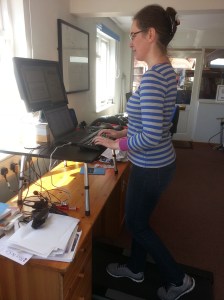 I guess by now pretty much everyone knows that it’s not a great idea to spend the majority of your time sitting down. But when you’re a researcher and a writer, that’s exactly what you do, at your desk, often all day every day. Now and again you get to go out and sit down in your car, or on a train, till you get to a meeting where you sit down and talk to people. Not a great improvement, as I’m sure you’ll agree.
![Creative research methods in the social sciences [FC]](https://helenkara.com/wp-content/uploads/2015/05/creative-research-methods-in-the-social-sciences-fc.jpg?w=108&h=150)
 I began work as an indie researcher in 1999. Over the next seven years I completed dozens of research contracts, an MSc, and a PhD. I also built up a good professional network, mostly in the English Midlands where I live. The people in my network ran local government departments and charities. They liked me and I liked them: we would meet for coffee, or lunch, and talk shop. After I was awarded my PhD in 2006, I rarely had to apply for work; mostly I was simply offered small contracts that I could complete alone, or slightly larger ones where I might sub-contract some of the work to a colleague. And on the rare occasions when I did write a tender for a local organisation, sometimes I was the only applicant, or the commissioner would have two or three to choose from.
 When I’m teaching research methods to postgraduate students, I encourage them to be comfortable with uncertainty. After all, research is a quest to discover the unknown, so if you’re already certain about everything you’re probably not doing it right. But if you want to be an indie researcher, you need to be comfortable with a higher level of uncertainty than most.

 One sole authored book chapter submitted, reviews received and dealt with
 As for the top secret project: it’s something I’m really excited about, and it won’t be top secret for ever. As soon as I’m ready to go public, you, my dear blog readers, will be the first to know.
 When you’ve published an academic journal article or two, you start getting emails which, at first sight, seem very flattering. They praise your previous work, or your expertise, or both, then invite you to write an article for their journal, or to edit a special issue, or produce an e-book. But when you look more closely, these emails start to look a bit odd. Some ask me to write for journals in medicine, life sciences, or STEM disciplines, all areas in which I have little knowledge and no expertise. Others want me to take on onerous editing responsibilities, sourcing articles from prestigious scholars in return for one whole free electronic journal issue or e-book. And some are verging on the surreal. Here is an example I did not make up:
![Creative research methods in the social sciences [FC]](https://helenkara.com/wp-content/uploads/2015/03/creative-research-methods-in-the-social-sciences-fc.jpg?w=215&h=300)
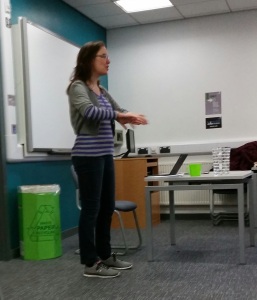 I spent last weekend teaching writing to doctoral students at Staffordshire University, and enjoyed it enormously. It was an experiential course that I had devised with input from Dr Katy Vigurs, who hosted the course. We included creative exercises on drafting and redrafting, getting unstuck, the relationship between writing and thinking, and how to find your voice. There was also a short talk from me and several discussion/Q&A sessions. In between these were a dozen half-hour ‘shut up and write’ sessions for students to work on their own writing.
 Helen Kara