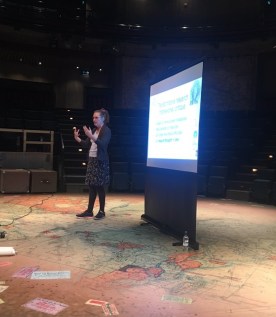
 Last Thursday, Friday and Saturday I was privileged to facilitate the inaugural Creative Research Methods summer school run by Keele University‘s Cultural Animation and Social Innovation Centre (CASIC) working with the New Vic Theatre in nearby Newcastle-under-Lyme. Around 40 people came, travelling from America and South Africa, Sweden and Poland, no doubt other countries I’ve forgotten, and all around the UK.
On the first two mornings we were lucky enough to get to work in the theatre’s auditorium, a wonderful space with plenty of room to move around and interact with people in all sorts of ways. On the first day we used pipecleaners to model journeys both literal and metaphorical, and on the second day we explored issues of power in research using Open Space Technology.
For the first two afternoons, we crossed the car park to the theatre’s Workspace rehearsal room, another great space – with a balcony! On the first afternoon we learned about cultural animation, used buttons to create community maps, then added frames and artefacts to help us come up with research questions. Then we devised and performed creative group presentations – that was so much fun! On the second afternoon we mapped pathways through participation in universities, using flip chart paper, coloured Post-It notes and pens, pipecleaners and tape – by now the creative juices were really flowing.
On the third day we were at the beautiful Keele campus, where (as it was a Saturday) we could use some of the university’s technology facilities: the KAVE for virtual reality and gaming, the Claus Moser studio for soundscapes, and the Turing Lab to make digital circuits. In the afternoon we focused on creative academic writing, hearing about ethnography as advocacy for the animals who are often invisible in social research, and geopoetics, before doing a geopoetics exercise.
We crammed in a great deal, yet there was so much else we could have included. Perhaps the richest part of the summer school was its discussions: between any two people, or a group, or all of us together. I was delighted and astonished by the calibre of the students: an enormously intelligent, creative, dynamic bunch; it was an honour to spend three days in their company.
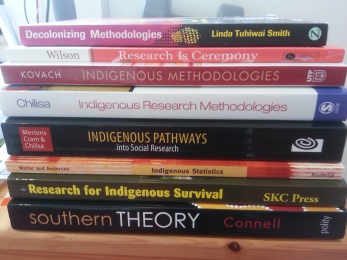
I love to teach creative research methods, and I’m looking forward to my next gig this Friday at LSE for the National Centre for Research Methods (fully booked I’m afraid). I find a lot of my teaching involves giving people permission to work creatively – or perhaps enabling them to give themselves permission – and advising people on how to convince supervisors and ethics committees that it is legitimate to take a creative approach to research. There is a long hard fight ahead to convince people in certain quarters that useful knowledge exists beyond the bounds of academic convention. In this fight, we are on the same side as Indigenous researchers around the world who find their methodologies are sidelined or ridiculed by the academy. Anishnabe researcher Kathy Absolon, in conversation with Plains Cree and Salteaux researcher Margaret Kovach, said this:
If you go on a water walk or quest, that is your methodology. I was reflecting when you were talking about yours [methodology]. If I said I am doing my PhD and my methodology is my dreams, and I am going to go on a fast every year, and after that fast I had somebody come and visit me and talk to me about my fast and take [teachings] with them. I wouldn’t propose that because I wouldn’t want that to [be] measured. I know that is Indigenous methodologies, but I wouldn’t propose it as a methodology within a mainstream setting because I don’t want them to have the power to say that that’s not research. But it is. (Absolon in Kovach 2009:152-3)
There is a parallel here with creative research in the Euro-Western paradigm, where supervisors, ethics committees, journal editors and reviewers, and others have the power to say ‘this is not research’ to people who know perfectly well that their textile art, ice-skating, or poetry, is indeed research. Patricia Leavy has written eloquently of ‘the ache of false separation’ that some people feel when required to keep their art separate from their research work (2010:240).
Some people have said to me that one reason I can write the books I write is that I’m not an academic. As an independent researcher, I have much less power than many academics, in many ways. But I do have the power to say ‘this is research’, and to collect the evidence that this is research, and put it in a scholarly book, so that other people can cite that work, which helps to convince doubting/frightened/threatened supervisors and others. And I will stand with Indigenous researchers, though their methods are not my methods, because I recognise that knowledge comes from more places and in more ways in this complex and beautiful world than those I can access myself.
Still it feels lonely sometimes. So having the opportunity to spend three days with a group of lively-minded people, who are not only open to this but engaging with it, excited by it, and pushing its boundaries in fascinating ways, was an absolute delight.
 Last week I wrote about
  In a
In a  One of the things I love about being an independent researcher is the sheer variety of projects I work on and tasks I might do in a day. Yesterday, I was only in the office for the afternoon, yet I worked on at least seven different things. Here’s what I did.
 Research misconduct is on the rise, certainly within hard science subjects, quite possibly elsewhere. Researchers around the world are inventing data, falsifying findings, and plagiarising the work of others. Part of this is due to the pressure on some researchers to publish their findings in academic journals. There is also career-related pressure on researchers to conduct accurate polls, produce statistically significant results, and get answers to questions, among other things. Some clients, managers, funders and publishers have a low tolerance for findings that chime with common sense or the familiar conclusion of ‘more research is needed’. They may expect researchers to produce interesting or novel findings that will direct action or support change.
 Evaluation is a particular type of applied research designed to assess the value of a service, intervention, policy or other such phenomenon. This is relevant to all of us as it forms the basis for many decisions about public service provision. Despite being applied research, evaluation also has a significant academic profile, with dedicated journals, many books, and university departments with professors of evaluation in countries around the world.
 Last week I wrote a post
  The university sector in the UK is in a shaky state at present. Several
  I don’t believe in writer’s block. I think it’s an umbrella term for a whole bunch of problems, each of which has a solution. For sure, writing is difficult, and it is perfectly possible to get stuck. That happens to me all the time. But a complete block? I don’t think so. Seems to me ‘writer’s block’ is a lazy catch-all term which conveniently shifts responsibility from the writer to the ‘block’. That’s certainly not going to help.
 Well, whaddaya know? You wait ages for someone to show you a book proposal, then two come along together. Three, in fact, as there are two book proposals for you to download from this post.
 Helen Kara