
 When a book is first published, it’s a strange and slightly confusing time. Exhilaration, panic, longing and impostor syndrome all collide in a big smash of emotions. There’s often a formal launch – sometimes more than one – and an anxious wait for feedback from readers and the first review.
Publication day of a second edition feels very different. I know it’s a good book, otherwise it wouldn’t have got to the second edition stage. Most of the reviews were good last time, and I’m confident that it’s a better book this time around, so with any luck they’ll mostly be good again. There is no formal launch, just a day of whooping online and then back to business.
While the impostor syndrome isn’t striking this time, I do feel a bit fraudulent, as I’ve actually had my copies for three weeks, and I know the pre-orders went out around the same time as I’ve been getting emails from readers since a week before Easter. But today is official publication day, so today is the day the blog post happens.
I say ‘the blog post’ but actually there are four, including this one. On Petra Boynton’s blog you’ll find the story of my career as an independent researcher and writer. Over on the Research Whisperer blog I talk about the process of writing the second edition. There wasn’t much information online when I started work on mine, so I hope that post will be helpful to others in the same position. And on my publisher Policy Press’s blog I add my two penn’orth to the debate about whether academia is (or should be) ‘fast’ or ‘slow’. I’ll keep this post short, in the hope that you’ll have time to read at least one of the others.
I’m also holding a Twitter competition for a signed copy of my second edition. Tweet your motivation or inspiration for doing research, using the hashtag #researchinspo, before 10 am GMT on 27 April. Then I’ll put all the names in the hat and pull out a winner, to whom I will send a signed copy, wherever they are in the world. Good luck!
There’s no formal launch this time round, but I’ve got the Prosecco chilling for a little celebration after work with a couple of good friends. Until then, I’ll be cracking on with the next book, because that’s what writers do.
![Creative research methods in the social sciences [FC]](https://helenkara.com/wp-content/uploads/2015/05/creative-research-methods-in-the-social-sciences-fc.jpg?w=236&h=330)
 I have always loved being independent. My parents like to tell the story of the time when, soon after I learned to walk, they took me for a picnic in a local park. My father put me down on the grass, and I got to my feet and toddled away. My mother looked anxious, and my father said, reassuringly, ‘She won’t go far.’ But his confidence was misplaced, because I headed determinedly off into the wide green yonder, and he had to do a quick sprint to bring me back before I came to grief.
 Yesterday I hit 10,000 words of the first draft of my research ethics book. That’s a huge milestone which has taken me two years to reach (though most of that was preparation – I started the actual writing earlier this year). I still have around 65,000 words to write, but having the first 10k safely on my computer and backed up is an enormous relief.
 As the end of the financial year is imminent, it seems a good time to talk about money. Turns out I had a bumper year in 2015/16: my company made a profit of over £36,000. That’s the most this decade. Part of the reason was I won a good-sized research contract, which is the first time that’s happened in this decade. I won a lot of work in the 2000s, and did a fair bit of sub-contracting too, but since the change of government in 2010 I’ve mostly been the sub-contractee. Which is fine by me, actually; it’s a lot less hassle, and I like working in teams.
 re work, instead I spend my time writing. And the books are beginning to yield something of an income, after six years of hard graft; I can now rely on a four-figure sum arriving each year, and that’s a month’s money, maybe two months this year if I’m lucky.
 Following my post last month about
  Goodness me, such a busy week, I almost forgot to blog. This time of year is often very pressured for independents and non-academics with 31 March being a crucial end-of-financial-year deadline by which many projects must be finished and invoices paid. So much so that I haven’t been around on social media anywhere near as much as usual.
 I have co-edited a special issue of the
  Calling academics! Do you want to be a useful ally to independent researchers? Then here’s how you can. No, wait, let’s start with why it’s a good idea. Independent researchers can add considerable value to academic research and teaching projects. We bring a fresh perspective, which can be useful to help disentangle problems that seem entrenched, or simply to provide a new view of a situation. We have time to think, because we don’t have to tangle with time-consuming internal meetings and university bureaucracy. And we are not limited in what we work on by managerial directives or departmental policy. Also, we are flexible and can sometimes help out at short notice, such as when a colleague has an unexpected leave of absence at a crucial stage in a project. One potential downside is that an indie researcher is unlikely to have the depth of knowledge in any one subject of a professor who has spent decades studying a single area. On the other other hand, indie researchers often bring a breadth of knowledge across several related areas, and are skilled in bringing themselves up-to-date fast in any area they haven’t worked on for a while.
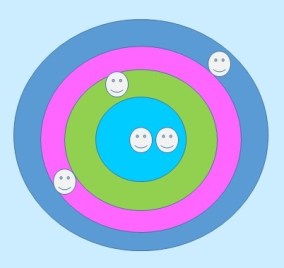
 Most people, when they think about gathering primary data for research, think of the ‘Big Three’ methods: questionnaire surveys, interviews, and focus groups. This is rather limiting when there are so many other methods that can help to answer research questions. One example is concentric circles. They are used quite frequently in market research, and have also been used in social research
  Helen Kara