
Twelve Top Tips for International Indie Work

plane.jpgMy chosen career has offered me some interesting opportunities to work outside my own country. First I went to Syria, before the conflict began, to teach qualitative research methods to doctors. It was a fascinating experience, I met some wonderful people, and I grieve for the plight of that delightful country. At the time I thought it was a one-off opportunity, but since my book on creative research methods came out last year, several others have arisen. I’ve taught in Scotland and Canada, next year I’m teaching in Wales, and next month I’m off to Australia!

Glamorous, right? Well maybe above the surface, but beneath, the administrative feet are paddling like mad. If you, too, want to do international work as a freelance indie/altac, here are my twelve top tips.

  1. Charge more for international than for national work. You need to factor in at least two unpaid days for pre-trip admin: sorting travel and accommodation, planning work, applying for a visa, getting travel insurance, having vaccinations – there’s a lot to do. I recommend adding 50% to your usual day rate as a minimum.
  1. Find out what you can charge in the country concerned. It may be more than your usual day rate plus 50%. If so, charge the going rate, or a little less. If you charge much less than the going rate, people will think you’re not worth much. Strange, but true.
  1. Make sure any costs you quote include, as extras on top of your day rate, any taxes and/or visa costs payable locally.
  1. Charge half your day rate for travelling time. I usually allocate half a day each way for short haul flights, one day each way for long haul.
  1. Make your own travel arrangements. Otherwise you risk several changes of flight and a hotel that is grotty, or inconveniently located, or with no wi-fi. Making your own arrangements takes more time but it’s worth it because you can suit yourself. Having said that, you can still use an agent for some of the work. I booked all my own travel for Canada and it took ages; for Australia, thanks to a suggestion from my Dad, I used FlightCentre (available worldwide) and I would recommend them highly. They understood my needs and my budget, and evidently have an encyclopaedic knowledge of international flight options.
  1. Don’t take the mick with expenses. I book economy class direct flights: that usually costs a bit more than flights with changes of plane, but I arrive in better condition and am fit for work sooner. I book accommodation that is comfortable and suitable for a business traveller but nowhere near top end (examples: Premier Inn in the UK, Best Western in Canada). I will use taxis, but only if I need to; I’ll use public transport where that’s easily accessible with suitable routes.
  1. Search for more work than the job you are initially offered. There’s no point flying all the way to wherever-it-is simply to deliver one short workshop or keynote speech. Use your contacts, your contacts’ contacts, social media, even cold emailing – any ideas you can come up with to generate more work. Don’t be shy. The very fact that someone wants to bring you to another country to work will impress other people. You need to maximise this opportunity, both financially and interpersonally.
  1. Where jet lag will be a factor, build in an initial day in which you won’t be working to help you acclimatise. Get onto local time as fast as you can: start before you leave for your trip if possible. And similarly, build in at least a day after you get home, before you have to do any substantive work.
  1. Plan for a final day with no commitments, so you can take up people’s offers to ‘grab a coffee’ while you’re in the area. If there are no such offers, you can spend the day exploring and having fun, so it’s a win-win.
  1. Check and double-check all travel arrangements, timings, and contact details. If someone has flown you thousands of miles for work, it’s enormously embarrassing if you don’t actually turn up in the right place at the right time. (I imagine. I’m glad to say I’ve never yet suffered such embarrassment – and I do not intend to in future.)
  1. Prepare your work carefully, and deliver it to the best of your ability. You are, to some extent, on trial. If you do well, you may be asked again.
  1. Do the follow-up work: send the emails you promised to send, pass on the references you mentioned, put people in touch with others as you said you would.

Working internationally is a lot of hard graft. It’s also a great deal of fun. I love to travel, meet new people, and see new places. But I find it helps to be realistic about what is involved, clear about what I can offer, and unambiguous about my terms.

Devising Your Own Research Method


yesI’ve had several emails recently from people asking whether they can devise their own research method. The answer is yes – in the right circumstances.
If you’re an undergraduate or a Masters’ student, you’ll have difficulty convincing your tutors that it’s a good idea for you to devise your own research method. They’re likely to say, with some justification, that you need to learn about existing research methods and practise doing research first. The possible exception is if you’re studying for a Masters’ degree in research methods and you want to use your dissertation to try out something new. But otherwise you probably need to leave the devising of a new method for your doctoral study or professional research.

Devising your own research method very rarely means creating a whole new method. Mostly it means tweaking an existing method, or layering two methods together, or some other form of adaptation. For example, Jacqueline Belzile and Gunilla Öberg, from the University of British Columbia, took a new look at focus group data. They found that it was usually treated in the same way as interview data, i.e. the content of the text was the focus of analysis while interactions between participants were generally ignored. Belzile and Öberg came up with new ways to analyse interactions in focus group data, and so moved analytic methods forward.

This usefully demonstrates that devising your own research method does not and need not apply only to data gathering. You can also experiment with writing, as I have done alongside many others, and there’s loads of room for creativity in presenting and disseminating findings. Art installations, theatrical performances, interactive multimedia – these are just a few of the options available to anyone who wants to go beyond the conventional conference presentation, thesis, journal article, or research report.

However, my inbox suggests that data gathering is the phase where people are most inclined to be experimental. And by ‘people’, I mean doctoral students. When I was doing the background reading for my book Creative Research Methods in the Social Sciences: A Practical Guide, I found that a surprisingly high proportion of papers on innovative methods were written by people who had developed those methods during their doctoral studies. This applied right across the methodological spectrum, from people developing new scales or algorithms, apps or computer games, or ways of mixing methods, to people developing new arts-based techniques. I myself developed a new method of gathering data using oral storytelling during my own doctoral studies. I guess this is at least in part because doctoral study provides enough time to research and develop methods – for those who have the inclination.

Some doctoral students find that their supervisors are nervous about the idea of a new method. The key to soothing supervisory anxiety is to construct a solid argument for the methodological move. So, let’s say a student, Ali, wants to research the effect of living close to mainline railway lines on outdoor social opportunities. Ali decides to create two three-dimensional models of small towns, identical except in one respect: one of the towns has a mainline railway running through the middle while the other has a stream with a path alongside. Ali also makes a collection of small figures and objects (barbecue, picnic blanket, bicycles etc) that participants can place on the model to show what kinds of outdoor social opportunities they would expect to see in which locations. However, Ali’s supervisors favour traditional methods of data collection such as interviewing. Ali needs to come up with some kind of precedent to demonstrate that the plans are viable, but there is no direct precedent – in fact, Ali can’t find anything anywhere in the methods literature about people using three-dimensional maps or model towns for qualitative research.

This means Ali needs to do some lateral thinking. There is some information in the methods literature about using maps with research participants, and there is also information about using objects to support interviewing. Ali collects and reads both sets of literature and uses the arguments therein to build a new argument in support of the planned method. Very sensibly, Ali also identifies some potential weaknesses of that method, and outlines plans to pilot and review the method as the first stage in its development.

So, if you want to devise a new method, whether for academic or other research, start by reading widely in the methods literature. Be prepared to think laterally, and to use a variety of search terms. At the methods frontiers, terminology is often unclear, and it would be embarrassing to claim you’d invented a new method then find several other people had invented it first but called it something different. Also, allow enough time to test your method thoroughly, through a pilot or a series of pilots, before you use it for real.

Devising a new method of gathering data – or, more likely, extending the boundaries of an existing method – is not for everyone, and it is certainly not necessary to do this to gain a doctoral qualification. But it can be great fun and very satisfying.

University Bureaucracy Is Driving Me Mad!!!

I understand that where there are institutions, there must also be bureaucracy. I know that when I work with a new university, I need to fill in a New Supplier Form for their records, and someone will have to raise a purchase order before I can get paid. This is how most universities work. The initial form-filling can be a bit of a pain, and it can take a while to get set up on the system, but once that’s done, the admin is usually straightforward. I do a job, a purchase order arrives in my inbox, I create an invoice for the specified amount bearing the purchase order number, email it off, then some time later the money appears in my bank account.

That kind of administrative overhead seems reasonable and proportionate for the kind of work I do and the amounts I charge. Most of my invoices are in three figures or the small end of four. However, some universities have a massive administrative overhead for new suppliers. I’ve just come across one at the other end of a very long spectrum. Nameless University requires me to do the following:

  1. Complete a New Supplier Form
  2. Complete a Vendor Appraisal Questionnaire
  3. Read and understand their Terms and Conditions for Purchase
  4. Complete a Supplier Engagement Tool online

The New Supplier Form is on a spreadsheet and has 22 questions. The Vendor Appraisal Questionnaire is two pages of A4 and has several of the same questions that are on the New Supplier Form.

The Terms and Conditions for Purchase are 11 pages long. Being savvy in these matters, I skipped straight to the insurance section, where I found that they want me to hold £5m in public liability insurance and £1m in professional indemnity insurance. My own insurers, in whose interests it is to sell me as much insurance as possible, have told me that I only need £2m in public liability and £250,000 in professional indemnity for the kind of work I do. To raise my cover to the levels demanded by Nameless University would cost me more than I will earn from my work with them.

The online Supplier Engagement Tool was the icing on the cake. Sample question: ‘Is there someone in your organisation who is responsible for sustainability? To qualify, sustainability must form 50% or more of the person’s job role.’ Yes, there is someone in my organisation who is responsible for sustainability. It’s me. I make sure we buy recycled paper and compost our teabags. But is that 50% of my job role? Is it heck. For a start it only takes about one minute a week to ensure that my business is as sustainable as possible, and for a second thing, if I spent half my time on sustainability, I wouldn’t be able to earn a living.

Most of the questions in the Supplier Engagement Tool were irrelevant to me, so I ended up answering almost all of them with the ‘other, please specify’ option. At the end of the process I got a personalised action plan for my business. This turned out to be a pdf of a single page with my company name at the top and NOTHING ELSE AT ALL.

I said in an email to the person commissioning my work that Nameless University was by far the most bureaucratic I had come across (it is). That person forwarded my email to the Head of Procurement. The HoP wrote me a lengthy email saying, among other things, that it is ‘standard business practice’ to operate in this way for any contract over £1,000 in value. (As this is the first university which has done this to me, I’m not sure what the standard is here, let alone the business; even the local authorities I used to work with didn’t operate like this for costs under five figures.)

The HoP did acknowledge that there was duplication between the spreadsheet and the questionnaire, and said they are ‘looking to merge the documents into one in the future’ (a job that could be done in five minutes flat). The HoP also said that ‘insurances can be negotiated… with suppliers such as yourself’ – so why not put that in the Terms and Conditions of Purchase? Some suppliers will reach that point and conclude that they are ineligible. Bureaucracy is not only a nuisance, it can also exclude, which is unlikely to be in anyone’s best interests.

Apparently the Supplier Engagement Tool will enable Nameless University to ensure that all their suppliers ‘fully comply with the recently introduced Modern Slavery Act‘. I know I can drive myself hard at times, but I didn’t realise I was at risk of enslaving myself. More seriously, this Act is only applicable to businesses with a turnover above £36million. The UK Government evidently understands the need to keep red tape to a minimum for small and micro businesses; why can’t Nameless University get its head around this too?

Most galling of all, it will take me a couple of hours to jump through all their hoops. I’m debating whether to reply to the HoP asking who I should invoice for my time. What do you think? Is that a good way to make a point? Or is it a good way to shoot myself in the foot?

Working On A Second Edition

2nd-ednI’m working on the second edition of Research and Evaluation for Busy Practitioners: A Time-Saving Guide. This was my first full-length research methods book, published by Policy Press in 2012, and it’s ready for an update. I’ve never worked on a second edition before and it’s an interesting process. One of the problems I had with the first edition was that the typescript review was not at all helpful – just half a page of text with only one point that I ended up implementing. That was frustrating at the time. I wanted more input this time around, and my lovely publisher agreed that this would be a good idea.

First they asked for a couple of unstructured pre-proposal reviews from people currently using the book. One was half a page and the other was 2.5 pages, and they were both helpful, with a useful balance of praise and constructive criticism. Of course authors need praise like plants need water, but also it’s handy when revising work to know which aspects I don’t need to worry about.

My next job was to write a proposal for the second edition, saying why I thought there was a need for a new edition, and what the key features of the new edition would be. This went out to five reviewers for structured responses, which again were very helpful and balanced. All seven reviewers had lots of ideas – two full pages of bullet points when I compiled them into a Word document – to add to the ideas I’d already had myself, and some that readers and reviewers had contributed after the first edition came out.

The second edition will be around 10,000 words longer than the first, with a whole new chapter on research approaches and methodologies. I can’t quite believe that didn’t go in the first edition! One of the main criticisms I received from the reviewers, which was also made in some of the published reviews when the book came out, was that while the book has ‘evaluation’ in the title, there is only one mention of evaluation in the text. That is not in fact the case, though it is what the index says. In 2012, when the first edition came out, I didn’t know how to check an index. I have more idea now! Evaluation is threaded through the text: for example, in the introductory chapter it is referred to seven times, on pages 1, 5, 6 (three times), 9, and 11. This time I will be making sure that evaluation is fully covered in the index, and that it appears in the contents list – another mistake we made. This is partly because the contents list only includes the chapter titles, and it’s easy to miss out the word ‘evaluation’ at that level, because you can’t say ‘research and evaluation’ every single time or it becomes very wearing for your readers. (I was comforted to find that other books have the same problem, e.g. the new edition of  Michael Quinn Patton‘s Qualitative Research and Evaluation Methods – though that book does have a full indexing of ‘evaluation’.)

I was worried that I wouldn’t be able to recapture the ‘voice’ of Research and Evaluation for Busy Practitioners. The voice of Creative Research Methods in the Social Sciences was very different. But I started writing yesterday and it came straight back, as familiar as the voice of an old friend. I have a lot of work to do, but it’s work I love, and I’m excited about it, because I think I can make a good book better.

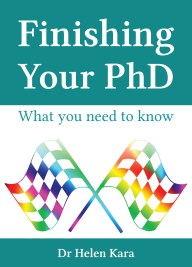
Finishing Your PhD: What You Need To Know

fyphd_teal2_flags2_multi_lc_rgbAs you know from my last post, the fifth e-book in my PhD Knowledge series is out. And so is the sixth! Phew!! I’m done!!!

I know, right? You wait ages for another e-book launch, then two come along at once! The sixth e-book is Finishing Your PhD: What You Need To Know. The final phase of doctoral study can be one of the most challenging phases, even though you’re almost there. This e-book has been vetted by expert beta readers, themselves in the final stages of the doctoral process.

While doctoral study doesn’t start (or finish) in line with the academic year, I find it satisfying that I managed to write and publish all the e-books in my PhD Knowledge series in time for the new semester. I’m also really happy that the first in the series, Starting Your PhD: What You Need To Know, is – and always will be – free to download. (Pretty happy about the reviews, too.) One of the things that book is designed to do is to help people figure out whether or not doctoral study is the right thing for them to do. I loved my PhD years, but it’s a massive commitment, and it’s not right for everyone. I know people who have worked towards a doctorate for years before they realised it wasn’t what they should have been doing. If I can help just one person to avoid that kind of frustrating and painful experience, the book will have been worth writing.

That series was last year’s new venture, now I can turn my attention to this year’s new venture: supporting late-stage and post-doctoral students with their writing. More information about that in my next post!

Research Ethics For Your PhD

REFYPhD_purple_compasses_LC_RGB.jpgWhile I’ve been away on holiday (yes, lovely, thank you!) a lot has been happening on the writing front. To begin with, the fifth e-book in my PhD Knowledge series is out. For my new followers (hello, new followers!) this is a series of six short e-books, each around 10,000 words, for potential and actual doctoral students in the social sciences, arts, and humanities. Although the titles mention PhDs, the books are also relevant for those doing professional doctorates such as EdDs, DBAs and so on. These e-books are designed to be readable by anyone with internet access – you don’t need a separate e-reader, you can download free software such as the Kindle App for your laptop, tablet, or phone. The first e-book in the series, Starting Your PhD: What You Need To Know, is free to download, and the others are each around the same price as a take-away coffee. They are: Gathering Data For Your PhD, Analysing Data For Your PhD, and Writing Your PhD. I have produced them separately to keep them affordable, and so that doctoral students can have the information and advice they need, when they need it, rather than having to buy a whole big expensive book all at once.

The fifth in the series is Research Ethics For Your PhD: An Introduction. Whether or not you have to go through a formal process of ethical review, your examiners are likely to want to see evidence that you have at least considered ethical issues during your doctoral research. Research ethics is a large and complex topic. This e-book offers a straightforward introduction that will help you decide how far you want and need to engage with ethics during your doctoral study.

Some people think ethics is a dry, boring subject. I find it endlessly fascinating because, for me, it’s about people and the choices they make. I’m working on a full-length book about ethics and I’m determined that it won’t be dull and turgid; I want it to be lively and readable, even – if I can manage it – compelling. I lead on ethics for the UK and Ireland Social Research Association and, due to my interest in ethics, Dr Katy Vigurs asked me to collaborate on a journal article. Which has just been published in the International Journal of Social Research Methodology! It’s called Participants’ productive disruption of a community photo-elicitation project: improvised methodologies in practice; there are some free downloads available and you might get one if you’re quick.

I have other writing news, as well, but that will have to wait for the next post. I hope you, too, have had a pleasant and productive summer, and I wish you all the best for the new academic year.

My Viva – Ten Years Ago Today

OUMy viva was on 20 July 2006, in a massive heatwave. Railways were buckling, roads were melting – it was much like today. I like heat. As far as I could tell, my examiners didn’t. My main examiner mopped his bald and sweaty head while I made a joke about being the one in the hot seat. It was his colleague’s first viva as an examiner and I think she was more nervous than I was.

I was nervous, though. Nervous enough not to want to drive myself the 100 miles from my home to the Open University campus in Milton Keynes, even though it was a route I knew well, because I wasn’t confident that I could keep my mind on the road. My lovely partner kindly drove me there and tolerated my disjointed gibbering along the way. Although I am comfortable in hot weather, I was also glad of the air conditioning in our car, which meant I arrived looking cool rather than a bedraggled dripping mess.

I arrived two hours early, as planned. I had a half-hour chat with my supervisors and was then delivered into the care of a kind member of the department who was assigned to look after me until the appointed hour of 2 pm. She was astonished when I demanded lunch. ‘People can’t usually eat before their viva,’ she said. ‘I’m not likely to perform well if my blood sugar is low, am I?’ I replied, quite logically I thought, and proceeded to demolish a baked potato with tuna mayo (fish! brain food!) and salad. Then we sat on the grass under a tree and chatted until it was viva time.

My examiners greeted me warmly and my main examiner told me straight away that I would be awarded a PhD, but that they wanted to discuss my thesis and some possible amendments. I didn’t know that could happen and from my point of view it was a great opener. I’d had several mock vivas and was well prepared for most of the questions, but one threw me. ‘What surprised you in your data?’ he asked. I did soundless goldfish mouth. He leaned over and tapped my copy of my thesis. ‘Pages 225 and 231,’ he said kindly, and gave me time to review what I’d written before discussing it in more detail.

Both examiners really engaged with my thesis, which was a great experience for me. They made some helpful suggestions about things I could add. After a few of these, I could see they were getting a bit over-enthusiastic, and (although I didn’t mention this at the time) I didn’t want to do more extra work than was absolutely necessary. So I gently pointed out that I was up to the maximum word count already, and while I could see the point of all their suggestions, I would also need some guidance from them about what I could take out to make space for the extra work they were recommending. They were surprised by this and checked with my supervisors, who were sitting behind me and confirmed what I had said. We discussed some options for removing text but I hadn’t waffled or included extraneous material so they rejected all of those and backpedalled on the number of amendments they wanted me to make.

My examiners each asked some of the questions, and after every question the examiner who had asked it checked with the other examiner about whether there was anything they wanted to add. Each time the other examiner said a hot and weary ‘no, that’s fine’. I truly don’t think I’d have got off so lightly if the weather had been cooler.

After just 45 minutes we were done. I had to do the statutory wait in the corridor, but only for about 10 minutes, and then it was back in for congratulations, hand-shakes, and off to the department for champagne in plastic cups. Then my partner drove me home while I rang and texted everyone. Two of my friends had kindly made a party for me while I was out; they’d questioned the wisdom of this, given that the result was not a foregone conclusion, but I felt fairly confident, and reasoned that if my confidence was misplaced I’d need distraction, sympathy, and a chance to drown my sorrows, so a party would work either way. As things turned out, it was a celebration, and for the first and only time in my life I drank champagne all evening as people kept turning up with bottles of the stuff and insisting it was for me.

Then two days later I went to Canada for a three-week holiday. Guess what I’m doing the day after tomorrow, for the first time in ten years? Yep, holiday on the horizon! So this blog will be quiet for a while. In the meantime, if you want to know more about my viva experience – and the viva experiences of others – I recommend Nathan Ryder’s Viva Survivors podcasts. I hope you all have a wonderful few weeks, and I’ll see you, refreshed and rejuvenated, in mid-August.

Getting Creative With Your Thesis Or Dissertation

draft thesis picMost doctoral theses and dissertations are produced as a block of printed paper, with the final version bound into a book. Those studying arts subjects may present a shorter written work that forms the theoretical framework for one or more artworks presented alongside the written work as part of the thesis or dissertation. These artworks could be, for example, a collection of poems, a piece of prose fiction, a short play or screenplay, a performance piece such as a dramatic monologue or interpretive dance, an art exhibition or installation, a musical arrangement or composition, or experimental work crossing artistic boundaries.

In recent years some doctoral students in non-arts disciplines have begun to take a creative approach to their theses or dissertations. For example, Anne Harris from Australia, an education researcher, was awarded her doctorate in 2010. She presented seven video films as part of her thesis on the educational experiences of Sudanese refugee women in Australia. Each film accompanies and complements one chapter of her written thesis.

Nick Sousanis, another education researcher, studied the importance of visual thinking in teaching and learning at Columbia University in New York. He was awarded his doctorate in 2014, and chose to present his doctoral dissertation as a 132-page graphic novel called Unflattening, which was published in 2015 by Harvard University Press. Benjamin Dix, a British visual ethnographer, also used the graphic novel format for presenting his thesis on complex human rights testimonies. He was awarded his PhD in 2016 and has received Arts Council funding to convert his thesis into a graphic novel.

From Canada, Patrick Stewart, a First Nation architect, wrote a doctoral dissertation called Indigenous Architecture through Indigenous Knowledge with almost no capital letters or punctuation, as a form of resistance to the unthinking acceptance of English language conventions. He received his doctorate in 2015.

Even some hard scientists are taking a creative approach to writing their dissertations or theses. For example, Piper Harron, a doctoral mathematician at Princeton University in the US, was awarded her PhD in 2016. She named her dissertation The Liberated Mathematician, and included in each chapter a section for ‘the layperson’, another for ‘the initiated’, and a third for ‘the mathematician’ – and a whole lot of jokes.

(I didn’t know all this till I asked on social media. From Facebook, thanks to Research Companion members Rebecca Ashley for information about the work of Benjamin Dix, and Melissa Terras for pointing me to Piper Harron’s dissertation. From Twitter, thanks to @librarykris for reminding me about Nick Sousanis, @ndarney for highlighting Patrick Stewart’s work, and @meganjmcpherson for directing me to the work of Anne Harris. Which just goes to show that social media is awesome.)

If you’re going to take some kind of creative approach to the presentation of your thesis or dissertation, it’s best to plan ahead if possible. However, some doctoral students may not realise until late in the process that they both want to, and can, do something a little different from the norm. If this applies to you, depending on what the difference is that you have in mind, it may still be possible. Producing a whole graphic novel at a late stage might be too big an ask – though if you are a talented artist and writer, maybe not. However, options such as weaving data excerpts in with your writing, or using a particular kind of format or structure for your dissertation or thesis, could be implemented in the last months of doctoral study.

Also, if you want to be just a little bit creative, it may be possible to take an experimental approach to a single chapter or section of your thesis or dissertation. I did this with my thesis: I wrote a chapter, on reflexivity, as a fictional story. That was an interesting challenge for me, and my examiners appreciated the change of pace. Alternatively, you could use a metaphor to draw your argument together. For example, Australian education researcher Deborah Netolicky, who was awarded her PhD in 2016, used themes and characters Alice in Wonderland as an extended metaphor to help structure her thesis. Or, again, you could do this in a smaller way, in a single chapter or section.

I would have liked to use a fictional style for my whole thesis, but my supervisors deemed it too risky. This was over 10 years ago, before I could ask social media – and even if I had been able to ask, I doubt many examples would have been available. Maybe not any. So I have drawn together the examples in this blog post in case any doctoral student feels creative but needs some evidence of precedent to comfort a nervous supervisor. If you know of other relevant examples, please share details in the comments.

Ten Top Tips For Becoming An Indie Researcher

independence.jpgPeople often ask me how to become an independent researcher. Then they ask me how I became an independent researcher, which is a different question. The answer to the latter is no help to anyone as I became an independent researcher by accident. Here’s the short version of that story. In January 1999 I was asked to do a piece of research as a one-off. I agreed, did a reasonably good job, people got to hear about it and I was asked to do more. I realised I enjoyed the work, signed up for an MSc in Social Research Methods in September 1999, got my PhD in 2006, and never looked back.
For the first 10 years or so, almost all my clients were local and national governments, charities, and public sector partnerships. Then we had the change of government in 2010, swiftly followed by a recession, in which most of the people in my networks took early retirement or redundancy or were demoted back from management to direct service delivery roles. My company’s financial year runs from August to July, and 2011-12 was the worst; the company’s turnover was less than £11,000. I had to get a part-time job for two years from September 2011, but – with a huge amount of support from my partner – managed to keep my business afloat.

Over the last five years I have reinvented myself as someone who works with academia. I still work with clients from other sectors, but these days the bulk of my work comes from universities. This reinvention has involved a lot of writing – two books, several journal articles, a bunch of e-books, this blog, tens of thousands of tweets, more of all those in the pipeline – and a lot of networking. Luckily I’m good at, and enjoy, both networking and writing.

So that’s my story, but it’s mostly made up of accidents, and so is not a route anyone else can follow. However, I do have ten top tips for people who want to adopt the indie lifestyle.

  1. Be able and willing to live on less money than your employed contemporaries. The day rates can be high but you won’t get paid work for every day, and some weeks or months you will have no paid work at all. There are none of the benefits of employment such as holiday pay or sickness pay, so you need to earn enough to cover those. Some years you will make more money than others, but the surplus from any good years needs to be put away to cushion you in the bad years, or you risk needing to give up being independent altogether. So if you crave luxury – perhaps even if you want, or have, children – the indie lifestyle is not for you.
  1. Be highly motivated. Some days you’ll have meetings, but much of the time there’s nothing to make you get out of bed but your own free will. Some people think that’s all there is to independent work: highly paid jobs for clients and a lot of time off. Thw6 is far from the case. You have to run your own business, which means doing your accounts (or earning enough to pay an accountant to do them for you, which still requires you to prepare a considerable amount of paperwork), marketing your services to help you gain further work, sorting out your own continuing professional development, and so on.
  1. Be very well organised. Sometimes you will have several client projects running at the same time, and you’ll need to keep on top of each of those, plus the needs of your own business. Even when you’re really busy with paid work, you should spend at least 10% of your time working on your business, making sure you keep up with your administration and marketing as a minimum.
  1. Networking is essential. You won’t have colleagues down the corridor who you can wander along to see for a chat when there’s something on your mind. At times you’ll need help and without a network you may have nobody to ask. Also, networking should be part of your marketing strategy, as it will help to bring you work. Network online as well as offline. Twitter is currently a very useful networking tool for researchers. I’ve had work from several sources that has come directly through Twitter, from people who have never met me in person.
  1. Keep up to date with developments in your field. When you’re employed this happens almost imperceptibly: you hear about new initiatives and legislation in meetings, relevant newsletters arrive in your inbox, organisational briefings ensure that nothing vital is missed. As an indie, you have to sign up for as much relevant free information as you can, decide what of the rest is worth paying for, and make time to read it all.
  1. Use your time productively. When work is thin on the ground it’s easy to fritter away hours, even days, surfing the internet or doing housework. When you’re busy it’s tempting to spend long hours at your computer, but it makes more sense to ‘work smart, not hard’. I have learned from experience that I can get more done working six to eight focused hours in a day than putting in 10-12 hour days. The workload is lumpy, though, and there are times when there is nothing for it but to work long hours. Try to keep those times to a minimum, and when necessary, organise your tasks so that you can do the easier, more routine work when you’re tired.
  1. Look after your health. This is a huge priority for those of us with no sick pay. Eat sensibly, get enough rest, take exercise. Make yourself have regular short breaks away from your desk even when you’re really busy. And be prepared to drag yourself out to work in physical, and emotional, states that would have an employed person reaching for the self-certification form. I have gone out to work for clients with sweat running down my back from a fever, immediately after hearing news of a bereavement, with a badly injured foot.
  1. Take proper breaks. I have at least one holiday a year, though the nature of those holidays depends on my finances: in the lean years, I might simply stay in the house of a family member or friend, while they’re away on holiday themselves, for a change of scene.
  1. Think at least twice before accepting unpaid work. Sometimes there are good reasons for volunteering. It might be a way of gaining valuable experience, or something you can give in exchange for something you want such as a conference place, or it may offer excellent networking opportunities. But when you are an indie researcher, time is your most valuable asset. People will ask you to do all sorts of things for free – even governments will – and you need to be sure that whatever you do will also benefit you in some way, and won’t take up too much of your precious time.
  1. Write for publication, even if you don’t plan to work with academia. Published writing looks great on your CV and is a marketing asset. What you write, and for whom, and where you publish your work, is for you to decide. But make it professionally relevant and write it well. Once you’ve got a piece in a newspaper, or produced a zine, or had an academic journal article accepted, shout about it all over social media and anywhere else that might help to increase your audience and networks.

If you’ve read all that and the prospect of becoming an indie researcher still excites you, then go for it, and good luck!

Why Should We Be Collegial?

loom_weaving3I was interested in this post from the Research Whisperer yesterday, written by Tseen Khoo and inspired by a researcher who chooses to do nothing unless it will benefit their career. I recently wrote a post about why it’s important to learn to say ‘no’. Yet I believe, very strongly, that it’s also important to be collegial, to look out for others, to offer support and help where it’s needed and where you can give it freely. Tseen’s post got me thinking about why I believe that. What is so important about being collegial? Would it be so awful if we all just looked out for ourselves – and, if so, why?

For me, the key point about learning to say ‘no’ is that it enables us to conserve enough resources to look after ourselves and other people. Yes, ourselves first, though I see that as at the level of health and happiness, rather than at the level of career management like the researcher mentioned in Tseen’s post. Each of us is best placed to know what we can and can’t cope with and how much energy we have; once we reach adulthood we cannot, and should not, expect others to manage this for us (though of course they sometimes help along the way). So when we’re asked to do something that will take us beyond our coping ability or use up too much of our energy, we need to be able to say ‘no’ – unless it’s an emergency, of course. Then it’s time to pull out all the stops and recoup later on.

Sometimes it’s worth saying ‘no’ to things we do have the ability and energy for, but which don’t bring us joy. I say ‘no’ to a lot of things by choosing to be an indie researcher. For example, I say a resounding ‘no’ to organisational bureaucracy, meetings about meetings, and ironing. I could manage all those things, and more of their ilk, and have done so at times. But I am much, much happier without them in my life.

Once we’ve done all the saying ‘no’ we want and need to do, we should have created the capacity to say some ‘yes’. We have choices there, too. We can act like the researcher in Tseen’s blog post and choose only to say ‘yes’ to things that will benefit our own career. Or we can use a different strategy for decision-making.

Tseen helps because she can. My own strategy is similar, along the lines of ‘if someone needs help, and I can help, I’ll help’. The ‘help’ in that sentence could be passing the butter or giving a troubled friend space to live in my house for a year while they sort themselves out. In professional terms, it could be downloading a pdf for someone who asks on Twitter, or providing years of support for a colleague doing a doctorate. But for me, that’s what I do, not why – and I think there’s more self-interest in why I help, though not the kind of self-interest shown by the researcher who so enraged Tseen. Helping others benefits me, not in the sense of stacking up brownie points to redeem in an afterlife, but because every time I help someone I learn something new. And desire to learn is the main reason why I do scholarly work in the first place.

That doesn’t mean I do some kind of cost-benefit analysis. I doubt it would be possible, even if I wanted to, because I couldn’t figure out in advance what I would learn from helping someone. Sometimes I learn a small thing from a big help, or vice versa. I don’t try to calculate return on investment, either. Offering help and support is part of the fabric of my life and it’s not about expecting some kind of payback. In fact, often I’m paying it forward, such as by helping people with postgraduate research. When I was doing my own MSc and PhD, I received an enormous amount of help from people who were further along in the process, and I never could pay that back – but I certainly can pay it forward, and encourage others to do the same.

The lovely thing, though, is that sometimes helping others has an unexpected payback, if someone you helped finds they are able to help you. A friend and colleague who I helped with her PhD, years ago, recently did me a big favour by hooking me up with the Head of her institution’s Graduate School who wants to commission the kind of courses I offer. My friend claims her main motivation was self-interest, because having identified someone who can help where it’s needed will reflect well on her. Perhaps it will, though I’d dispute the self-interest being her main motivation, because I know her to be a generous person with an eye to the ways she can help others. In fact, she’s thoroughly collegial.

I think I’ve worked out at least two of the reasons why it would be worse if we all just looked out for ourselves. We would deny ourselves regular opportunities to learn from helping others, and occasional opportunities for unexpected benefits further down the road. Those opportunities seem to me to be two good reasons for being collegial, and they constitute two shining threads in the fabric of our lives and work.

I’m sure there are other reasons too. If you have any in mind, please leave a comment; I’d be interested.