The International Creative Research Methods Conference was a tremendous success. So I’m going to do it again next year, on 9-10 September, at the same venue in central Manchester, England. Once again I need to sign a contract with the venue for a five-figure sum, which is scary – but not quite as scary as last year, because I feel more confident that people will come. If anything goes wrong, I am at risk of losing half of my life savings, so it is still a big gamble, but it feels like less of one than last year.
Also the organisation is so much easier! Last year my support worker and I spent weeks researching venues. This year it took me approx 30 seconds to email the venue and request the same spaces for next year. And I am grateful to people who attended this year and offered their help as we prepare for next year’s conference; I am glad to be able to ask different people for help this year. I have already called on one of those people for feedback on the draft call for proposals. This is now finalised and available here. Deadline: 15 December. Go go go!
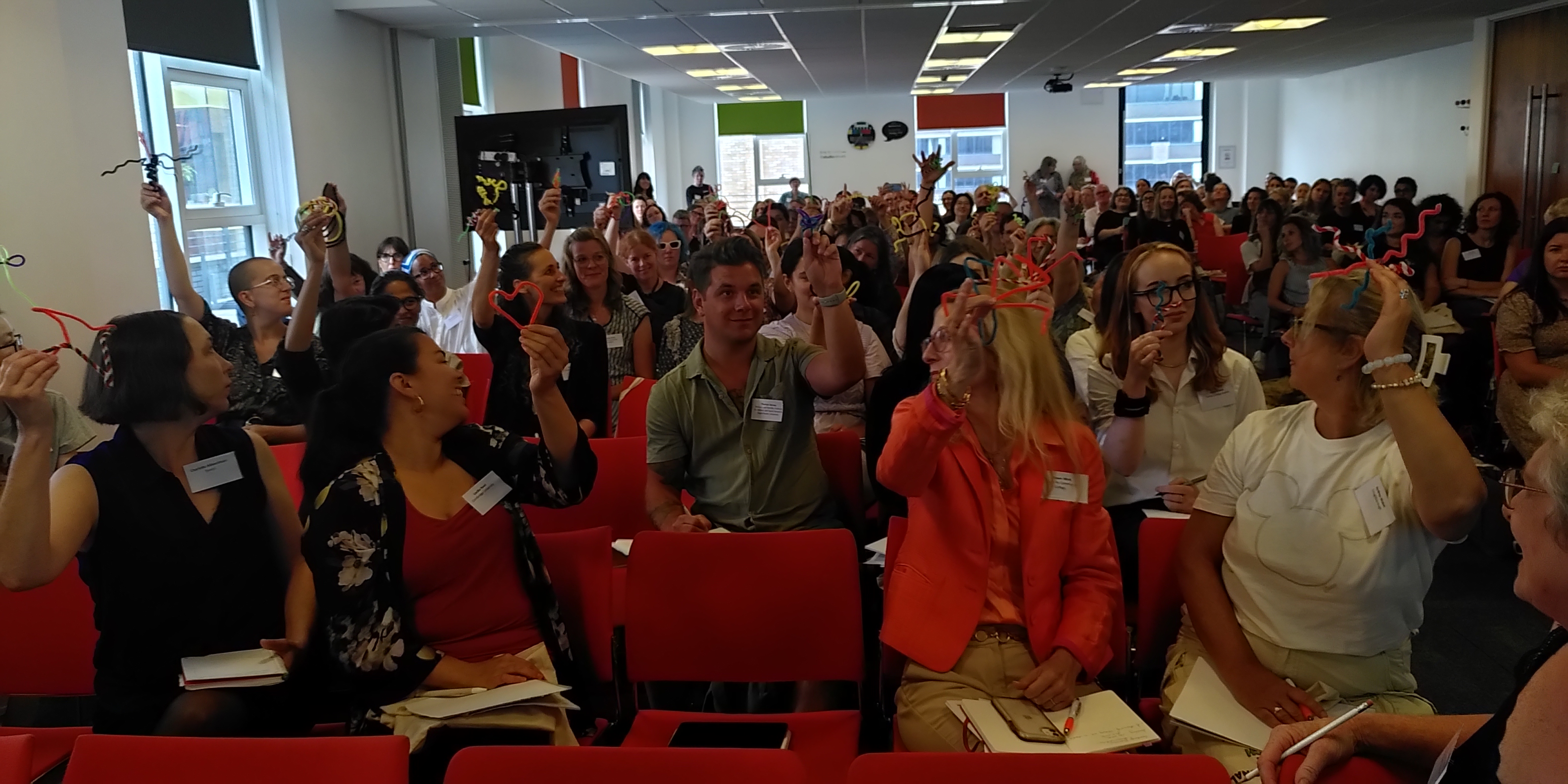
It was such an amazing couple of days! People came from Australia, New Zealand, Canada, the US, India, Nepal, Denmark, Belgium, the Netherlands, Ireland, and all over the UK – maybe other countries too but those are the ones I know about. And the people attending online were all over the world as well. This photo shows most of the 180 people at the venue for the first keynote, given by Pam Burnard from Cambridge University here in the UK. She talked about the importance of rebellion and disobedience, and demonstrated her points through poetry, sound, wool throwing, interaction, art, and dynamism. The keynote on day 2 was given by Caroline Lenette from the University of New South Wales in Sydney, Australia. She talked about anti-colonial practice and gave us a preview of her tremendous new resource: The Anti-Colonial Research Library. Both keynote speeches are now online and available for you to view via the links in this paragraph.I was astonished and delighted that both keynote speakers attended the whole conference. The biggest complaint I had from in-person delegates was that there were too many interesting sessions and it was very hard to choose. By the morning of the second day, some people were telling me they had stopped trying to decide and were picking sessions at random because they knew all the sessions would be good. There was much more laughter, and many more hugs, than I have experienced at a conference before. And we had such a diverse group of people which made for rich conversations. As well as the international diversity, there were different genders, ethnicities, abilities – we had presentations from researchers with intellectual disabilities, neurodivergent researchers, researchers with physical disabilities, and others – and a wide range of disciplines. People came from the private sector, academia, the non-profit sector, and self-employment. And everyone was willing to be generous, collegial, and supportive of others. One colleague said to me that it was an unusual conference, in his experience, because there was nobody he was trying to avoid.We did our best to make it inclusive. It wasn’t perfect; the venue doesn’t have a hearing loop, and I will raise that in my feedback because it prevented at least one person from attending. But we had a quiet room, and communication badges, and the venue was entirely accessible for those with physical disabilities including one person who came on a mobility scooter. The feedback I have heard and seen so far has been glowing. Examples include:”It was a brilliant, wonderful conference, and the best online conference that I’ve ever attended.””Excellent few days in Manchester for #ICRMC where the vibe was most welcoming and the content engaging, important and imaginative. Everything you’d want a creative methods space to be. Thanks and congrats to all involved.”And lots more in the same vein. Dawn Wink, from Santa Fe, wrote a whole blog post about the creativity, research, and passion at the conference.I have been imagining and dreaming of this conference for years. I am so, so happy that at last I have been able to do it. We didn’t make a big surplus – I don’t have the final figures yet, but I think around £3-4,000 – and that will help to fund a keynote speaker from the majority world for next year. Yes, we will be doing it again; I have already booked the venue! Save the dates: 9-10 September 2024, Manchester, England. Hope to see you there!
When I learned history at school, it was all about European royalty and battles from the distant past. This was in the 1970s when Britain was an even more overtly racist country than it is now. Yet I learned nothing about the British empire, or about other empires either. At least not from my lessons; what I learned about the British empire, I learned from the fiction I read.
My father took care to provide diverse reading for me, including books by African and Caribbean authors, and Enid Blyton’s books were banned from our house because of their overt racism and sexism. But a number of other authors whose work had racist elements slipped through, such as Hugh Lofting, Willard Price, and Laura Ingalls Wilder. From these books, and from the wider culture around me, I learned that the British empire had been a great endeavour in which brave pioneers had travelled, and sometimes settled, in lands where no white man had ever been. This was a heroic narrative involving encounters with ‘the other’, i.e. black and brown people, who were generally either hostile or servile. They were sometimes treated by the white characters with respect and kindness, but they could never, ever, be equal. The white people in the stories ended up richer in some way or another, and the black and brown characters were incidental to that story. The fundamental message was one of white superiority, whether on an individual, local, national or global scale.
I have written before on this blog about my own racism. In recent years I have been taking steps to educate myself about colonialism and its impacts. This mostly involved reading a bunch of books. As always with my book-related posts, I am not presenting this as any kind of exhaustive or authoritative list, but simply the books I have chosen to read.
The first book I read was Inglorious Empire: What the British Did to India by Shashi Tharoor. This is a dignified, scholarly, polite assessment of Britain’s looting and ravaging of India over 200 years from the mid-1700s to the mid-1900s. Tharoor builds his argument carefully, piece by piece, giving credit where it is – occasionally – due. He acknowledges that the English language was and is a valuable legacy for India (p 202). But he concludes, unequivocally, that ‘The India that succumbed to British rule enjoyed an enormous financial surplus, deployed a skilled artisan class, exported high-quality goods in great global demand, disposed of plenty of arable land, had a thriving agricultural base, and supported some 100 to 150 million without either poverty or landlessness. All of this was destroyed by British rule.’ (pp 219-20)
Then I read Slave Empire: How Slavery Built Modern Britain by Padraic Scanlan. This is written more like my school history books, with lots of names and dates. It focuses on slavery, primarily British slavery albeit in a global context, defining England as ‘among the world’s largest slaveholding powers and one of its most prolific slave traders’ (p 28). Scanlan covers the rise and the fall of the slave trade, and carefully documents how the official end of slavery did not in fact end ‘Britain’s entanglement with slavery’ as ‘British industry and finance remained deeply connected to enslaved labour’ (p 373).
Next came Empireland: How Imperialism Has Shaped Modern Britain by Sathnam Sanghera. Sanghera’s chatty journalistic writing style initially made his book seem like an easier read, but – unsurprisingly, given the subject matter – it was as demanding as the others. Sanghera, though, has a unique view in both directions. As a British Sikh, he has been on the sharp end of colonialism, but also had to face up to Sikh collusion in some aspects of colonisation, such as Sikhs’ participation in violently quashing the Indian rebellion against British rule in 1857. Sanghera describes facing up to this as ‘onerous’ (p 153) and acknowledges the possibility that the history of colonialism ‘is just too painful to digest’ (p 208).
I am grateful to Sanghera because I, too, find the process of facing up to this history to be onerous and painful. I realise that this may be seen as a form of ‘white tears’ – what right do I have to feel sad about a change to my national narrative when millions of lives were stolen? Yet I think if we do not acknowledge the potential and actual emotional impacts of this facing up process, we are effectively expecting people to learn about dreadful atrocities without any emotional consequences, and that is unrealistic.
Learning about this stuff is tough. It is also vital.
The next book I read was The New Age of Empire: How Racism and Colonialism Still Rule the World by Kehinde Andrews. Andrews demonstrates that the systems developed as colonialism was formed are still in action today. He also argues that we need to know about this because ‘The world can only ever be as equal as the knowledge it is built upon’ (p 2). Andrews asserts that ‘the premise of this book is deeply optimistic’ (p 205), but I have to say it didn’t seem so to me and I’m not sure how it could. The author does, though, express a hope that I share, which is that ‘understanding the scale of the problem and the limits of the solutions offered can spark a genuine conversation about how to overhaul this wicked system.’ (p 207)
Now I am reading Epistemic Freedom in Africa: Deprovincialization and Decolonization by Sabelo Ndlovu-Gatsheni. The author draws primarily on theoretical and research work from African, Asian, and south American scholars. He shows us, among other things, that not only lands and bodies but also people’s minds are colonized by the global dominance of Eurocentric thought and ideas. ‘Epistemic freedom is fundamentally about the right to think, theorize, interpret the world, develop own methodologies and write from where one is located and unencumbered by Eurocentrism.’ (p 3).
Although these books are justifiably angry, they are not polemics. Each engages with other structural inequalities such as sexism/patriarchy and class as well as racism, embraces nuance, and looks forward as well as back. Of course there is much, much more to each book than I have been able to explain here. I would recommend them all to anyone wanting to learn more about colonialism.
Ndlovu-Gatsheni’s book seems to me to be truly optimistic, perhaps because it offers a key to action I can take. It is easy to feel powerless in the face of colonialism, not least because that is partly what colonialism is designed to achieve. And for sure what I can do is only a minute fraction of what is needed. It is a truism that I can only do what I can do, but that truism is used too often to absolve people from the need to act. I think it is equally true that I should do what I can do. And what I can do – what I realise, now, I have been doing for years – is to encourage people towards epistemic freedom.
This blog and the videos on my YouTube channel are funded by my beloved Patrons. Patrons receive exclusive content and various rewards, depending on their level of support, such as access to my special private Patreon-only blog posts, bi-monthly Q&A sessions on Zoom, free e-book downloads and signed copies of my books. Patrons can also suggest topics for my blogs and videos. If you want to support me by becoming a Patron click here. Whilst ongoing support would be fantastic you can make a one-time donation instead, through the PayPal button on this blog, if that works better for you. If you are not able to support me financially, please consider reviewing any of my books you have read – even a single-line review on Amazon or Goodreads is a huge help – or sharing a link to my work on social media. Thank you!
When I wrote my doctoral thesis, nearly 20 years ago now, I wanted to write it creatively. I was already a professional writer and I could see the potential for creative approaches to help me communicate the points I needed to make. Also, I gathered data in the form of stories, so to me it made sense that my thesis should be made up of stories too. But my supervisors were resistant. After some discussions, they allowed me to write one chapter creatively, as long as I wrote the rest of my thesis in a conventional style.
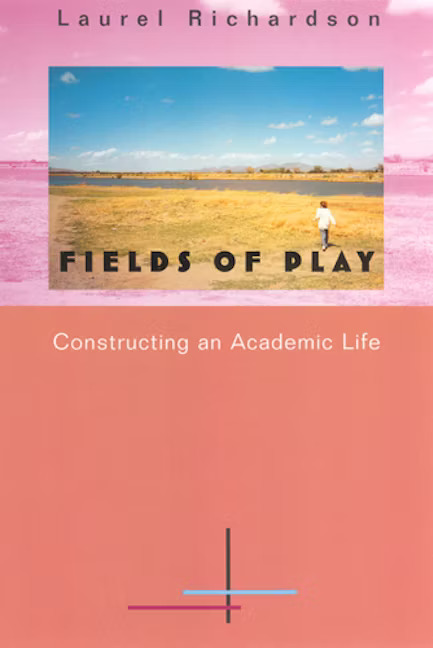
The difference between then and now is that back in the mid-2000s, the literature on writing creatively in academia was very limited. Laurel Richardson’s seminal Fields of Play was available, but it was on its own at that time; there was no body of literature from which to build a rationale for using creative techniques in academic writing. And of course that was exactly what I needed to do to reassure my supervisors about the merits of my intended approach.
But now there is such a body of literature! In this post I share four particularly useful books, all published in the last couple of years. Also, they are all well referenced, so you can use them to find other literature, if you wish. Then you can create a cogent, evidence-based argument for using creative techniques in writing your doctoral dissertation or thesis.
I also want to recommend Fields of Play. Although it was written late in the last century, it is still highly relevant today. Laurel Richardson dismantles the rationale for the norms of conventional academic writing such as passive voice and authorial authority. Then she creates a new rationale for using fiction techniques, poetry, drama and other creative approaches in academic writing. And she practises what she preaches within the text, to excellent effect.
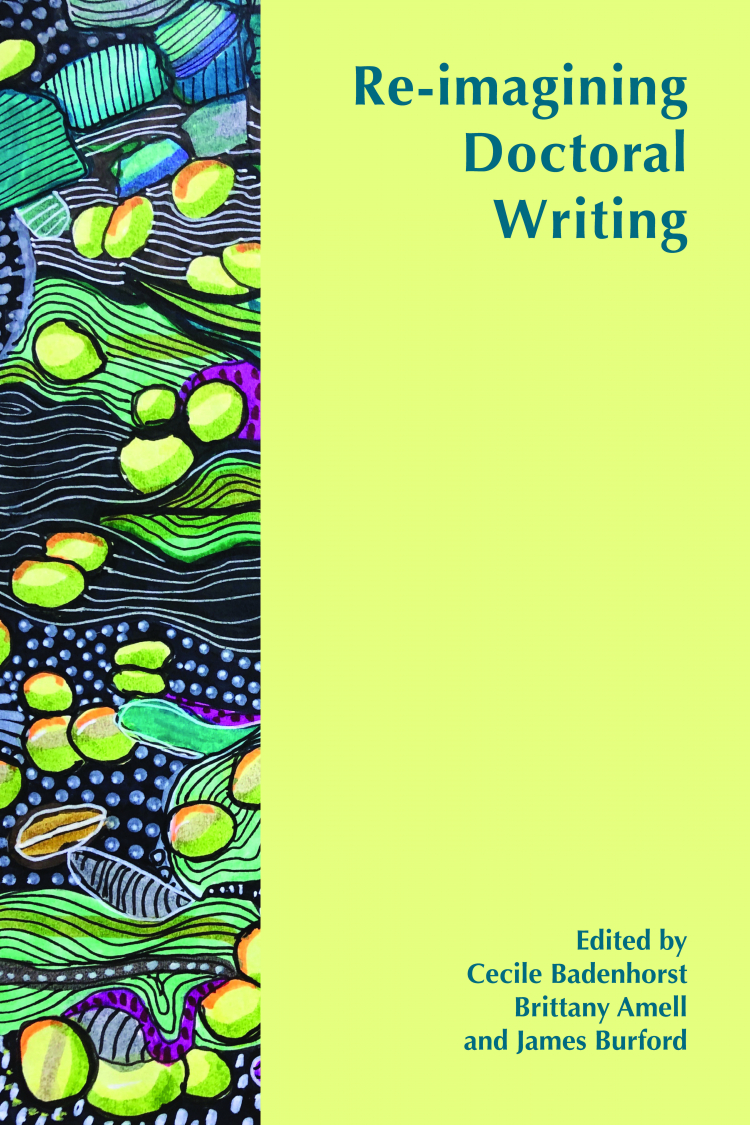
Reimagining Doctoral Writing (University of Colorado Press, April 2022) is edited by Cecile Badenhorst, Brittany Amell and James Burford. This edited collection is all about doctoral writing. Authors come from around the world, and they investigate doctoral writing from a range of perspectives and in a range of contexts. They also consider some potential futures of doctoral writing. This book is available as an open access ebook through the WAC Clearing House.
Doing Rebellious Research: In and Beyond the Academy (Brill, May 2022) is edited by Pam Burnard, Elizabeth Mackinlay, David Rousell and Tatjana Dragovic. This edited collection has four parts. The second part is called ‘Rebellious Writings Written Differently: A Manifesto’. It contains seven chapters and a set of reflective questions, and overall is designed to encourage and inspire a radical approach to academic communication.
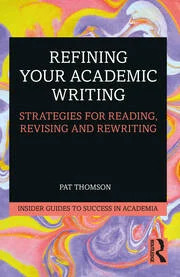
Refining Your Academic Writing (Routledge, December 2022) is by Pat Thomson. This short book treats revision as not a boring mechanical process but a creative, imaginative craft. It is part of the Insider Guides to Success in Academia series which, in the interests of full disclosure, I should point out is co-edited by Pat and me. But I am recommending this book here, not simply because it’s in our series, but because it is as useful and radical as the others in this post.
Creative Writing for Social Research (Policy Press, January 2021) is by Richard Phillips and me, with 14 tremendous contributors who put the principles set out in the book into practice. We have received excellent feedback on this book, such as: ‘The text is well written and engaging… I would recommend this book to all qualitative researchers.’ Thank you Ruthi Margulis for your heartwarming review in Research Matters (Dec 2021, p 13), the quarterly magazine for researchers published by the Social Research Association.
These books are in general a pleasure to read. They are well written and full of ideas, encouragement, and inspiration. And it’s not only the books – if you want more personalised support with your thesis writing, you can always come on one of my writing retreats (if there are still places available). Whatever resources you draw on, I wish you joy of your doctoral writing.
This blog and the videos on my YouTube channel are funded by my beloved Patrons. Patrons receive exclusive content and various rewards, depending on their level of support, such as access to my special private Patreon-only blog posts, bi-monthly Q&A sessions on Zoom, free e-book downloads and signed copies of my books. Patrons can also suggest topics for my blogs and videos. If you want to support me by becoming a Patron click here. Whilst ongoing support would be fantastic you can make a one-time donation instead, through the PayPal button on this blog, if that works better for you. If you are not able to support me financially, please consider reviewing any of my books you have read – even a single-line review on Amazon or Goodreads is a huge help – or sharing a link to my work on social media. Thank you!
There are still a lot of people who don’t really understand what creative research methods are, or what they are for, or when you might use them. These people are usually labouring under one misconception or another. So I thought it might be helpful to run through these misconceptions and explain why they are wrong.
1. Creative research methods are a new fad.
In fact research has always been a creative endeavour. The first clinical trial was conducted in the mid-18th century. The questionnaire was invented in 1838, interviews were first used by researchers in the early 20th century, and focus groups were devised in the 1940s. So the questionnaire was created less than 200 years ago, and the focus group was created within living memory. And no doubt ingenious humans were devising a whole bunch of other ways to try to find out new information since long before the clinical trial was born.
2. Creative is the same as innovative.
This is more arguable; there is certainly a lot of overlap between creation and innovation. However, there is also scope for creativity in the use of conventional methods. A questionnaire may include appealing visual elements and be creatively laid out on the page or screen. It is still a questionnaire, but a more creative one than the usual online or paper form.
3. Creative research methods are only useful for qualitative research.
Actually a lot of quantitative and multi-modal researchers do very creative work. Much of this is at the further reaches of disciplines such as physics and electronics, but some is more accessible. Piper Harron wrote her pure maths doctoral dissertation in a very creative way. Daina Taimina solved a centuries-old problem in hyperbolic geometry using crochet. And field biologist Colleen Campbell uses artistic techniques alongside her scientific work with bears and coyotes.
4. Creative research is the same as arts-based research.
Arts-based research is a big sub-set of creative research methods, but not the whole story. There is some very creative work being done with digital methods, embodied methods, and methods in multi-modal research.
5. Arts-based research is all about visual methods.
This is perhaps understandable because we are such a visual species, but it is incorrect. Arts-based methods do include visual methods, for sure, but also writing, music, drama, dance, textile arts – the lot.
6. Creative methods do not involve rigour.
This is closely aligned to the misperception that states creative research methods are antithetical to good research practice. This is absolutely not the case. The key principles of good research practice – designing carefully, working systematically, disseminating widely etc – apply whether you are using creative or conventional methods, or a mix of the two.
7. Only creative people can use creative research methods.
This implies that some people are not creative; a viewpoint I do not embrace. I believe everyone is creative. We all co-create our relationships with other people, for a start. Making and maintaining relationships is a creative process because no two relationships are the same, and the different relationships we have with different people demand different responses from us. Also, you do not need any formal qualifications or recognised skills to be creative: you don’t need an arts degree to use arts-based methods effectively, or great technical acumen to use digital methods well.
8. Creative research methods are only useful for gathering data.
I think this misconception arises because of the general conflation of research with data gathering. It is the visible part of research; the part we are all, regularly, asked to participate in; the part that research ethics committees focus on. But it is far from the only stage of research where creative methods can be useful. In fact, creative methods can be used effectively at all stages of the research process.
I have an exciting new venture to share with you. For the last couple of years I have been working with Policy Press on a new series of short affordable books on creative research methods in practice. And we have just gone public! The first book is on its way: Photovoice, Reimagined by Nicole Brown. And there are several more books in the pipeline. Two are being written right now – one on fiction in research, and one on phenomenography – and four other book proposals are under review.
I wanted to edit this series because there are no such books available to help researchers learn in detail about why, when, and how to use a new research method. There are several books giving an overview of creative research methods, within or across academic disciplines; some sole-authored, some edited collections. These are useful texts but they do not generally offer enough depth of information to enable readers to try out the methods for themselves with confidence. The main rationale for this new series is to do just that.
One of the hardest things to sort out was the design for the covers and webpage. That took months and a lot of emails, discussions, and meetings (most of which I didn’t need to attend, thank goodness). We almost agreed on some covers and then the sales and marketing people at Policy Press said the designs weren’t good enough. They were absolutely right. So we went back to the actual drawing board and started again. I am so pleased with the final result. I think hot air balloons are a delightful combination of science and art, innovation and exploration and adventure – just like creative research methods. (Let’s not focus too closely on the ‘hot air’ part, OK?!) Also Policy Press likes to have a Bristol element to their designs, and Bristol holds an annual International Balloon Fiesta – Europe’s largest event of its kind – so the design works from that viewpoint too.
I am so happy to be able to tell you about this new book series. And if you would like to propose a book for the series, do get in touch!
This blog and the videos on my YouTube channel are funded by my beloved Patrons. Patrons receive exclusive content and various rewards, depending on their level of support, such as access to my special private Patreon-only blog posts, bi-monthly Q&A sessions on Zoom, free e-book downloads and signed copies of my books. Patrons can also suggest topics for my blogs and videos. If you want to support me by becoming a Patron click here. Whilst ongoing support would be fantastic you can make a one-time donation instead, through the PayPal button on this blog, if that works better for you. If you are not able to support me financially, please consider reviewing any of my books you have read – even a single-line review on Amazon or Goodreads is a huge help – or sharing a link to my work on social media. Thank you!
I ran my first academic writing retreat in 2015, over a weekend, for doctoral students at Staffordshire University. It was very enjoyable for me and, judging by the feedback, for the students too. Since then I have led many retreats and courses, mostly for doctoral students and/or university staff at institutions around the world. My standpoint is that all writing is creative, writing is a research method, and writing can be fun.
This month I ran an academic writing retreat over three days for Cumbria University in a delightful rural venue; a welcome change from the gritty urban spaces I usually go to for such gigs. This one had a transdisciplinary flavour with people from health and criminology, fashion and social care, media and education, and no doubt other departments I have forgotten. I never mind working with people from a single discipline, school, or faculty, but I do find that transdisciplinary groups have richer discussions. And the feedback I got was very positive.
I also get rich transdisciplinary discussions and good feedback when I run my four-day creative academic writing course for the Methods@Manchestersummer school, which this year is from 3–7 July online. The people who come on the course are always from a wide variety of disciplines and professions, and every year it is exciting to find out who I will be working with. (There are still some tickets available if you’re interested.)
And I run creative thesis writing courses for various universities, doctoral training partnerships, and other clients such as Guild HE. In fact I am running a creative thesis writing course next week for Liverpool John Moore’s University.
I love these parts of my work. I really enjoy demystifying the writing process, seeing the light-bulb moments people have, and witnessing their satisfaction in the progress they make. So I have taken the big step of booking other delightful rural venues for three independent residential retreats in 2023–24, one of which will be co-facilitated. In brief:
20–23 May 2024: creative research writing for publication, at Northern College near Barnsley.
My retreats are supportive, with some taught sessions, plenty of breaks, lots of time to write, and optional one-to-one chats with me. Costs are inclusive of accommodation and catering. The venues are delightful. More information here and if you have any questions, please ask in the comments or email enquiries@creativeresearchemethods.com.
This blog and the videos on my YouTube channel are funded by my beloved Patrons. Patrons receive exclusive content and various rewards, depending on their level of support, such as access to my special private Patreon-only blog posts, bi-monthly Q&A sessions on Zoom, free e-book downloads and signed copies of my books. Patrons can also suggest topics for my blogs and videos. If you want to support me by becoming a Patron click here. Whilst ongoing support would be fantastic you can make a one-time donation instead, through the PayPal button on this blog, if that works better for you. If you are not able to support me financially, please consider reviewing any of my books you have read – even a single-line review on Amazon or Goodreads is a huge help – or sharing a link to my work on social media. Thank you!
Back in 2015–16 I published a set of short affordable e-books for doctoral students – or, in the case of the first book, would-be doctoral students. Starting Your PhD: What You Need To Know was free on all platforms, because I wanted it to be easily accessible for people thinking about maybe doing a PhD or a professional doctorate such as an EdD or DBA. The other five were each around the price of a coffee in the UK, which seemed a reasonably affordable price.
Over the last year I have revised these e-books thoroughly and the second editions are now available. The first e-book is still free on all platforms except Amazon, because now the minimum price for a Kindle e-book appears to be 77 pence in the UK (and presumably equivalent amounts elsewhere). If you only have a Kindle, I recommend getting the e-book from Payhip where you can get a free epub.
I have updated all the text, references and resources in each of the books. Also, this time around I used a formatting service. I would have liked to do that last time but I couldn’t afford it – I paid for editing and cover design, and that was all I could manage. This time I used the same covers with a ‘second edition’ banner added, and my support worker did the editing for me. So I was delighted to be able to work with Leigh Forbes of Blot Publishing, a hugely experienced formatter of e-books and paper books. Her advice was consistently helpful and her professional approach made working with her a pleasure.
To celebrate the launch of these second editions, I am offering them to readers of this blog post at half price until 9 May 2023. This is also through Payhip where if you use this code at the checkout – RLCFPO6XU9 – you should receive 50% off any of the e-books. Or you can buy all six in a bundle, which is priced at £15.00 on Payhip, cheaper than Amazon UK where the whole series is currently £18.22. The 50% off code will work for the bundle too. Please feel free to share the code with others in your networks, though do also tell them about its expiry date.
In case it’s of interest, I am not doing this as a money-making exercise. The first editions never even covered their costs, let alone making any profit to pay for the time I spent in writing and publishing them. I charge for five of the e-books because (a) I am an eternal optimist and they might cover their costs this time and (b) I know that, bizarrely, people value things more if they cost money than if they are free.
I got ‘paid’ in good reviews which were heartening and encouraging to read. However, a downside of producing second editions is that all the first edition reviews have disappeared. I hope some people will write new ones soon, to help potential purchasers. Maybe even you!
This blog and the videos on my YouTube channel are funded by my beloved Patrons. Patrons receive exclusive content and various rewards, depending on their level of support, such as access to my special private Patreon-only blog posts, bi-monthly Q&A sessions on Zoom, free e-book downloads and signed copies of my books. Patrons can also suggest topics for my blogs and videos. If you want to support me by becoming a Patron click here. Whilst ongoing support would be fantastic you can make a one-time donation instead, through the PayPal button on this blog, if that works better for you. If you are not able to support me financially, please consider reviewing any of my books you have read – even a single-line review on Amazon or Goodreads is a huge help – or sharing a link to my work on social media. Thank you!
I am glad to say you can now buy tickets for the International Creative Research Methods Conference in Manchester, UK on 11-12 September 2023. Tickets are available in limited numbers for in-person attendance, and in unlimited numbers for online attendance. There is a sliding scale of prices and bursaries are available; the closing date for bursary applications is 30 June. More information here. Hope to see you there!
‘written, graphical or pictorial matter, or a combination of these types of content, in order to transmit or store information or meaning’ (p 11).
So documents have a range of purposes, and can come in a wide variety of forms and formats: digital or hard copy; reports, letters, emails, social media posts, forms, meeting minutes, web pages, leaflets, shopping lists; and so on. Documents are rarely just containers of information, they are also tools for people to use in the world. Documents are used for purposes such as communication (letters, emails etc), or enforcement (legislation and legal judgements), or to make something happen (a child’s birthday present wish-list or an adult’s last will and testament).
Documents can be rich sources of data for research. They may be collected, from libraries, the internet, archives etc, or constructed, such as when a researcher asks participants to keep a diary of relevant events for a specific time period. Collected documents are secondary data, and using secondary data where possible is an ethical approach to research, because it reduces the burden of primary data collection for participants and for researchers.
There are many ways to analyse documentary data: thematic analysis, content analysis, discourse analysis, narrative analysis and metaphor analysis are just a few. And documents are being used as data for research across a wide range of disciplines and fields: psychology, ecology, education, health, technology, linguistics and many others too. Innovative work is being done with documents in research all around the world.
What does not yet exist is an edited collection of chapters to give a sense of the breadth and depth of possibilities offered to research by documents. So I am delighted that Aimee Grant has invited me to co-edit just such a book, which we intend to showcase some of the excellent work being done with documents by researchers worldwide. We formulated our call for proposals last week; the deadline is midday BST on 24 April 2023. Please help us to spread the word!
This blog and the videos on my YouTube channel are funded by my beloved Patrons. Patrons receive exclusive content and various rewards, depending on their level of support, such as access to my special private Patreon-only blog posts, bi-monthly Q&A sessions on Zoom, free e-book downloads and signed copies of my books. Patrons can also suggest topics for my blogs and videos. If you want to support me by becoming a Patron click here. Whilst ongoing support would be fantastic you can make a one-time donation instead, through the PayPal button on this blog, if that works better for you. If you are not able to support me financially, please consider reviewing any of my books you have read – even a single-line review on Amazon or Goodreads is a huge help – or sharing a link to my work on social media. Thank you!








 Helen Kara