The Handbook of Creative Data Analysis

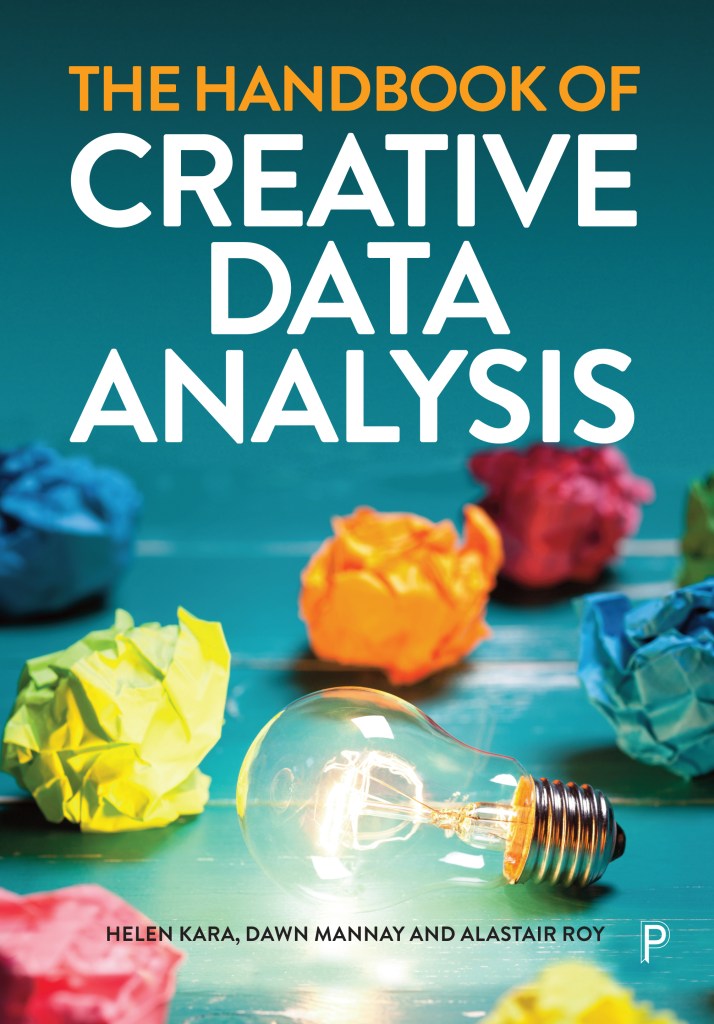
I am delighted to say that The Handbook of Creative Data Analysis was published this month. It’s a chunky tome with 29 substantive chapters, each outlining a creative method and its implications, plus introductory and concluding chapters by the editors.

Here’s how it came about. I first wanted to do this book in 2016. I knew it wasn’t a book I could write myself unless I could get some funding to research it – I applied for a grant from Leverhulme in 2017, for which independent researchers were eligible, but I was unsuccessful. I didn’t think it was a book that could be co-written, either. I thought of an edited collection, but wasn’t confident of doing that well enough on my own. And I didn’t have any good ideas about who to ask to co-edit with me.

Then in February 2021 I chaired a webinar on creativity in research for Policy Press with Dawn Mannay (Professor of Creative Research Methodologies at Cardiff) and Ali Roy (Professor of Social Research at UCLan). I already knew them both and it was a pleasure to do the webinar with them. We were surprised by the number of questions about data analysis, and after the webinar it occurred to me that they would be good co-editors for the book I had in mind. Then I considered their busy academic lives and figured they probably wouldn’t be interested. Then I thought I could just send an email to ask – nothing ventured, nothing gained… and they both said yes!

We decided Policy Press should publish the book and we put together a call for proposals. At this stage we were envisaging a standard-sized book with maybe 12 chapters. What we weren’t envisaging was around 60 proposals, most of which were really good. So we asked Policy Press if we could do a Handbook instead and they said yes. (Around this time I had also been asked to edit the Bloomsbury Handbook of Creative Research Methods. Fortunately I was able to divert a lot of the good proposals we couldn’t fit into the Policy Press Handbook to the Bloomsbury Handbook, so we didn’t have to reject too many outright.)

The process of editing this Handbook was a joy for several reasons. Dawn and Ali were great to work with – we named ourselves ‘good cop’ (me), ‘bad cop’ (Dawn), and ‘ambivalent cop’ (Ali)! I wanted to say yes to as much as possible, Dawn had a keen eye for quality standards, and Ali was great at seeing the merits of, and balancing, different arguments. And the combination of those three attributes was, in practice, greater than the sum of its parts. Then our contributors were, without exception, terrific, responsive, collegial people to work with. And Policy Press were thoroughly supportive throughout.

The part I liked best, though, was the learning. Each individual chapter held fascinating lessons and made me want to have a go at doing analysis with emojis, or reflective stitching, or word clouds. But there were some overall learning points, each made by several authors, that I found particularly interesting. The first is that any data can be analysed creatively: quant or qual, conventionally collected or creatively generated. The second is that analysis is not a discrete phase of research which falls between acquiring data and reporting results. Analytic work begins at the design stage of research and continues through dissemination and beyond. The third overall learning point is that doing analysis differently helps us to find new insights, learning, and understanding. The fourth is that analysing data often requires creativity, whether or not this is explicit.

Researchers use tacit as well as acknowledged creative practices to support their analytic work, and this is highlighted in several chapters. These tacit creative practices have always fascinated me. When I get stuck in the analytic mire, I write poems or create diagrams to help me move forward. Sometimes only half a poem or diagram, and my analytic poems never see the light of day though occasionally my diagrams do. But these techniques help my analytic thought processes. I was interested to discover other tacit creative practices, such as visual arts (doodling, drawing, collage etc), making (models, installations etc), music (to accompany and promote thought), and embodied practices such as walking, running and swimming. No doubt there are others too.

The fifth overall learning point is that analytic processes do not need to be fixed or rigid. This book demonstrates, in many ways, that analytic work can be experimental, playful, and fun.

At present the book is only available in hardback and digital versions. The digital version is much cheaper than the hardback, and you can get a 25% discount on either version by signing up to the publisher’s e-newsletter. If you are at college or university you should be able to get hold of a copy from the library. And there will be a paperback in due course. I am so happy that this book is out in the world because I think it will help a lot of people.

Why We Need To Learn About Colonialism

When I learned history at school, it was all about European royalty and battles from the distant past. This was in the 1970s when Britain was an even more overtly racist country than it is now. Yet I learned nothing about the British empire, or about other empires either. At least not from my lessons; what I learned about the British empire, I learned from the fiction I read.

My father took care to provide diverse reading for me, including books by African and Caribbean authors, and Enid Blyton’s books were banned from our house because of their overt racism and sexism. But a number of other authors whose work had racist elements slipped through, such as Hugh Lofting, Willard Price, and Laura Ingalls Wilder. From these books, and from the wider culture around me, I learned that the British empire had been a great endeavour in which brave pioneers had travelled, and sometimes settled, in lands where no white man had ever been. This was a heroic narrative involving encounters with ‘the other’, i.e. black and brown people, who were generally either hostile or servile. They were sometimes treated by the white characters with respect and kindness, but they could never, ever, be equal. The white people in the stories ended up richer in some way or another, and the black and brown characters were incidental to that story. The fundamental message was one of white superiority, whether on an individual, local, national or global scale.

I have written before on this blog about my own racism. In recent years I have been taking steps to educate myself about colonialism and its impacts. This mostly involved reading a bunch of books. As always with my book-related posts, I am not presenting this as any kind of exhaustive or authoritative list, but simply the books I have chosen to read.

The first book I read was Inglorious Empire: What the British Did to India by Shashi Tharoor. This is a dignified, scholarly, polite assessment of Britain’s looting and ravaging of India over 200 years from the mid-1700s to the mid-1900s. Tharoor builds his argument carefully, piece by piece, giving credit where it is – occasionally – due. He acknowledges that the English language was and is a valuable legacy for India (p 202). But he concludes, unequivocally, that ‘The India that succumbed to British rule enjoyed an enormous financial surplus, deployed a skilled artisan class, exported high-quality goods in great global demand, disposed of plenty of arable land, had a thriving agricultural base, and supported some 100 to 150 million without either poverty or landlessness. All of this was destroyed by British rule.’ (pp 219-20)

Then I read Slave Empire: How Slavery Built Modern Britain by Padraic Scanlan. This is written more like my school history books, with lots of names and dates. It focuses on slavery, primarily British slavery albeit in a global context, defining England as ‘among the world’s largest slaveholding powers and one of its most prolific slave traders’ (p 28). Scanlan covers the rise and the fall of the slave trade, and carefully documents how the official end of slavery did not in fact end ‘Britain’s entanglement with slavery’ as ‘British industry and finance remained deeply connected to enslaved labour’ (p 373).

Next came Empireland: How Imperialism Has Shaped Modern Britain by Sathnam Sanghera. Sanghera’s chatty journalistic writing style initially made his book seem like an easier read, but – unsurprisingly, given the subject matter – it was as demanding as the others. Sanghera, though, has a unique view in both directions. As a British Sikh, he has been on the sharp end of colonialism, but also had to face up to Sikh collusion in some aspects of colonisation, such as Sikhs’ participation in violently quashing the Indian rebellion against British rule in 1857. Sanghera describes facing up to this as ‘onerous’ (p 153) and acknowledges the possibility that the history of colonialism ‘is just too painful to digest’ (p 208).

I am grateful to Sanghera because I, too, find the process of facing up to this history to be onerous and painful. I realise that this may be seen as a form of ‘white tears’ – what right do I have to feel sad about a change to my national narrative when millions of lives were stolen? Yet I think if we do not acknowledge the potential and actual emotional impacts of this facing up process, we are effectively expecting people to learn about dreadful atrocities without any emotional consequences, and that is unrealistic.

Learning about this stuff is tough. It is also vital.

The next book I read was The New Age of Empire: How Racism and Colonialism Still Rule the World by Kehinde Andrews. Andrews demonstrates that the systems developed as colonialism was formed are still in action today. He also argues that we need to know about this because ‘The world can only ever be as equal as the knowledge it is built upon’ (p 2). Andrews asserts that ‘the premise of this book is deeply optimistic’ (p 205), but I have to say it didn’t seem so to me and I’m not sure how it could. The author does, though, express a hope that I share, which is that ‘understanding the scale of the problem and the limits of the solutions offered can spark a genuine conversation about how to overhaul this wicked system.’ (p 207)

Now I am reading Epistemic Freedom in Africa: Deprovincialization and Decolonization by Sabelo Ndlovu-Gatsheni. The author draws primarily on theoretical and research work from African, Asian, and south American scholars. He shows us, among other things, that not only lands and bodies but also people’s minds are colonized by the global dominance of Eurocentric thought and ideas. ‘Epistemic freedom is fundamentally about the right to think, theorize, interpret the world, develop own methodologies and write from where one is located and unencumbered by Eurocentrism.’ (p 3).

Although these books are justifiably angry, they are not polemics. Each engages with other structural inequalities such as sexism/patriarchy and class as well as racism, embraces nuance, and looks forward as well as back. Of course there is much, much more to each book than I have been able to explain here. I would recommend them all to anyone wanting to learn more about colonialism.

Ndlovu-Gatsheni’s book seems to me to be truly optimistic, perhaps because it offers a key to action I can take. It is easy to feel powerless in the face of colonialism, not least because that is partly what colonialism is designed to achieve. And for sure what I can do is only a minute fraction of what is needed. It is a truism that I can only do what I can do, but that truism is used too often to absolve people from the need to act. I think it is equally true that I should do what I can do. And what I can do – what I realise, now, I have been doing for years – is to encourage people towards epistemic freedom.

This blog and the videos on my YouTube channel are funded by my beloved Patrons. Patrons receive exclusive content and various rewards, depending on their level of support, such as access to my special private Patreon-only blog posts, bi-monthly Q&A sessions on Zoom, free e-book downloads and signed copies of my books. Patrons can also suggest topics for my blogs and videos. If you want to support me by becoming a Patron click here. Whilst ongoing support would be fantastic you can make a one-time donation instead, through the PayPal button on this blog, if that works better for you. If you are not able to support me financially, please consider reviewing any of my books you have read – even a single-line review on Amazon or Goodreads is a huge help – or sharing a link to my work on social media. Thank you!

Write Your Doctoral Research Differently

When I wrote my doctoral thesis, nearly 20 years ago now, I wanted to write it creatively. I was already a professional writer and I could see the potential for creative approaches to help me communicate the points I needed to make. Also, I gathered data in the form of stories, so to me it made sense that my thesis should be made up of stories too. But my supervisors were resistant. After some discussions, they allowed me to write one chapter creatively, as long as I wrote the rest of my thesis in a conventional style.

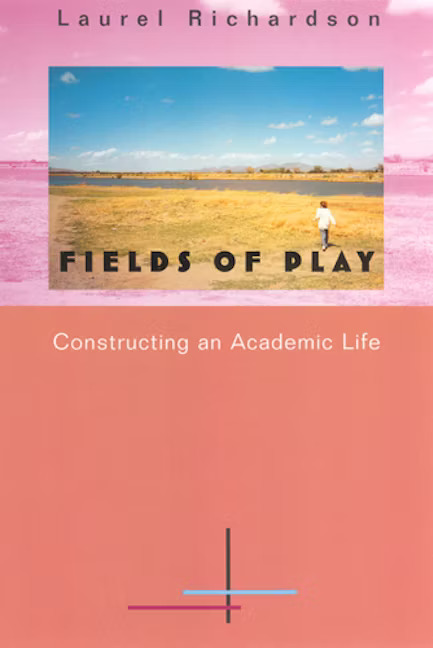
The difference between then and now is that back in the mid-2000s, the literature on writing creatively in academia was very limited. Laurel Richardson’s seminal Fields of Play was available, but it was on its own at that time; there was no body of literature from which to build a rationale for using creative techniques in academic writing. And of course that was exactly what I needed to do to reassure my supervisors about the merits of my intended approach.

But now there is such a body of literature! In this post I share four particularly useful books, all published in the last couple of years. Also, they are all well referenced, so you can use them to find other literature, if you wish. Then you can create a cogent, evidence-based argument for using creative techniques in writing your doctoral dissertation or thesis.

I also want to recommend Fields of Play. Although it was written late in the last century, it is still highly relevant today. Laurel Richardson dismantles the rationale for the norms of conventional academic writing such as passive voice and authorial authority. Then she creates a new rationale for using fiction techniques, poetry, drama and other creative approaches in academic writing. And she practises what she preaches within the text, to excellent effect.

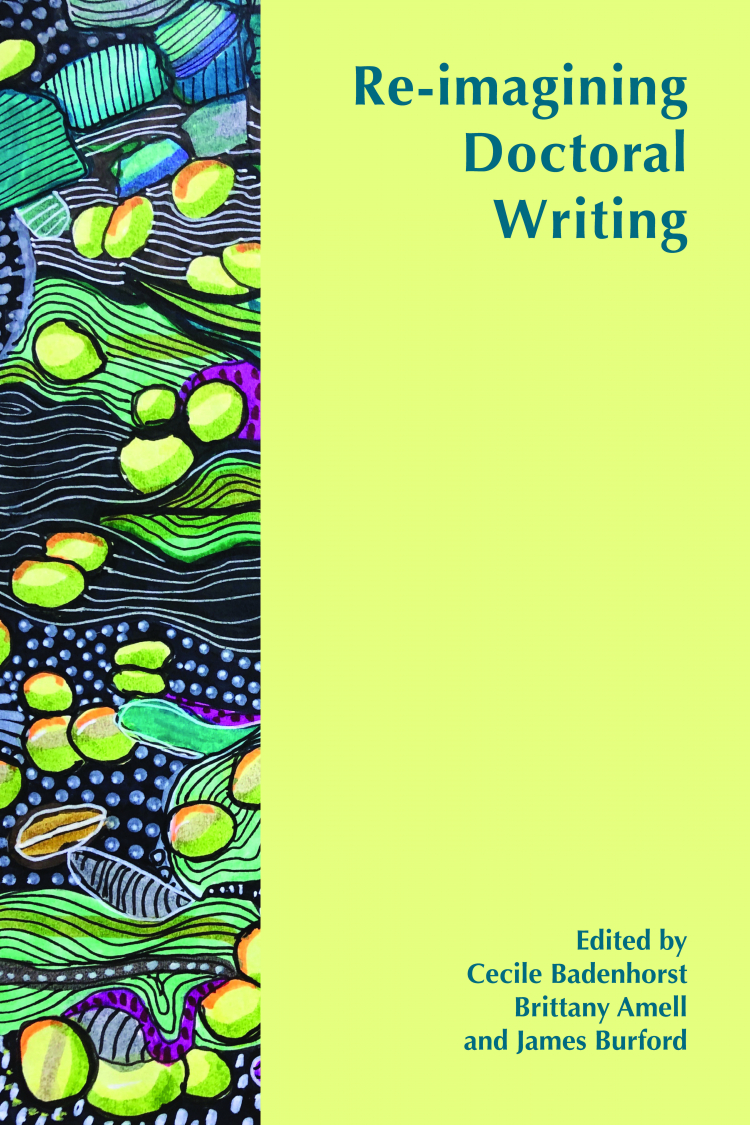
Reimagining Doctoral Writing (University of Colorado Press, April 2022) is edited by Cecile Badenhorst, Brittany Amell and James Burford. This edited collection is all about doctoral writing. Authors come from around the world, and they investigate doctoral writing from a range of perspectives and in a range of contexts. They also consider some potential futures of doctoral writing. This book is available as an open access ebook through the WAC Clearing House.

Doing Rebellious Research: In and Beyond the Academy (Brill, May 2022) is edited by Pam Burnard, Elizabeth Mackinlay, David Rousell and Tatjana Dragovic. This edited collection has four parts. The second part is called ‘Rebellious Writings Written Differently: A Manifesto’. It contains seven chapters and a set of reflective questions, and overall is designed to encourage and inspire a radical approach to academic communication.

Refining Your Academic Writing (Routledge, December 2022) is by Pat Thomson. This short book treats revision as not a boring mechanical process but a creative, imaginative craft. It is part of the Insider Guides to Success in Academia series which, in the interests of full disclosure, I should point out is co-edited by Pat and me. But I am recommending this book here, not simply because it’s in our series, but because it is as useful and radical as the others in this post.

Creative Writing for Social Research (Policy Press, January 2021) is by Richard Phillips and me, with 14 tremendous contributors who put the principles set out in the book into practice. We have received excellent feedback on this book, such as: ‘The text is well written and engaging… I would recommend this book to all qualitative researchers.’ Thank you Ruthi Margulis for your heartwarming review in Research Matters (Dec 2021, p 13), the quarterly magazine for researchers published by the Social Research Association.

These books are in general a pleasure to read. They are well written and full of ideas, encouragement, and inspiration. And it’s not only the books – if you want more personalised support with your thesis writing, you can always come on one of my writing retreats (if there are still places available). Whatever resources you draw on, I wish you joy of your doctoral writing.

This blog and the videos on my YouTube channel are funded by my beloved Patrons. Patrons receive exclusive content and various rewards, depending on their level of support, such as access to my special private Patreon-only blog posts, bi-monthly Q&A sessions on Zoom, free e-book downloads and signed copies of my books. Patrons can also suggest topics for my blogs and videos. If you want to support me by becoming a Patron click here. Whilst ongoing support would be fantastic you can make a one-time donation instead, through the PayPal button on this blog, if that works better for you. If you are not able to support me financially, please consider reviewing any of my books you have read – even a single-line review on Amazon or Goodreads is a huge help – or sharing a link to my work on social media. Thank you!

Writing Retreats And Courses

I ran my first academic writing retreat in 2015, over a weekend, for doctoral students at Staffordshire University. It was very enjoyable for me and, judging by the feedback, for the students too. Since then I have led many retreats and courses, mostly for doctoral students and/or university staff at institutions around the world. My standpoint is that all writing is creative, writing is a research method, and writing can be fun.

This month I ran an academic writing retreat over three days for Cumbria University in a delightful rural venue; a welcome change from the gritty urban spaces I usually go to for such gigs. This one had a transdisciplinary flavour with people from health and criminology, fashion and social care, media and education, and no doubt other departments I have forgotten. I never mind working with people from a single discipline, school, or faculty, but I do find that transdisciplinary groups have richer discussions. And the feedback I got was very positive.

I also get rich transdisciplinary discussions and good feedback when I run my four-day creative academic writing course for the Methods@Manchester summer school, which this year is from 3–7 July online. The people who come on the course are always from a wide variety of disciplines and professions, and every year it is exciting to find out who I will be working with. (There are still some tickets available if you’re interested.)

And I run creative thesis writing courses for various universities, doctoral training partnerships, and other clients such as Guild HE. In fact I am running a creative thesis writing course next week for Liverpool John Moore’s University.

I love these parts of my work. I really enjoy demystifying the writing process, seeing the light-bulb moments people have, and witnessing their satisfaction in the progress they make. So I have taken the big step of booking other delightful rural venues for three independent residential retreats in 2023–24, one of which will be co-facilitated. In brief:

16–19 October 2023: creative thesis writing for doctoral students, at Northern College near Barnsley.

4–8 December 2023: creative research writing, at Gladstone’s Library near Chester, with Dr Lucy Pickering.

20–23 May 2024: creative research writing for publication, at Northern College near Barnsley.

My retreats are supportive, with some taught sessions, plenty of breaks, lots of time to write, and optional one-to-one chats with me. Costs are inclusive of accommodation and catering. The venues are delightful. More information here and if you have any questions, please ask in the comments or email enquiries@creativeresearchemethods.com.

This blog and the videos on my YouTube channel are funded by my beloved Patrons. Patrons receive exclusive content and various rewards, depending on their level of support, such as access to my special private Patreon-only blog posts, bi-monthly Q&A sessions on Zoom, free e-book downloads and signed copies of my books. Patrons can also suggest topics for my blogs and videos. If you want to support me by becoming a Patron click here. Whilst ongoing support would be fantastic you can make a one-time donation instead, through the PayPal button on this blog, if that works better for you. If you are not able to support me financially, please consider reviewing any of my books you have read – even a single-line review on Amazon or Goodreads is a huge help – or sharing a link to my work on social media. Thank you!

PhD Guides – Second Editions

Back in 2015–16 I published a set of short affordable e-books for doctoral students – or, in the case of the first book, would-be doctoral students. Starting Your PhD: What You Need To Know was free on all platforms, because I wanted it to be easily accessible for people thinking about maybe doing a PhD or a professional doctorate such as an EdD or DBA. The other five were each around the price of a coffee in the UK, which seemed a reasonably affordable price.

Over the last year I have revised these e-books thoroughly and the second editions are now available. The first e-book is still free on all platforms except Amazon, because now the minimum price for a Kindle e-book appears to be 77 pence in the UK (and presumably equivalent amounts elsewhere). If you only have a Kindle, I recommend getting the e-book from Payhip where you can get a free epub.

I have updated all the text, references and resources in each of the books. Also, this time around I used a formatting service. I would have liked to do that last time but I couldn’t afford it – I paid for editing and cover design, and that was all I could manage. This time I used the same covers with a ‘second edition’ banner added, and my support worker did the editing for me. So I was delighted to be able to work with Leigh Forbes of Blot Publishing, a hugely experienced formatter of e-books and paper books. Her advice was consistently helpful and her professional approach made working with her a pleasure.

To celebrate the launch of these second editions, I am offering them to readers of this blog post at half price until 9 May 2023. This is also through Payhip where if you use this code at the checkout – RLCFPO6XU9 – you should receive 50% off any of the e-books. Or you can buy all six in a bundle, which is priced at £15.00 on Payhip, cheaper than Amazon UK where the whole series is currently £18.22. The 50% off code will work for the bundle too. Please feel free to share the code with others in your networks, though do also tell them about its expiry date.

In case it’s of interest, I am not doing this as a money-making exercise. The first editions never even covered their costs, let alone making any profit to pay for the time I spent in writing and publishing them. I charge for five of the e-books because (a) I am an eternal optimist and they might cover their costs this time and (b) I know that, bizarrely, people value things more if they cost money than if they are free.

I got ‘paid’ in good reviews which were heartening and encouraging to read. However, a downside of producing second editions is that all the first edition reviews have disappeared. I hope some people will write new ones soon, to help potential purchasers. Maybe even you!

This blog and the videos on my YouTube channel are funded by my beloved Patrons. Patrons receive exclusive content and various rewards, depending on their level of support, such as access to my special private Patreon-only blog posts, bi-monthly Q&A sessions on Zoom, free e-book downloads and signed copies of my books. Patrons can also suggest topics for my blogs and videos. If you want to support me by becoming a Patron click here. Whilst ongoing support would be fantastic you can make a one-time donation instead, through the PayPal button on this blog, if that works better for you. If you are not able to support me financially, please consider reviewing any of my books you have read – even a single-line review on Amazon or Goodreads is a huge help – or sharing a link to my work on social media. Thank you!

How To Edit Your Writing

When I teach creative academic writing, students sometimes ask: ‘How should I edit my writing?’ It’s a good question. There are lots of books and courses to teach you how to write; far fewer to teach you how to edit, which is a key part of the writing process.

Editing is really quite straightforward. The first step is to make a list of the editing tasks that need to be done. This list will be different every time, and for different writers, and for different pieces of work. It will also be different if you are editing your own first draft into a second draft, or if you are editing in response to reviewers’ comments.

In producing different drafts, it may help to consider that in the first draft you are telling the story for yourself, to figure it out and get it clear in your own mind. Then in the second draft you are re-telling it for other people, to help them understand the story you have to tell. When you have a complete first draft (and have celebrated your achievement and taken a break from your writing), you can read it through and make your list of editing tasks based on what you find that needs attention. My list for a journal article might look something like this:

  1. Pull out sub-headings to check that structure is OK – revise if necessary
  2. Make sure tenses are used consistently
  3. Find over-long sentences and split them up into shorter ones
  4. Check that conclusion is effective
  5. Make sure all literature cited is in reference list
  6. Make sure everything in reference list is cited

Your list might need to include different tasks. Mine doesn’t say anything about spelling because the Spelling Gods blessed me with champion spelling abilities. But it does mention consistent use of tenses and over-long sentences, because I know that in first drafts I don’t always use tenses consistently and sometimes I forget to use punctuation where I should. As an experienced writer, I can often write my editing to-do list without re-reading my work (or maybe just re-reading a bit of it), because I know my failings and what I need to do at the second draft stage.

You may also notice that the list above doesn’t include polishing tasks such as reading carefully line by line to check for errors. This is because those are end-stage tasks, for the third draft, but editing is a middle-stage task, for the second draft. The distinctions are not hard-and-fast – some people would leave tasks 5 and 6 above for the third draft, and that would be fine – but the general point is sound.

If you are working with reviewers’ feedback on a journal article, your list may include things like:

  1. Revise abstract for clarity
  2. Include work of X in literature review
  3. Expand methodology section
  4. Delete all references to Y as it is beyond the scope of the article
  5. Take a more critical analytic approach to findings – don’t just describe
  6. Ensure article is as culturally sensitive as possible

When you have your list, the second step is to do each task in turn. Don’t try to do them all at once as you work through your draft because you will inevitably miss things. It can become tedious to keep on going through the draft again and again, so take plenty of breaks, or aim for a certain amount each day. This is particularly important if you are working on a long piece of writing such as a dissertation, thesis or book.

As you work on your text, you may notice another task that is needed, in which case go right ahead and add it to your list.

And that’s it! Simple, yes?

This blog and the videos on my YouTube channel are funded by my beloved Patrons. Patrons receive exclusive content and various rewards, depending on their level of support, such as access to my special private Patreon-only blog posts, bi-monthly Q&A sessions on Zoom, free e-book downloads and signed copies of my books. Patrons can also suggest topics for my blogs and videos. If you want to support me by becoming a Patron click here. Whilst ongoing support would be fantastic you can make a one-time donation instead, through the PayPal button on this blog, if that works better for you. If you are not able to support me financially, please consider reviewing any of my books you have read – even a single-line review on Amazon or Goodreads is a huge help – or sharing a link to my work on social media. Thank you!

How Much This Academic Writer Earns

I have been writing for Policy Press since 2011. I am contractually forbidden to tell you the level of royalties they pay me, but I can tell you it is higher than any of the other publishers I work for. However, there is nothing to stop me telling you how much money I make from the writing I do for them. I just received my most recent royalty statement, which is my tenth. 

Before we get to the actual figures, you need a sense of the scale of the work I have done for them. I have written three full-length sole-authored books. Two are now in their second editions, and the third edition of the first one will be out early next year. I have co-written two full-length books and co-edited three e-books and a full-length book. I have also created four short digital books, adapted from chapters in my first full-length book. Even over 11 years, that is a lot of work. And my books sell well.

However, you also need to know that, as yet, none of these books have been translated into other languages. Translations are great for writers because they are effectively free money. This means they are good for publishers, too, and I know Policy Press has tried to get translation deals for me. Maybe one day they will succeed. But in the meantime, all the money I have earned to date has been from the original English-language editions.

I began writing in early 2011, my first book was published in September 2012, and I received my first royalties in October 2013. Royalties are calculated on sales from August to July. Here are the amounts, by year:

  • 2012-13 – £128.39
  • 2013-14 – £324.76
  • 2014-15 – £482.70
  • 2015-16 – £1,040.00
  • 2016-17 – £1,627.20
  • 2017-18 – £1,663.70
  • 2018-19 – £947.46
  • 2019-20 – £1,901.93
  • 2020-21 – £5,197.57
  • 2021-22 – £2,417.27

Total: £15,748.98

Average per year (11 years): £1,431.73

Assuming 42 writing days per year: overall, on average, £34.09 per day.

You can see the upward progression has not been smooth. Between 2017 and 2018 there was not much increase; between 2018 and 2019 there was a big reduction. 2021 was a bumper year, probably because the pandemic led to lots of e-book buying (and I had negotiated higher royalties on e-books with Policy Press), but 2022 was again a big reduction.

I negotiated a good royalty deal when Policy Press were a younger, more idealistic organisation, wanting to support independent researchers and others outside the academy. I don’t think any author would be able to negotiate such a good deal now, even a more experienced author, even if their books sold well.

It is fortunate that I love writing books. Also my Policy Press books increase my income in other ways. I get well-paid teaching and speaking work, particularly because of my creative research methods and creative academic writing books. And I was accepted to work as an ethics expert for the European Commission largely because of my research ethics book.

Also, I get a few hundred pounds every year from ALCS (the UK Authors’ Licensing and Collecting Society, which gathers income from mysterious sources such as educational photocopying). I get very little from PLR (Public Lending Rights, which gathers income from library loans) because they don’t include academic libraries. 

So it’s not just the royalties. But they do count. And their count is surprisingly small. Even if I add on my royalties from my other publishers (which are very much smaller) and from my self-published books (smaller still), I don’t get anywhere near the average income from book sales for an author in the UK. The latest survey, done in 2017 and published in 2018, found that the average was £10,500. I dream of my royalties hitting five figures, but I have a long way to go.

This blog and the videos on my YouTube channel are funded by my beloved Patrons. Patrons receive exclusive content and various rewards, depending on their level of support, such as access to my special private Patreon-only blog posts, bi-monthly Q&A sessions on Zoom, free e-book downloads and signed copies of my books. Patrons can also suggest topics for my blogs and videos. If you want to support me by becoming a Patron click here. Whilst ongoing support would be fantastic you can make a one-time donation instead, through the PayPal button on this blog, if that works better for you. If you are not able to support me financially, please consider reviewing any of my books you have read – even a single-line review on Amazon or Goodreads is a huge help – or sharing a link to my work on social media. Thank you!

Why Peer Reviewing Is More Difficult These Days

I have been a peer reviewer of journal articles for the last eight years. I documented my first peer review, in late 2014, on this blog. Peer reviewing has never seemed easy to me – and I don’t think it should. Reviewing original work by other scholars is bound to be intellectually and emotionally demanding. But I feel as if peer reviewing has become more difficult, even over the comparatively short time I have been involved. There are several reasons for this, and I will focus on three of them here: hoaxes, malpractice and complexity.

Academic hoaxes pre-date my reviewing experience. In 2005, three US-based doctoral students in computer science, Jeremy Stribling, Max Krohn and Dan Aguayo, created SCIgen. SCIgen is a computer program which can generate whole computer science journal articles including graphs, figures and citations, that look credible but are in fact nonsensical. A lot of articles generated by SCIgen have been accepted by, and published in, academic journals, despite the use of peer reviewers.

And such hoaxes are not limited to computer science. In 2017–18, three UK-based scholars, James Lindsay, Helen Pluckrose and Peter Boghossian, wrote 20 fake articles using social science jargon. They were able to get several of these articles published in academic journals, even though some of them promoted morally questionable acts. The aim of these three scholars was apparently to highlight what they saw as poor quality work in some areas of the social sciences. However, I am not sure this intended end justifies the questionable means of duping reviewers and editors into publishing bogus research.

Sadly, though, it seems that academic journals are regularly duped into publishing bogus research by researchers themselves. Retraction Watch, based in the US, has been keeping track of retracted journal articles for the last 12 years. Some articles are retracted because their authors made honest mistakes. But the Retraction Watch database lists a lot of other reasons for retraction, including falsification or fabrication of data, and falsification, fabrication or manipulation of images or results. And the numbers are staggering. At the time of writing, there are over 1,500 articles listed on the database as retracted due to the falsification and/or fabrication of data, and over 1,000 due to the manipulation of images. Also, the database only includes those articles in which fabrication, falsification or manipulation have been detected and reported. By its own admission, Retraction Watch is biased towards the life sciences, so problematic journal articles in other sectors will be even less visible.

A bunch of people make it their business to find and publicise these problematic articles. One even does it under her own name: Elisabeth Bik. Others use pseudonyms such as Clare Francis, Smut Clyde, Cheshire, and TigerBB8.

Bik specialises in identifying manipulated images, and has found through empirical research that their prevalence is increasing. However, Bik has a particular talent for pattern recognition. Of course it is useful to know that images may be manipulated, and Bik regularly shares examples on social media and elsewhere which can help others understand what to look for. But even so, spotting manipulated images can be difficult for the average, harassed, unpaid peer reviewer. And catching fabricated or falsified images, data or results may be almost impossible without inside information. Most journal articles have strict word limits which can work against them here. These restrictions mean researchers are used to some aspects of their processes receiving a cursory mention at best, and this can enable cheating to pass undetected.

When reviewing goes wrong, consequences can be disastrous. The link is to a recent controversy about a published article promoting a morally questionable act. I am not using any of its keywords in this article. I think there are some particularly interesting aspects of this case. It is not the first article to be published that features morally questionable acts. I have read the article; it is well written, and I can see how a peer reviewer could regard it as worthy of publication – as its own peer reviewers did. The problem, for me, lay in the background of the author who promotes morally questionable acts outside of academia. He may have written this article in the hope that publication would lend legitimacy to his actions. Even if he did not, publication might be perceived to confer such legitimacy, which could cause reputational damage to the publisher and the university concerned.

So, the article you are reviewing may be a hoax, and/or may contain data, images, and/or results that have been manipulated, fabricated or falsified, in ways that are difficult or impossible to detect, and/or may have been written by someone with a dodgy agenda. But that’s not all. Academic work – and, indeed, the world around us – is becoming more complex. More research is transdisciplinary, pushes methodological boundaries, is multi-lingual, and so on. The process of peer review was devised when people worked in neat, tidy, single disciplines and fields. In that landscape people could act as experts on other people’s work in its entirety. These days that is not so easy. Topics such as sustainability, the climate crisis, and food security transcend disciplines and methods. This means that nobody, really, is an expert any more, so peer review is effectively obsolete. Yet it is still being used.

This means we need not only peer review before publication, but also after publication. Luckily there is a tool for this: PubPeer, a website where you can comment on published journal articles, anonymously if you wish. This enables researchers with inside information to whistleblow without risking the loss of their jobs. Also, you can use PubPeer to check articles you are intending to cite, to make sure nobody has raised any concerns about the work you want to use. At the moment PubPeer focuses mostly on laboratory and clinical research, but there is also (not surprisingly) some computer science. In fact PubPeer can be used for any published journal article as long as the article has a recognisable ID such as a DOI. Also, there is a PubPeer browser plugin which enables PubPeer comments to be visible on other websites besides PubPeer itself.

This blog and the videos on my YouTube channel are funded by my beloved Patrons. Patrons receive exclusive content and various rewards, depending on their level of support, such as access to my special private Patreon-only blog posts, bi-monthly Q&A sessions on Zoom, free e-book downloads and signed copies of my books. Patrons can also suggest topics for my blogs and videos. If you want to support me by becoming a Patron click here. Whilst ongoing support would be fantastic you can make a one-time donation instead, through the PayPal button on this blog, if that works better for you. If you are not able to support me financially, please consider reviewing any of my books you have read – even a single-line review on Amazon or Goodreads is a huge help – or sharing a link to my work on social media. Thank you!

Resources for Creative Academic Writing

I am delighted to say that creative academic writing is gaining in popularity and acceptance, at least in some parts of the world. I have been teaching creative thesis writing and creative academic writing at universities around the world since 2015, and I know many postgraduate students and early career researchers are keen to learn and to apply their learning. I know they also, sometimes, meet resistance from their supervisors or managers. The best way to overcome this resistance is to formulate an academic argument based on academic resources. I am happy to say there are now a range of resources people can cite as they outline the rationale for writing creatively in academia.

The main reason for writing creatively is that it makes your writing more interesting and memorable for your readers. I’m sure most of us want other people to be interested in our work and remember the points we make. However, the thought of writing creatively can be daunting for those of us who have learned to report as factually as possible. The good news is we don’t have to use creativity at a macro level, such as by producing graphic novels, epic poems or full-length screenplays – though for those of us with the talent and dedication, macro creativity is certainly an option. But we can all use micro creativity: sensory language, imagery, metaphor and so on. And if we’re not sure how, these resources will help.

The first is a book edited by Pamela Burnard, Elizabeth Mackinlay, David Rousell and Tatjana Dragovic: Doing Rebellious Research In and Beyond the Academy, and in particular, Part 2, which focuses on ‘rebellious writings’. I am not highlighting this book because Pam has kindly agreed to give the first keynote at the International Conference on Creative Research Methods next year. I am highlighting it because it is a wonderful, transgressive, boundary-bulldozing book. It was published in 2022 and uses colour and theory, poems and images, concepts and diagrams, prose and music, and a bunch of other devices to get its points across. This book is a real tour de force and I cannot recommend it highly enough.

The next book is edited by Cecile Badenhorst, Brittany Amell and James Burford: Re-imagining Doctoral Writing. This one was published in 2021 and is also available as an open access ebook. While it is evidently aimed at doctoral students, I think it could be useful to any academic writer wanting to work more creatively. I found it interesting, informative and thought-provoking, and I have been doing academic writing at postgraduate level and beyond since 1999.

ertthyrthtyaldkfja;ldjfg

lasjdf alsdkjf h

In 2022 a book was published focusing on creative academic writing in a single discipline. When that happens, you know an approach is taking hold. Edited by Francesca Cavallerio, it is Creative Nonfiction in Sport and Exercise Research. There is no paperback at present, only a very expensive hardback or a quite expensive ebook, so it is best to use if you have access to an academic library. Again, I think it would be helpful for people in any discipline wanting to write more creatively.

ertsfdgsdfgdgfthyrthtyh

ertsertr

So far, these are all edited collections. In 2021 a book was published written by Richard Phillips and, er, me, called Creative Writing for Social Research: A Practical Guide. We included 14 creative contributions from 17 researcher-writers to show how this can work in practice. I’m pleased to say we’ve had excellent feedback on the book so far. It even generated an online book club in the year of its publication.

ertthyrthtyal dkfja;ldjfg

lasjdf alsdkjf h

There are a couple of potentially useful open access journals, too, each founded in 2020. Both are aimed at the humanities, but again people working in other sectors may well find articles that are of use to them. One is from the Rochester Institute of Technology in the US, and it is the Journal of Creative Writing Studies. The other is from the UK National Association of Writers in Education (aka NAWE), and it is the Journal of Creative Writing Research.

I am quite sure this is not an exhaustive list, though I hope it will be a useful one. If you have other resources to add, please share them in the comments.

This blog and the videos on my YouTube channel are funded by my beloved Patrons. Patrons receive exclusive content and various rewards, depending on their level of support, such as access to my special private Patreon-only blog posts, bi-monthly Q&A sessions on Zoom, free e-book downloads and signed copies of my books. Patrons can also suggest topics for my blogs and videos. If you want to support me by becoming a Patron click here. Whilst ongoing support would be fantastic you can make a one-time donation instead, through the PayPal button on this blog, if that works better for you. If you are not able to support me financially, please consider reviewing any of my books you have read – even a single-line review on Amazon or Goodreads is a huge help – or sharing a link to my work on social media. Thank you!

How To Find A Collaborator

The question to ask first is, when might you want to find a collaborator? Some work needs to be done alone, such as most doctoral research. Some work is sometimes best done alone, such as writing an opinion piece for a high-profile blog. But some work definitely needs to be done in collaboration. Most research benefits from collaboration. When I am commissioned to do a piece of research alone or with one other colleague, I always recommend that the commissioner set up a small group of relevant people to advise and steer the research project. And writing often benefits from collaboration too. In fact academic writing is always more or less collaborative: even if only one person is named as the author, the work will have been influenced by other scholars, colleagues, reviewers, editors – the list is long. And if more than one author is named, the work is likely to have benefited from the sustained engagement of more than one person.

Some work really needs collaborators. Three colleagues and I wrote Creative Research Methods in Education, and it was a better book, as a result, than it would have been if any three or two of us had worked on the project. I often receive requests to collaborate with others on research, or writing or both. Sometimes they are from friends or colleagues, and I always consider those carefully. Narelle Lemon from Swinburne University in Melbourne, Australia, suggested we work together on the education book when we first met in person. Sometimes requests to collaborate come from people I don’t know. The reception those ones get will vary depending on what the person is proposing and how they put that across. If the email is from a free email provider such as gmail, with lots of spelling mistakes, asking me to collaborate on research to help prove that hemlock cures cancer – and to contribute to the funding of that research – I will reach swiftly for the delete button. Conversely, if the email is from an organisational address, well written, and asking me to collaborate on work that is within one of my areas of expertise, I will respond – and if the enquirer mentions that they have a budget, I am likely to respond positively.

The best collaboration request I have had from a stranger came from Richard Phillips of Sheffield University. His initial message, in July 2018, simply said: “Dear Helen, I would like to explore the possibility of involving you in a workshop on creative writing and social research, and have a budget for this. It would be great to hear from you and discuss. Thanks, Richard.” Short, to the point, and very interesting indeed. I emailed straight back, and in his reply he told me he liked my book on creative research methods. Better and better! We spoke a couple of days later, met a couple of weeks after that, ran the workshop in November 2018, and our book on Creative Writing for Social Research was published in January 2021.

If you want to find a collaborator, the most important thing is to do your homework. If you want someone to co-write a journal article about the role of manicures in ex-convict rehabilitation, you need to find someone who shares that niche interest. And when you do find someone who seems suitable, make sure your potential collaborator likes to write; not everyone does. There should be no need to introduce yourself, because the person you are contacting should be able to find information about you online; if they can’t, they are much less likely to agree to collaborate with you.

Overall, people are more likely to agree to collaborate if you are their peer or above, the work you are proposing is within their areas of interest, and you have a budget. If you have nothing but passion for a project, it is still worth asking suitable people if they are willing to collaborate, but be prepared for rejection. Also, please be aware that offering to collaborate for free could put you at risk of being exploited. However much you care about an issue, it is equally important to take care of yourself.

This blog, the monthly #CRMethodsChat on Twitter, and the videos on my YouTube channel, are funded by my beloved Patrons. Patrons receive exclusive content and various rewards, depending on their level of support, such as access to my special private Patreon-only blog posts, bi-monthly Q&A sessions on Zoom, free e-book downloads and signed copies of my books. Patrons can also suggest topics for my blogs and videos. If you want to support me by becoming a Patron click here. Whilst ongoing support would be fantastic you can make a one-time donation instead, through the PayPal button on this blog, if that works better for you. If you are not able to support me financially, please consider reviewing any of my books you have read – even a single-line review on Amazon or Goodreads is a huge help – or sharing a link to my work on social media. Thank you!