Writer’s Block Debunked

writers blockI don’t believe in writer’s block. I think it’s an umbrella term for a whole bunch of problems, each of which has a solution. For sure, writing is difficult, and it is perfectly possible to get stuck. That happens to me all the time. But a complete block? I don’t think so. Seems to me ‘writer’s block’ is a lazy catch-all term which conveniently shifts responsibility from the writer to the ‘block’. That’s certainly not going to help.

Here are six of the things I think may be really going on.

Fear of failure. Writing for submission or publication can be terrifying. You’re working towards putting your work out in the world where it – and to some extent you – will be judged. What if people don’t like your writing? What if they don’t like YOU? This kind of fear can be paralysing.

Fear of success. Success equals change, and change is frightening, because it’s a leap into the unknown. This can be equally paralysing.

Boredom. This is a higher risk for long-term projects, or writing that has been imposed on you – say, by your manager, or a departmental imperative – that you don’t want to do.

Perfectionism. Novice writers sometimes think that writing is (or should be, or is for some people) as easy as reading. It isn’t. To write, you have to be willing to write badly first, and then make it good at the editing stage, sometimes through many revisions.

Running out of steam with a particular avenue or genre. Minette Walters is a successful author of psychological thrillers who published 12 books between 1992 and 2007, then didn’t publish another book for 10 years. She had become bored with writing psychological thrillers, but her publisher wanted her to carry on, presumably because they sold well. Now she has found a new publisher and is bringing out a historical novel. This can apply for non-fiction and scholarly writers, too, particularly if you’ve been writing in a specific area for some time and long to change tack.

Self-sabotage. If you say, think, believe that you want to write, but you’re not writing, then you are in some way sabotaging your own desires. This is a common human trait and probably links back to fear of failure, or perhaps fear of success.

Here are five potential solutions.

Freewrite. I love the technique of freewriting, and so do the doctoral students I teach it to. Here’s what you do. Set yourself a prompt, which must be in the first person and active voice, such as:

What I want to say is…

In this chapter, I want to argue…

I am writing this [thesis/dissertation/article/report/etc] because…

Then write for five minutes without stopping or correcting your work. This is only for your eyes so it doesn’t matter how scrawly or mis-spelled it may be. If you hesitate during the five minutes, write the prompt again, more than once if you need to, until it leads you somewhere else. Then see what you’ve got. You may well have a new insight or a phrase or sentence that you can use in your project. More importantly, though, you’ll have a load of words on a page, which – in five minutes flat – gives the lie to ‘writer’s block’.

Set small targets. Some people prefer word targets; others prefer time targets. Either is fine. Choose a target that feels easily achievable: perhaps somewhere between 100-500 words, or 10-30 minutes. Then set a frequency: once a day is good to begin with, or twice if you can manage that. And stick to it.

Switch projects. Working on more than one project is great because if you get bored, or stuck, you can move to another. I didn’t have a single idea for a blog post this morning, so I worked on a short story for a while till I came up with the idea of writing about writer’s block.

Keep a daily journal. Writing about your life, or some aspect of your life, for your eyes only, is a great way to convince your subconscious that you can write. This can be structured, or unstructured, as you prefer. For example, you might want to keep a journal of your dreams, or a ‘resilience journal’ where you write down three things you are grateful for and three things you did well each day, or a ‘reflective journal’ where you record what you have learned that day. Or you might just want to write whatever you feel like writing.

Go for counselling. If fear of failure, or fear of success, are really getting in the way – and, for some people, they can – then find a counsellor or therapist who can help you work on this.

If you have other solutions to share, please add them in the comment box.

How Independent is an Indie Researcher?

independent womanI have always loved being independent. My parents like to tell the story of the time when, soon after I learned to walk, they took me for a picnic in a local park. My father put me down on the grass, and I got to my feet and toddled away. My mother looked anxious, and my father said, reassuringly, ‘She won’t go far.’ But his confidence was misplaced, because I headed determinedly off into the wide green yonder, and he had to do a quick sprint to bring me back before I came to grief.

When I began researching, I called myself a freelance researcher, or a consultant researcher. I didn’t start calling myself an independent researcher until Immy Holloway told me I should, at a terrific research methods conference in Bournemouth in 2006. (The same conference where I met the incomparable Ken and Mary Gergen, as a result of which they kindly wrote the foreword for my creative research methods book.) As soon as Immy suggested the phrase, I took to it immediately. It seemed to suit.

I love working independently. Particularly at the moment, when I’m mostly home-office-based and writing – though after a few weeks I’ll be pleased to have the meetings and teaching that are scheduled then. But for now, I’m really happy sitting alone at my desk, looking out at the garden growing into spring, listening to the birdsong and the squeals of next door’s children on their trampoline, and writing this blog post.

You know, though, I’ve been thinking recently that despite being officially an independent researcher, I’m actually very dependent. For example, I am completely dependent on others for my income. If nobody chooses me, or not enough people choose me, to do available work, I will go under – particularly as there is so little research funding for which indies can apply. Also, I often need to ask for favours, from small (please can I put your name down as a referee for this research tender?) to large (please will you write a foreword for my book?). As an independent writer, I am dependent on readers for reviews, whether official written ones on websites or in journals, or unofficial verbal ones – the coveted ‘word of mouth’ (at least, it’s coveted if the words are complimentary). More worryingly, I am also dependent on readers to help get my books translated into other languages. My publisher tells me that this usually happens when a bilingual academic makes a proposal to a non-English publisher and offers to support the translation. I am only fluent in English, and although I have good international networks, they’re mostly in English-speaking countries. Unlike institution-based scholars, I have never been able to afford to go to a conference outside the UK where I might make contacts with bilingual academics who could help with translations, perhaps in return for other favours. As a result, I know very few people who I can ask to help with translations. (If you know anyone in the social sciences, arts, or humanities who might help, do tell me please!)

I remember when my supervisor and I were planning my viva. I knew who I wanted for my external examiner, but my supervisor over-ruled me, because she didn’t know the person I wanted, and she did know someone else who she thought would be good (and was). She said she was sure he would do it because he owed her a favour. I have learned since then that a lot of academia seems to work through giving and calling in favours. In such an environment it feels odd to call myself ‘independent’.

The book I’m writing is on research ethics. In the Indigenous research paradigm, reciprocity between researchers and participants is a key ethical principle. However, in the Euro-Western paradigm, researchers have found that attempting such reciprocity where there is an imbalance of power is difficult and can even have dangerous consequences (Israel 2015:137-8). I can’t find much work on reciprocity between academics, and what I can find addresses reciprocity between countries or disciplines and doesn’t say much about power imbalances. I haven’t found anything about reciprocity across the walls of the academy, where there is undoubtedly a power imbalance. I’m glad to say that, in my own experience at least, academics have mostly been courteous and often generous with their help and support for my work, even though, as an indie, I can’t reciprocate in all the same ways that I could if I was based in an institution. This potentially makes me even more dependent, because I have less to offer than salaried mid-career academics. As I progress in my work, will this power imbalance grow? Will it adversely affect the reciprocity on which my entire career depends? Or am I needlessly worrying about something because it feels insecure, when in fact it doesn’t really matter?

Mixed-Methods Data Analysis

concentric circles slide 2Following my post last month about using concentric circles for gathering research data, I had a question from a reader. Nieky van Veggel asked me, “How would I analyse the outcomes of this method?” This is a good question and, like many good questions, it has more than one answer.

First, you can do quantitative analysis: counting and measuring. If you have the participant at the centre, you can count the number of people, agencies, or whatever it is that they have drawn or placed around the concentric circles. Then in either system you can measure the distance, or distances, between the fixed central point and the drawn or placed point(s) chosen by the participant. Once you have the raw numerical data from your counting and/or measurement, you can use statistical calculations as appropriate to your sample size and sampling technique.

Second, you can do qualitative analysis. You can look at the types of relationships depicted and sort those into categories and themes. You can cross-tabulate relationships with other participant attributes, e.g. age or gender. You can also cross-tabulate with any other data you have collected to see if there is a relationship.

Third, you can do both. Then you can synthesize your qualitative and quantitative analyses – or, at least, you can try. There are too many ways of synthesizing data to give full details in a blog post, but you can find more information, references, and examples on pages 106-109 of my book on creative research methods. This post is designed to give you an overview of the subject.

Data synthesis, or data integration as it is also known, can be useful in a number of ways. For example, it can be used to triangulate your data, or to enrich your analysis, and it can yield results which could not be obtained through the analysis of any single dataset. The findings of each single dataset will help to answer your research questions up to a point, but bringing those findings together may give a fuller explanatory narrative. However, integrating findings from different datasets can be one of the most challenging aspects of mixed-methods data analysis. Therefore, it makes sense to have a rationale for doing this, rather than trying to do it for its own sake.

Broadly, when you try to integrate your data, one of three things can happen:

  1. The findings from the different datasets agree. Sadly this is not as common as you might think.
  2. The findings from the different datasets agree in some respects but not in others. This is probably the most common outcome, and requires hard thinking and more analysis to try to resolve the disagreements as far as possible, with further research required where resolution cannot be reached.
  3. The findings from the different datasets do not agree at all. This almost certainly indicates a need for further research – which is not always a palatable message for research managers, commissioners, or funders.

When you write up your data integration process and findings, you need to show how each element relates to the others. The danger with this is it can make your article or report rather ‘methods-heavy’, so be concise where you can.

Australian researchers Reesa Sorin, Tamara Brooks and Ute Haring did some research into children’s understandings of their physical environment. In the process, they developed an analytical procedure using three different methods to analyse a dataset made up of children’s artworks and stories. They began with a quantitative technique: content analysis. This involved identifying the main features of children’s drawings and putting them into categories such as animals, houses and trees. Then they counted the number and frequency of items in each category, reasoning that the more frequently something appeared, the more meaningful it was to children. The other two methods were qualitative. One was interpretive analysis, in which they identified more categories, this time based on the presentation of each drawing, its mood, and the messages in the story the child had told about their drawing. The other qualitative method was developmental analysis, which suggests that stages in the development of children’s artworks can be correlated with their ages. So the content analysis outlined the features of the drawings, the interpretive analysis added depth by showing multiple meanings, and the developmental analysis added ages and stages. The researchers concluded that this combination of analytic methods can ‘provide deep insights into young children’s understandings’ (Sorin, Brooks and Haring 2012: 29).

Data analysis is at the core of our interpretive work as researchers, yet it is rarely discussed and often misunderstood. You can’t learn how to analyse data from a blog post, but it may help you to figure out what some of your current questions are. And I hope, Nieky van Veggel, that this post will provide a step on the way to ticking off another item on your impossible list. Good luck!

Social Media: Is It Just A Numbers Game?

jumbled numbersGoodness me, such a busy week, I almost forgot to blog. This time of year is often very pressured for independents and non-academics with 31 March being a crucial end-of-financial-year deadline by which many projects must be finished and invoices paid. So much so that I haven’t been around on social media anywhere near as much as usual.

Nevertheless, in the last couple of weeks, I have passed the 3,000 follower mark on Twitter, hit 200 followers on Instagram, and reached the magic 500+ on LinkedIn. Ding!

I’ve been on Twitter since 2009 and Instagram since 2014, so these figures aren’t particularly impressive. Publishers, for example, don’t start taking notice till you reach 10,000 followers on Twitter and Instagram. Part of the reason is I’ve never tried to attract followers, other than by being around and talking to people, and following those I feel a connection with. Others take very different approaches. I know a fiction writer on Instagram, someone I’ve met IRL a couple of times, who reached 10,000 followers in less than a year and is now coaching other writers on how to attract followers like honeysuckle attracts bees. She wrote a blog post with a few pointers, such as: choose, and stick to, a colour palette, so that when someone looks at your Instagram profile and sees your last nine photos, they give a coherent message. There were other tips, like how to schedule posts for maximum impact, all of which seemed entirely feasible to implement.

So, I thought, I could do that.

I’d probably sell more books that way.

But.

I can’t do that.

I simply can’t bring myself to be so contrived. It’s not me at all. The thought of choosing a colour palette, and scheduling my posts for maximum impact, makes me feel queasy.

One of the things I love about social media is the randomness. Yesterday I mislaid my landline handset, wailed on Twitter, and a woman from Brisbane told me how to find it. On Instagram I seek out interesting academics and I talk to a Romanian woman studying for a PhD in Japan, a Dutch academic in America, an Australian academic in America, and so on. The glimpses of their lives are fascinating to me; I hope mine are to them.

I should take the ‘colour palette’ approach; it’s sensible marketing. I should create and nurture a brand for myself. To an extent, this blog has a colour palette. The designer friend who made it for me asked what my favourite colours were; I told her; she liked and used those colours. But I don’t pick photos in those colours for my blog posts (though I did for this post, because I came across one on freeimages.com and it amused me), and I certainly can’t Instagram everything in purple, turquoise, and hot pink. It would be exhausting even to try.

I was musing about all this to a friend who is quite the social media expert.

“I just like, y’know, hanging out with people online,” I said. “I don’t want to do this ‘brand’ thing. I want the weird, the random, the serendipitous. I like making friends.”

“That,” he said, “that IS your brand.”

I guess he’s right. It’s not much of a brand, though, in marketing terms. It’s just me, bimbling around online like I do offline, forgetting things sometimes, doing my best. I could change; I could do this whole thing differently. Maybe, sometime in the future, I will. But, for now… I don’t want to put myself under the pressure of trying to present myself as something I’m not, something polished and shiny. It would be too much like having a proper job. So I shall carry on dropping in and out of social media as I please, chatting when I have something to say, and otherwise lurking or taking time out. That makes me happy. And while my approach may not sell as many books as the ‘colour palette’ system, it has made me some great friends and taken me all around the world. So, in my terms, it works just fine.

New Directions in Qualitative Research Ethics

TSRMcover 1..2I have co-edited a special issue of the International Journal of Social Research Methodology with my friend and colleague Dr Lucy Pickering from the University of Glasgow. It is online today – International Women’s Day, how timely! – and it’s called New Directions in Qualitative Research Ethics.

I am the ethics lead for the UK and Ireland Social Research Association, and Lucy is the ethics lead for the Association of Social Anthropologists of the UK and Commonwealth. Lucy and I both help our respective associations’ members with real-life ethical dilemmas (and trilemmas, and quadrilemmas). We have both found that the emphasis of the ethical review process on data gathering and participant well-being leaves researchers ill-equipped to cope with ethical difficulties at other stages of the research process. Overall, the ethics literature is similarly skewed, with most articles and chapters focusing on data gathering and participant well-being. Our aim was to produce a special issue that would help to shift this balance. We wrote one of the articles, on the ethics of presentation and representation, and of course the editorial. Other articles cover the teaching of research ethics, the ethics of recruitment and sampling, working ethically with participants who have profound intellectual disabilities, what to do when ethics committees’ stipulations prove irrelevant in the field, and some of the ethical issues raised by cross-cultural research. There is also a useful review essay of three recent books on research and social justice.

We are proud that our authors are truly international, hailing from New Zealand, Australia, Finland, America and Thailand as well as the UK. The journal is paywalled, but there are 50 free downloads of every article, so get in quick if you don’t have access.


Concentric Circles for Gathering Research Data

concentric-circlesMost people, when they think about gathering primary data for research, think of the ‘Big Three’ methods: questionnaire surveys, interviews, and focus groups. This is rather limiting when there are so many other methods that can help to answer research questions. One example is concentric circles. They are used quite frequently in market research, and have also been used in social research for several decades, yet I am frequently surprised to come across people who have no knowledge of this approach.

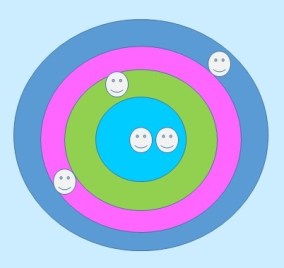
Concentric circles are generally used to investigate people’s relationships with other people, objects, or phenomena. There are two main ways to use concentric circles. One way is to put something at the centre – in market research, usually a product or brand – and ask the participant to make a cross, or drag-and-drop a digital image, to a point within the circles that they feel represents their closeness to that product or brand. So, for me, if the brand was Nestlé I’d put myself right on the outer edge, whereas with a product such as the Co-op’s fairly traded wine, I’d be close to the centre.

The other option is to put the participant at the centre, and ask them to use the concentric circles to map relationships such as the people or agencies who support them, with those they feel closest to placed nearest to the centre and vice versa. This can be done in evaluation research as part of a pre-post design to document changes. For example, if part of the point of a service is to act as a gateway or signpost to other relevant agencies, it might be useful to ask users of that service to map their relationship with other agencies at the first point of contact, and again after a suitable period of time. That would help to assess the impact of the service in increasing users’ links with other agencies.

The concept of this is easy for participants to grasp, perhaps because the circles provide a recognisable structure but are not prescriptive. They are appealing because they give the participant a lot of choice and flexibility in how they respond. This avoids difficulties that can be raised by a standard type of research question such as, ‘How supportive is your spouse or partner?’ Some participants would find a question like this difficult to answer, say if their spouse or partner was unsupportive, or abusive, or recently deceased. If such a participant met this question in a survey, interview, or focus group, at best they would provide no or inaccurate data, and they could suffer serious embarrassment or upset. However, with the concentric circles, a participant can choose which of the people in their lives they include in the discussion.

Perhaps because of their ease and sensitivity, concentric circles have been used effectively in research with children, the elderly, and people with learning disabilities, among other groups. They are rarely the only method used, but they add an interesting and useful dimension to an investigation. In fact, the potential applications of concentric circles are many and varied. For example, they could be used in:

  • Nutritional research to explore people’s relationships with different foodstuffs
  • Tourism research to investigate people’s relationships with different modes of travel
  • Sports research to assess people’s relationships with different types of exercise

And that’s just off the top of my head.

Completed concentric circles can provide powerful illustrations for research reports and presentations, although care should be taken to ensure that participants and others who may be mentioned cannot be identified as a result. One option here is for a researcher to recreate a participant’s concentric circles with different names and/or with changes to other identifying details.

I’ve just put in a proposal to a potential client including concentric circles. I hope they like the idea. Do you use concentric circles? Or do you think you might use them in the future?

Getting Creative with your Thesis or Dissertation #2

treasure-1357460__340I wrote the first post in this series last summer, not knowing then that there would be another. In that post I highlighted work by doctoral students who have presented their theses or dissertations in various creative ways such as graphic novels or a combination of video and text. I’m grateful to MzOpera for commenting on that post and pointing me to the work of Rebecca Zak from America, who created the first ever entirely web-based PhD dissertation, made up of YouTube videos and blog posts.

Rebecca Zak had a close predecessor in Saliha Bava, whose web-based dissertation was produced as long ago as 2001. She describes it, in her dissertation abstract, as ‘a montage of a postmodern inquiry… within the discourses of postmodern, dissertation, academia, experimental and cyberspace innovations among others.’ Sadly, a lot of the links in Bava’s online dissertation are no longer functioning, but there are still pdfs to download and read, and videos to view. I wanted to check whether Zak had referenced Bava, and thought of searching Zak’s blog, but the site where her blog lives, at http://www.davezak.com/questioneducation/, has been reported as an attack page and blocked by my anti-virus software. These demonstrate some of the downsides of web-based dissertations or theses: they are only publicly available, to those with internet access, for as long as the technology permits.

MzOpera, via Rebecca Zak, also led me to Spencer Harrison from Canada. He is an artist and gay rights activist who painted his PhD on the outside of a circus tent; it seems almost redundant to add that he was the first Canadian academic to do so. I also discovered the work of Daria Loi, who did her PhD in Melbourne, Australia, and presented her thesis as a suitcase containing written text and a variety of interactive artefacts.

Rebecca Zak makes the point that to present your thesis or dissertation in such a creative way, your university needs to have (or develop) an ‘alternative format’ policy. I’ve had a look at several of these and they are very varied. Some only allow for the inclusion of published or publishable written material, such as a book chapter or journal article. Others are much more flexible. For example, the University of Exeter, in the UK, has a particularly comprehensive policy which says:

  • Regardless of whether they are on a named programme, which has specific submission requirements, which may differ from the norm, students are permitted to make representations to submit a thesis/dissertation in an alternative format, requests to do so must normally be made at the application stage.
  • An alternative format may include either:
    a) the presentation of part or all of the thesis in an alternative format e.g. it may be a multimedia document (e.g. an element or the thesis in its entirety, which is presented in a format appropriate perhaps for presentation at a conference);
    b) A constructed text such as a piece of art, or a record of professional practice in the form of a series of case-studies, which must be accompanied by a commentary.
  • The formats listed here are not exclusive and candidates should first discuss the matter with their supervisor should they consider there to be potential to present their thesis/dissertation differently, who will be able to offer advice on the appropriateness of different formats within the context of that discipline, and with regard specifically to how they relate to the candidate’s research project.
  • Permission to do so may be given provided that by virtue of the subject:
    a) the intellectual quality of the thesis/dissertation would be enhanced;
    b) that a qualified supervisor and appropriate examiners can be appointed;
    c) the format is appropriate to the thesis/dissertation;
    d) that the format will allow the student to demonstrate their ability to meet the award criteria;
    e) or, that the alternative format is an appropriate specific arrangement to make to ensure the consistent equitable assessment of a student with disabilities.

The commentary referred to has to be 30-40,000 words long. This differs from the experience of Daria Loi, who had to write the same amount of words as for a conventional thesis to put into her suitcase with the other artefacts she prepared.

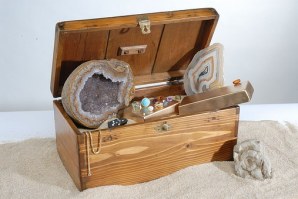
We’ll end with a supervisor’s view. This is recorded on p. 46 of Playing with Purpose: Adventures in Performative Social Science by American psychologists Kenneth and Mary Gergen. They describe ‘…one of the most audacious performance pieces we know: Zoë Fitzgerald Pool’s PhD dissertation (in 2008) from the University of Bournemouth. The dissertation arrived for Mary’s review in a wooden box inscribed with a brass nameplate. In the box were placed two books, each page illustrated in colorful graphics, describing the outcomes of interviews conducted during the research. Also included were DVDs with visual and auditory expositions of this material. As appreciative gifts to the reader, there were an assortment of treasures: music, a mermaid doll, a large doll representing a stuffy old-fashioned professor, chocolates, and hundreds of tiny scrolls, each with a quote from the interviewees written in elegant calligraphy. Included as well was a map to describe how to “read” the ensemble, which was secreted into various sections of the box. There was no single way to “read” the dissertation. It was a cornucopia of possible experiences, rich and exciting.’

So there are some positive voices in academia – but not yet enough. Getting creative with your thesis or dissertation may take even longer than the conventional method because, as Daria Loi points out, you may need time for making as well as writing. Yet these creative approaches offer new ways to articulate, communicate, and understand research. All universities need to get to grips with facilitating these kinds of creative approaches within doctoral research to allow some doctoral students to reach their full potential.

Open Access Research Methods Journals

oaThis post was inspired by a recent post on the Global Social Change Research Project site, which lists a lot of free resources for social research and evaluation. Having taken the Open Access Pledge, and given my specialism, I was particularly interested in OA journals on research and evaluation methods. So I have compiled all those I could find, through gsocialchange and elsewhere, that focus primarily on methods, are peer reviewed, and publish in English. (Some also publish in other languages, but I only speak and read English – a limitation – so, sadly, I am unable to include non-English journals.) Almost all are exclusively digital.

I was interested to find that many of these journals have quick publication timescales, sometimes only a few weeks from submission to publication. I was also very relieved to find that few ask for financial contributions from authors. When OA came in, I was broadly in favour – I do believe that research funded by public money should be publicly available – but I was worried that article processing charges (APCs) levied on authors would exclude many scholarly writers from publishing their work. I’m delighted to discover that this is not the case (at least, not in my field) and I’m grateful to all the universities and others that sponsor these journals. Also, where APCs are levied by these journals, they are only charged on acceptance for publication, not on submission, and waivers are sometimes available in exceptional circumstances.

As far as I can tell, only one of these journals, the African Evaluation Journal, is a member of the Committee on Publication Ethics. Some other journals have their own ethical statements, or follow a specified code of ethics from an institution or association. But most make no mention of ethics, which in the current climate seems a little lax at best.

So here they are, in alphabetical order, with brief details.

African Evaluation Journal

Funded and published by the African Evaluation Association (AfrEA); no APCs.

Publishes high quality peer-reviewed articles of merit on any subject related to evaluation, and provides targeted information of professional interest to members of AfrEA and its national associations and evaluators across the globe. Aims:

  • To build a high quality, useful body of evaluation knowledge for development.
  • To develop a culture of peer-reviewed publication in African evaluation.
  • To stimulate Africa-oriented knowledge networks and collaborative efforts.
  • To strengthen the African voice in evaluation.

Art/Research International

Sponsored by the University of Alberta. No APCs.

A transdisciplinary journal dedicated to exploring and advancing art as research, and/or within the research process, across disciplines and internationally. It offers a space for art/research practitioners: to draw on working examples to discuss challenges, best practices, ethical quandaries, and new directions  for the practice of bringing art and research together; to explore the methodological ambitions and theoretical or philosophical underpinnings and issues of art/research practices; and to provide insights and critiques of art/research projects of other art/research practitioners.

Critical Approaches to Discourse Analysis across Disciplines

Published by CADAAD, which seems to be run voluntarily by academics from various universities. No APCs.

Publishes articles which investigate, from a ‘critical’ perspective, contemporary discourse and genres in social, political, public and professional communication.  Especially interested in articles which highlight, develop and apply new theoretical and methodological frameworks for critical discourse research or which assess established methods and assumptions.

Electronic Journal of Business Research Methods

Published by Academic Publishing Limited. APC of £250 (inc. VAT) on acceptance for publication – no submission fee.

Publishes articles and provides perspectives on topics relevant to research in the field of business and management. Aims to contribute to the development of theory and practice.

Forum: Qualitative Social Research

Supported by the Institute for Qualitative Research and the Center for Digital Systems, Freie Universität Berlin. No APCs.

Interested in empirical studies conducted using qualitative methods, and in contributions that deal with the theory, methodology and application of qualitative research. Innovative ways of thinking, writing, researching and presenting are especially welcome. They favour contributions with an inter-disciplinary and/or multinational perspective which was already manifest at the conceptualization stage, for example through co-authorship.

International Journal of Qualitative Methods

Published by Sage on behalf of the International Institute of Qualitative Methodology

APCs of $1,000-$1,750 on acceptance for publication – this funds the journal. Part payment and waivers possible in exceptional circumstances.

Publishes articles that report methodological advances, innovations, and insights in qualitative or mixed-methods studies. Also publishes funded full studies using qualitative or mixed-methods.

Journal of Methods and Measurement in the Social Sciences

Funded by the University of Arizona Library – no APCs.

An online scholarly publication focusing on methodology and research design, measurement, and data analysis – providing a new venue for unique and interesting contributions in these study areas which frequently overlap.

Journal of Modern Applied Statistical Methods

Published in partnership by JMASM Inc and Wayne State University Library System. No APCs.

Designed to provide an outlet for the scholarly works of applied nonparametric or parametric statisticians, data analysts, researchers, classical or modern psychometricians, and quantitative or qualitative methodologists/evaluators.

Journal of MultiDisciplinary Evaluation

Published by Western Michigan University. No APCs.

Publishes work that contributes to the development of evaluation theory, methods, and practice.

Journal of Research Practice

Published by AU Press, Athabasca University. Funded by sponsorship. No APCs.

Aims to develop understanding of research as a type of practice, and to assist both research practitioners and research theorists to share their experiences with and ideas about research, so as to extend and enhance that practice in multiple domains.

methods, data, analyses

Published by Leibniz Institute for the Social Sciences. No APCs.

Publishes research on all questions important to quantitative methods, with a special emphasis on survey methodology. In spite of this focus they welcome contributions on other methodological aspects.

Practical Assessment, Research and Evaluation

Funded by sponsorship. No APCs. Despite being a professional researcher and skilled internet sleuth, I was unable to find out who publishes this journal.

Publishes scholarly syntheses of research and ideas about methodological issues and practices, designed to help members of the community keep up-to-date with effective methods, trends, and research developments from a variety of settings.

Qualitative Sociology Review

Published by Lodz University, Poland. No APCs.

Qualitative Sociology Review publishes empirical, theoretical and methodological articles applicable to all fields and specializations within sociology.

Social Research Practice

Funded and published by the UK and Ireland Social Research Association; no APCs.

They welcome articles from anyone working in social research or social policy, whether as a producer or a user of research. Aims: to encourage and promote high standards of social research for public benefit, and to encourage methodological development.

Survey Methods: Insights from the Field

Published jointly by the Swiss Centre of Expertise in the Social Sciences and Leibniz Institute for the Social Sciences. No APCs.

Aim: to promote professional exchange on practical survey research issues and discussion on new and promising paths in survey research. Focus is on practical aspects of the daily work of surveying, including questionnaire design, sampling, interviewer training, fieldwork administration, data preparation, documentation and dissemination.

Survey Practice

Published by the American Association for Public Opinion Research. No APCs.

 Aim: to emphasize useful and practical information designed to enhance survey quality by providing a forum to share advances in practical survey methods, current information on conditions affecting survey research, and interesting features about surveys and people who work in survey research.

Survey Research Methods

Published by the European Survey Research Association with the Communication, Information, Media Centre of the University of Konstanz.No APCs.

Topics of particular interest include survey design, sample design, question and questionnaire design, data collection, nonresponse, data capture, data processing, coding and editing, measurement errors, imputation, weighting and survey data analysis methods.

Turkish Online Journal of Qualitative Inquiry

Published by DergiPark. No APCs.

Publishes high quality and original research conducted with qualitative, mixed or action research methodology in educational sciences. Manuscripts required in both English and Turkish.

The Qualitative Report

Published by Nova Southeastern University. No APCs.

Methods may be qualitative, comparative, mixed, collaborative, action-oriented, appreciative, and/or critical in nature. Articles may be qualitative research studies, commentaries about the conduct of qualitative research, prescriptive pieces on carrying out qualitative research, “back stage” essays in which authors give a perspective on how they created and crafted a particular project, presentations on technological innovations relevant to qualitative researchers and their inquiries, and any other issues which would be important for practitioners, teachers, and learners of qualitative research. Scientific, artistic, critical and clinical approaches are all welcome.

And that’s the lot! If anyone knows of another OA methods journal I’ve missed, please leave a comment, with a link to the journal, and I’ll update the post.


How ethical is it to write a book?

indigenous-research-meth-cover_Three bloggers and tweeters had an online conversation in December and this post is a response to that discussion, which  began when Naomi Barnes, aka @DrNomyn, posted her thoughts on qualitative research. She wrote of the politics and power of research and knowledge, and her realisation that there are ethical implications to every decision she makes as a researcher. Naomi describes that as ‘a huge and sobering responsibility’.

Naomi tweeted the link to her blog post, which was picked up by Ian Guest, aka @IanInSheffield. He responded, first on Twitter and then on his blog. Ian’s concern is with southern-theory-cover_the ethics of representation, and in particular what and who is missing from accounts of research and communication. This leads to his interest in where knowledge shared online may go, and what impact it may have, beyond that which is visible in tweets and blog posts.

Then Deborah Netolicky, aka @debsnet, joined in. She problematises the ethics of writing: how to represent the messiness of research (and life) within the inevitable neatness of writing, and how much – or how little – of the author’s self is, and/or should explicitly be, expressed in their academic writing.

research-as-ceremony-cover_Each of these points links to my current writing project: the book on research ethics which I have spent the last two years talking about and researching, and which, this year, I will actually write. Like Naomi, I’m aware that there are ethical implications to every decision I make as I work on this book. What I choose to read; what I choose to take from that reading; who I speak to; what I decide is significant from those conversations; how I select and place each word in the text; how I acknowledge my reading and conversations within that process; what I leave out, and why – Naomi is right, it is a ‘huge and sobering responsibility’.

decolonising-meth-cover_One of my proposal reviewers said, ” There is a considerable international literature on research ethics with which the author may not (yet) be familiar: Mertens and Ginsberg; Hammersley and Trianou; Tolich and Sieber; Posel and Ross; Iphofen; Israel; vd Hoonaard; Denzin, Lincoln and Smith; and even Stark; Schrag…” This was not a lack of familiarity – most of these are on my bookshelves or in my electronic folders – simply a lack of reference. But I am interested in the reviewer’s view of ‘international’ and – like Ian – in what, and who, is missing from that view.

Most of the work cited by this reviewer is written from Euro-Western locations. The chilisa-mertens-cram-cover_exceptions are Posel and Ross (South Africa) and Sieber and Tolich (New Zealand). Yet I would argue that these authors, too, turn a predominantly Euro-Western gaze on the topic of research ethics. For example, neither text addresses the impact of colonization on research worldwide, nor mentions the work to decolonize research methods or the Indigenous research being done in their country of origin. I am currently reading a different body of work which highlights this as a huge lacuna at best, and imperial epistemological violence at worst. Books on Indigenous research and decolonizing methods are opening my eyes to the value, power, and ethics of non-Euro-Western research practices.

decolonising-solidarity-coverSo of course I will include this body of work in my forthcoming book. To do that was an easy ethical decision: as soon as I knew the work existed, it was obvious that I should read and incorporate it into my own work. The hard part is how to do that. I guess I’ll figure it out as I write, but one thing’s for sure: it won’t be a tokenistic chapter or mentions in passing with a few footnotes.

Like Deb, I also need to figure out where and how to put myself into this writing. I am white, British, a descendant of some of the most predatory imperialists the world has yet seen. I benefit daily, hugely, from the legacy of colonization. I live in a country made rich on the profits of oppression, invasion, exploitation and slavery. I only speak English, because I only need to speak English, because my ancestors invaded so much of the land on this planet that now English is the most commonly spoken language worldwide. One thing I’m learning, in reading about Indigenous research, is that in many cultures worldwide, people value their ancestors as highly as their living relatives. For me, the dead are dead; if I was ever to have a relationship with my own ancestors, I would probably need to start by shouting at them for several years.

Sometimes I wonder whether I have any right to even write about this body of work. But then I think that the risk of perpetrating epistemic imperialism by leaving it out is worse than the risk of perpetrating epistemic violence through inept inclusion. Sometimes I wonder whether it’s even ethical to write books at all. I have discovered, since I began to write professionally, that being an author is a way of claiming authority. Is that ethical? I guess it depends on how you do it. My aim is not only to write about ethics but also to do so ethically. As Deb says, there will be ‘moments of awkwardness, uncertainty, openness, weakness, resistance, emotion’, and I want to reveal as many of these as I can. That, too, seems like an ethical approach. Yet I wonder how ethically I can write, given that I write with enormous privilege: access to structures such as universities and publishers, and social capital that is denied to most Indigenous researchers. I’m not arrogant enough to think I can write a book which will change that situation. But at least, perhaps, I can move the goalposts by acknowledging and including work on Indigenous research and decolonizing methods alongside Euro-Western methods and ethics. Also, I want to acknowledge the Euro-Western location of Euro-Western research methods and ethics, rather than maintaining the common assumption that these are the only methods and ethics on the planet.

fork-in-the-roadIt’s a tough and daunting task. I’m not even sure whether I’m going in the right direction – or whether there is a “right direction” at all. But I aim to consider all the ethical implications of each decision I have to make and, at each fork in the road, to choose the most ethical path. I think that’s the best I can do.

Devising Your Own Research Method


yesI’ve had several emails recently from people asking whether they can devise their own research method. The answer is yes – in the right circumstances.

If you’re an undergraduate or a Masters’ student, you’ll have difficulty convincing your tutors that it’s a good idea for you to devise your own research method. They’re likely to say, with some justification, that you need to learn about existing research methods and practise doing research first. The possible exception is if you’re studying for a Masters’ degree in research methods and you want to use your dissertation to try out something new. But otherwise you probably need to leave the devising of a new method for your doctoral study or professional research.

Devising your own research method very rarely means creating a whole new method. Mostly it means tweaking an existing method, or layering two methods together, or some other form of adaptation. For example, Jacqueline Belzile and Gunilla Öberg, from the University of British Columbia, took a new look at focus group data. They found that it was usually treated in the same way as interview data, i.e. the content of the text was the focus of analysis while interactions between participants were generally ignored. Belzile and Öberg came up with new ways to analyse interactions in focus group data, and so moved analytic methods forward.

This usefully demonstrates that devising your own research method does not and need not apply only to data gathering. You can also experiment with writing, as I have done alongside many others, and there’s loads of room for creativity in presenting and disseminating findings. Art installations, theatrical performances, interactive multimedia – these are just a few of the options available to anyone who wants to go beyond the conventional conference presentation, thesis, journal article, or research report.

However, my inbox suggests that data gathering is the phase where people are most inclined to be experimental. And by ‘people’, I mean doctoral students. When I was doing the background reading for my book Creative Research Methods in the Social Sciences: A Practical Guide, I found that a surprisingly high proportion of papers on innovative methods were written by people who had developed those methods during their doctoral studies. This applied right across the methodological spectrum, from people developing new scales or algorithms, apps or computer games, or ways of mixing methods, to people developing new arts-based techniques. I myself developed a new method of gathering data using oral storytelling during my own doctoral studies. I guess this is at least in part because doctoral study provides enough time to research and develop methods – for those who have the inclination.

Some doctoral students find that their supervisors are nervous about the idea of a new method. The key to soothing supervisory anxiety is to construct a solid argument for the methodological move. So, let’s say a student, Ali, wants to research the effect of living close to mainline railway lines on outdoor social opportunities. Ali decides to create two three-dimensional models of small towns, identical except in one respect: one of the towns has a mainline railway running through the middle while the other has a stream with a path alongside. Ali also makes a collection of small figures and objects (barbecue, picnic blanket, bicycles etc) that participants can place on the model to show what kinds of outdoor social opportunities they would expect to see in which locations. However, Ali’s supervisors favour traditional methods of data collection such as interviewing. Ali needs to come up with some kind of precedent to demonstrate that the plans are viable, but there is no direct precedent – in fact, Ali can’t find anything anywhere in the methods literature about people using three-dimensional maps or model towns for qualitative research.

This means Ali needs to do some lateral thinking. There is some information in the methods literature about using maps with research participants, and there is also information about using objects to support interviewing. Ali collects and reads both sets of literature and uses the arguments therein to build a new argument in support of the planned method. Very sensibly, Ali also identifies some potential weaknesses of that method, and outlines plans to pilot and review the method as the first stage in its development.

So, if you want to devise a new method, whether for academic or other research, start by reading widely in the methods literature. Be prepared to think laterally, and to use a variety of search terms. At the methods frontiers, terminology is often unclear, and it would be embarrassing to claim you’d invented a new method then find several other people had invented it first but called it something different. Also, allow enough time to test your method thoroughly, through a pilot or a series of pilots, before you use it for real.

Devising a new method of gathering data – or, more likely, extending the boundaries of an existing method – is not for everyone, and it is certainly not necessary to do this to gain a doctoral qualification. But it can be great fun and very satisfying.