

Don’t Get Off At Cliché Central

clicheI went to a meeting recently with some clients, lovely people doing really worthwhile work, and boy did they love a cliché. They were forever touching base, working across the piece, and moving the dial. There were any number of deep dives and light touches, and they were either sold on something or not feeling it. Learning had to be captured (poor thing) and change had to be embedded (though they never said into what).

By the end I was ready to prepare a bingo card for the next meeting. More seriously, though, I was getting a sense that these clichés had a couple of effects. One was positive and one was sinister. On the positive side, the common use of language was serving to create and build group identity. On the sinister side, clichés were so prevalent that they seemed to be reducing the space available for creative thought and discussion.

A cliché is initially a creative, original, sometimes even funny way of saying (or writing) something. It is so effective that it gets repeated a lot, and that is what turns it into a cliché. It stops being creative and original and starts being habitual, almost reflex, and can be stultifying in its effect on speech and prose.

Using clichés is lazy writing. Avoiding clichés requires more effort, more thought and care. Whatever you’re writing – job application, journal article, funding bid, doctoral thesis – aim for the specific. The initial impact of a cliché is lost through overuse, so it can seem quite vague, while particular details often seem interesting and fresh.

Take this short paragraph from a draft research proposal:

We will leave no stone unturned to ensure we get as many questionnaire responses as possible. Then it will be just a matter of time before we analyse the data and write the report. At the end of the day the research report will be fit for purpose.

Compare it with this version:

We will make every effort to maximise questionnaire responses. Our strategies will include: circulating the link by email and by social media; monitoring respondents’ locations regularly and targeting any identified geographical gaps; and offering a prize draw as an incentive. The questionnaire will be live online for one month, and it will take us another two weeks to analyse the data and write the draft report. We will write in plain English and the draft will be submitted for feedback which we will use to produce the final version.

The first version is stuffed with clichés and assertions and tells the reader nothing of substance. The second gives specific details, explaining how the researchers propose to achieve their aims.

It is really sensible to avoid clichés in your writing. Whatever you’re writing. What would you write in a condolence card? “I’m sorry for your loss”? “You are in my thoughts/prayers”? Don’t do that. Take a little time to think about the person who has died. Is there a memory you treasure that you could share in a few words? Perhaps an impact the person had on you that you could describe briefly and which will form part of their legacy? Whoever you are sending the card to will have dozens of others bearing standard clichés. Make the effort to send them something personal, real, authentic. It doesn’t have to be long, or take long, and it will mean a great deal more than platitudes.

One place you can get away with clichés is in titles, as with the title of this piece (which I could equally have called Colour Me Clichéd, or The Cliché At The End Of The Universe, or… you get the idea). But that’s about the only place you can use them in academic writing. So don’t!

This blog is funded by my beloved patrons. It takes me around one working day per month to post here each week. At the time of writing I’m receiving funding of $35 per month. If you think a day of my time is worth more than $35 – you can help! Ongoing support would be fantastic but you can also make a one-time donation through the PayPal button on this blog if that works better for you. Support from Patrons and donors also enables me to keep this blog ad-free. If you are not able to support me financially, please consider reviewing any of my books you have read – even a single-line review on Amazon or Goodreads is a huge help – or sharing a link to my work on social media. Thank you!

Achieving A Good Work-Work Balance

work workA lot is said and written about achieving a good work-life balance, as though work is only one thing (and life another). Work is in fact several things and achieving a good balance between them is also important. In fact, a good work-work balance is an essential prerequisite for a good work-life balance.

Let’s start by thinking about paid and unpaid work. If you’re doing more unpaid than paid work, you are more likely to be a woman than a man. For sure some men do more unpaid than paid work, and anyway gender isn’t binary, but nevertheless this is a feminist issue. Having said that, sometimes more unpaid than paid work is inevitable, such as if you’re an unemployed job-seeker or on maternity leave. But if you’re employed or self-employed such that paid work occupies a good chunk of each week or month, you’ll need to take care to balance that paid work with any unpaid work you take on.

Of course people can have more than one job, or a job plus self-employment, or several kinds of paid self-employment. I currently earn money from research, writing, teaching, speaking, private coaching, and occasional bits of consultancy advice. Unpaid work, too, comes in a variety of forms. Although I earn money from my writing, I don’t receive any income until after my work is done, so the actual act of writing is unpaid (except for the rare occasions where some lovely person decides to pay me to write, which I’m glad to say does happen from time to time). But I love writing so I’m going to do it anyway. My visiting fellowship at the UK National Centre for Research Methods is also unpaid, though I do receive access to academic literature and some mentoring in return for providing help with various academic tasks, none of which are overly time-consuming or onerous.

Other forms of unpaid work include:

  • Formal volunteering (I’m currently a member of the publications committee of the Academy of Social Sciences)
  • Informal volunteering such as helping out a neighbour on request, reviewing an article for an academic journal, or joining a community litter-pick
  • Caring for family members who need your care, perhaps because they are very young or very old or living with one or more disabilities, and
  • Domestic work such as cleaning, shopping, and cooking.

We all have to do domestic work, though there are shortcuts – grocery shopping can be done online, ironing is not as important as some people seem to think, and if you have spare cash you may be able to outsource cleaning/gardening/DIY etc. But you will still have to do some domestic tasks. Also, caring may not be optional. If you have children you’re generally expected to meet their needs, while caring for older relatives or those living with disabilities may be optional in theory but is likely not to feel optional in practice.

However, formal and informal volunteering are optional and when necessary you can resign from formal positions or say no to informal requests. I have posted before about why and how to say no; it’s not always easy but it is essential if you are to create a good work-work balance. We all know people who wear themselves out doing everything for everyone and forget to meet their own needs. Maybe you’re one of those people. If so, you need to look at your unpaid work and think about what you can jettison. This can be difficult: it feels good to be needed, and it can be demoralising to realise that you are not indispensable. But it’s not impossible. And if you don’t control your unpaid work, it may end up controlling you.

In the final year of my PhD, realising that push actually had come to shove and I needed to spend a lot of time writing my thesis, I gave up all of my formal volunteering. I had a few roles at the time and giving them up was the only way I could meet my thesis deadline. I also turned down various offers of unpaid work – some of which were really tempting – on the grounds that I needed to get my thesis written. My doctoral work was also unpaid, as I was self-employed, and spending lots of time writing my thesis was quite enough unpaid work for one year. This meant I had a good work-work balance. (I gave up most of my social life for that year, too, so my work-life balance was terrible, but it was temporary and a means to an end.)

These days I take on one formal volunteering role at a time plus an honorary fellowship. Alongside my unpaid writing work, and the unpaid admin that goes with running a business, this is plenty to set against my paid work. So on the whole I think I have a good work-work balance. What about you?

This blog is funded by my beloved patrons who help with my work-work balance. It takes me around one working day per month to post here each week. At the time of writing I’m receiving funding of $34 per month. If you think a day of my time is worth more than $34 – you can help! Ongoing support would be fantastic but you can also make a one-time donation through the PayPal button on this blog if that works better for you. Support from Patrons and donors also enables me to keep this blog ad-free. If you are not able to support me financially, please consider reviewing any of my books you have read – even a single-line review on Amazon or Goodreads is a huge help – or sharing a link to my work on social media. Thank you!

How To Check An Index

index checkingIn August 2012 I was eagerly awaiting publication of my first research methods book, Research and Evaluation for Busy Students and Practitioners: A Time-Saving Guide (now in its second edition). I received an email asking me to check and give feedback on the attached draft index. I had absolutely no clue how to check an index. It looked like a credible index to me so I sent an email back saying thanks, it looks great, and hoped that would pass muster.

In May 2014 I was delighted to receive another email telling me that the book had been positively reviewed in the International Journal of Social Research Methodology. Although the review was indeed predominantly positive, the reviewer – as reviewers will – offered some criticism too. For example, she stated that, in contradiction to the book’s title, evaluation had only been mentioned once in its pages. Almost two years had passed since I’d worked on the manuscript and I began to doubt myself so I turned to my copy to check. I was reassured to find evaluation mentioned on many pages. But then I wondered, how could the reviewer have made such an error? The rest of her review suggested that she had read the book quite carefully. I turned to the index – and found that there was only one page number given for ‘evaluation’.

I could argue here that the reviewer should have been more careful, or that the indexer should have been more thorough. But actually I think it’s my fault because I didn’t know how to check an index. On the plus side, this is a useful cautionary tale which demonstrates that indexes are used by many people in many ways. This is something that indexers understand, though they are not infallible and will never know a book as well as its author – which is why authors are asked to check indexes. But nobody ever explains how to check an index. So I’m going to try to do just that. I’m still no expert, but I have learned some points I can share.

There are three key points to consider: what the index does for the book, what the index does for the book’s readers, and whether the index is a good index by the standards of other indexes. These can be converted into three questions:

  1. Does the index accurately reflect the content of the book?
  2. Does it do so in a way that will make sense to your readers?
  3. Is the index, in itself, a good quality index?

To answer the first question, begin by making a list of key words from your title, chapter headings, and sub-headings. Ensure all of those words are properly and fully represented in the index. If they’re not, don’t try to fix it yourself or even make suggestions about how to fix the problem. Simply explain to the indexer which words need more prominence and why. Then let them sort it out because they will be able to do so far more quickly and effectively than you.

Once you’ve done that, read through the index with your book’s readers in mind. Is the language of the index closely aligned with the language of the book? Are the headings and sub-headings concise and useful? Is the index logically organised and easy to read? Are there double postings when necessary, e.g. ‘data: quantitative’ and ‘quantitative data’? Is the punctuation clear and consistent?

Then consider the more detailed indicators of index quality, usefully set out by the American Society for Indexing. For example:

  • Do main headings or sub-headings have more than 5-7 page numbers attached? If so, they may need to be broken down further.
  • Are there a reasonable number of sub-headings for each main heading? If there are more than a column’s worth then some may need to be combined.
  • Are sub-headings at a sensible level? If not, revision may be needed.
  • Are the page numbers accurate? Spot-check some to make sure.

If you want to know more, the ASI have also produced a book on the subject: Indexing for Editors and Authors: A Practical Guide to Understanding Indexes. I haven’t read it myself yet but it looks comprehensive and useful. (Thanks to Nicola King aka @icemaiden1964 for pointing me to these resources on Twitter.)

When my second edition index arrived and evaluation still didn’t have a high profile, I asked the indexer to make appropriate amendments. Which she did, quickly and cheerfully.

These days I feel more confident when I receive an index to check. I hope you will too.

If you have any good index-related stories to tell, please share them in the comments.

This blog is funded by my beloved patrons. It takes me around one working day per month to post here each week. At the time of writing I’m receiving funding of $34 per month. If you think a day of my time is worth more than $34 – you can help! Ongoing support would be fantastic but you can also make a one-time donation through the PayPal button on this blog if that works better for you. Support from Patrons also enables me to keep this blog ad-free. If you are not able to support me financially, please consider reviewing any of my books you have read – even a single-line review on Amazon or Goodreads is a huge help – or sharing a link to my work on social media. Thank you!

Collaborating Through A Book-Finishing Frenzy

collaboration on bookIn Meredith Belbin’s terms I am a Completer-Finisher which means I love to finish projects. The term describes a team role rather than a personality type, though it goes with personality traits such as having high standards (yep), being conscientious (yep), and anxiety (yes, though not to a debilitating level). Attention to detail is a feature of completer-finishers which is probably why I made a success of being a freelance proof-reader and copy editor for some years before I became a researcher.

Over the last few months I’ve been collaborating with Dr Janet Salmons (aka @einterview) from Boulder, Colorado, on a book called Publishing From Your Doctoral Research which will be published by Routledge next March. Janet, too, is a professional writer, who has produced some excellent books about online research. Like me, she is fascinated by methods and ethics, so we have a lot in common. We’re almost done with the manuscript of our book and had a Skype meeting last week to plan the final stages. Janet is dealing with all the tables and figures, the chapter summaries and good practice points, and reviewing the exercises and reflective questions that we have set. I have been dealing with the overviews, illustrative case studies, and the referencing. These tasks have involved pulling out each of these elements from the individual chapters into a Word document of their own and then reviewing them for consistency. This is an amazing way to spot glitches. For example, we realised our chapter overviews varied in length from 71 to 922 words. That’s such a big variation that our readers would have been likely to notice – or at least to pick up a sense of inconsistency, which is not what we’re aiming for. On the other hand, I don’t have the perfectionist/obsessive tendencies that can be the downside of the Completer-Finisher, so I didn’t think we needed each overview to be exactly the same length. We agreed that 300-500 words would be about right. Then we had a chunk of work to do to make that happen, adding to some overviews and deleting from others, which meant figuring out whether we could swap sentences between each overview and other places in that chapter or whether we had to gain new words or lose old ones altogether.

We have spent the last few days in a finishing frenzy. Emails have been hurtling back and forth at speeds hitherto unknown to science. I don’t know what Janet’s Belbin role is but I figured she was probably a Shaper. I ran this past her and she said yes and she also thinks we are both Plants because we’re creative and undeterred by obstacles. Makes sense to me, particularly as Plants work well alone on the whole, but also benefit from collaborating – that’s us both to a T! We’ve collaborated with each other before and she’s a joy to work with: responsive, inventive, diligent. It’s not easy, though, for either of us. We have to keep an eye on the whole picture (‘here’s the latest word count’) and the tiny details (‘can we think of a better title for our case studies?’) all at the same time. This makes your brain hurt. We have had the occasional version control problem, which is almost inevitable at this stage if you’re working at speed, and the odd thing has been overlooked here and there. Luckily we’re both forgiving of each other’s flaws and disinclined to sweat the small stuff.

All I really want to do is get the book done. It’s irritating to have to stop to do things like eat and sleep and answer emails. Hang on a minute, though – wasn’t I just claiming not to have obsessive tendencies? Oh… But I do stop for food and rest and correspondence! So… yeah. OK. You can stop rolling your eyes now, I admit I can be a teeny bit obsessive. (Just as well Janet is so tolerant!)

On the plus side, we can easily put in a 16-hour day between us. When I start work in the early UK morning, Janet is sleeping sweetly in her cosy bed. When she starts work, first thing in the US morning, it’s the afternoon here. We overlap for a few hours when we can Skype and whizz emails back and forth, then I knock off for the evening and Janet carries on into her afternoon. When I get to work the next morning there will be new emails from her, and by the time she gets to work there will be new emails from me. We both find that this is a very efficient and effective way of working.

In some ways it’s a bit odd having a sprint finish at the end of a marathon. I find it helpful, though, because otherwise it can be hard to let go. I have experienced that with my sole-authored books before. I don’t foresee any such problem with this book, perhaps partly because it’s a collaboration. When collaborations work well, as this one has, it’s so encouraging. Janet and I both feel very positive about this book; we think it will offer information, advice and guidance that late-stage and post- doctoral students really need but often struggle to find. It’s almost as if she and I are racing neck-and-neck to the finish, though we’re racing together rather than against each other. And that is what would make me drag my feet if anything could. I won’t be sorry to see the back of the book, but I will miss working with Janet.

This blog is funded by my beloved patrons. It takes me around one working day per month to post here each week. At the time of writing I’m receiving funding of $26 per month. If you think 4-5 of my blog posts is worth more than $26 – you can help! Ongoing support would be fantastic but you can also support for a single month if that works better for you. Support from Patrons also enables me to keep this blog ad-free. If you are not able to support me financially, please consider reviewing any of my books you have read – even a single-line review on Amazon or Goodreads is a huge help – or sharing a link to my work on social media. Thank you!

Ten Ways To Reduce Negative Mind Chatter

talkingSo many of my friends and colleagues mention negative mind chatter. Only the other day I had a woman tell me she doesn’t feel like a good enough mother (she is), and a man tell me he doesn’t know how he got to where he is in life (because he’s clever, kind, and hardworking). I could quote numerous other examples, and I think writers are particularly prone to this.
Negative mind chatter sits in between the social self-deprecation that is practised by some cultures, including mine, and full-on impostor syndrome. It is the little voices in your mind that tell you you ought to work harder, you’re too fat/thin, your writing is rubbish. And so on. Almost everyone has them, I think, to some degree or another. They’re a nuisance at best, hard to get rid of, and can be destructive, sabotaging our conscious wishes to move forward in our lives.

The good news is there are things we can do to help reduce our negative mind chatter. Here are ten ideas to consider. None of these will work for everyone, but each of them should work for some people.

  1. Aim for calm acceptance of each voice and its message. If it can’t upset or scare you, it will have much less power; maybe even no power. Imagine it has come to visit; welcome it in politely, as you might a tradesperson who has come to fix something in your house, then let it do its own thing while you focus on whatever you want to be doing.
  1. Visualise the character who is speaking. Feel free to make them as comic and grotesque as you like. Then visualise yourself batting that creature away in any way you choose. This is your visualisation so there are no holds barred: if you want to visualise yourself pushing it off a cliff, or punching it into oblivion, that’s your call. Mine is a little coal-black goblin who I belt out of sight with a frying pan. I have no idea why, but it is, and it works – at least for a while.
  1. Take a step back from the voice. Think about what it’s saying to you and why. Then imagine one of your friends is in the position you are in, and think about what you would say to them. I bet you anything you like it’s not the same. Then try saying to yourself, out loud, what you would say to your friend.
  1. Flip the voice. Whatever it is saying, find the opposite and say it out loud. So if you have a voice that says you don’t work hard enough, you might choose to say ‘I work effectively and well and I value my work-life balance’. You could also write your statement on a Post-It note and stick it somewhere you’ll see it regularly.
  1. Positive affirmations may sound airy-fairy but they can be helpful. They should be in the present tense, include the word ‘I’, and contradict some of your mind chatter. So if you have a voice muttering that you’re unattractive and nobody will ever love you, you might decide on the affirmation ‘I am beautiful/handsome and I am loved.’ Say it out loud, ten times, every day, with as much conviction as you can muster.
  1. Meditation helps to rest the mind from all thoughts, not only the negative ones. For seated meditation, find somewhere quiet that you can be comfortable and close your eyes. Focus on your breath at the tip of your nose: in and out, in and out. If thoughts intrude don’t worry, let them go and bring yourself back to your breath. Any single moment free of thought is a success. It takes years, maybe decades of practice to let thoughts go for a sustained period. But don’t let that worry you either because even sitting and focusing on your breath for five minutes, with a couple of moments within that where you’re truly thought-free, will leave you more rested than you expect.
  1. Walking meditation is also great, particularly if you’re restless or don’t have easy access to quiet space. Walk slowly and steadily, through a green space if you can. Focus on the movement and sensation of walking and the sights and sounds around you in the present moment. Feel your connection to the earth and the sky. Hear the traffic or the birdsong, notice the air on your face, any aromas – pay attention as fully as you can to all the sensations from your body walking and the place you’re in. If thoughts intrude don’t worry, let them go by or walk away from them and bring your focus back to your body and your surroundings. Some people find this easier or preferable to seated meditation; others like to use both depending on their mood, the weather, etc or as a complement to each other.
  1. Writing can be useful for particularly persistent voices. Divide a page into two columns, whether hard copy or electronic. In the left column write whatever the voice says. In the right column write a counter-argument. Repeat this, always writing the same thing in the left column and something different in the right column, until the arguments in the right column become convincing. Keep the document handy and refer back to it any time that voice starts up again.
  1. Smile at yourself in the mirror and give yourself three honest compliments, out loud. This can be a great way to start and finish the day. If you use this regularly, vary the compliments. They can be about small actions or qualities: ‘Well done for letting that woman with the crying baby go ahead of you in the queue.’ ‘Good job staying calm when your co-worker was being really annoying.’ Or of course they can be about bigger things when that’s appropriate.
  1. Remember that thoughts, and their associated feelings, move and change. They are not static and you are not stuck with them. Look back and remember times when you thought and felt differently from the way you think and feel today. Know that you can think and feel differently in the future.

If you suffer from negative mind chatter I hope you will find something here to help you and so help your writing. If none of these work for you, or your negative mind chatter feels overwhelming, please consider seeking professional help. I’ve used professional help in the past, and I still use some of the tactics above, to quiet my own negative mind chatter. It’s not completely gone but I can deal with it now. So can you. Good luck!

This blog is funded by my beloved patrons. It takes me around one working day per month to post here each week. At the time of writing I’m receiving funding of $17 per month. If you think 4-5 of my blog posts is worth more than $17 – you can help! Ongoing support would be fantastic but you can also support for a single month if that works better for you. Support from Patrons also enables me to keep this blog ad-free. If you are not able to support me financially, please consider reviewing any of my books you have read – even a single-line review on Amazon or Goodreads is a huge help – or sharing a link to my work on social media. Thank you!

Getting Creative with your Thesis or Dissertation #3

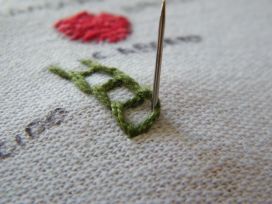
embroideryI have some more examples of creative doctoral work for you, and this time they’re all from the UK. (If you haven’t seen my previous posts on this topic, which include examples from other parts of the globe, they’re here and here.) They are also all from Twitter without which my work and life would be very much harder.

Chris Bailey, from Sheffield Hallam University, investigated the lived experience of an after-school Minecraft club. (For the uninitiated, Minecraft is a computer game which is itself creative and educational.) Chris wrote his thesis abstract as a comic strip. Parts of the thesis are conventional text and other parts are in comic strip form. He also uses the comic format to present data excerpts. Further, Chris uses images and a soundscape as integral parts of his thesis, and even represents the soundscape visually in a variety of ways.

Kate Fox, herself a poet and stand-up comedy and poetry performer, included comedy and poetry in her thesis from the University of Leeds. She was studying resistance in solo stand-up performance by Northern English women. There are poems in every chapter, and Kate uses an ‘interrupting voice’ throughout her thesis, in italic text, to illustrate the dialogic nature of stand-up in some very funny ways. For Kate, stand-up ‘can function as an academic methodology and critical pedagogy’ – I think many of us would like to see more of that!

Jenny Hall, from the University of the West of England (though now at Bournemouth University), used creative inquiry to study ‘the essence of the art of a midwife’ for her EdD. Jenny collected written personal histories, conducted ‘educational sessions’ that involved making, and used photo-elicitation with her participants. She also kept a reflexive research diary and used this to create a textile quilt with squares made as a response to individual diary entries, in a form of creative autoethnography. Jenny’s ‘Midwifery Quilt’ now has its own website.

Clare Danek is currently investigating ways in which people learn amateur craft making skills in community making spaces for a PhD from the University of Leeds. So this is something of a departure as she doesn’t yet have a finished thesis or dissertation, though I’m sure that day will come. Clare is keeping a diary of her PhD which is relevant here as it’s a ‘stitch journal’, as she calls it, using textile art. Also, she is documenting the process online. I am increasingly interested in the ways in which researchers are using creative methods for process as well as output. However, this is not generally well documented so it’s great to see Clare making her journal available as she creates. I’m sure this will help and inspire others.

It seems to me that doctoral students are increasingly finding their creative voices, and that more supervisors and examiners are willing to support this process. I am sure that part of this is due to the existence of precedents such as those listed here and in previous posts. These precedents – and, I’m told, also my book on creative research methods and its bibliography – enable doctoral students to build convincing academic arguments for the use of creative approaches that help to persuade reluctant supervisors. I am delighted to be able to witness and support this quiet revolution in academia.

This blog is funded by my beloved patrons. It takes me around one working day per month to post here each week. At the time of writing I’m receiving funding of $12 per month. If you think 4-5 of my blog posts is worth more than $12 – you can help! Ongoing support would be fantastic but you can also support for a single month if that works better for you. Support from Patrons also enables me to keep this blog ad-free. If you are not able to support me financially, please consider reviewing any of my books you have read – even a single-line review on Amazon or Goodreads is a huge help – or sharing a link to my work on social media. Thank you!

New Year’s Resolution: Review A Book A Week

booksHappy New Year, lovely blog readers! I hope 2019 is full of happiness for each and every one of you.

My New Year’s resolution this year is to spread a little happiness by reviewing an academic book each week. Academic books, even those that are widely read and cited, rarely receive public reviews. Yet public reviews online are the most useful tools to help potential readers decide whether or not to read a book. People are using reviews more and more: to find ways to meet their needs for everything from holiday accommodation to plumbers. I’m ashamed to admit I wrote more reviews on TripAdvisor last year than I did on Amazon.

That’s a sticking point, of course. Some people are ideologically opposed to using Amazon because of the company’s exploitative employment policies and avoidance of tax. Another option is Goodreads – though (little-known fact coming up) Goodreads are owned by Amazon, which I only found out as I looked them up online for information to share here. Yet Amazon and Goodreads are the most useful sites from a potential reader’s viewpoint because they are where most book reviews are posted.

For an ethical alternative, Wordery are independent and ship worldwide for free. There aren’t many book reviews on Wordery as yet; the website is more interested in promoting reviews for its business than in encouraging book reviews. This may be because it is a newish business, founded in 2012. But there is space to write reviews on Wordery.

Of course I could also review on social media, and sharing information about books that way is helpful. However it’s not as permanent, and doesn’t enable comparison of different viewpoints in the same way, as reviewing on a website. Reviewing on blogs is good, especially the more widely read blogs, but writing a whole blog post is much more demanding for the reviewer. A review on Amazon/Goodreads/Wordery need only be a few sentences long.

If you’re not sure how to review a book, here are two top tips. First, give an honest opinion of what you liked or disliked, or found useful/not useful, with reasons. Reviews that say ‘This book is pointless’ or ‘This book is marvellous’, without explaining why, are not helpful. An example from my own approach: I always deduct a star for an academic book with an inadequate index or no index at all, because for me this reduces the usefulness of the book. When I’m working I need to be able to navigate swiftly around a book’s contents and a good professional index is an essential aid. But this is a personal requirement, so explaining why I’ve taken away a star is helpful for potential readers who may have different requirements. For example, some people only ever read a book once and make careful notes as they read which they use for reference later. For those people, an index is much less important.

Second, say what kind of people you think will find the book useful. That could be people at a particular stage of education, or with specific interests or needs, or studying/working in a certain discipline or field. You can do more if you wish, but if you do those two things, you will have written a review which could help others decide whether to spend time and/or money on the book in question.

I’ve written my first review for this year on amazon.co.uk and copied it to Wordery. (I also tried to copy it to amazon.com, as I have done in the past, but found I’m ineligible because I haven’t spent $50 there in the last year.) The book I chose to review was Indigenous Research Methodologies by Bagele Chilisa which I have mentioned before on this blog. This illustrates another important point: reviewing a book a week doesn’t mean reading a book a week. I will review books I read during the year, and I will also review a selection of the books from my shelves that I haven’t yet reviewed. I plan to prioritise books by women, queer people, scholars with disabilities, Indigenous writers, and others who have to contend with oppression.

As an author myself, it would be disingenuous of me not to declare that reviews help authors too. Bagele Chilisa’s book has (at the time of writing) 1109 citations on Google Scholar, yet only one review on Amazon UK and three on Goodreads. While citations are great if you’re in academia, public reviews increase visibility for authors far more than citations. I have never understood why academic readers don’t take a few minutes to write public reviews like readers of other types of books. Though I’m guilty too… but that is going to change! The minute I publish this blog post I’m going to write my second review for this year.

You can join in if you too would like to spread a little happiness. All you need to do is take five minutes to write a short public review of an academic book. Perhaps a book you think should be more widely known, or that you would not recommend (don’t forget to say why), or that would help readers in a particular category. Even if you only review a book a month – or even a book a year – that will help potential readers, and authors too. I’ll be using the hashtags #reviewabook and #reviewabookaweek to talk about this on social media. Hope to see you there!

This blog is funded by my beloved patrons. It takes me around one working day per month to post here each week. At the time of writing I’m receiving funding of $12 per month. If you think 4-5 of my blog posts is worth more than $12 – you can help! Ongoing support would be fantastic but you can also support for a single month if that works better for you. Support from Patrons also enables me to keep this blog ad-free. If you are not able to support me financially, please consider reviewing any of my books you have read – even a single-line review on Amazon or Goodreads is a huge help – or sharing a link to my work on social media. Thank you!

How To Give Feedback On Academic Writing – Twelve Top Tips

feedback peopleA recent discussion on Facebook reminded me that I’ve written about how to deal with feedback from reviewers, but I haven’t written about how to give feedback to peers and colleagues. There is an art to this which I have learned, paradoxically, from receiving feedback, which taught me what helps and what does not help.

Feedback is a fairly neutral word but what we’re actually dealing with is criticism. Some people call it ‘critique’ to make it sound better but it’s still criticism. Criticism is not neutral and so it has lots of emotion attached.

In the last decade I joined a closed online short story writing group of around a dozen fiction writers. We all knew each other online through blogging and wanted to improve our writing. The idea was that we would each write and share a story once a fortnight. The stories were posted anonymously by one of the group – we took turns – and the others would give feedback. To begin with we only gave positive feedback until one of us pointed out that we weren’t going to get very far that way. We were a bit scared about being more critical, but gradually our feedback became more robust, with honesty about the elements of each story that didn’t work for us and why, as well as praise for the parts that did and suggestions for how to overcome weaknesses. We built up a lot of trust in that group and it helped us to give better feedback and so become better writers.

This experience taught me that trust is important to effective feedback. In the group we built trust over time. If you’re writing an anonymous peer review, you need to create trust all at once.

Another thing that is important is blending praise where possible, or at least advice, with your criticism. I had a review for the typescript of my last book which was entirely critical. Essentially, it said the book was rubbish and should never be published. The reviewer is entitled to their opinion, and I have been a writer for far too long to be upset by critical feedback, but the problem was that the review gave me no help at all. There was nothing in it which I could use to improve my writing. (Luckily I had two other reviewers at that stage who took a more balanced approach and did give me constructive criticism, advice, and some praise.)

So, from all my years of experience of receiving and giving feedback on writing in several genres, here are my twelve top tips for giving good quality feedback that others will trust.

  1. Be honest in all the feedback you give.
  2. Read the piece you’re giving feedback on carefully, thoroughly, at least twice.
  3. While you read, make notes of thoughts that occur to you. As a minimum, these should include: aspects of the work you think are good; where you think there is room for improvement; anything you don’t understand; references the author might find helpful.
  4. Be sure to praise the good points in the author’s work. This helps to build trust and also lets the author know what they can relax about.
  5. Be open about anything you don’t understand. Doing this worries some people because they think they may look stupid, particularly if they’re giving feedback to a peer or colleague rather than writing an anonymous review. But it’s really helpful feedback for writers because it may be that they haven’t written clearly enough.
  6. Give a straightforward assessment of areas where you think there is room for improvement.
  7. Tell the author how you think they can improve their work. This is crucial. If you’re only saying where improvement is needed, you’re only doing half the job.
  8. Where relevant, suggest references the author has missed.
  9. If you think extra references would be helpful but nothing specific springs to mind, have a quick look on a website such as Google Scholar or the Directory of Open Access Journals and see if you can find something to point the author towards.
  10. Don’t worry if you can only offer a certain amount of help because of the limits to your own knowledge. It’s fine to say, for example, that a quick online search suggests there is more relevant literature in the area of X; you’re not certain because X lies outside your own areas of interest but you think it would be worth the author taking a look.
  11. Acknowledge the author’s emotions. For example, after giving quite critical feedback, you might say something like, “I realise that implementing my suggestions will involve a fair amount of extra work and this may seem discouraging. I hope you won’t be put off because I do think you have a solid basis here and you are evidently capable of producing an excellent piece of writing.” (Though remember #1 above and don’t say this if it’s not true.)
  12. Be polite throughout, even if your review is anonymous. Anonymity is not an excuse for rudeness.

If there’s anything I’ve missed, please add it in the comments.

This blog is funded by my beloved patrons. It takes me around one working day per month to post here each week. At the time of writing I’m receiving funding of $12 per month. If you think four of my blog posts are worth more than $12 – you can help! Ongoing support would be fantastic but you can also support for a single month if that works better for you. Support from Patrons also enables me to keep this blog ad-free. If you are not able to give financial support at this time, please consider reviewing any of my books you have read – even a single-line review on Amazon or Goodreads is a huge help – or sharing a link to my work on social media. Thank you!

Independent Research, Writing, and Financial Reality

money twenty pound notesEvery so often I post about how much money I make. As I’m just finishing my 2017-18 accounts, it seems a good time to update this.

I have written before about the difficulties the recession caused to my business and the bumpy road back to reasonable prosperity. In 2017-18 I invoiced for £34,338.54 of business, a bit down on the 2016-17 figure of £39,939 though that was partly because I took on a sizeable contract in the spring of 2018 but didn’t receive my first payment instalment until after my year end on 31.7.18.

The amount I invoice for is representative of the amount of work I do, not the amount of money I have in my pockets. In 2016-17 my post-tax profit was £14,057 – and I was able to pay myself a bit more than that because I’d had an even better year in 2015-16, as reported in my earlier post. In fact, 2015-16 was by far the best year of the last 8 years.

So it’s still bumpy, but the bumps are evening out, and I’m beginning to feel that I’m back on my financial feet (except when I think about my pension plans, eek, must do something about that). It helps that my mortgage is paid off, I’m happily child-free, and I don’t have expensive tastes. Also, I have plenty of work scheduled in for early 2018. For the first time in eight years, I don’t feel as if I should spend every spare moment trying to generate work.

Also, my research business doesn’t represent the whole of my income. There is also the income I derive from writing, which in 2017-18 was royalties of £1,663.70 from my trade published books and £306.25 from my self-published books, plus £268.64 from the wonderful ALCS. That’s a total of £2,238.59 for the year – though again there were outgoings to set against that: memberships of the Society of Authors and the Textbook and Academic Authors’ Association, royalties to Nathan Ryder who co-authored Self-Publishing for Academics, and all the books I bought. Altogether that comes to £593.48 and brings down my writing-related income to £1,645.11. Which is enough to pay for a month of writing time. I have to look at it that way, and not think in terms of an hourly rate, or I’d never write another word… if I wasn’t a writing addict.

Writing income is bumpy too. As my trade royalties arrive annually in October, I already know that they are lower in 2018-19 (£947.46) and I don’t really understand why. But I have a new book out this month, and I’ll have two short books out next month in the new series I’m working on for SAGE, plus two more next July, and I’m also co-editing and writing for a new series for Routledge, and have three other book proposals in the pipeline. The SAGE and Routledge books come with small advances totalling £1,250 so far, so in this financial year I’ve already made more from those than from the royalties on my published books. I’m hopeful that perhaps by 2021 I’ll make enough to buy myself out for two months of writing time. At that rate it should only take another 30 years of work to be able to write full-time, so it doesn’t look as though I’ll achieve that dream, as I’ll be 87 in 2051!

Sometimes people think that because my day rates are comparatively high, I must be rich. In fact, my day rates don’t only cover a day’s work, they also cover holidays, sickness and bereavement leave, time spent on unpaid but essential work such as admin and accounts, travelling time, business expenses such as heat and light and IT equipment and accountants’ fees and so on, and of course tax to be paid.

There are independent researchers who make more money than me – I know of one who is registered for VAT, which suggests they turn over more than £85,000 per year, but they work very hard for that, travelling all around the world for most of the year. That may sound delightful and glamorous but I can assure you that travelling for work, while it does have lovely moments, is mostly about trains, planes, taxis, hotel rooms and classrooms or meeting rooms. I like to work overseas, and could probably make more money if I did more of it, but once or twice a year is about right for me.

I think it is important to be open about how much money I make overall, not least because so many people ask me what it’s like to be an independent researcher. For me, it’s a terrific lifestyle, but it wouldn’t suit everyone. I’d say it’s probably as difficult as being an academic or practice-based researcher but the difficulties are in different places. If it’s an option you’re considering, you need to be as realistic as possible about the financial side.

This blog is funded by my beloved patrons. It takes me around one working day per month to post here each week. At the time of writing I’m receiving funding of $11 per month. If you think four or five of my blog posts are worth more than $11 in total – you can help! Ongoing support would be fantastic but you can also support for a single month if that works better for you. Support from Patrons also enables me to keep this blog ad-free. If you are not able to support me financially, please consider reviewing any of my books you have read – even a single-line review on Amazon or Goodreads is a huge help – or sharing a link to my work on social media. Thank you!

Book Launch And Reviews

Research ethics in the real world [FC]My book launch was yesterday afternoon, and it was a peak experience – I’ve written about these before; they don’t come along often. I gave a free seminar on research ethics at City University in London, which was well received, and my lovely publisher kindly put on a wine reception afterwards. It was an amazing night with friends old and new making up an attentive audience who asked insightful questions. I had so much fun I forgot to take any photos!

I am absolutely amazed that, just a week after publication, this book already has two five-star reviews online. That is unprecedented in my experience. And no, they’re not by people I’ve paid to write them, or by my Mum – they’re by genuine readers. One review is on Amazon and says ‘New researchers and seasoned academics can learn much’ from the book, and also describes it as ‘an enjoyable read’ (that was my favourite part!). The other is on Goodreads and describes the book as ‘an invaluable resource for the researcher’.

Of course these are very pleasing reviews, but that’s not all they are. The time between publication and first reviews is always quite nerve-racking for an author. I know that aspects of this book are controversial. Some of the typescript reviews were very negative, and I’m not expecting all of the book reviews to be positive either. So it is a huge relief to me that the first reviews, at least, are favourable.

My book is properly out in the world now and I’ll stop banging on about it after this – but honestly it has dominated my life for the last couple of weeks and I really haven’t had anything else to write about! Normal service, as they say, will be resumed next week.