
 Systems of research ethics regulation differ around the world. Some countries have no research ethics regulation system at all. Others may have a system but, if they do, it is only available in their home language so people like me who only speak and read English are unable to study that system (Israel 2015:45). The main English-speaking countries tend to have formal systems of research ethics regulation, stemming from biomedical research in response to ethical crises such as Nuremberg and Tuskegee. These are usually implemented through research ethics committees or their equivalents such as institutional review boards in the US.
One big difference in Australasia is that work on research ethics by and for Indigenous communities seems to be further ahead in Australia and New Zealand than in any other continental region as a whole. Australia has the Guidelines for Ethical Research in Australian Indigenous Studies produced by the Australian Institute of Aboriginal and Torres Strait Islander Studies (AIATSIS). AIATSIS is a statutory organisation, set up by white settlers in the 1960s and governed by a Council, with the first Aboriginal Council member joining in 1970. The Council is now predominantly made up of Aboriginal people and Torres Strait Islanders. The latest edition of the Guidelines is dated 2012 but they are under review at the time of writing. In New Zealand, Māori people with experience from research ethics committees came together to write Te Ara Tika, a document offering guidelines for Māori research ethics published in 2010. These kinds of guidelines help Indigenous peoples to claim their right of research sovereignty, i.e. control over the conduct of and participation in research that affects them. However, they are not necessarily aligned with each other, or with other systems of ethical governance for research that may exist in the same jurisdictions. This may hamper collaborative or multi-area research and lead to increased separation rather than reconciliation between peoples (Ríos, Dion and Leonard 2018).
So it’s a complex and fascinating picture. I am fortunate to be working on a project at present with three experts in Australasian research ethics: Gary Allen, Mark Israel, and Colin Thomson. (The sharp-eyed among you may notice that I cited Israel in the first paragraph above. He has written a rather good book on research ethics subtitled Beyond Regulatory Compliance and now in its second edition.) Together they are the senior consultants of the Australasian Human Research Ethics Consultancy (AHRECS), established in 2007 to provide expert consultancy services around research ethics in Australasia and Asia-Pacific. AHRECS also works with Indigenous consultants from both Australia and New Zealand, one of the latter being Barry Smith who is a co-author of Te Ara Tika.
The amount of expertise in AHRECS is enormous. Better still, they offer to share some of this expertise to anyone who wants to sign up for their free monthly e-newsletter on research ethics (and I can confirm from experience that they don’t spam you). Link here (scroll down, it’s on the right). Their blog provides a useful archive and they accept guest posts on relevant topics; I just wrote one for them on The Ethics of Evaluation Research. So you get two for the price of one this week!
This blog is funded by my beloved patrons. It takes me around one working day per month to post here each week. At the time of writing I’m receiving funding of $17 per month. If you think 4-5 of my blog posts is worth more than $17 – you can help! Ongoing support would be fantastic but you can also support for a single month if that works better for you. Support from Patrons also enables me to keep this blog ad-free. If you are not able to support me financially, please consider reviewing any of my books you have read – even a single-line review on Amazon or Goodreads is a huge help – or sharing a link to my work on social media. Thank you!
 So many of my friends and colleagues mention negative mind chatter. Only the other day I had a woman tell me she doesn’t feel like a good enough mother (she is), and a man tell me he doesn’t know how he got to where he is in life (because he’s clever, kind, and hardworking). I could quote numerous other examples, and I think writers are particularly prone to this.
 I have some more examples of creative doctoral work for you, and this time they’re all from the UK. (If you haven’t seen my previous posts on this topic, which include examples from other parts of the globe, they’re
  Sometimes academics ask me to come and speak to their students. The conversation often goes like this.
 Do you know the independent researchers in your discipline or field? Have you got a clear strategy for when, how, and why you would involve independent researchers in your work? No? Then you’re missing a trick.
 When someone mentions research methods, what do you think of? Questionnaires? Interviews? Focus groups? Ways of doing research online? Do you only think of data gathering, or do you think of methods of planning research, analysing data, presenting and disseminating findings?
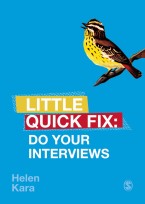 On 20 December last I received hard copies of my first two books in the

 And I have four copies to give away! Two of Write A Questionnaire and two of Do Your Interviews, which I will gladly post anywhere in the world. This competition is only open to followers of this blog (if you want to enter and you don’t already follow the blog, you can find the ‘follow’ button at the top right). Leave a comment with your name, telling me which book you’d like and why. You can only enter once, for one title, not both. This time next week I will put the names into two hats, one for each title, and announce the winners in the comments on this post. Can’t say fairer than that!
 Happy New Year, lovely blog readers! I hope 2019 is full of happiness for each and every one of you.
 Have you noticed how people seem to be getting offended about the strangest things? For example, there has been controversy this month over two songs that are regularly played in English-speaking countries at this time of year. The first is Baby It’s Cold Outside, a duet between two people (usually a man and a woman, though the lyrics are not gender-specific). It was written by Frank Loesser in 1944 to sing with his wife as a party trick. One character is persuading a slightly reluctant other to stay in the warm rather than go out into the winter weather. It’s flirtatious and funny, especially in
  The 11th annual
  Helen Kara