
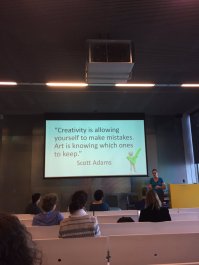
Via @ssoulis
I’m at the end of a working week in Melbourne, sitting in my hotel room; all I have to do is write this blog post and pack. It’s been a great week. One keynote, three workshops and six meetings. Miles and miles of pavement-pounding, including four bookshops (only one book bought due to luggage weight restrictions; several others noted) and the best pistachio gelato I ever ate. Free trams! Melbourne has free trams in the city centre! I didn’t figure out how to use them till day four of six, but my feet have been grateful to me since. And lots of lovely drinks and snacks and dinners. Melbourne likes its grub, and so do I.
The best part about this week, though, is the people I have met. People I’ve only known on Twitter up to now. Not all of them from Melbourne, either: Naomi Barnes (@DrNomyn) from Brisbane and Deborah Netolicky (@debsnet) from Perth were both in town for the Australian Association for Research in Education conference, and it was great to hang out with them. They have both, since, written considered and scholarly blog posts: Deb wrote about the conference, and commented that one thing she loves about Twitter is that it helps her feel as though she knows people, even if they’ve never met in person. Naomi reflected on whether Twitter really creates or enables communities.
I came to Melbourne this week entirely as a result of Twitter. The photo at the top of this blog post was harvested from Twitter. I’ve been doing work generated through Twitter, and people have been tweeting that work out into the Twittersphere. Twitter supports my work in a lot of different ways. This week I have met and talked with eight people who I only knew online up to now. With each of them we went straight into real conversation: when you already know someone online, you can dispense with all the ‘how was your journey?’ and ‘did you find us OK?’ type small talk. This means that when you only have a couple of hours with someone, that time is much more useful. So I get where Deb is coming from with her comment.
Naomi makes a distinction between communities and, as sub-sets of communities, tribes. This is pretty much how I experience Twitter. There is a community of researchers that flocks around hashtags such as #ecrchat (early career researchers chat), #phdchat (PhD chat) and #acwri (academic writing). And there are smaller tribes. I have felt for some time that there’s a little Australian tribe that I belong to, made up of ten or a dozen people. Twitter tribes aren’t necessarily co-located, and indeed my Australian Twitter tribe is scattered around Perth, Brisbane, Sydney, Melbourne, and Canberra. But the biggest concentration is in Melbourne, and the others either have spent time in Melbourne or visit the city fairly regularly. So this feels like the geographical heart of the tribe. Also, not everyone in my Australian Twitter tribe knows everyone else. I was able to introduce Naomi and Deb to another tribe member. And there’s one tribe member who, despite being at one of the universities where I taught this week, doesn’t know any of the others. And to be fair, I first got to know her through her work, rather than through Twitter; our Twitter contact came later. But that doesn’t matter; she’s still part of my tribe.
Meeting these people in person has, without exception, been an absolute delight. They have introduced me to wonderful bars and restaurants. We have talked non-stop, planned projects, generated ideas, and laughed immoderately. I have wanted to meet them for years but thought it could never happen. It has, quite literally, been a dream come true.

 I mentioned before that I’ve been working on the second edition of my first full-length research methods book. And I’ve just finished! It’s been quite a chunk of work. I’m sure some people turn out second editions that just have a few new paragraphs, some updated references and a different cover. Not this one. This second edition has a whole new chapter, several new sections, lots of updated references, and all the work that goes with shuffling the old bits to make the text cohere and the narrative flow smoothly around the new bits. We’ve even updated the cover – isn’t it lovely?
 My chosen career has offered me some interesting opportunities to work outside my own country. First I went to Syria, before the conflict began, to teach qualitative research methods to doctors. It was a fascinating experience, I met some wonderful people, and I grieve for the plight of that delightful country. At the time I thought it was a one-off opportunity, but since my book on creative research methods came out last year, several others have arisen. I’ve taught in Scotland and Canada, next year I’m teaching in Wales, and next month I’m off to Australia!
 I’ve had several emails recently from people asking whether they can devise their own research method. The answer is yes – in the right circumstances.
 I’m working on the second edition of
 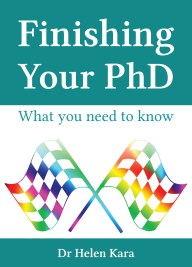 As you know from my last post, the fifth e-book in
  While I’ve been away on holiday (yes, lovely, thank you!) a lot has been happening on the writing front. To begin with, the fifth e-book in
  My viva was on 20 July 2006, in a massive heatwave. Railways were buckling, roads were melting – it was much like today. I like heat. As far as I could tell, my examiners didn’t. My main examiner mopped his bald and sweaty head while I made a joke about being the one in the hot seat. It was his colleague’s first viva as an examiner and I think she was more nervous than I was.
 Helen Kara