
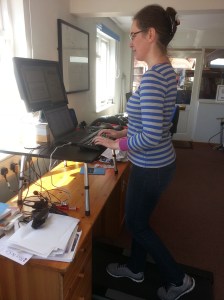
 I guess by now pretty much everyone knows that it’s not a great idea to spend the majority of your time sitting down. But when you’re a researcher and a writer, that’s exactly what you do, at your desk, often all day every day. Now and again you get to go out and sit down in your car, or on a train, till you get to a meeting where you sit down and talk to people. Not a great improvement, as I’m sure you’ll agree.
A couple of years I heard about standing desks, and was interested, though unsure I’d be able to stand for hours at a time. I asked around on Twitter and found some people who liked them and said I’d get used to it. But I still wasn’t sure. Then I found out about sit-stand desks, which let you swap between sitting and standing. That sounded more manageable, but I still wasn’t entirely convinced, and the price was prohibitive with (at the time) nothing available for under £1,000.
Also, the received wisdom is that we should all walk ten thousand steps a day. I don’t have a gadget to count my steps for me, so I did some old-fashioned counting and sums a while back and worked out that I rarely hit 10K, most days landing somewhere between 2K and 5K. I couldn’t see how a desk that simply enabled me to stand would help much with my overall fitness.
Then I heard about treadmill desks. And I really, really wanted one. But the prices were even more eye-watering than for the sit-stand desks. Also, I was worried about how many electrical components could go wrong – which, in a worst-case scenario, could mean shelling out for a whole new ensemble.
Social media came to my rescue, specifically the lovely Nicola Morgan (@nicolamorgan), eminent writer, speaker, haver of bright ideas, and all-round Good Egg. She in turn had been alerted by her friend Vee Frier to the possibility of using a standing desk with an office treadmill. Nicola implemented this ensemble and found that it worked really well for her.
And now I have one too. Specifically: a Stand Steady desk, which sits on top of my old desk (I don’t usually shop at Amazon but they’re the only UK stockist), and an Office Fitness walking treadmill. The treadmill goes up to more than 4 miles per hour; Nicola is happily working at 2.5 mph and I’ve accelerated from 1.5 to 2 mph over the last few weeks. At that speed, I do 76 steps a minute, or 4,560 in an hour. Which means that, in just two hours a day, I do 9,120 steps – and suddenly my 10k target is very achievable indeed. And I have no trouble typing while walking slowly and steadily, as this video demonstrates:
I have no idea whether I’ve lost weight, as I don’t use scales, but I feel a little more toned in places. And fitter. Also, like Nicola, I don’t need to use the heating so much, as moving keeps me warm. The sound of the treadmill doesn’t worry me at all, in fact it’s quite soothing. The only thing I don’t like is that the treadmill stops, after 30 minutes, very suddenly with no warning. I think some beeping and a gradual slow-down would be safer and more pleasant. But I do like the textured footplates on either side of the treadmill, which make it easy and safe to move to a standing position, so I can e.g. reach down to my old desktop for my headphones when the phone rings, and then step back onto the moving treadmill while I chat with whoever has called me.
I can’t walk all the time I’m working – I tried that to begin with, and wore myself out – so I’ve had to create another workstation for sitting (I have arthritis which affects my hands and they don’t work well enough for me to shift everything around when I want to change position). Luckily I have another desk, which already had a computer screen and most of a docking station so, a few accessories later, I was sorted. I can’t imagine going back to sitting all day. I love my treadmill desk!
![Creative research methods in the social sciences [FC]](https://helenkara.com/wp-content/uploads/2015/05/creative-research-methods-in-the-social-sciences-fc.jpg?w=108&h=150) There are two other things I love this week. One is the first review of my new book on Creative Research Methods, which I was glad and relieved to see is a positive review. And the other is the conference on Creative Research Methods at the British Library conference centre, this Friday, where the book will be officially launched. I can’t wait!
There are two other things I love this week. One is the first review of my new book on Creative Research Methods, which I was glad and relieved to see is a positive review. And the other is the conference on Creative Research Methods at the British Library conference centre, this Friday, where the book will be officially launched. I can’t wait!
 I began work as an indie researcher in 1999. Over the next seven years I completed dozens of research contracts, an MSc, and a PhD. I also built up a good professional network, mostly in the English Midlands where I live. The people in my network ran local government departments and charities. They liked me and I liked them: we would meet for coffee, or lunch, and talk shop. After I was awarded my PhD in 2006, I rarely had to apply for work; mostly I was simply offered small contracts that I could complete alone, or slightly larger ones where I might sub-contract some of the work to a colleague. And on the rare occasions when I did write a tender for a local organisation, sometimes I was the only applicant, or the commissioner would have two or three to choose from.
 When I’m teaching research methods to postgraduate students, I encourage them to be comfortable with uncertainty. After all, research is a quest to discover the unknown, so if you’re already certain about everything you’re probably not doing it right. But if you want to be an indie researcher, you need to be comfortable with a higher level of uncertainty than most.

 One sole authored book chapter submitted, reviews received and dealt with
 As for the top secret project: it’s something I’m really excited about, and it won’t be top secret for ever. As soon as I’m ready to go public, you, my dear blog readers, will be the first to know.
 When you’ve published an academic journal article or two, you start getting emails which, at first sight, seem very flattering. They praise your previous work, or your expertise, or both, then invite you to write an article for their journal, or to edit a special issue, or produce an e-book. But when you look more closely, these emails start to look a bit odd. Some ask me to write for journals in medicine, life sciences, or STEM disciplines, all areas in which I have little knowledge and no expertise. Others want me to take on onerous editing responsibilities, sourcing articles from prestigious scholars in return for one whole free electronic journal issue or e-book. And some are verging on the surreal. Here is an example I did not make up:
![Creative research methods in the social sciences [FC]](https://helenkara.com/wp-content/uploads/2015/03/creative-research-methods-in-the-social-sciences-fc.jpg?w=215&h=300)
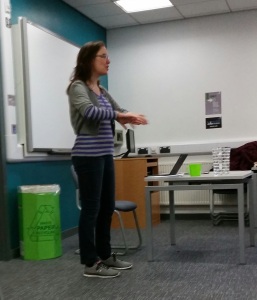 I spent last weekend teaching writing to doctoral students at Staffordshire University, and enjoyed it enormously. It was an experiential course that I had devised with input from Dr Katy Vigurs, who hosted the course. We included creative exercises on drafting and redrafting, getting unstuck, the relationship between writing and thinking, and how to find your voice. There was also a short talk from me and several discussion/Q&A sessions. In between these were a dozen half-hour ‘shut up and write’ sessions for students to work on their own writing.
 I love to teach writing. I have taught writing for research in various contexts: to voluntary sector practitioners, statutory sector managers, and postgraduate students. Next weekend, for the first time, I will be running a writing course for doctoral students with
  Doing research ethically is not about finding a set of rules to follow or ticking boxes on a form. It’s about learning to think and act in an ethical way. How ethical an action is, or is not, usually depends on its context. Therefore, everything must be thought through as far as possible, because even standard ‘ethical’ actions may not always be right. For example, many researchers regard anonymity as a basic right for participants. However, if your participants have lived under a repressive regime where their voices were silenced, they may feel very upset at the thought of being anonymised, and want any information they provide to be attributed to them using their real names. In such a context, claiming that they must be anonymised because of research ethics would in fact be unethical, because it would cause unnecessary stress to your participants.
 Helen Kara