
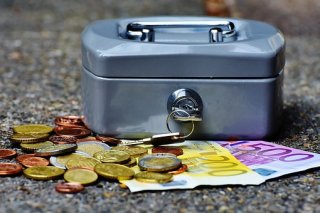
 As the end of the financial year is imminent, it seems a good time to talk about money. Turns out I had a bumper year in 2015/16: my company made a profit of over £36,000. That’s the most this decade. Part of the reason was I won a good-sized research contract, which is the first time that’s happened in this decade. I won a lot of work in the 2000s, and did a fair bit of sub-contracting too, but since the change of government in 2010 I’ve mostly been the sub-contractee. Which is fine by me, actually; it’s a lot less hassle, and I like working in teams.
When you run your own business, one year’s profit doesn’t tell the whole story. You need to look at the last five years to get a sense of where you’re at financially. My worst years were 2011 and 2012, and those are now receding into the distance, thank goodness. Here are my profit figures for the last five years:
2016: £36,168
2015: £8,594
2014: £26,939
2013: £12,357
2012: £5,261
The profit on a business does not constitute your income, because you have to pay tax. I’m happy about this because I appreciate the public services that taxes fund (though I wish more would be spent on schools and hospitals, and less on armaments and wars, but that’s a discussion for another time). Here’s the tax I’ve paid on the profits above:
2016: £7,271
2015: £1,719
2014: £5,316
2013: £2,486
2012: £0
This is corporation tax, not income tax. I also pay tax on my income, but nowhere near as much, because my income is quite small. My income tax is usually a few hundred pounds (I would give the actual figures but I haven’t kept records).
To really get a sense of the full story, we need to look at the averages of these figures. The average profit my business has made over the last five years is £17,862, and the average tax I’ve paid over the last five years is £2,491. So, on average, I’ve had a surplus of around £15,000. From this, I have to put money aside for business expenses such as professional subscriptions and training/conference costs (so now you probably understand why I am rarely able to pay for conferences). Then I can give myself an income.
Through 2011-13 I paid myself very little from the business, but since late 2013 I’ve been able to pay myself £1,000 per month. This provides me with a comfortable living, mainly because I’ve paid off my mortgage, don’t have children, do have a partner who earns a similar amount, and am happy to live fairly cheaply.
It’s strange to see that the odd numbered years are less lucrative than the even numbered years. If I wasn’t a fan of empirical methods, I’d probably start reading something into that, especially as 2017 looks set to follow the pattern.
I’m sure some independent researchers make more money than me, and I’m equally sure others make less. I could probably earn more if I chased work harder, but I like writing books. This means that as long as I have enough work to keep me going, I don’t chase mo re work, instead I spend my time writing. And the books are beginning to yield something of an income, after six years of hard graft; I can now rely on a four-figure sum arriving each year, and that’s a month’s money, maybe two months this year if I’m lucky.
We don’t talk about money much, but I think we need to, because this is the reality behind our high day rates. I’m not complaining, though; quite the reverse. I feel very lucky that I can support myself by doing the work I love. And I can even afford holidays. Right now I’m in the Canary Islands having a wonderful time, and not missing the British March weather at all!
 Calling academics! Do you want to be a useful ally to independent researchers? Then here’s how you can. No, wait, let’s start with why it’s a good idea. Independent researchers can add considerable value to academic research and teaching projects. We bring a fresh perspective, which can be useful to help disentangle problems that seem entrenched, or simply to provide a new view of a situation. We have time to think, because we don’t have to tangle with time-consuming internal meetings and university bureaucracy. And we are not limited in what we work on by managerial directives or departmental policy. Also, we are flexible and can sometimes help out at short notice, such as when a colleague has an unexpected leave of absence at a crucial stage in a project. One potential downside is that an indie researcher is unlikely to have the depth of knowledge in any one subject of a professor who has spent decades studying a single area. On the other other hand, indie researchers often bring a breadth of knowledge across several related areas, and are skilled in bringing themselves up-to-date fast in any area they haven’t worked on for a while.
 My chosen career has offered me some interesting opportunities to work outside my own country. First I went to Syria, before the conflict began, to teach qualitative research methods to doctors. It was a fascinating experience, I met some wonderful people, and I grieve for the plight of that delightful country. At the time I thought it was a one-off opportunity, but since my book on creative research methods came out last year, several others have arisen. I’ve taught in Scotland and Canada, next year I’m teaching in Wales, and next month I’m off to Australia!
 People often ask me how to become an independent researcher. Then they ask me how I became an independent researcher, which is a different question. The answer to the latter is no help to anyone as I became an independent researcher by accident. Here’s the short version of that story. In January 1999 I was asked to do a piece of research as a one-off. I agreed, did a reasonably good job, people got to hear about it and I was asked to do more. I realised I enjoyed the work, signed up for an MSc in Social Research Methods in September 1999, got my PhD in 2006, and never looked back.
 I’m putting the finishing touches to the report of a research project that’s been running for the last 18 months. And then it’ll be over. Which is a bit sad, for a number of reasons.
 Following on from
  One of the great frustrations of being an indie researcher is inability to access funding. Maybe this is easier in other parts of the world but there are few options here in the UK. The UK’s
  Helen Kara